GRAMMAR BOOK
  Carla Morgan
TABLE OF CONTENTS


1.   El Presente
2.   Irregular Yo Forms
3.   Ser y Estar
4.   Verbos Como Gustar
5.   El Preterito
6.   El Imperfecto
7.   El Imperfecto y el Preterito
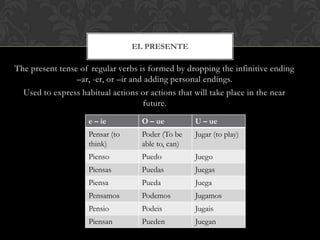
EL PRESENTE

The present tense of regular verbs is formed by dropping the infinitive ending
                 –ar, -er, or –ir and adding personal endings.
  Used to express habitual actions or actions that will take place in the near
                                     future.

                    e – ie         O – ue          U – ue
                    Pensar (to     Poder (To be    Jugar (to play)
                    think)         able to, can)
                    Pienso         Puedo           Juego
                    Piensas        Puedas          Juegas
                    Piensa         Pueda           Juega
                    Pensamos       Podemos         Jugamos
                    Pensio         Podeis          Jugais
                    Piensan        Pueden          Juegan
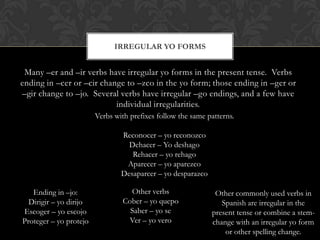
IRREGULAR YO FORMS


 Many –er and –ir verbs have irregular yo forms in the present tense. Verbs
ending in –cer or –cir change to –zco in the yo form; those ending in –ger or
–gir change to –jo. Several verbs have irregular –go endings, and a few have
                           individual irregularities.
                        Verbs with prefixes follow the same patterns.

                                Reconocer – yo reconozco
                                  Dehacer – Yo deshago
                                   Rehacer – yo rehago
                                 Aparecer – yo aparezco
                                Desaparcer – yo desparazco

   Ending in –jo:                  Other verbs                Other commonly used verbs in
  Dirigir – yo dirijo            Cober – yo quepo               Spanish are irregular in the
Escoger – yo escojo                Saber – yo se             present tense or combine a stem-
Proteger – yo protejo             Ver – yo vero              change with an irregular yo form
                                                                 or other spelling change.
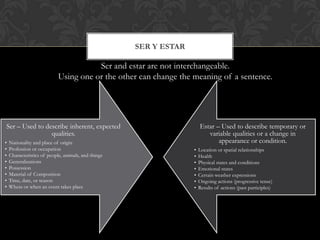
SER Y ESTAR

                                       Ser and estar are not interchangeable.
                            Using one or the other can change the meaning of a sentence.


Ser – Used to describe inherent, expected                              Estar – Used to describe temporary or
                qualities.                                                variable qualities or a change in
•   Nationality and place of origin                                           appearance or condition.
•   Profession or occupation                                       •   Location or spatial relationships
•   Characteristics of people, animals, and things                 •   Health
•   Generalizations                                                •   Physical states and conditions
•   Possession                                                     •   Emotional states
•   Material of Composition                                        •   Certain weather expressions
•   Time, date, or season                                          •   Ongoing actions (progressive tense)
•   Where or when an event takes place                             •   Results of actions (past participles)
VERBOS COMO GUSTAR


• Gustar is preceded by an indirect object pronoun indicating the person
  who is pleased.
• Because the thing or person that pleases is the subject, gustar agrees in
  person and number with it.
• When gustar is followed by one or more verbs in the infinitive, the singular
  form of gustar is always used.
• Gustar is often used in the conditional (me gustaria) to soften a request.
• The construction a + [prepositional pronoun] or a + [noun] can be used to
  emphasize who is pleased, bothered, etc.
• Quedar expresses what someone or something has left. It is also used to
  talk about how clothing fits or looks on someone.
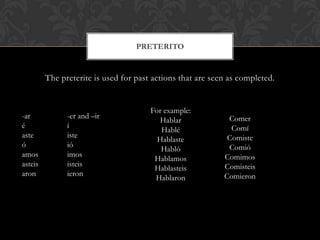
PRETERITO


         The preterite is used for past actions that are seen as completed.


                                       For example:
-ar            -er and –ir                                   Comer
                                         Hablar
é              í                                              Comí
                                          Hablé
aste           iste                                          Comiste
                                         Hablaste
ó              ió                                            Comió
                                          Habló
amos           imos                                         Comimos
                                        Hablamos
asteis         isteis                                       Comisteis
                                        Hablasteis
aron           ieron                                        Comieron
                                        Hablaron
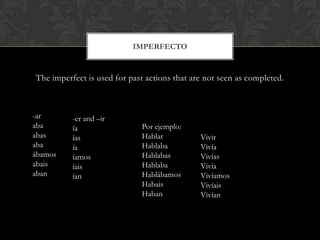
IMPERFECTO


The imperfect is used for past actions that are not seen as completed.


-ar       -er and –ir
aba       ía                 Por ejemplo:
abas      ías                Hablar           Vivir
aba       ía                 Hablaba          Vivía
ábamos    íamos              Hablabas         Vivías
abais     íais               Hablaba          Vivía
aban      ían                Hablábamos       Vivíamos
                             Habais           Vivíais
                             Haban            Vivían
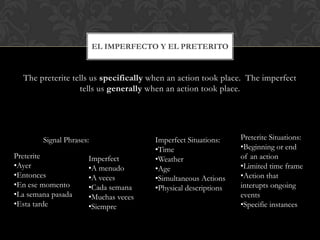
EL IMPERFECTO Y EL PRETERITO


  The preterite tells us specifically when an action took place. The imperfect
                  tells us generally when an action took place.


        Signal Phrases:                Imperfect Situations:    Preterite Situations:
                                       •Time                    •Beginning or end
Preterite             Imperfect        •Weather                 of an action
•Ayer                 •A menudo        •Age                     •Limited time frame
•Entonces             •A veces         •Simultaneous Actions    •Action that
•En ese momento       •Cada semana     •Physical descriptions   interupts ongoing
•La semana pasada     •Muchas veces                             events
•Esta tarde           •Siempre                                  •Specific instances

Grammar book

  • 1.
    GRAMMAR BOOK Carla Morgan
  • 2.
    TABLE OF CONTENTS 1. El Presente 2. Irregular Yo Forms 3. Ser y Estar 4. Verbos Como Gustar 5. El Preterito 6. El Imperfecto 7. El Imperfecto y el Preterito
  • 3.
    EL PRESENTE The presenttense of regular verbs is formed by dropping the infinitive ending –ar, -er, or –ir and adding personal endings. Used to express habitual actions or actions that will take place in the near future. e – ie O – ue U – ue Pensar (to Poder (To be Jugar (to play) think) able to, can) Pienso Puedo Juego Piensas Puedas Juegas Piensa Pueda Juega Pensamos Podemos Jugamos Pensio Podeis Jugais Piensan Pueden Juegan
  • 4.
    IRREGULAR YO FORMS Many –er and –ir verbs have irregular yo forms in the present tense. Verbs ending in –cer or –cir change to –zco in the yo form; those ending in –ger or –gir change to –jo. Several verbs have irregular –go endings, and a few have individual irregularities. Verbs with prefixes follow the same patterns. Reconocer – yo reconozco Dehacer – Yo deshago Rehacer – yo rehago Aparecer – yo aparezco Desaparcer – yo desparazco Ending in –jo: Other verbs Other commonly used verbs in Dirigir – yo dirijo Cober – yo quepo Spanish are irregular in the Escoger – yo escojo Saber – yo se present tense or combine a stem- Proteger – yo protejo Ver – yo vero change with an irregular yo form or other spelling change.
  • 5.
    SER Y ESTAR Ser and estar are not interchangeable. Using one or the other can change the meaning of a sentence. Ser – Used to describe inherent, expected Estar – Used to describe temporary or qualities. variable qualities or a change in • Nationality and place of origin appearance or condition. • Profession or occupation • Location or spatial relationships • Characteristics of people, animals, and things • Health • Generalizations • Physical states and conditions • Possession • Emotional states • Material of Composition • Certain weather expressions • Time, date, or season • Ongoing actions (progressive tense) • Where or when an event takes place • Results of actions (past participles)
  • 6.
    VERBOS COMO GUSTAR •Gustar is preceded by an indirect object pronoun indicating the person who is pleased. • Because the thing or person that pleases is the subject, gustar agrees in person and number with it. • When gustar is followed by one or more verbs in the infinitive, the singular form of gustar is always used. • Gustar is often used in the conditional (me gustaria) to soften a request. • The construction a + [prepositional pronoun] or a + [noun] can be used to emphasize who is pleased, bothered, etc. • Quedar expresses what someone or something has left. It is also used to talk about how clothing fits or looks on someone.
  • 7.
    PRETERITO The preterite is used for past actions that are seen as completed. For example: -ar -er and –ir Comer Hablar é í Comí Hablé aste iste Comiste Hablaste ó ió Comió Habló amos imos Comimos Hablamos asteis isteis Comisteis Hablasteis aron ieron Comieron Hablaron
  • 8.
    IMPERFECTO The imperfect isused for past actions that are not seen as completed. -ar -er and –ir aba ía Por ejemplo: abas ías Hablar Vivir aba ía Hablaba Vivía ábamos íamos Hablabas Vivías abais íais Hablaba Vivía aban ían Hablábamos Vivíamos Habais Vivíais Haban Vivían
  • 9.
    EL IMPERFECTO YEL PRETERITO The preterite tells us specifically when an action took place. The imperfect tells us generally when an action took place. Signal Phrases: Imperfect Situations: Preterite Situations: •Time •Beginning or end Preterite Imperfect •Weather of an action •Ayer •A menudo •Age •Limited time frame •Entonces •A veces •Simultaneous Actions •Action that •En ese momento •Cada semana •Physical descriptions interupts ongoing •La semana pasada •Muchas veces events •Esta tarde •Siempre •Specific instances