1
TABLE OF CONTENTS
•   Present Tense
      • Stem changers
      • Irregular yo
•   Ser and Estar
•   Verbs like gustar
•   Preterite vs Imperfect

End of part one 2012


•   Subjunctive
•   Irregulars
•   Saber vs Conocer
•   Reflexives
•   “Se” imporsonals
•   Dipthongs with accents
•   Verbs like ger/gir, uir/guir, cer/cir


                                            2
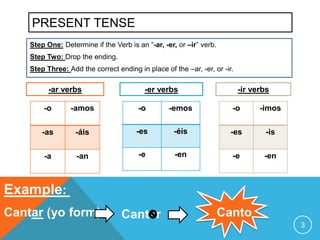
PRESENT TENSE
    Step One: Determine if the Verb is an “-ar, -er, or –ir” verb.
    Step Two: Drop the ending.
    Step Three: Add the correct ending in place of the –ar, -er, or -ir.

          -ar verbs                       -er verbs                        -ir verbs

        -o       -amos                  -o        -emos                -o        -imos

        -as        -áis                -es          -éis               -es         -is


        -a         -an                  -e          -en                -e         -en


Example:
Cantar (yo form)                  Cantar                             Canto
                                                                                         3
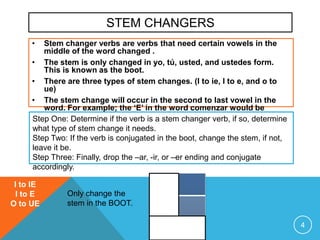
STEM CHANGERS
     •  Stem changer verbs are verbs that need certain vowels in the
        middle of the word changed .
     • The stem is only changed in yo, tú, usted, and ustedes form.
        This is known as the boot.
     • There are three types of stem changes. (I to ie, I to e, and o to
        ue)
     • The stem change will occur in the second to last vowel in the
        word. For example; the ‘E’ in the word comenzar would be
        changed.
     Step One: Determine if the verb is a stem changer verb, if so, determine
     what type of stem change it needs.
     Step Two: If the verb is conjugated in the boot, change the stem, if not,
     leave it be.
     Step Three: Finally, drop the –ar, -ir, or –er ending and conjugate
     accordingly.

 I to IE
  I to E       Only change the
O to UE        stem in the BOOT.

                                                                                 4
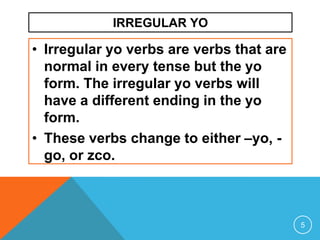
IRREGULAR YO

• Irregular yo verbs are verbs that are
  normal in every tense but the yo
  form. The irregular yo verbs will
  have a different ending in the yo
  form.
• These verbs change to either –yo, -
  go, or zco.


                                          5
SER
                    Descrip
                     tion
          Dates               Origin


                                   Charac
      Events
                      Ser          teristics


       Posses
                                   Time
        sion
                Relatio   Occupa
                nships     tion


                                               6
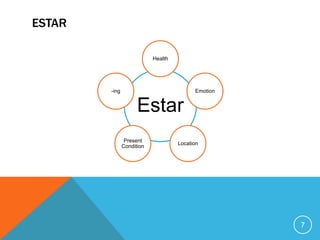
ESTAR

                           Health


        -ing                              Emotion


                     Estar
                Present
                                    Location
               Condition


                                                    7
VERBS LIKE GUSTAR

Gustar- To like               Gustar and verbs like gustar are only
Molestar-To bother            conjugated in two different way based on if
Fascinar-To fascinate         the object is singular or plural. (-a or –an)
Aburrir-To bore
Importar-To be important to   Example:
Interesar-To Interest
Disgustar-To disgust          Me gusta su gato.
Doler(e-ue)-To inflict pain   Me gustan sus tortugas.
Encantar- To love something
Quedar-To remain


                                                                              8
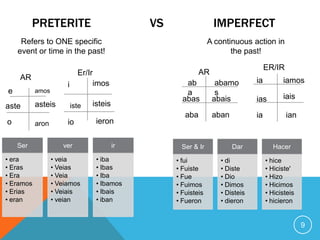
PRETERITE                         VS                 IMPERFECT
     Refers to ONE specific                                   A continuous action in
    event or time in the past!                                       the past!

                                                                                  ER/IR
                         Er/Ir                            AR
    AR                                                                       ia         iamos
                       i      imos                  ab          abamo
e          amos                                     a           s
                                                   abas        abais         ias        iais
aste       asteis      iste   isteis
                                                    aba        aban          ia           ian
o          aron        io      ieron


    Ser              ver               ir          Ser & Ir           Dar           Hacer
• era             • veia       • iba             • fui           • di             • hice
• Eras            • Veias      • Ibas            • Fuiste        • Diste          • Hiciste'
• Era             • Veia       • Iba             • Fue           • Dio            • Hizo
• Eramos          • Veiamos    • Ibamos          • Fuimos        • Dimos          • Hicimos
• Erias           • Veiais     • Ibais           • Fuisteis      • Disteis        • Hicisteis
• eran            • veian      • iban            • Fueron        • dieron         • hicieron


                                                                                                9
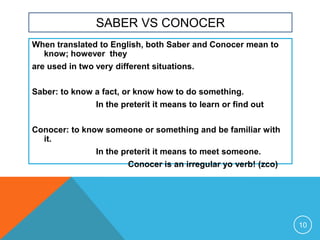
SABER VS CONOCER
When translated to English, both Saber and Conocer mean to
  know; however they
are used in two very different situations.


Saber: to know a fact, or know how to do something.
                In the preterit it means to learn or find out


Conocer: to know someone or something and be familiar with
  it.
                In the preterit it means to meet someone.
                         Conocer is an irregular yo verb! (zco)


                                                                  10
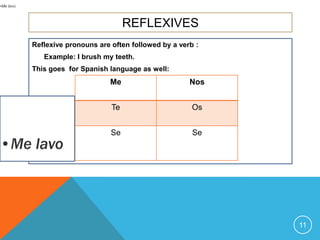
•Me lavo.


                                        REFLEXIVES
            Reflexive pronouns are often followed by a verb :
               Example: I brush my teeth.
            This goes for Spanish language as well:
                                   Me                     Nos


                                   Te                      Os


                                   Se                      Se
•Me lavo             .


                                                                11
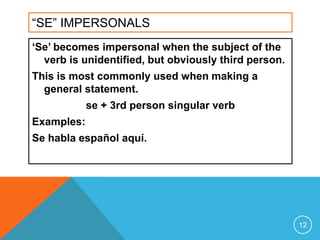
“SE” IMPERSONALS
‘Se’ becomes impersonal when the subject of the
  verb is unidentified, but obviously third person.
This is most commonly used when making a
  general statement.
            se + 3rd person singular verb
Examples:
Se habla español aquí.


                                                      12
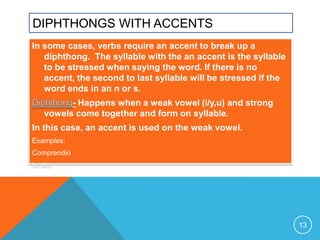
DIPHTHONGS WITH ACCENTS
In some cases, verbs require an accent to break up a
   diphthong. The syllable with the an accent is the syllable
   to be stressed when saying the word. If there is no
   accent, the second to last syllable will be stressed if the
   word ends in an n or s.
         - Happens when a weak vowel (i/y,u) and strong
   vowels come together and form on syllable.
In this case, an accent is used on the weak vowel.
Examples:
Comprendió
tenéis


                                                                 13
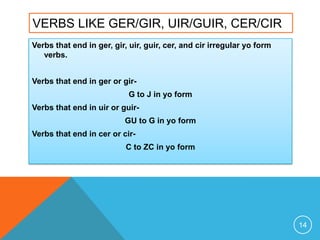
VERBS LIKE GER/GIR, UIR/GUIR, CER/CIR
Verbs that end in ger, gir, uir, guir, cer, and cir irregular yo form
   verbs.


Verbs that end in ger or gir-
                           G to J in yo form
Verbs that end in uir or guir-
                          GU to G in yo form
Verbs that end in cer or cir-
                           C to ZC in yo form


                                                                        14
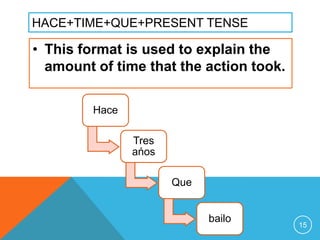
HACE+TIME+QUE+PRESENT TENSE

• This format is used to explain the
  amount of time that the action took.

         Hace

                Tres
                ańos

                       Que


                             bailo
                                         15
IMPERFECT
Imperfect tense is used when an action is continuous and has no
   exact beginning or ending point.
*Think about it like a movie*


      Ia             Iamos            Aba         Abamos

     Ias                              Abas

      Ia              Ian             Aba         Aban


           -Ir/-Er                                    -Ar


                                                                  16
PRETERITE
Preterite tense is used when the action is past tense that is over
   and done with.
*Think of it as a snapshot*


To the tune of “row row row your boat”
                                         Trigger Words:
E, I, aste, iste,                        Anteayer
O, io-o-o,                               Anoche
Amos, imos, aron, ieron                  Ayer
El es preterito                          La semanapasada


                                                                     17
IRREGULARS

   -Car

   • Que

   -Gar

   • Gue

   -Zar

   • Ce


Must have accent over e in yo form only!
                                           18
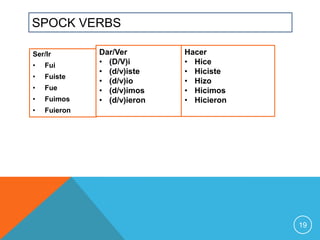
SPOCK VERBS

Ser/Ir        Dar/Ver        Hacer
•   Fui       • (D/V)i       • Hice
              • (d/v)iste    • Hiciste
•   Fuiste
              • (d/v)io      • Hizo
•   Fue       • (d/v)imos    • Hicimos
•   Fuimos    • (d/v)ieron   • Hicieron
•   Fuieron


                                          19

Grammar book

  • 1.
  • 2.
    TABLE OF CONTENTS • Present Tense • Stem changers • Irregular yo • Ser and Estar • Verbs like gustar • Preterite vs Imperfect End of part one 2012 • Subjunctive • Irregulars • Saber vs Conocer • Reflexives • “Se” imporsonals • Dipthongs with accents • Verbs like ger/gir, uir/guir, cer/cir 2
  • 3.
    PRESENT TENSE Step One: Determine if the Verb is an “-ar, -er, or –ir” verb. Step Two: Drop the ending. Step Three: Add the correct ending in place of the –ar, -er, or -ir. -ar verbs -er verbs -ir verbs -o -amos -o -emos -o -imos -as -áis -es -éis -es -is -a -an -e -en -e -en Example: Cantar (yo form) Cantar Canto 3
  • 4.
    STEM CHANGERS • Stem changer verbs are verbs that need certain vowels in the middle of the word changed . • The stem is only changed in yo, tú, usted, and ustedes form. This is known as the boot. • There are three types of stem changes. (I to ie, I to e, and o to ue) • The stem change will occur in the second to last vowel in the word. For example; the ‘E’ in the word comenzar would be changed. Step One: Determine if the verb is a stem changer verb, if so, determine what type of stem change it needs. Step Two: If the verb is conjugated in the boot, change the stem, if not, leave it be. Step Three: Finally, drop the –ar, -ir, or –er ending and conjugate accordingly. I to IE I to E Only change the O to UE stem in the BOOT. 4
  • 5.
    IRREGULAR YO • Irregularyo verbs are verbs that are normal in every tense but the yo form. The irregular yo verbs will have a different ending in the yo form. • These verbs change to either –yo, - go, or zco. 5
  • 6.
    SER Descrip tion Dates Origin Charac Events Ser teristics Posses Time sion Relatio Occupa nships tion 6
  • 7.
    ESTAR Health -ing Emotion Estar Present Location Condition 7
  • 8.
    VERBS LIKE GUSTAR Gustar-To like Gustar and verbs like gustar are only Molestar-To bother conjugated in two different way based on if Fascinar-To fascinate the object is singular or plural. (-a or –an) Aburrir-To bore Importar-To be important to Example: Interesar-To Interest Disgustar-To disgust Me gusta su gato. Doler(e-ue)-To inflict pain Me gustan sus tortugas. Encantar- To love something Quedar-To remain 8
  • 9.
    PRETERITE VS IMPERFECT Refers to ONE specific A continuous action in event or time in the past! the past! ER/IR Er/Ir AR AR ia iamos i imos ab abamo e amos a s abas abais ias iais aste asteis iste isteis aba aban ia ian o aron io ieron Ser ver ir Ser & Ir Dar Hacer • era • veia • iba • fui • di • hice • Eras • Veias • Ibas • Fuiste • Diste • Hiciste' • Era • Veia • Iba • Fue • Dio • Hizo • Eramos • Veiamos • Ibamos • Fuimos • Dimos • Hicimos • Erias • Veiais • Ibais • Fuisteis • Disteis • Hicisteis • eran • veian • iban • Fueron • dieron • hicieron 9
  • 10.
    SABER VS CONOCER Whentranslated to English, both Saber and Conocer mean to know; however they are used in two very different situations. Saber: to know a fact, or know how to do something. In the preterit it means to learn or find out Conocer: to know someone or something and be familiar with it. In the preterit it means to meet someone. Conocer is an irregular yo verb! (zco) 10
  • 11.
    •Me lavo. REFLEXIVES Reflexive pronouns are often followed by a verb : Example: I brush my teeth. This goes for Spanish language as well: Me Nos Te Os Se Se •Me lavo . 11
  • 12.
    “SE” IMPERSONALS ‘Se’ becomesimpersonal when the subject of the verb is unidentified, but obviously third person. This is most commonly used when making a general statement. se + 3rd person singular verb Examples: Se habla español aquí. 12
  • 13.
    DIPHTHONGS WITH ACCENTS Insome cases, verbs require an accent to break up a diphthong. The syllable with the an accent is the syllable to be stressed when saying the word. If there is no accent, the second to last syllable will be stressed if the word ends in an n or s. - Happens when a weak vowel (i/y,u) and strong vowels come together and form on syllable. In this case, an accent is used on the weak vowel. Examples: Comprendió tenéis 13
  • 14.
    VERBS LIKE GER/GIR,UIR/GUIR, CER/CIR Verbs that end in ger, gir, uir, guir, cer, and cir irregular yo form verbs. Verbs that end in ger or gir- G to J in yo form Verbs that end in uir or guir- GU to G in yo form Verbs that end in cer or cir- C to ZC in yo form 14
  • 15.
    HACE+TIME+QUE+PRESENT TENSE • Thisformat is used to explain the amount of time that the action took. Hace Tres ańos Que bailo 15
  • 16.
    IMPERFECT Imperfect tense isused when an action is continuous and has no exact beginning or ending point. *Think about it like a movie* Ia Iamos Aba Abamos Ias Abas Ia Ian Aba Aban -Ir/-Er -Ar 16
  • 17.
    PRETERITE Preterite tense isused when the action is past tense that is over and done with. *Think of it as a snapshot* To the tune of “row row row your boat” Trigger Words: E, I, aste, iste, Anteayer O, io-o-o, Anoche Amos, imos, aron, ieron Ayer El es preterito La semanapasada 17
  • 18.
    IRREGULARS -Car • Que -Gar • Gue -Zar • Ce Must have accent over e in yo form only! 18
  • 19.
    SPOCK VERBS Ser/Ir Dar/Ver Hacer • Fui • (D/V)i • Hice • (d/v)iste • Hiciste • Fuiste • (d/v)io • Hizo • Fue • (d/v)imos • Hicimos • Fuimos • (d/v)ieron • Hicieron • Fuieron 19