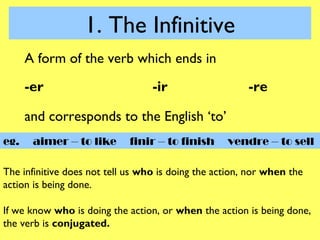
1. The Infinitive
      A form of the verb which ends in
      -er                         -ir                   -re

      and corresponds to the English ‘to’
eg.    aimer – to like       finir – to finish     vendre – to sell

The infinitive does not tell us who is doing the action, nor when the
action is being done.

If we know who is doing the action, or when the action is being done,
the verb is conjugated.
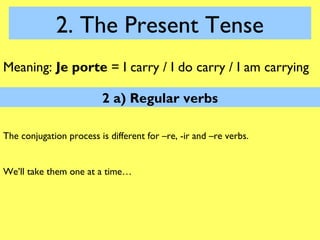
2. The Present Tense
Meaning: Je porte = I carry / I do carry / I am carrying

                         2 a) Regular verbs

The conjugation process is different for –re, -ir and –re verbs.


We’ll take them one at a time…
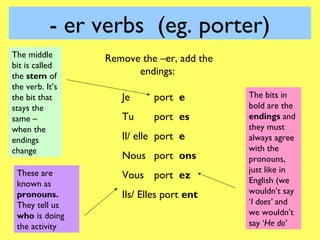
- er verbs (eg. porter)
The middle       Remove the –er, add the
bit is called
the stem of            endings:
the verb. It’s
the bit that        Je      port e         The bits in
stays the                                  bold are the
same –              Tu      port es        endings and
when the                                   they must
endings             Il/ elle port e        always agree
change                                     with the
                    Nous port ons          pronouns,
 These are                                 just like in
                    Vous port ez           English (we
 known as
 pronouns.          Ils/ Elles port ent    wouldn’t say
 They tell us                              ‘I does’ and
 who is doing                              we wouldn’t
 the activity                              say ‘He do’
- ir verbs (eg. finir)
                         Remove the –ir, add the
                               endings:
  We call these the
  ‘singular forms of         Je      fin is
  the verb’…
  because they refer         Tu      fin is
  to only 1 person
                             Il/ elle fin it

  We call these the          Nous fin issons             Vous can be
  ‘plural forms of the                                   singular, if you’re
  verb’ because they         Vous fin issez
                                                         talking politely to
  refer to more than                                     1 person
                             Ils/ Elles fin issent
  1 person. BUT…

Don’t forget to look for patterns…
here, you can see the familiar –ons, -ez – ent hidden in the endings.
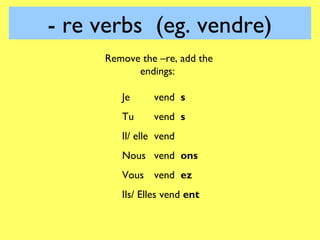
- re verbs (eg. vendre)
     Remove the –re, add the
           endings:

        Je     vend s
        Tu     vend s
        Il/ elle vend
        Nous vend ons
        Vous vend ez
        Ils/ Elles vend ent
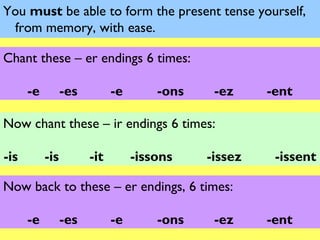
You must be able to form the present tense yourself,
 from memory, with ease.

Chant these – er endings 6 times:

      -e         -es         -e       -ons    -ez     -ent

Now chant these – ir endings 6 times:

-is        -is         -it        -issons    -issez    -issent

Now back to these – er endings, 6 times:

      -e         -es         -e       -ons    -ez     -ent
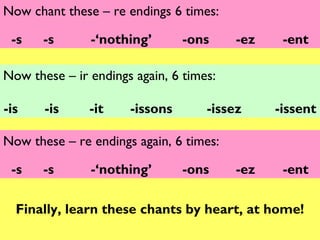
Now chant these – re endings 6 times:

 -s    -s      -‘nothing’       -ons     -ez    -ent

Now these – ir endings again, 6 times:

-is    -is     -it    -issons       -issez     -issent

Now these – re endings again, 6 times:

 -s    -s      -‘nothing’       -ons     -ez    -ent

  Finally, learn these chants by heart, at home!
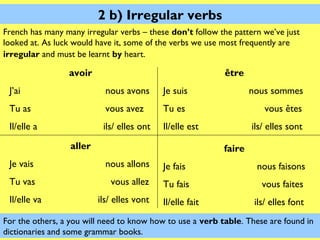
2 b) Irregular verbs
French has many many irregular verbs – these don’t follow the pattern we’ve just
looked at. As luck would have it, some of the verbs we use most frequently are
irregular and must be learnt by heart.

                 avoir                                     être
 J’ai                       nous avons      Je suis                nous sommes
 Tu as                      vous avez       Tu es                      vous êtes
 Il/elle a                 ils/ elles ont   Il/elle est            ils/ elles sont

                  aller                                    faire
 Je vais                    nous allons     Je fais                 nous faisons
 Tu vas                      vous allez     Tu fais                   vous faites
 Il/elle va               ils/ elles vont   Il/elle fait            ils/ elles font
For the others, a you will need to know how to use a verb table. These are found in
dictionaries and some grammar books.
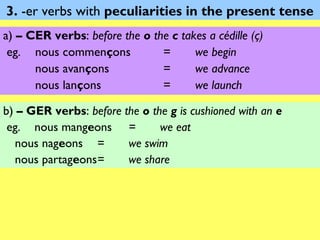
3. -er verbs with peculiarities in the present tense
a) – CER verbs: before the o the c takes a cédille (ç)
 eg. nous commençons           =      we begin
      nous avançons            =      we advance
      nous lançons             =      we launch

b) – GER verbs: before the o the g is cushioned with an e
 eg. nous mangeons =           we eat
  nous nageons =        we swim
  nous partageons=      we share
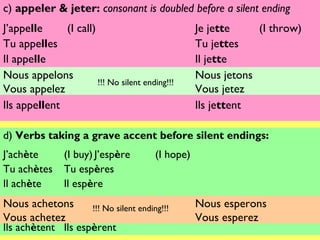
c) appeler & jeter: consonant is doubled before a silent ending
J’appelle     (I call)                               Je jette    (I throw)
Tu appelles                                          Tu jettes
Il appelle                                           Il jette
Nous appelons                                        Nous jetons
                       !!! No silent ending!!!
Vous appelez                                         Vous jetez
Ils appellent                                        Ils jettent

d) Verbs taking a grave accent before silent endings:
J’achète        (I buy) J’espère          (I hope)
Tu achètes      Tu espères
Il achète       Il espère
Nous achetons           !!! No silent ending!!!      Nous esperons
Vous achetez                                         Vous esperez
Ils achètent Ils espèrent

Present tense powerpoint

  • 1.
    1. The Infinitive A form of the verb which ends in -er -ir -re and corresponds to the English ‘to’ eg. aimer – to like finir – to finish vendre – to sell The infinitive does not tell us who is doing the action, nor when the action is being done. If we know who is doing the action, or when the action is being done, the verb is conjugated.
  • 2.
    2. The PresentTense Meaning: Je porte = I carry / I do carry / I am carrying 2 a) Regular verbs The conjugation process is different for –re, -ir and –re verbs. We’ll take them one at a time…
  • 3.
    - er verbs(eg. porter) The middle Remove the –er, add the bit is called the stem of endings: the verb. It’s the bit that Je port e The bits in stays the bold are the same – Tu port es endings and when the they must endings Il/ elle port e always agree change with the Nous port ons pronouns, These are just like in Vous port ez English (we known as pronouns. Ils/ Elles port ent wouldn’t say They tell us ‘I does’ and who is doing we wouldn’t the activity say ‘He do’
  • 4.
    - ir verbs(eg. finir) Remove the –ir, add the endings: We call these the ‘singular forms of Je fin is the verb’… because they refer Tu fin is to only 1 person Il/ elle fin it We call these the Nous fin issons Vous can be ‘plural forms of the singular, if you’re verb’ because they Vous fin issez talking politely to refer to more than 1 person Ils/ Elles fin issent 1 person. BUT… Don’t forget to look for patterns… here, you can see the familiar –ons, -ez – ent hidden in the endings.
  • 5.
    - re verbs(eg. vendre) Remove the –re, add the endings: Je vend s Tu vend s Il/ elle vend Nous vend ons Vous vend ez Ils/ Elles vend ent
  • 6.
    You must beable to form the present tense yourself, from memory, with ease. Chant these – er endings 6 times: -e -es -e -ons -ez -ent Now chant these – ir endings 6 times: -is -is -it -issons -issez -issent Now back to these – er endings, 6 times: -e -es -e -ons -ez -ent
  • 7.
    Now chant these– re endings 6 times: -s -s -‘nothing’ -ons -ez -ent Now these – ir endings again, 6 times: -is -is -it -issons -issez -issent Now these – re endings again, 6 times: -s -s -‘nothing’ -ons -ez -ent Finally, learn these chants by heart, at home!
  • 8.
    2 b) Irregularverbs French has many many irregular verbs – these don’t follow the pattern we’ve just looked at. As luck would have it, some of the verbs we use most frequently are irregular and must be learnt by heart. avoir être J’ai nous avons Je suis nous sommes Tu as vous avez Tu es vous êtes Il/elle a ils/ elles ont Il/elle est ils/ elles sont aller faire Je vais nous allons Je fais nous faisons Tu vas vous allez Tu fais vous faites Il/elle va ils/ elles vont Il/elle fait ils/ elles font For the others, a you will need to know how to use a verb table. These are found in dictionaries and some grammar books.
  • 9.
    3. -er verbswith peculiarities in the present tense a) – CER verbs: before the o the c takes a cédille (ç) eg. nous commençons = we begin nous avançons = we advance nous lançons = we launch b) – GER verbs: before the o the g is cushioned with an e eg. nous mangeons = we eat nous nageons = we swim nous partageons= we share
  • 10.
    c) appeler &jeter: consonant is doubled before a silent ending J’appelle (I call) Je jette (I throw) Tu appelles Tu jettes Il appelle Il jette Nous appelons Nous jetons !!! No silent ending!!! Vous appelez Vous jetez Ils appellent Ils jettent d) Verbs taking a grave accent before silent endings: J’achète (I buy) J’espère (I hope) Tu achètes Tu espères Il achète Il espère Nous achetons !!! No silent ending!!! Nous esperons Vous achetez Vous esperez Ils achètent Ils espèrent