J. Evans St. Clair County RESA
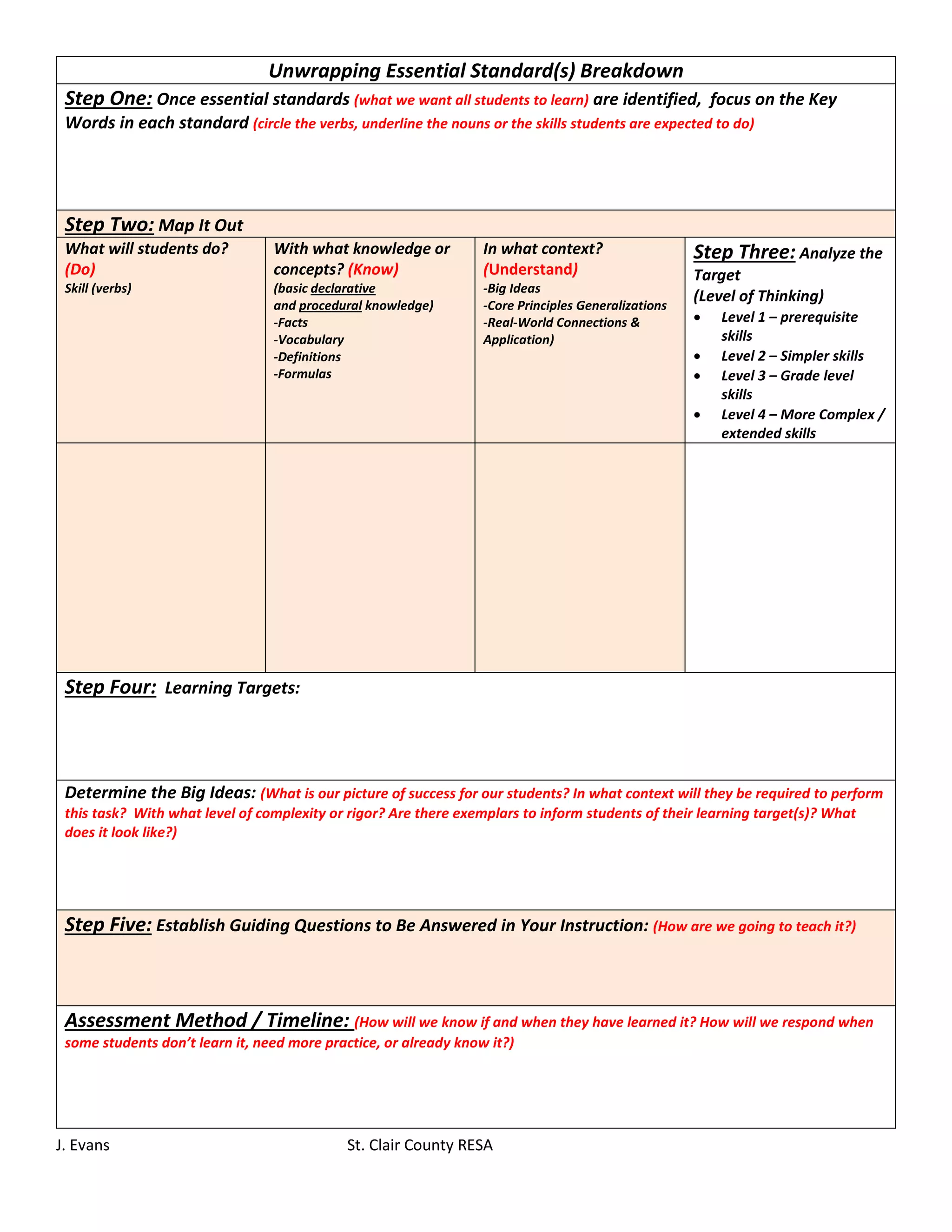
Unwrapping Essential Standard(s) Breakdown
Step One: Once essential standards (what we want all students to learn) are identified, focus on the Key
Words in each standard (circle the verbs, underline the nouns or the skills students are expected to do)
Step Two: Map It Out
What will students do?
(Do)
Skill (verbs)
With what knowledge or
concepts? (Know)
(basic declarative
and procedural knowledge)
-Facts
-Vocabulary
-Definitions
-Formulas
In what context?
(Understand)
-Big Ideas
-Core Principles Generalizations
-Real-World Connections &
Application)
Step Three: Analyze the
Target
(Level of Thinking)
• Level 1 – prerequisite
skills
• Level 2 – Simpler skills
• Level 3 – Grade level
skills
• Level 4 – More Complex /
extended skills
Step Four: Learning Targets:
Determine the Big Ideas: (What is our picture of success for our students? In what context will they be required to perform
this task? With what level of complexity or rigor? Are there exemplars to inform students of their learning target(s)? What
does it look like?)
Step Five: Establish Guiding Questions to Be Answered in Your Instruction: (How are we going to teach it?)
Assessment Method / Timeline: (How will we know if and when they have learned it? How will we respond when
some students don’t learn it, need more practice, or already know it?)
SL K.1 - Participate in collaborative conversations with diverse partners about K topics and texts with peers and adults in small and larger groups.
SL.K.1a - Follow agreed-upon rules for discussions (e.g., listening to others and taking turns speaking about the
topics and texts under discussion).
Participate
Follow
I can participate in small and larger group conversations with peers and adults about kindergarten topics and texts.
a. I can follow our class norms when I participate in a conversation.
students will raise their hand before they speak during teacher-led discussions
Benchmark Unit 1
checklist
revisit at end of unit 1
rules for discussions
K topics and texts
Class norms
conversation
listening to others
K topics and texts
taking turns
speaking about the topic
diverse partners
small groups
large groups
with peers and adults
ELL document
Benchmark levels
J. Evans St. Clair County RESA
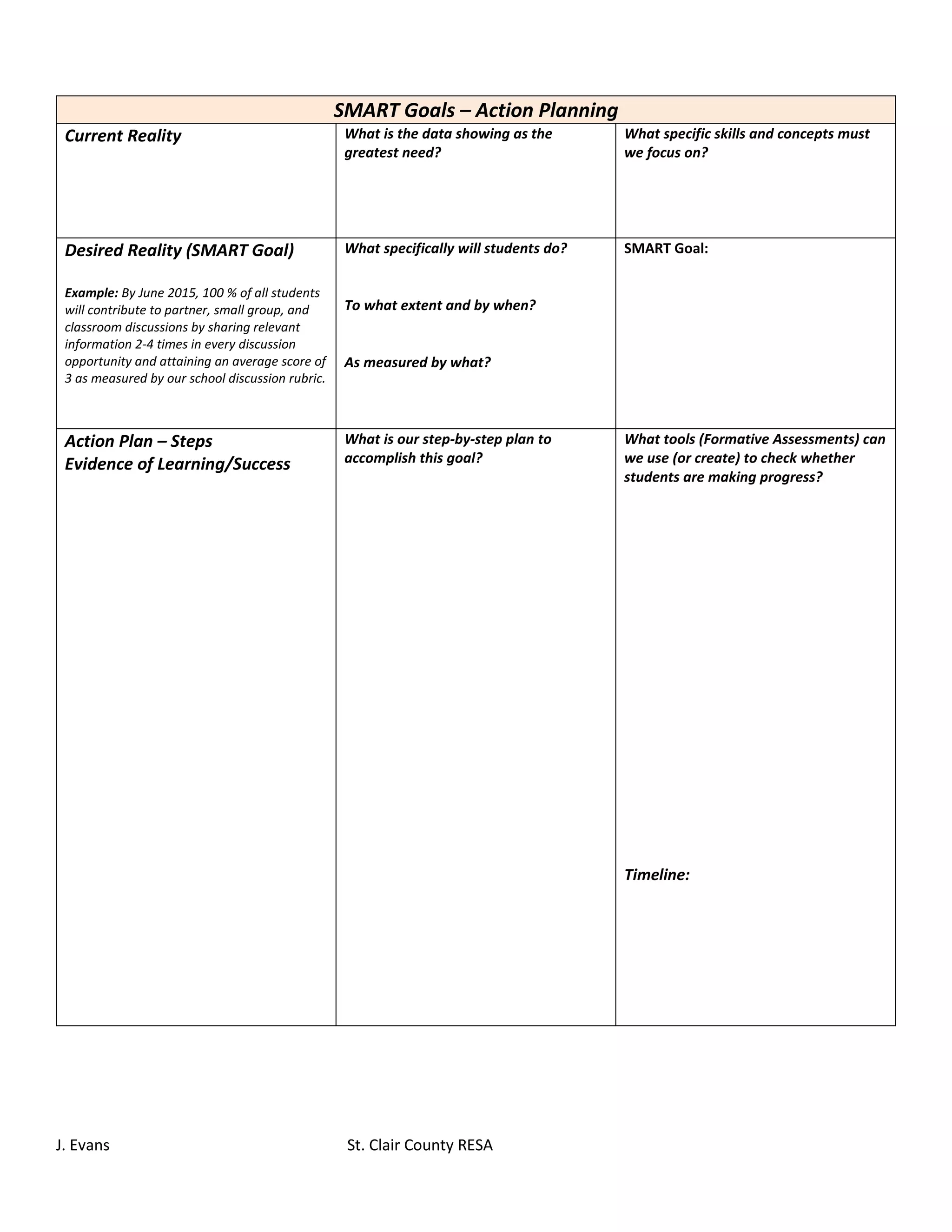
SMART Goals – Action Planning
Current Reality What is the data showing as the
greatest need?
What specific skills and concepts must
we focus on?
Desired Reality (SMART Goal)
Example: By June 2015, 100 % of all students
will contribute to partner, small group, and
classroom discussions by sharing relevant
information 2-4 times in every discussion
opportunity and attaining an average score of
3 as measured by our school discussion rubric.
What specifically will students do?
To what extent and by when?
As measured by what?
SMART Goal:
Action Plan – Steps
Evidence of Learning/Success
What is our step-by-step plan to
accomplish this goal?
What tools (Formative Assessments) can
we use (or create) to check whether
students are making progress?
Timeline:
By June 2016,100% of all
students will raise their hand to
speak during teacher-led
classroom discussion 85% of
the time as measured by our
Kindergarten observational
checklist.

Gr k unwrapping essential standard

  • 1.
    J. Evans St.Clair County RESA Unwrapping Essential Standard(s) Breakdown Step One: Once essential standards (what we want all students to learn) are identified, focus on the Key Words in each standard (circle the verbs, underline the nouns or the skills students are expected to do) Step Two: Map It Out What will students do? (Do) Skill (verbs) With what knowledge or concepts? (Know) (basic declarative and procedural knowledge) -Facts -Vocabulary -Definitions -Formulas In what context? (Understand) -Big Ideas -Core Principles Generalizations -Real-World Connections & Application) Step Three: Analyze the Target (Level of Thinking) • Level 1 – prerequisite skills • Level 2 – Simpler skills • Level 3 – Grade level skills • Level 4 – More Complex / extended skills Step Four: Learning Targets: Determine the Big Ideas: (What is our picture of success for our students? In what context will they be required to perform this task? With what level of complexity or rigor? Are there exemplars to inform students of their learning target(s)? What does it look like?) Step Five: Establish Guiding Questions to Be Answered in Your Instruction: (How are we going to teach it?) Assessment Method / Timeline: (How will we know if and when they have learned it? How will we respond when some students don’t learn it, need more practice, or already know it?) SL K.1 - Participate in collaborative conversations with diverse partners about K topics and texts with peers and adults in small and larger groups. SL.K.1a - Follow agreed-upon rules for discussions (e.g., listening to others and taking turns speaking about the topics and texts under discussion). Participate Follow I can participate in small and larger group conversations with peers and adults about kindergarten topics and texts. a. I can follow our class norms when I participate in a conversation. students will raise their hand before they speak during teacher-led discussions Benchmark Unit 1 checklist revisit at end of unit 1 rules for discussions K topics and texts Class norms conversation listening to others K topics and texts taking turns speaking about the topic diverse partners small groups large groups with peers and adults ELL document Benchmark levels
  • 2.
    J. Evans St.Clair County RESA SMART Goals – Action Planning Current Reality What is the data showing as the greatest need? What specific skills and concepts must we focus on? Desired Reality (SMART Goal) Example: By June 2015, 100 % of all students will contribute to partner, small group, and classroom discussions by sharing relevant information 2-4 times in every discussion opportunity and attaining an average score of 3 as measured by our school discussion rubric. What specifically will students do? To what extent and by when? As measured by what? SMART Goal: Action Plan – Steps Evidence of Learning/Success What is our step-by-step plan to accomplish this goal? What tools (Formative Assessments) can we use (or create) to check whether students are making progress? Timeline: By June 2016,100% of all students will raise their hand to speak during teacher-led classroom discussion 85% of the time as measured by our Kindergarten observational checklist.