GUIDED READING
PARAPROFESSIONALS
YALE PUBLIC SCHOOLS
2015-16
Jennifer Evans
Assistant Director ELA
St. Clair County RESA
Evans.jennifer@sccresa.org
http://www.protopage.com/evans.jennifer
AGENDA
Structure of
Guided
Reading
Questioning
Questioning
in Guided
Reading
Connections
Connections
in Guided
Reading
Nonfiction
The ultimate measure
of success in
comprehending is
when a student can
describe how and why
use of a
comprehension
strategy helps him/her
understand more
completely
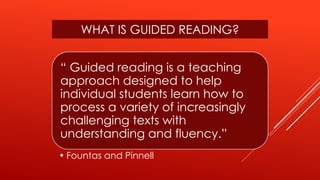
“ Guided reading is a teaching
approach designed to help
individual students learn how to
process a variety of increasingly
challenging texts with
understanding and fluency.”
• Fountas and Pinnell
WHAT IS GUIDED READING?
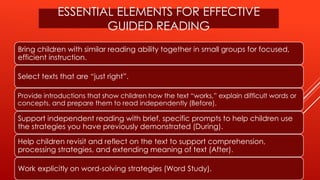
ESSENTIAL ELEMENTS FOR EFFECTIVE
GUIDED READING
Bring children with similar reading ability together in small groups for focused,
efficient instruction.
Select texts that are “just right”.
Provide introductions that show children how the text “works,” explain difficult words or
concepts, and prepare them to read independently (Before).
Support independent reading with brief, specific prompts to help children use
the strategies you have previously demonstrated (During).
Help children revisit and reflect on the text to support comprehension,
processing strategies, and extending meaning of text (After).
Work explicitly on word-solving strategies (Word Study).
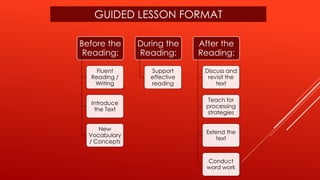
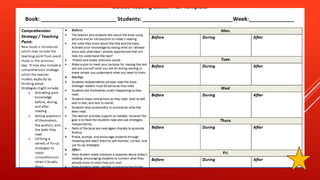
GUIDED LESSON FORMAT
Before the
Reading:
Fluent
Reading /
Writing
Introduce
the Text
New
Vocabulary
/ Concepts
During the
Reading:
Support
effective
reading
After the
Reading:
Discuss and
revisit the
text
Teach for
processing
strategies
Extend the
text
Conduct
word work
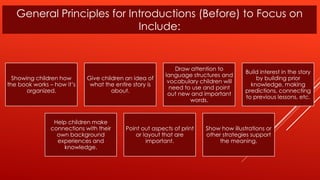
Showing children how
the book works – how it’s
organized.
Give children an idea of
what the entire story is
about.
Draw attention to
language structures and
vocabulary children will
need to use and point
out new and important
words.
Build interest in the story
by building prior
knowledge, making
predictions, connecting
to previous lessons, etc.
Help children make
connections with their
own background
experiences and
knowledge.
Point out aspects of print
or layout that are
important.
Show how illustrations or
other strategies support
the meaning.
General Principles for Introductions (Before) to Focus on
Include:
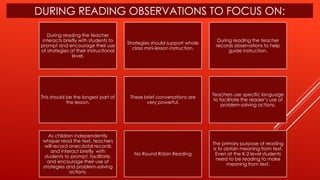
DURING READING OBSERVATIONS TO FOCUS ON:
During reading the teacher
interacts briefly with students to
prompt and encourage their use
of strategies at their instructional
level.
Strategies should support whole
class mini-lesson instruction.
During reading the teacher
records observations to help
guide instruction.
This should be the longest part of
the lesson.
These brief conversations are
very powerful.
Teachers use specific language
to facilitate the reader’s use of
problem-solving actions.
As children independently
whisper read the text, teachers
will record anecdotal records
and interact briefly with
students to prompt, facilitate,
and encourage their use of
strategies and problem-solving
actions.
No Round Robin Reading
The primary purpose of reading
is to obtain meaning from text.
Even at the K-2 level students
need to be reading to make
meaning from text.
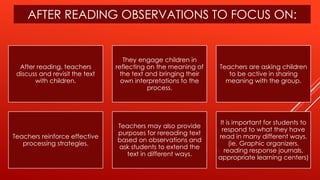
AFTER READING OBSERVATIONS TO FOCUS ON:
After reading, teachers
discuss and revisit the text
with children.
They engage children in
reflecting on the meaning of
the text and bringing their
own interpretations to the
process.
Teachers are asking children
to be active in sharing
meaning with the group.
Teachers reinforce effective
processing strategies.
Teachers may also provide
purposes for rereading text
based on observations and
ask students to extend the
text in different ways.
It is important for students to
respond to what they have
read in many different ways.
(ie. Graphic organizers,
reading response journals,
appropriate learning centers)
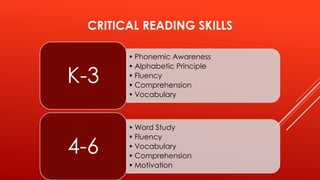
CRITICAL READING SKILLS
• Phonemic Awareness
• Alphabetic Principle
• Fluency
• Comprehension
• Vocabulary
K-3
• Word Study
• Fluency
• Vocabulary
• Comprehension
• Motivation
4-6
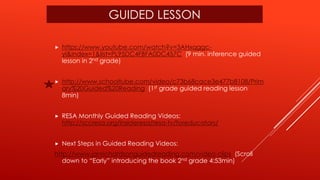
GUIDED LESSON
 https://www.youtube.com/watch?v=3AHxqggc-
yI&index=1&list=PL95DC4FBFA0DC457C (9 min. inference guided
lesson in 2nd grade)
 http://www.schooltube.com/video/c73b68cace3e477b8108/Prim
ary%20Guided%20Reading (1st grade guided reading lesson
8min)
 RESA Monthly Guided Reading Videos:
http://sccresa.org/insideresa/resa-tv/foreducators/
 Next Steps in Guided Reading Videos:
http://www.janrichardsonguidedreading.com/video-clips (Scroll
down to “Early” introducing the book 2nd grade 4:53min)
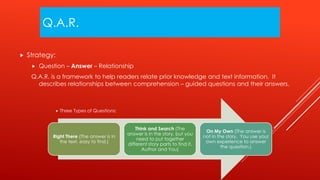
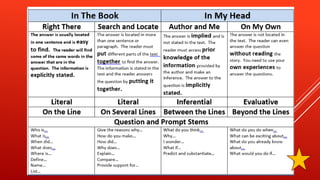
Q.A.R.
 Strategy:
 Question – Answer – Relationship
Q.A.R. is a framework to help readers relate prior knowledge and text information. It
describes relationships between comprehension – guided questions and their answers.
 Three Types of Questions:
Right There (The answer is in
the text, easy to find.)
Think and Search (The
answer is in the story, but you
need to put together
different story parts to find it.
Author and You)
On My Own (The answer is
not in the story. You use your
own experience to answer
the question.)
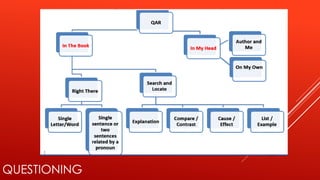
QUESTIONING
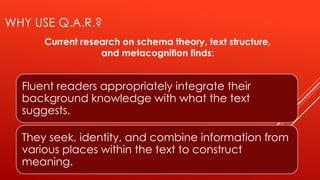
WHY USE Q.A.R.?
Fluent readers appropriately integrate their
background knowledge with what the text
suggests.
They seek, identity, and combine information from
various places within the text to construct
meaning.
Current research on schema theory, text structure,
and metacognition finds:
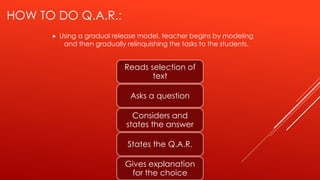
HOW TO DO Q.A.R.:
 Using a gradual release model, teacher begins by modeling
and then gradually relinquishing the tasks to the students.
Reads selection of
text
Asks a question
Considers and
states the answer
States the Q.A.R.
Gives explanation
for the choice
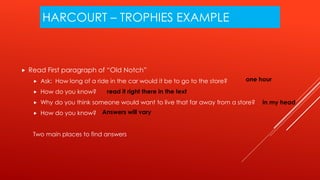
HARCOURT – TROPHIES EXAMPLE
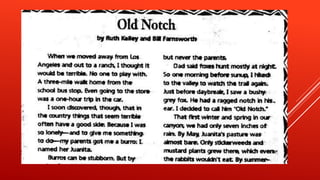
 Read First paragraph of “Old Notch”
 Ask: How long of a ride in the car would it be to go to the store?
 How do you know?
 Why do you think someone would want to live that far away from a store?
 How do you know?
Two main places to find answers
one hour
read it right there in the text
in my head
Answers will vary
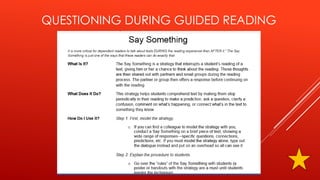
QUESTIONING DURING GUIDED READING
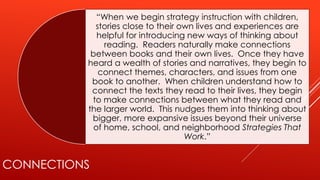
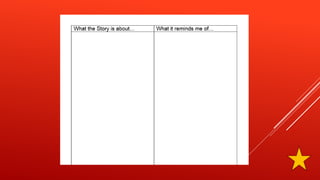
CONNECTIONS
“When we begin strategy instruction with children,
stories close to their own lives and experiences are
helpful for introducing new ways of thinking about
reading. Readers naturally make connections
between books and their own lives. Once they have
heard a wealth of stories and narratives, they begin to
connect themes, characters, and issues from one
book to another. When children understand how to
connect the texts they read to their lives, they begin
to make connections between what they read and
the larger world. This nudges them into thinking about
bigger, more expansive issues beyond their universe
of home, school, and neighborhood Strategies That
Work.”
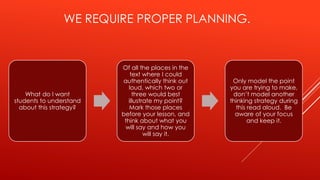
WE REQUIRE PROPER PLANNING.
What do I want
students to understand
about this strategy?
Of all the places in the
text where I could
authentically think out
loud, which two or
three would best
illustrate my point?
Mark those places
before your lesson, and
think about what you
will say and how you
will say it.
Only model the point
you are trying to make,
don’t model another
thinking strategy during
this read aloud. Be
aware of your focus
and keep it.
As we teach the students to think through
the text we encourage the students to
respond using this terminology:
•“When I read [of heard] these words… it
reminded me of…”
•“When I saw the picture of… it made me
think about…”
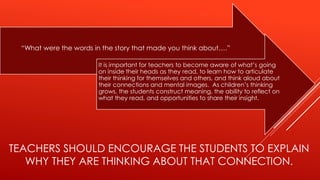
TEACHERS SHOULD ENCOURAGE THE STUDENTS TO EXPLAIN
WHY THEY ARE THINKING ABOUT THAT CONNECTION.
“What were the words in the story that made you think about….”
It is important for teachers to become aware of what’s going
on inside their heads as they read, to learn how to articulate
their thinking for themselves and others, and think aloud about
their connections and mental images. As children’s thinking
grows, the students construct meaning, the ability to reflect on
what they read, and opportunities to share their insight.
Remember to ask your
students, “How does that
connection help you
understand?”
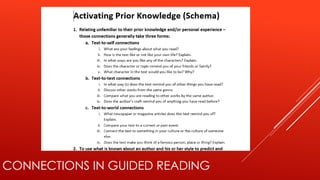
CONNECTIONS IN GUIDED READING
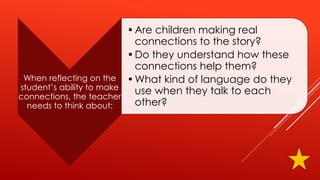
When reflecting on the
student’s ability to make
connections, the teacher
needs to think about:
•Are children making real
connections to the story?
•Do they understand how these
connections help them?
•What kind of language do they
use when they talk to each
other?
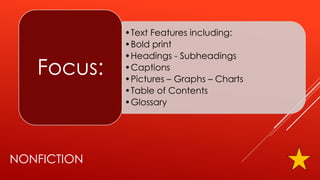
NONFICTION
•Text Features including:
•Bold print
•Headings - Subheadings
•Captions
•Pictures – Graphs – Charts
•Table of Contents
•Glossary
Focus:
PLANNING
Think of a
group you are
working with:
Plan tomorrow’s
guided reading
lesson using one of
the strategies
learned today.
Practice teaching
your lesson to a
partner.
QUESTIONS?

Para Reading PD

  • 1.
    GUIDED READING PARAPROFESSIONALS YALE PUBLICSCHOOLS 2015-16 Jennifer Evans Assistant Director ELA St. Clair County RESA Evans.jennifer@sccresa.org http://www.protopage.com/evans.jennifer
  • 2.
  • 3.
    The ultimate measure ofsuccess in comprehending is when a student can describe how and why use of a comprehension strategy helps him/her understand more completely
  • 4.
    “ Guided readingis a teaching approach designed to help individual students learn how to process a variety of increasingly challenging texts with understanding and fluency.” • Fountas and Pinnell WHAT IS GUIDED READING?
  • 5.
    ESSENTIAL ELEMENTS FOREFFECTIVE GUIDED READING Bring children with similar reading ability together in small groups for focused, efficient instruction. Select texts that are “just right”. Provide introductions that show children how the text “works,” explain difficult words or concepts, and prepare them to read independently (Before). Support independent reading with brief, specific prompts to help children use the strategies you have previously demonstrated (During). Help children revisit and reflect on the text to support comprehension, processing strategies, and extending meaning of text (After). Work explicitly on word-solving strategies (Word Study).
  • 6.
    GUIDED LESSON FORMAT Beforethe Reading: Fluent Reading / Writing Introduce the Text New Vocabulary / Concepts During the Reading: Support effective reading After the Reading: Discuss and revisit the text Teach for processing strategies Extend the text Conduct word work
  • 7.
    Showing children how thebook works – how it’s organized. Give children an idea of what the entire story is about. Draw attention to language structures and vocabulary children will need to use and point out new and important words. Build interest in the story by building prior knowledge, making predictions, connecting to previous lessons, etc. Help children make connections with their own background experiences and knowledge. Point out aspects of print or layout that are important. Show how illustrations or other strategies support the meaning. General Principles for Introductions (Before) to Focus on Include:
  • 8.
    DURING READING OBSERVATIONSTO FOCUS ON: During reading the teacher interacts briefly with students to prompt and encourage their use of strategies at their instructional level. Strategies should support whole class mini-lesson instruction. During reading the teacher records observations to help guide instruction. This should be the longest part of the lesson. These brief conversations are very powerful. Teachers use specific language to facilitate the reader’s use of problem-solving actions. As children independently whisper read the text, teachers will record anecdotal records and interact briefly with students to prompt, facilitate, and encourage their use of strategies and problem-solving actions. No Round Robin Reading The primary purpose of reading is to obtain meaning from text. Even at the K-2 level students need to be reading to make meaning from text.
  • 9.
    AFTER READING OBSERVATIONSTO FOCUS ON: After reading, teachers discuss and revisit the text with children. They engage children in reflecting on the meaning of the text and bringing their own interpretations to the process. Teachers are asking children to be active in sharing meaning with the group. Teachers reinforce effective processing strategies. Teachers may also provide purposes for rereading text based on observations and ask students to extend the text in different ways. It is important for students to respond to what they have read in many different ways. (ie. Graphic organizers, reading response journals, appropriate learning centers)
  • 11.
    CRITICAL READING SKILLS •Phonemic Awareness • Alphabetic Principle • Fluency • Comprehension • Vocabulary K-3 • Word Study • Fluency • Vocabulary • Comprehension • Motivation 4-6
  • 13.
    GUIDED LESSON  https://www.youtube.com/watch?v=3AHxqggc- yI&index=1&list=PL95DC4FBFA0DC457C(9 min. inference guided lesson in 2nd grade)  http://www.schooltube.com/video/c73b68cace3e477b8108/Prim ary%20Guided%20Reading (1st grade guided reading lesson 8min)  RESA Monthly Guided Reading Videos: http://sccresa.org/insideresa/resa-tv/foreducators/  Next Steps in Guided Reading Videos: http://www.janrichardsonguidedreading.com/video-clips (Scroll down to “Early” introducing the book 2nd grade 4:53min)
  • 14.
    Q.A.R.  Strategy:  Question– Answer – Relationship Q.A.R. is a framework to help readers relate prior knowledge and text information. It describes relationships between comprehension – guided questions and their answers.  Three Types of Questions: Right There (The answer is in the text, easy to find.) Think and Search (The answer is in the story, but you need to put together different story parts to find it. Author and You) On My Own (The answer is not in the story. You use your own experience to answer the question.)
  • 15.
  • 16.
    WHY USE Q.A.R.? Fluentreaders appropriately integrate their background knowledge with what the text suggests. They seek, identity, and combine information from various places within the text to construct meaning. Current research on schema theory, text structure, and metacognition finds:
  • 17.
    HOW TO DOQ.A.R.:  Using a gradual release model, teacher begins by modeling and then gradually relinquishing the tasks to the students. Reads selection of text Asks a question Considers and states the answer States the Q.A.R. Gives explanation for the choice
  • 19.
    HARCOURT – TROPHIESEXAMPLE  Read First paragraph of “Old Notch”  Ask: How long of a ride in the car would it be to go to the store?  How do you know?  Why do you think someone would want to live that far away from a store?  How do you know? Two main places to find answers one hour read it right there in the text in my head Answers will vary
  • 21.
  • 22.
    CONNECTIONS “When we beginstrategy instruction with children, stories close to their own lives and experiences are helpful for introducing new ways of thinking about reading. Readers naturally make connections between books and their own lives. Once they have heard a wealth of stories and narratives, they begin to connect themes, characters, and issues from one book to another. When children understand how to connect the texts they read to their lives, they begin to make connections between what they read and the larger world. This nudges them into thinking about bigger, more expansive issues beyond their universe of home, school, and neighborhood Strategies That Work.”
  • 23.
    WE REQUIRE PROPERPLANNING. What do I want students to understand about this strategy? Of all the places in the text where I could authentically think out loud, which two or three would best illustrate my point? Mark those places before your lesson, and think about what you will say and how you will say it. Only model the point you are trying to make, don’t model another thinking strategy during this read aloud. Be aware of your focus and keep it.
  • 24.
    As we teachthe students to think through the text we encourage the students to respond using this terminology: •“When I read [of heard] these words… it reminded me of…” •“When I saw the picture of… it made me think about…”
  • 25.
    TEACHERS SHOULD ENCOURAGETHE STUDENTS TO EXPLAIN WHY THEY ARE THINKING ABOUT THAT CONNECTION. “What were the words in the story that made you think about….” It is important for teachers to become aware of what’s going on inside their heads as they read, to learn how to articulate their thinking for themselves and others, and think aloud about their connections and mental images. As children’s thinking grows, the students construct meaning, the ability to reflect on what they read, and opportunities to share their insight.
  • 26.
    Remember to askyour students, “How does that connection help you understand?”
  • 27.
  • 30.
    When reflecting onthe student’s ability to make connections, the teacher needs to think about: •Are children making real connections to the story? •Do they understand how these connections help them? •What kind of language do they use when they talk to each other?
  • 31.
    NONFICTION •Text Features including: •Boldprint •Headings - Subheadings •Captions •Pictures – Graphs – Charts •Table of Contents •Glossary Focus:
  • 32.
    PLANNING Think of a groupyou are working with: Plan tomorrow’s guided reading lesson using one of the strategies learned today. Practice teaching your lesson to a partner.
  • 33.

Editor's Notes

  • #3 Respond to the prompt (on a sticky note): “After looking at today’s agenda, what is one thing you hope to get out of the training?” Hand up, stand –up, pair-up: to share answers Place sticky notes on parking lot – be sure to answer
  • #6 Fountas and Pinnell
  • #11 CORE Reading Sourcebook
  • #12 Trainer Notes: You will want to acknowledge that these critical reading skills are also referred to as the Big Ideas of Early Literacy or the Essential Components of Reading. The intent of this slide is to provide a quick listing of these critical reading skills.
  • #13 Think – Write – Round Robin (1 min. each) After learning about guided reading, paras will think about the “gist” of the components of guided reading and record them. (3 min). Each person will go around the table sharing their gist of the important components of guided reading, starting with number 1. Each person will get 1 min. to share.
  • #14 Model guided reading lesson with Para’s as students
  • #20 Practice : Rally Coach
  • #21 RALLY COACH: Partner A shares answers to questions for video 1 Partner B coaches if necessary by: Tip Tip Teach Try Again Praise Switch Partner Roles for next video
  • #22 See Say Something Handout – Practice with partner – both taking turns (Rally Coach)
  • #23 Strategies That Work, Chapter 6 Making Connections: A Bridge from the New to the Known
  • #30 With a partner, practice rally coach using “Say Something” strategy but instead of using it for questioning, use it for connections.
  • #31 Inside – Outside Review (use questions)
  • #32 Using Rally Coach, use questioning and connecting strategies learned/practiced, apply to nonfiction.
  • #34 Be sure to cover any sticky note questions that were not answered during the presentation.