J. Evans St. Clair County RESA
Reading Conference
Name____________________________Date___________Text___________________
Why did you
pick the book?
Title/Cover/
Pictures
Friend/Parent/
Teacher
Genre / Topic/
Subject Matter
Series Author Other
Book Level Independent Instructional Frustration
Performance Criteria 4 3 2 1 Notes
Opinion:
What do you think of the book?
Detailed and makes
connection to text
and reader, supported
with evidence.
General and/or
vague opinion.
Teacher must
search for opinion
or student
evidence is,
“Because I do.”
Unable to form
informed opinion.
Comprehension / Retell:
Text supported
Teacher scaffold
Focused Comprehension Strategy:
Includes all important
story elements in
sequence with details.
Uses specific
evidence to answer
teacher questions.
Has internalized
comprehension
strategy and easily
applies it.
(What does it
matter/mean to me?)
Re-tell may leave
out one thing
and/or may be
spotty. Answers
teacher questions
in general manner.
Average use of
comprehension
strategy.
(What does it
matter – why
important?)
Re-tell is heavily
scaffolded by
teacher.
Needs more
practice with the
focused
comprehension
strategy. (What
does it mean?)
Has no idea how to
re-tell in response
to teacher
prompt.
Cannot use
comprehension
strategy.
(What does the
text say?)
Student Read Aloud:
Accuracy rate: _________
Strategies used:
Decode Picture Initial Sound
Chunking Small Words Reread
Word Families Appeal Guess
Context Clues Substitute
Prior knowledge Mouth Ready
On-set/rime
Uses Cueing system: sound right,
look right, make sense
Reader is fluent with
limited or no errors
or chooses from many
strategies to self
correct.
Strong phrasing,
comprehension,
fluency, speed,
punctuation and word-
solving.
Reader relies on
only one strategy
to self-correct or
problem solve
when they come to
a word they don’t
know.
Good phrasing,
comprehension,
fluency, speed,
punctuation and
word-solving.
Reader has to be
provided word-
solving strategies
by teacher, but
then corrects.
Ok phrasing,
comprehension,
fluency, speed,
punctuation and
word-solving.
Reader shows no
sign of word-
solving strategies
even after
teacher prompt.
Weak phrasing,
comprehension,
fluency, speed,
punctuation and
word-solving.
Prediction / Vocabulary: Reader gives detailed
prediction or
inference based on
text and/or prior
knowledge. Continually
confirms/denies/
changes predictions.
Applies and uses new
vocabulary.
Reader is
inconsistent with
prediction cycle.
Doesn’t always
support prediction
with textual
evidence.
Sometimes uses
new vocabulary.
Reader’s
prediction is
limited or
inference is vague.
Does not
confirm/deny
prediction.
New vocabulary is
recalled with
prompts.
Reader’s
prediction is
implausible or
inference is off.
Has no
recollection of
new vocabulary.
What is next for you as a reader?
(Next book - interests – time
spent reading outside of school –
what student is going to do to
achieve their goal)
Reader gives specific
information leading to
goal and a reading life
outside of school
and/or a detailed one
inside school.
Reader has a
general idea about
where they’re
going and who
they are as a
reader.
Reader is
prompted as a
reader only
through teacher
direction.
Reader has
trouble being a
reader even with
teacher direction.
Instructional Plan:
Progressing / Attained
Strengths: Focus/Goals:
J. Evans St. Clair County RESA

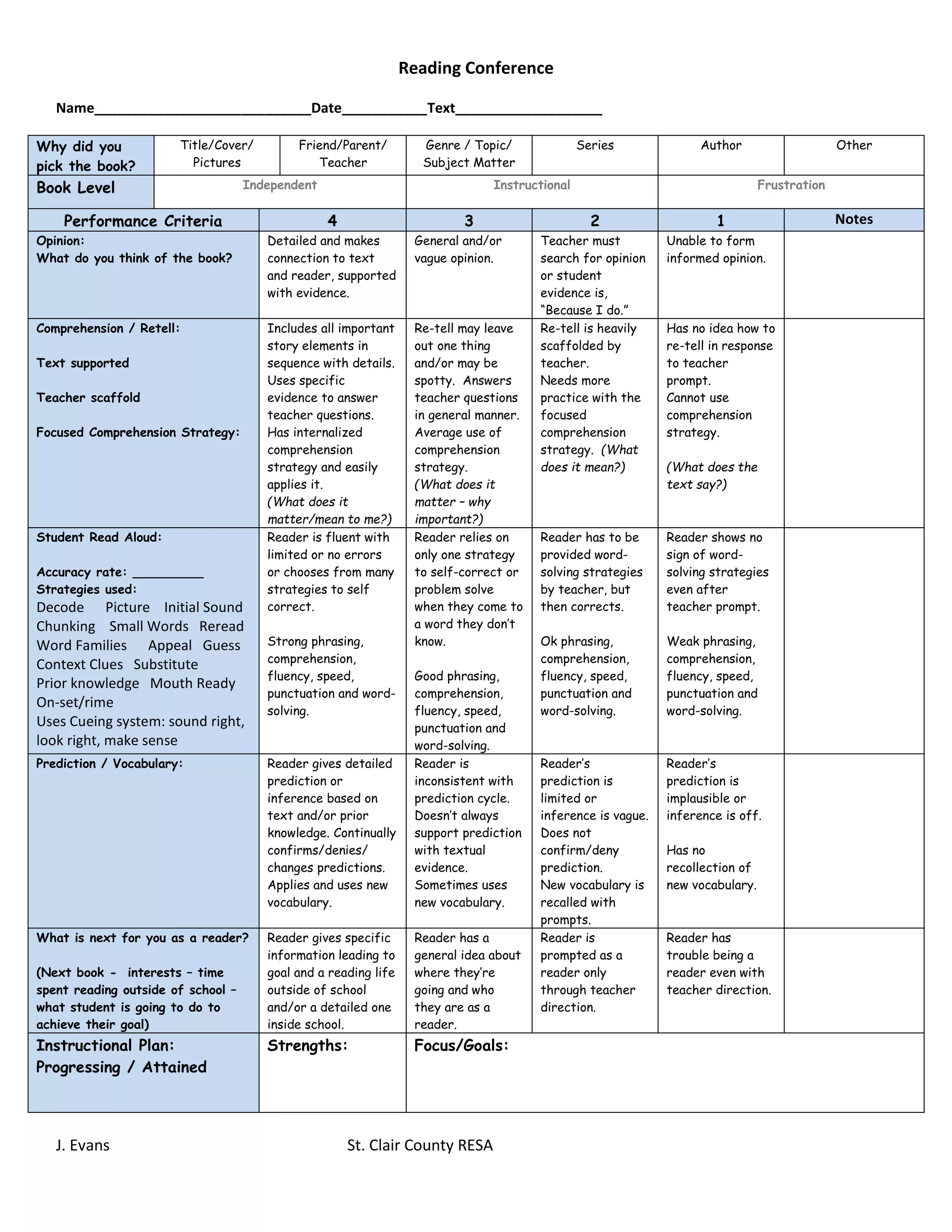
Evans reading conference recording form

  • 1.
    J. Evans St.Clair County RESA Reading Conference Name____________________________Date___________Text___________________ Why did you pick the book? Title/Cover/ Pictures Friend/Parent/ Teacher Genre / Topic/ Subject Matter Series Author Other Book Level Independent Instructional Frustration Performance Criteria 4 3 2 1 Notes Opinion: What do you think of the book? Detailed and makes connection to text and reader, supported with evidence. General and/or vague opinion. Teacher must search for opinion or student evidence is, “Because I do.” Unable to form informed opinion. Comprehension / Retell: Text supported Teacher scaffold Focused Comprehension Strategy: Includes all important story elements in sequence with details. Uses specific evidence to answer teacher questions. Has internalized comprehension strategy and easily applies it. (What does it matter/mean to me?) Re-tell may leave out one thing and/or may be spotty. Answers teacher questions in general manner. Average use of comprehension strategy. (What does it matter – why important?) Re-tell is heavily scaffolded by teacher. Needs more practice with the focused comprehension strategy. (What does it mean?) Has no idea how to re-tell in response to teacher prompt. Cannot use comprehension strategy. (What does the text say?) Student Read Aloud: Accuracy rate: _________ Strategies used: Decode Picture Initial Sound Chunking Small Words Reread Word Families Appeal Guess Context Clues Substitute Prior knowledge Mouth Ready On-set/rime Uses Cueing system: sound right, look right, make sense Reader is fluent with limited or no errors or chooses from many strategies to self correct. Strong phrasing, comprehension, fluency, speed, punctuation and word- solving. Reader relies on only one strategy to self-correct or problem solve when they come to a word they don’t know. Good phrasing, comprehension, fluency, speed, punctuation and word-solving. Reader has to be provided word- solving strategies by teacher, but then corrects. Ok phrasing, comprehension, fluency, speed, punctuation and word-solving. Reader shows no sign of word- solving strategies even after teacher prompt. Weak phrasing, comprehension, fluency, speed, punctuation and word-solving. Prediction / Vocabulary: Reader gives detailed prediction or inference based on text and/or prior knowledge. Continually confirms/denies/ changes predictions. Applies and uses new vocabulary. Reader is inconsistent with prediction cycle. Doesn’t always support prediction with textual evidence. Sometimes uses new vocabulary. Reader’s prediction is limited or inference is vague. Does not confirm/deny prediction. New vocabulary is recalled with prompts. Reader’s prediction is implausible or inference is off. Has no recollection of new vocabulary. What is next for you as a reader? (Next book - interests – time spent reading outside of school – what student is going to do to achieve their goal) Reader gives specific information leading to goal and a reading life outside of school and/or a detailed one inside school. Reader has a general idea about where they’re going and who they are as a reader. Reader is prompted as a reader only through teacher direction. Reader has trouble being a reader even with teacher direction. Instructional Plan: Progressing / Attained Strengths: Focus/Goals:
  • 2.
    J. Evans St.Clair County RESA