Teacher: _______________________________________ Date:_____________ J. EvansSt. ClairCountyRESA
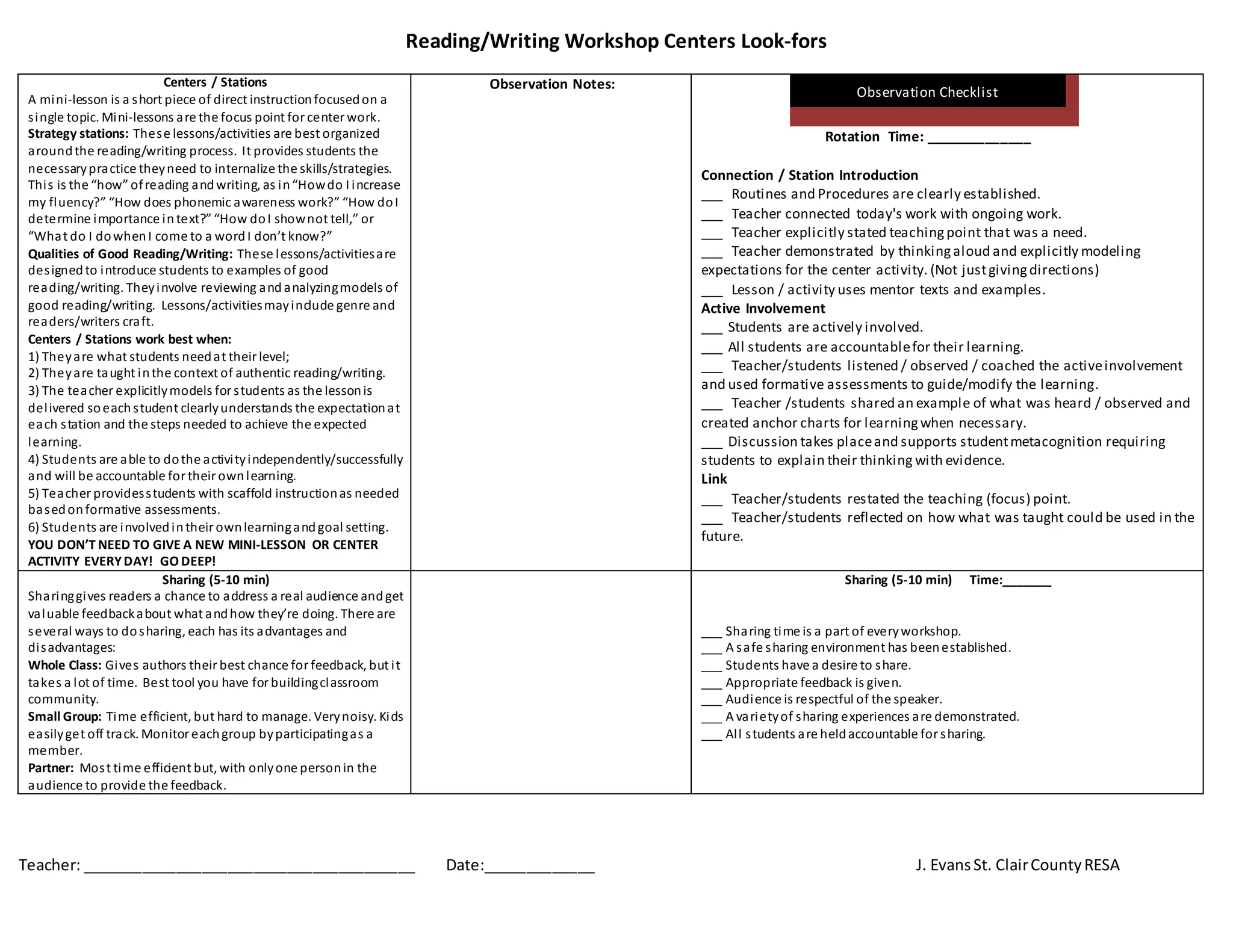
Reading/Writing Workshop Centers Look-fors
Centers / Stations
A mini-lesson is a short piece of direct instructionfocusedon a
single topic. Mini-lessons are the focus point for center work.
Strategy stations: These lessons/activities are best organized
aroundthe reading/writing process. It provides students the
necessarypractice theyneed to internalize the skills/strategies.
This is the “how” ofreading andwriting, as in“Howdo I increase
my fluency?” “How does phonemic awareness work?” “How doI
determine importance intext?” “How doI shownot tell,” or
“What do I dowhenI come to a wordI don’t know?”
Qualities of Good Reading/Writing: These lessons/activitiesare
designedto introduce students to examples of good
reading/writing. Theyinvolve reviewing and analyzingmodels of
good reading/writing. Lessons/activitiesmayinclude genre and
readers/writers craft.
Centers / Stations work best when:
1) Theyare what students needat their level;
2) Theyare taught inthe context of authentic reading/writing.
3) The teacher explicitlymodels for students as the lessonis
delivered soeachstudent clearlyunderstands the expectationat
each station and the steps needed to achieve the expected
learning.
4) Students are able to dothe activityindependently/successfully
and will be accountable for their ownlearning.
5) Teacher providesstudents with scaffold instructionas needed
basedonformative assessments.
6) Students are involvedintheir ownlearningandgoal setting.
YOU DON’T NEED TO GIVE A NEW MINI-LESSON OR CENTER
ACTIVITY EVERYDAY! GO DEEP!
Observation Notes:
Observation Checklist
Rotation Time: ______________
Connection / Station Introduction
___ Routines and Procedures are clearly established.
___ Teacher connected today's work with ongoing work.
___ Teacher explicitly stated teachingpoint that was a need.
___ Teacher demonstrated by thinkingaloud and explicitly modeling
expectations for the center activity. (Not justgivingdirections)
___ Lesson / activity uses mentor texts and examples.
Active Involvement
___ Students are actively involved.
___ All students are accountablefor their learning.
___ Teacher/students listened / observed / coached the activeinvolvement
and used formative assessments to guide/modify the learning.
___ Teacher /students shared an example of what was heard / observed and
created anchor charts for learningwhen necessary.
___ Discussion takes placeand supports studentmetacognition requiring
students to explain their thinking with evidence.
Link
___ Teacher/students restated the teaching (focus) point.
___ Teacher/students reflected on how what was taught could be used in the
future.
Sharing (5-10 min)
Sharinggives readers a chance to address a real audience andget
valuable feedbackabout what andhow they’re doing. There are
several ways to dosharing, each has its advantages and
disadvantages:
Whole Class: Gives authors their best chance for feedback, but it
takes a lot of time. Best tool you have for buildingclassroom
community.
Small Group: Time efficient, but hard to manage. Verynoisy. Kids
easilyget off track. Monitor eachgroup byparticipatingas a
member.
Partner: Most time efficient but, with onlyone personin the
audience to provide the feedback.
Sharing (5-10 min) Time:_______
___ Sharing time is a part of everyworkshop.
___ A safe sharing environment has beenestablished.
___ Students have a desire to share.
___ Appropriate feedback is given.
___ Audience is respectful of the speaker.
___ A varietyof sharing experiences are demonstrated.
___ All students are heldaccountable for sharing.

Center station look-fors

  • 1.
    Teacher: _______________________________________ Date:_____________J. EvansSt. ClairCountyRESA Reading/Writing Workshop Centers Look-fors Centers / Stations A mini-lesson is a short piece of direct instructionfocusedon a single topic. Mini-lessons are the focus point for center work. Strategy stations: These lessons/activities are best organized aroundthe reading/writing process. It provides students the necessarypractice theyneed to internalize the skills/strategies. This is the “how” ofreading andwriting, as in“Howdo I increase my fluency?” “How does phonemic awareness work?” “How doI determine importance intext?” “How doI shownot tell,” or “What do I dowhenI come to a wordI don’t know?” Qualities of Good Reading/Writing: These lessons/activitiesare designedto introduce students to examples of good reading/writing. Theyinvolve reviewing and analyzingmodels of good reading/writing. Lessons/activitiesmayinclude genre and readers/writers craft. Centers / Stations work best when: 1) Theyare what students needat their level; 2) Theyare taught inthe context of authentic reading/writing. 3) The teacher explicitlymodels for students as the lessonis delivered soeachstudent clearlyunderstands the expectationat each station and the steps needed to achieve the expected learning. 4) Students are able to dothe activityindependently/successfully and will be accountable for their ownlearning. 5) Teacher providesstudents with scaffold instructionas needed basedonformative assessments. 6) Students are involvedintheir ownlearningandgoal setting. YOU DON’T NEED TO GIVE A NEW MINI-LESSON OR CENTER ACTIVITY EVERYDAY! GO DEEP! Observation Notes: Observation Checklist Rotation Time: ______________ Connection / Station Introduction ___ Routines and Procedures are clearly established. ___ Teacher connected today's work with ongoing work. ___ Teacher explicitly stated teachingpoint that was a need. ___ Teacher demonstrated by thinkingaloud and explicitly modeling expectations for the center activity. (Not justgivingdirections) ___ Lesson / activity uses mentor texts and examples. Active Involvement ___ Students are actively involved. ___ All students are accountablefor their learning. ___ Teacher/students listened / observed / coached the activeinvolvement and used formative assessments to guide/modify the learning. ___ Teacher /students shared an example of what was heard / observed and created anchor charts for learningwhen necessary. ___ Discussion takes placeand supports studentmetacognition requiring students to explain their thinking with evidence. Link ___ Teacher/students restated the teaching (focus) point. ___ Teacher/students reflected on how what was taught could be used in the future. Sharing (5-10 min) Sharinggives readers a chance to address a real audience andget valuable feedbackabout what andhow they’re doing. There are several ways to dosharing, each has its advantages and disadvantages: Whole Class: Gives authors their best chance for feedback, but it takes a lot of time. Best tool you have for buildingclassroom community. Small Group: Time efficient, but hard to manage. Verynoisy. Kids easilyget off track. Monitor eachgroup byparticipatingas a member. Partner: Most time efficient but, with onlyone personin the audience to provide the feedback. Sharing (5-10 min) Time:_______ ___ Sharing time is a part of everyworkshop. ___ A safe sharing environment has beenestablished. ___ Students have a desire to share. ___ Appropriate feedback is given. ___ Audience is respectful of the speaker. ___ A varietyof sharing experiences are demonstrated. ___ All students are heldaccountable for sharing.