Guided Reading:  Let’s Get It Started Daniel J. Sonnier 6 th  Grade Reading Teacher TEAM Academy
Who are you?
AGENDA Purpose Phonemics, Phonics and Fluency Independent vs. Instructional Emergent, Early, and Fluent Readers Getting Started with Data Overview of Guided Reading What Does Guided Reading Look Like? Next Steps/Questions
Purpose Guided reading is a time to have students practice using decoding and comprehension strategies as they read a text that is on their instructional level.  Membership in a Guided Reading group is flexible and depends on the needs of students. The teacher works with a small group (ideally, no more than six or  seven) to support their reading.
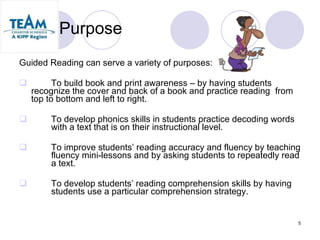
Purpose Guided Reading can serve a variety of purposes: To build book and print awareness – by having students  recognize the cover and back of a book and practice reading  from top to bottom and left to right. To develop phonics skills in students practice decoding words  with a text that is on their instructional level. To improve students’ reading accuracy and fluency by teaching  fluency mini-lessons and by asking students to repeatedly read  a text. To develop students’ reading comprehension skills by having  students use a particular comprehension strategy.
Phonemics, Phonics & Fluency PHONEMIC AWARENESS  is the ability to notice, think about, and work with the individual sounds in spoken words.  Before children learn to read print, they need to become aware of how sounds in words work. They must understand that words are made up of speech sounds, or phonemes.
Phonemics, Phonics & Fluency PHONICS  is the relationship between the letters (graphemes) of written language and the individual sounds (phonemes) of spoken language.  It teaches children to use these relationships to read and write words.
Phonemic, Phonics & Fluency FLUENCY  is the ability to read a text accurately and quickly.  When fluent readers read silently, they recognize words automatically.  They group words quickly to help them gain meaning from what they read.  Fluent readers read aloud effortlessly and with expression.  Their reading sounds natural, as if they are speaking.  Readers who have not developed fluency read slowly, word by word.  Their oral reading is choppy and plodding.
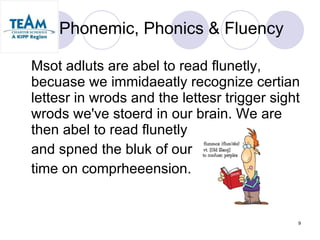
Phonemic, Phonics & Fluency Msot adluts are abel to read flunetly, becuase we immidaeatly recognize certian lettesr in wrods and the lettesr trigger sight wrods we've stoerd in our brain. We are then abel to read flunetly  and spned the bluk of our  time on comprheeension.
Independent vs. Instructional INDEPENDENT  is the level at which a child can read easily and with pleasure.  Independent reading levels are identified by having students read a text aloud and is based on fluency and accuracy.  A range of 96% - 100% accuracy is generally agreed to be a range of independence in reading.
Independent vs. Instructional INSTRUCTIONAL   is the level at which the teacher “stretches” the student in his/her thinking and reading.  Instructional reading levels are identified in the same way as independent reading levels.  A range of 90% - 95% is generally agreed to be an appropriate range for instruction in reading.  A range lower than 90% is considered to be a level of FRUSTRATION!
Emergent, Early & Fluent Readers EMERGENT READERS  are typically broken into to groups:  Early Emergent & Emergent Early Emergent Readers – Levels A – C Emergent Readers – Levels D – I Emergent Readers are  “ learning to read”.
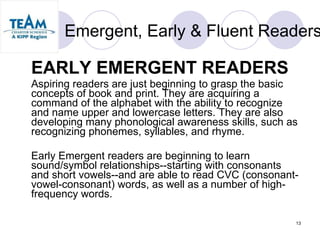
Emergent, Early & Fluent Readers EARLY EMERGENT READERS   Aspiring readers are just beginning to grasp the basic concepts of book and print. They are acquiring a command of the alphabet with the ability to recognize and name upper and lowercase letters. They are also developing many phonological awareness skills, such as recognizing phonemes, syllables, and rhyme.  Early Emergent readers are beginning to learn sound/symbol relationships--starting with consonants and short vowels--and are able to read CVC (consonant-vowel-consonant) words, as well as a number of high-frequency words. 
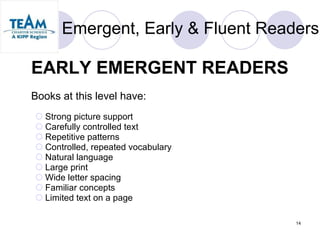
Emergent, Early & Fluent Readers EARLY EMERGENT READERS   Books at this level have: Strong picture support  Carefully controlled text  Repetitive patterns  Controlled, repeated vocabulary  Natural language  Large print  Wide letter spacing  Familiar concepts  Limited text on a page
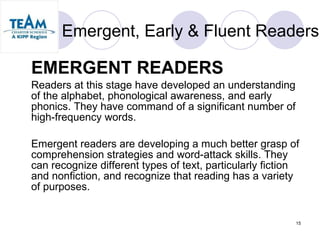
Emergent, Early & Fluent Readers EMERGENT READERS Readers at this stage have developed an understanding of the alphabet, phonological awareness, and early phonics. They have command of a significant number of high-frequency words.  Emergent readers are developing a much better grasp of comprehension strategies and word-attack skills. They can recognize different types of text, particularly fiction and nonfiction, and recognize that reading has a variety of purposes. 
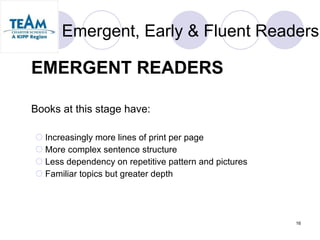
Emergent, Early & Fluent Readers EMERGENT READERS Books at this stage have: Increasingly more lines of print per page  More complex sentence structure  Less dependency on repetitive pattern and pictures  Familiar topics but greater depth
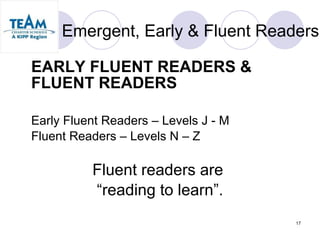
Emergent, Early & Fluent Readers EARLY FLUENT READERS & FLUENT READERS Early Fluent Readers – Levels J - M Fluent Readers – Levels N – Z Fluent readers are  “ reading to learn”.
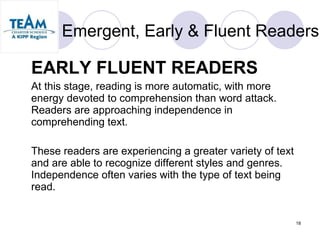
Emergent, Early & Fluent Readers EARLY FLUENT READERS At this stage, reading is more automatic, with more energy devoted to comprehension than word attack. Readers are approaching independence in comprehending text.  These readers are experiencing a greater variety of text and are able to recognize different styles and genres. Independence often varies with the type of text being read. 
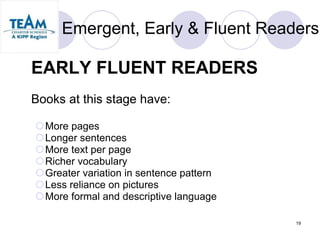
Emergent, Early & Fluent Readers EARLY FLUENT READERS Books at this stage have: More pages  Longer sentences  More text per page  Richer vocabulary  Greater variation in sentence pattern  Less reliance on pictures  More formal and descriptive language
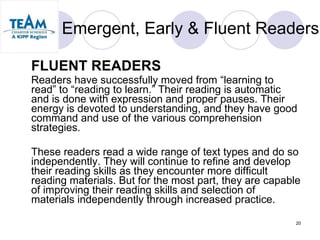
Emergent, Early & Fluent Readers FLUENT READERS Readers have successfully moved from “learning to read” to “reading to learn.” Their reading is automatic and is done with expression and proper pauses. Their energy is devoted to understanding, and they have good command and use of the various comprehension strategies.  These readers read a wide range of text types and do so independently. They will continue to refine and develop their reading skills as they encounter more difficult reading materials. But for the most part, they are capable of improving their reading skills and selection of materials independently through increased practice. 
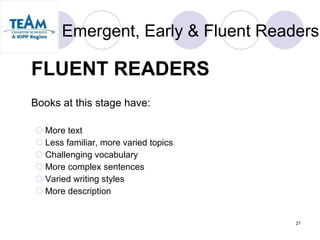
Emergent, Early & Fluent Readers FLUENT READERS Books at this stage have: More text  Less familiar, more varied topics  Challenging vocabulary  More complex sentences  Varied writing styles  More description
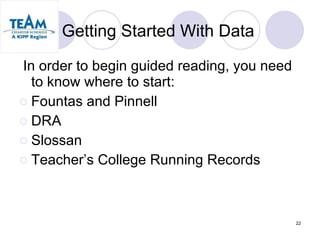
Getting Started With Data In order to begin guided reading, you need to know where to start: Fountas and Pinnell DRA Slossan Teacher’s College Running Records
Getting Started With Data Teachers College  http://www.tc.edu/rwp/assessment/2008/ Slossan Oral Test http://www.literacychicago.org/downloads/SlossonReadingTest.pdf
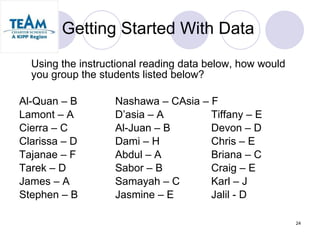
Getting Started With Data Using the instructional reading data below, how would you group the students listed below? Al-Quan – B Nashawa – C Asia – F Lamont – A D’asia – A Tiffany – E Cierra – C Al-Juan – B Devon – D Clarissa – D Dami – H Chris – E Tajanae – F Abdul – A Briana – C Tarek – D Sabor – B Craig – E James – A Samayah – C Karl – J Stephen – B Jasmine – E Jalil - D
Overview of Guided Reading Guided Reading generally has four components:  Word Work/Vocabulary Instruction Pre-Reading  During Reading Post Reading
Overview of Guided Reading WORD WORK/VOCABULARY A variety of activities can and should occur in this portion of guided reading: Phonemic awareness practices  Sight word Review Phonics strategies Chunking words Identifying syllables  Context Clues
Overview of Guided Reading PRE-READING This is the point in guided reading where you set the purpose for reading.  You will provide students with the tools, skills, and strategies that will help them read an instructional level text meaningfully. Depending on the level of the group and the text you are working will determine what the purpose of the session is: Identify high frequency/sight words  Use context clues Identify/Work with story elements Begin working with reading strategies
Overview of Guided Reading PRE-READING Guided Reading is the ideal place to work on the core four comprehension strategies: predicting summarizing clarifying* questioning *This skill is perhaps the most important taught in guided reading, because students need to monitor their reading.
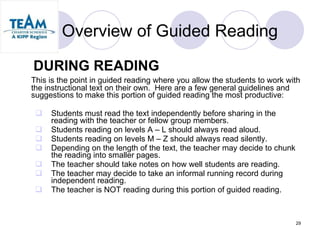
Overview of Guided Reading   DURING READING This is the point in guided reading where you allow the students to work with the instructional text on their own.  Here are a few general guidelines and suggestions to make this portion of guided reading the most productive: Students must read the text independently before sharing in the  reading with the teacher or fellow group members. Students reading on levels A – L should always read aloud. Students reading on levels M – Z should always read silently. Depending on the length of the text, the teacher may decide to chunk  the reading into smaller pages. The teacher should take notes on how well students are reading. The teacher may decide to take an informal running record during  independent reading. The teacher is NOT reading during this portion of guided reading.
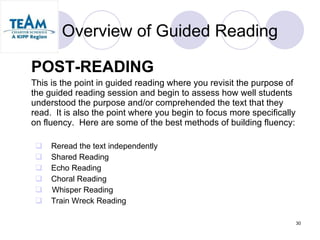
Overview of Guided Reading POST-READING This is the point in guided reading where you revisit the purpose of the guided reading session and begin to assess how well students understood the purpose and/or comprehended the text that they read.  It is also the point where you begin to focus more specifically on fluency.  Here are some of the best methods of building fluency: Reread the text independently Shared Reading Echo Reading Choral Reading Whisper Reading Train Wreck Reading
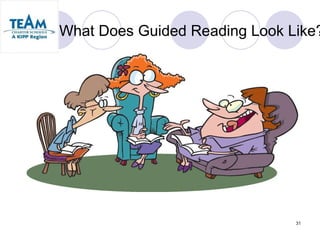
What Does Guided Reading Look Like?
Next Steps/Questions Ask questions Observe a teacher conducting a guided reading session Explore Teachers College Running Records Become familiar with Reading a-z Don’t Stop Believing [email_address]

Guided Reading

  • 1.
    Guided Reading: Let’s Get It Started Daniel J. Sonnier 6 th Grade Reading Teacher TEAM Academy
  • 2.
  • 3.
    AGENDA Purpose Phonemics,Phonics and Fluency Independent vs. Instructional Emergent, Early, and Fluent Readers Getting Started with Data Overview of Guided Reading What Does Guided Reading Look Like? Next Steps/Questions
  • 4.
    Purpose Guided readingis a time to have students practice using decoding and comprehension strategies as they read a text that is on their instructional level. Membership in a Guided Reading group is flexible and depends on the needs of students. The teacher works with a small group (ideally, no more than six or seven) to support their reading.
  • 5.
    Purpose Guided Readingcan serve a variety of purposes: To build book and print awareness – by having students recognize the cover and back of a book and practice reading from top to bottom and left to right. To develop phonics skills in students practice decoding words with a text that is on their instructional level. To improve students’ reading accuracy and fluency by teaching fluency mini-lessons and by asking students to repeatedly read a text. To develop students’ reading comprehension skills by having students use a particular comprehension strategy.
  • 6.
    Phonemics, Phonics &Fluency PHONEMIC AWARENESS is the ability to notice, think about, and work with the individual sounds in spoken words. Before children learn to read print, they need to become aware of how sounds in words work. They must understand that words are made up of speech sounds, or phonemes.
  • 7.
    Phonemics, Phonics &Fluency PHONICS is the relationship between the letters (graphemes) of written language and the individual sounds (phonemes) of spoken language. It teaches children to use these relationships to read and write words.
  • 8.
    Phonemic, Phonics &Fluency FLUENCY is the ability to read a text accurately and quickly. When fluent readers read silently, they recognize words automatically. They group words quickly to help them gain meaning from what they read. Fluent readers read aloud effortlessly and with expression. Their reading sounds natural, as if they are speaking. Readers who have not developed fluency read slowly, word by word. Their oral reading is choppy and plodding.
  • 9.
    Phonemic, Phonics &Fluency Msot adluts are abel to read flunetly, becuase we immidaeatly recognize certian lettesr in wrods and the lettesr trigger sight wrods we've stoerd in our brain. We are then abel to read flunetly and spned the bluk of our time on comprheeension.
  • 10.
    Independent vs. InstructionalINDEPENDENT is the level at which a child can read easily and with pleasure. Independent reading levels are identified by having students read a text aloud and is based on fluency and accuracy. A range of 96% - 100% accuracy is generally agreed to be a range of independence in reading.
  • 11.
    Independent vs. InstructionalINSTRUCTIONAL is the level at which the teacher “stretches” the student in his/her thinking and reading. Instructional reading levels are identified in the same way as independent reading levels. A range of 90% - 95% is generally agreed to be an appropriate range for instruction in reading. A range lower than 90% is considered to be a level of FRUSTRATION!
  • 12.
    Emergent, Early &Fluent Readers EMERGENT READERS are typically broken into to groups: Early Emergent & Emergent Early Emergent Readers – Levels A – C Emergent Readers – Levels D – I Emergent Readers are “ learning to read”.
  • 13.
    Emergent, Early &Fluent Readers EARLY EMERGENT READERS Aspiring readers are just beginning to grasp the basic concepts of book and print. They are acquiring a command of the alphabet with the ability to recognize and name upper and lowercase letters. They are also developing many phonological awareness skills, such as recognizing phonemes, syllables, and rhyme.  Early Emergent readers are beginning to learn sound/symbol relationships--starting with consonants and short vowels--and are able to read CVC (consonant-vowel-consonant) words, as well as a number of high-frequency words. 
  • 14.
    Emergent, Early &Fluent Readers EARLY EMERGENT READERS Books at this level have: Strong picture support Carefully controlled text Repetitive patterns Controlled, repeated vocabulary Natural language Large print Wide letter spacing Familiar concepts Limited text on a page
  • 15.
    Emergent, Early &Fluent Readers EMERGENT READERS Readers at this stage have developed an understanding of the alphabet, phonological awareness, and early phonics. They have command of a significant number of high-frequency words.  Emergent readers are developing a much better grasp of comprehension strategies and word-attack skills. They can recognize different types of text, particularly fiction and nonfiction, and recognize that reading has a variety of purposes. 
  • 16.
    Emergent, Early &Fluent Readers EMERGENT READERS Books at this stage have: Increasingly more lines of print per page More complex sentence structure Less dependency on repetitive pattern and pictures Familiar topics but greater depth
  • 17.
    Emergent, Early &Fluent Readers EARLY FLUENT READERS & FLUENT READERS Early Fluent Readers – Levels J - M Fluent Readers – Levels N – Z Fluent readers are “ reading to learn”.
  • 18.
    Emergent, Early &Fluent Readers EARLY FLUENT READERS At this stage, reading is more automatic, with more energy devoted to comprehension than word attack. Readers are approaching independence in comprehending text.  These readers are experiencing a greater variety of text and are able to recognize different styles and genres. Independence often varies with the type of text being read. 
  • 19.
    Emergent, Early &Fluent Readers EARLY FLUENT READERS Books at this stage have: More pages Longer sentences More text per page Richer vocabulary Greater variation in sentence pattern Less reliance on pictures More formal and descriptive language
  • 20.
    Emergent, Early &Fluent Readers FLUENT READERS Readers have successfully moved from “learning to read” to “reading to learn.” Their reading is automatic and is done with expression and proper pauses. Their energy is devoted to understanding, and they have good command and use of the various comprehension strategies.  These readers read a wide range of text types and do so independently. They will continue to refine and develop their reading skills as they encounter more difficult reading materials. But for the most part, they are capable of improving their reading skills and selection of materials independently through increased practice. 
  • 21.
    Emergent, Early &Fluent Readers FLUENT READERS Books at this stage have: More text Less familiar, more varied topics Challenging vocabulary More complex sentences Varied writing styles More description
  • 22.
    Getting Started WithData In order to begin guided reading, you need to know where to start: Fountas and Pinnell DRA Slossan Teacher’s College Running Records
  • 23.
    Getting Started WithData Teachers College http://www.tc.edu/rwp/assessment/2008/ Slossan Oral Test http://www.literacychicago.org/downloads/SlossonReadingTest.pdf
  • 24.
    Getting Started WithData Using the instructional reading data below, how would you group the students listed below? Al-Quan – B Nashawa – C Asia – F Lamont – A D’asia – A Tiffany – E Cierra – C Al-Juan – B Devon – D Clarissa – D Dami – H Chris – E Tajanae – F Abdul – A Briana – C Tarek – D Sabor – B Craig – E James – A Samayah – C Karl – J Stephen – B Jasmine – E Jalil - D
  • 25.
    Overview of GuidedReading Guided Reading generally has four components: Word Work/Vocabulary Instruction Pre-Reading During Reading Post Reading
  • 26.
    Overview of GuidedReading WORD WORK/VOCABULARY A variety of activities can and should occur in this portion of guided reading: Phonemic awareness practices Sight word Review Phonics strategies Chunking words Identifying syllables Context Clues
  • 27.
    Overview of GuidedReading PRE-READING This is the point in guided reading where you set the purpose for reading. You will provide students with the tools, skills, and strategies that will help them read an instructional level text meaningfully. Depending on the level of the group and the text you are working will determine what the purpose of the session is: Identify high frequency/sight words Use context clues Identify/Work with story elements Begin working with reading strategies
  • 28.
    Overview of GuidedReading PRE-READING Guided Reading is the ideal place to work on the core four comprehension strategies: predicting summarizing clarifying* questioning *This skill is perhaps the most important taught in guided reading, because students need to monitor their reading.
  • 29.
    Overview of GuidedReading DURING READING This is the point in guided reading where you allow the students to work with the instructional text on their own. Here are a few general guidelines and suggestions to make this portion of guided reading the most productive: Students must read the text independently before sharing in the reading with the teacher or fellow group members. Students reading on levels A – L should always read aloud. Students reading on levels M – Z should always read silently. Depending on the length of the text, the teacher may decide to chunk the reading into smaller pages. The teacher should take notes on how well students are reading. The teacher may decide to take an informal running record during independent reading. The teacher is NOT reading during this portion of guided reading.
  • 30.
    Overview of GuidedReading POST-READING This is the point in guided reading where you revisit the purpose of the guided reading session and begin to assess how well students understood the purpose and/or comprehended the text that they read. It is also the point where you begin to focus more specifically on fluency. Here are some of the best methods of building fluency: Reread the text independently Shared Reading Echo Reading Choral Reading Whisper Reading Train Wreck Reading
  • 31.
    What Does GuidedReading Look Like?
  • 32.
    Next Steps/Questions Askquestions Observe a teacher conducting a guided reading session Explore Teachers College Running Records Become familiar with Reading a-z Don’t Stop Believing [email_address]