Teacher: _______________________________________ Date:_____________ J. Evans St. Clair County RESA
Reading Workshop Look-fors
Mini-Lesson (10-15 min.)
A mini-lesson is a short piece of direct instruction focused on a
single topic. Mini-lessons fall into three categories:
Procedures: Anything readers need to do to participate
effectively in the workshop: How to get materials; How to store
and organize reading; How to select texts; How to confer; How to
conduct sharing, etc.
Strategies: These lessons are best organized around the reading
process.
This is the “how” of reading, as in “How do I increase my
fluency?” “How does phonemic awareness work?” “How do I
determine importance in text?” or “What do I do when I come to
a word I don’t know?”
Qualities of Good Reading: These lessons are designed to
introduce students to examples of good reading. They involve
reviewing and analyzing models of good reading. Lessons may
include genre and readers craft.
Mini-lessons work best when:
1) They are what students need at their level;
2) They are taught in the context of authentic reading;
3) The teacher models for students as the lesson is delivered.
YOU DON’T NEED TO GIVE A NEW MINI-LESSON EVERY DAY! GO
DEEP!
Observation Notes: Observation Checklist
Mini-Lesson Time: ______________
Connection
Teacher connected today's work with ongoing work.
Teacher explicitly stated teaching point that was a need of the class.
Teach
Teacher told a personal or class story connected to the teaching point.
Teacher demonstrated by thinking aloud and explicitly modeling.
Teacher pointed out things students should have noticed.
Lesson is appropriate length.
Lesson uses mentor texts and examples.
Active Involvement
Students were asked to be actively involved by turning and talking.
All students are accountable for the learning.
Teacher listened / observed / coached their active involvement.
Teacher shared an example of what was heard / observed and created
anchor charts for learning when necessary.
Link
Teacher restated the teaching point.
Teacher told students how what was taught can be used in the future.
Teacher provided students with explicit directions to practice.
Reading Time (15-80 min. – Usually done in rounds)
READING TIME IS THE HEART OF THE WORKSHOP! Reading time
is the centerpiece of the workshop and the longest workshop
section. During reading time, students read or work at stations.
The teacher can:
Model: Work on your own reading briefly. You can read at your
desk or at the board or overhead. Allowing students to see what
and how you read as you read is very good for them. You will
often discover your most valuable mini-lessons when you read in
front of your students.
Conference: Work with individual students on their reading. This
can be one of your most valuable teaching times.
Small Group Mini-Lesson: While the majority of the class is
reading or working at stations, you can take a small group of
students and deliver a mini-lesson for a skill need.
Guided Reading: While the majority of the class is reading or
Reading Time (15-80 min.) Time: ____________
There is a smooth transition from the focus lesson to the reading time.
Students clearly understand routines and procedures.
Students are actively engaged and on task.
All students are accountable.
Teacher expects students to apply what they learn in the focus lesson to
their own reading.
Teacher provides students with choice (choice of text at appropriate level,
application, sharing, etc.)
Students read daily at appropriate level.
Students are conferring with each other.
Reading area of classroom is easily identifiable.
Students have individual book bags with appropriately leveled text.
Students have reading logs/journals.
Students read appropriate amounts of fiction/nonfiction.
Teacher: _______________________________________ Date:_____________ J. Evans St. Clair County RESA
working at stations, you work with a guided reading group.
Reading time works best when:
1) Students have internalized effective classroom procedures;
2) Students read frequently, and for long periods of time, daily
and at their level;
3) You explicitly model for your students..
Guided Reading:
Before:
Students do not interrupt guided reading or conferences.
Teacher introduces the text (ie. Picture walk, set purpose, introduces vocab., etc.)
Familiar reading/writing
Word study – based on needs of students:
Teacher teaches ONLY ONE skill or strategy.
Teacher reads/models the things expected of students.
Running records - teacher listens to students read and determines need
(perhaps using running records and retrospective miscue analysis).
Students are appropriately grouped.
Guided Reading / Conferring (During Reading Time)
During reading time you have a chance to work individually with
students and in small groups. The keys to successful conferencing
and small group instruction include good management and
consistent execution.
Guided Reading/Conferencing works best when:
1) Students know how to do it;
2)You stay focused on one thing(strategy) at a time;
3) You keep conferences to less than five minutes and guided
reading lessons to 20 minutes;
4) You check back with students to see if they’re following up on
what you conference about.
5) You keep appropriate records to guide instruction.
GUIDED READING / CONFERENCING IS YOUR MOST IMPORTANT
TEACHING TIME!
During:
After:
Types of questions asked:
Guided Reading (During Reading Time)
There is no round-robin reading.
Teacher uses open ended questions.
Student reading is the longest part of the lesson
Teacher affirms the good work the student is doing.
Teacher “teaches the reader, not the reading.”
Students are reading and using strategies independently.
Teacher listens as students read and determines need/teaching point to move
students and reinforce metacognition.
Teacher keeps records.
Teacher uses recorded observational data to guide instruction.
Teacher helps students set goals for what they are working on as a reader.
The whole class does not listen to the story on tape.
Teacher sees 2-4 groups or 3 – 5 students during a workshop.
Sharing (5-10 min)
Sharing gives readers a chance to address a real audience and get
valuable feedback about what and how they’re doing. There are
several ways to do sharing, each has its advantages and
disadvantages:
Whole Class: Gives authors their best chance for feedback, but it
takes a lot of time. Best tool you have for building classroom
community.
Small Group: Time efficient, but hard to manage. Very noisy. Kids
easily get off track. Monitor each group by participating as a
member.
Partner: Most time efficient but, with only one person in the
audience to provide the feedback.
Sharing works best when:
1) It is voluntary;
2) The author asks the audience to listen for or help with
something specific;
3) Kids with long pieces read only a short section;
4) You take an active part as a reader and an audience member;
5) Students make constructive comments using the language of
the classroom criteria
7) Students ask questions instead of making comments.
Sharing (5-10 min) Time:_______
Sharing time is a part of every workshop.
A safe sharing environment has been established.
Students have a desire to share.
Appropriate feedback is given.
Audience is respectful of the speaker.
A variety of sharing experiences are demonstrated.
Teacher: _______________________________________ Date:_____________ J. Evans St. Clair County RESA

Reading workshop look fors2

  • 1.
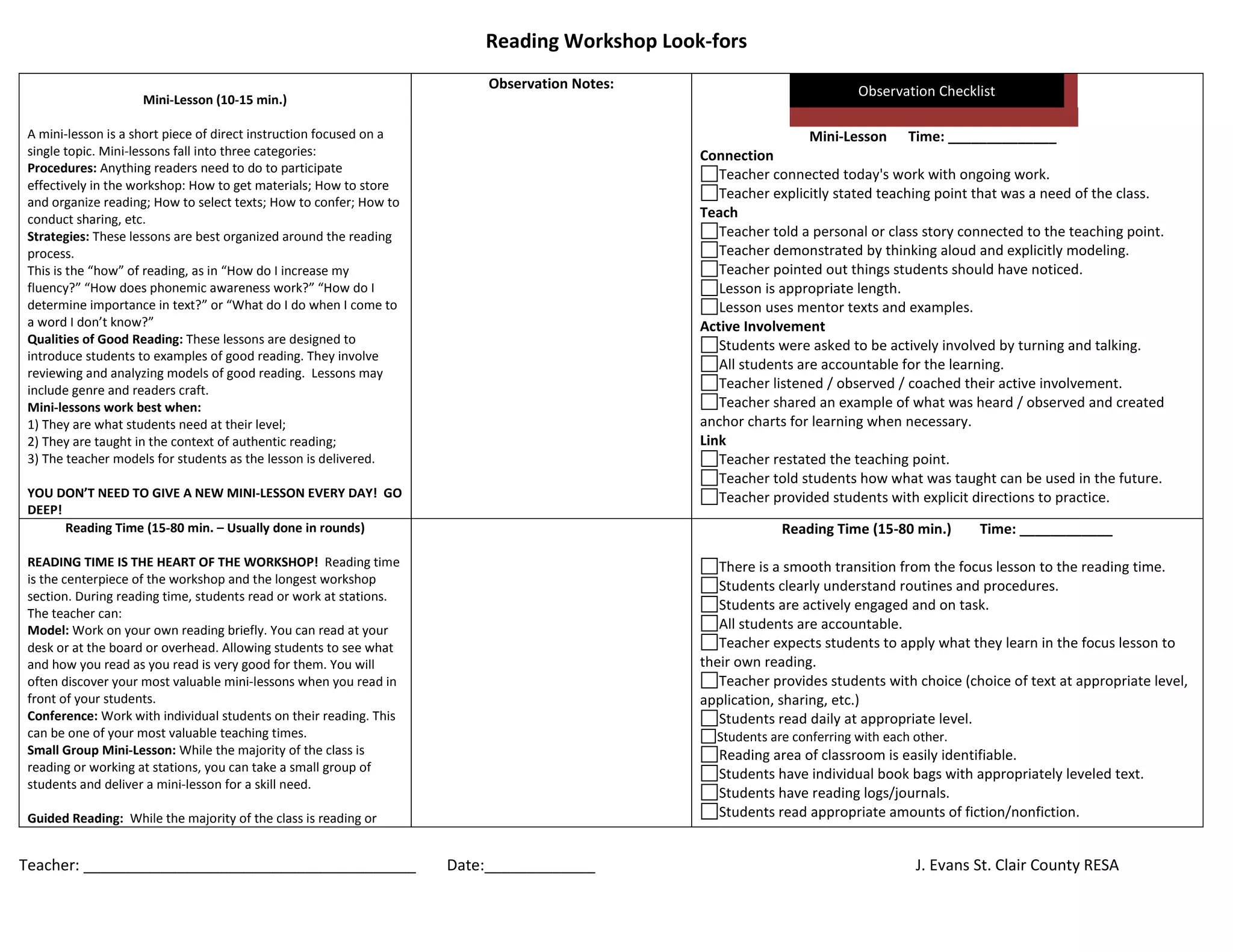
    Teacher: _______________________________________ Date:_____________J. Evans St. Clair County RESA Reading Workshop Look-fors Mini-Lesson (10-15 min.) A mini-lesson is a short piece of direct instruction focused on a single topic. Mini-lessons fall into three categories: Procedures: Anything readers need to do to participate effectively in the workshop: How to get materials; How to store and organize reading; How to select texts; How to confer; How to conduct sharing, etc. Strategies: These lessons are best organized around the reading process. This is the “how” of reading, as in “How do I increase my fluency?” “How does phonemic awareness work?” “How do I determine importance in text?” or “What do I do when I come to a word I don’t know?” Qualities of Good Reading: These lessons are designed to introduce students to examples of good reading. They involve reviewing and analyzing models of good reading. Lessons may include genre and readers craft. Mini-lessons work best when: 1) They are what students need at their level; 2) They are taught in the context of authentic reading; 3) The teacher models for students as the lesson is delivered. YOU DON’T NEED TO GIVE A NEW MINI-LESSON EVERY DAY! GO DEEP! Observation Notes: Observation Checklist Mini-Lesson Time: ______________ Connection Teacher connected today's work with ongoing work. Teacher explicitly stated teaching point that was a need of the class. Teach Teacher told a personal or class story connected to the teaching point. Teacher demonstrated by thinking aloud and explicitly modeling. Teacher pointed out things students should have noticed. Lesson is appropriate length. Lesson uses mentor texts and examples. Active Involvement Students were asked to be actively involved by turning and talking. All students are accountable for the learning. Teacher listened / observed / coached their active involvement. Teacher shared an example of what was heard / observed and created anchor charts for learning when necessary. Link Teacher restated the teaching point. Teacher told students how what was taught can be used in the future. Teacher provided students with explicit directions to practice. Reading Time (15-80 min. – Usually done in rounds) READING TIME IS THE HEART OF THE WORKSHOP! Reading time is the centerpiece of the workshop and the longest workshop section. During reading time, students read or work at stations. The teacher can: Model: Work on your own reading briefly. You can read at your desk or at the board or overhead. Allowing students to see what and how you read as you read is very good for them. You will often discover your most valuable mini-lessons when you read in front of your students. Conference: Work with individual students on their reading. This can be one of your most valuable teaching times. Small Group Mini-Lesson: While the majority of the class is reading or working at stations, you can take a small group of students and deliver a mini-lesson for a skill need. Guided Reading: While the majority of the class is reading or Reading Time (15-80 min.) Time: ____________ There is a smooth transition from the focus lesson to the reading time. Students clearly understand routines and procedures. Students are actively engaged and on task. All students are accountable. Teacher expects students to apply what they learn in the focus lesson to their own reading. Teacher provides students with choice (choice of text at appropriate level, application, sharing, etc.) Students read daily at appropriate level. Students are conferring with each other. Reading area of classroom is easily identifiable. Students have individual book bags with appropriately leveled text. Students have reading logs/journals. Students read appropriate amounts of fiction/nonfiction.
  • 2.
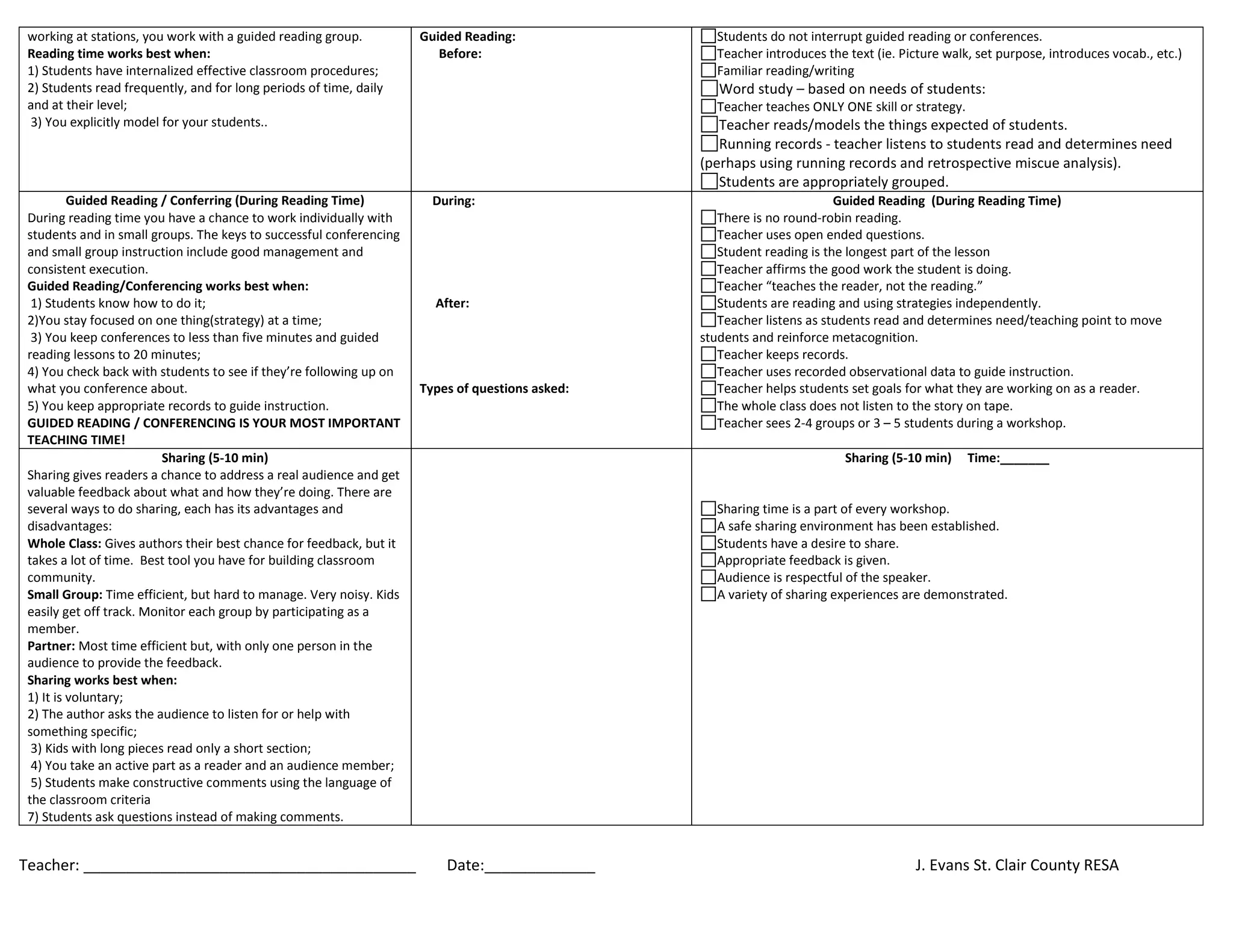
    Teacher: _______________________________________ Date:_____________J. Evans St. Clair County RESA working at stations, you work with a guided reading group. Reading time works best when: 1) Students have internalized effective classroom procedures; 2) Students read frequently, and for long periods of time, daily and at their level; 3) You explicitly model for your students.. Guided Reading: Before: Students do not interrupt guided reading or conferences. Teacher introduces the text (ie. Picture walk, set purpose, introduces vocab., etc.) Familiar reading/writing Word study – based on needs of students: Teacher teaches ONLY ONE skill or strategy. Teacher reads/models the things expected of students. Running records - teacher listens to students read and determines need (perhaps using running records and retrospective miscue analysis). Students are appropriately grouped. Guided Reading / Conferring (During Reading Time) During reading time you have a chance to work individually with students and in small groups. The keys to successful conferencing and small group instruction include good management and consistent execution. Guided Reading/Conferencing works best when: 1) Students know how to do it; 2)You stay focused on one thing(strategy) at a time; 3) You keep conferences to less than five minutes and guided reading lessons to 20 minutes; 4) You check back with students to see if they’re following up on what you conference about. 5) You keep appropriate records to guide instruction. GUIDED READING / CONFERENCING IS YOUR MOST IMPORTANT TEACHING TIME! During: After: Types of questions asked: Guided Reading (During Reading Time) There is no round-robin reading. Teacher uses open ended questions. Student reading is the longest part of the lesson Teacher affirms the good work the student is doing. Teacher “teaches the reader, not the reading.” Students are reading and using strategies independently. Teacher listens as students read and determines need/teaching point to move students and reinforce metacognition. Teacher keeps records. Teacher uses recorded observational data to guide instruction. Teacher helps students set goals for what they are working on as a reader. The whole class does not listen to the story on tape. Teacher sees 2-4 groups or 3 – 5 students during a workshop. Sharing (5-10 min) Sharing gives readers a chance to address a real audience and get valuable feedback about what and how they’re doing. There are several ways to do sharing, each has its advantages and disadvantages: Whole Class: Gives authors their best chance for feedback, but it takes a lot of time. Best tool you have for building classroom community. Small Group: Time efficient, but hard to manage. Very noisy. Kids easily get off track. Monitor each group by participating as a member. Partner: Most time efficient but, with only one person in the audience to provide the feedback. Sharing works best when: 1) It is voluntary; 2) The author asks the audience to listen for or help with something specific; 3) Kids with long pieces read only a short section; 4) You take an active part as a reader and an audience member; 5) Students make constructive comments using the language of the classroom criteria 7) Students ask questions instead of making comments. Sharing (5-10 min) Time:_______ Sharing time is a part of every workshop. A safe sharing environment has been established. Students have a desire to share. Appropriate feedback is given. Audience is respectful of the speaker. A variety of sharing experiences are demonstrated.
  • 3.