6-12 ELA: Day 1
• Introductions
• Name, Grade/Courses, Favorite Book
• Dates/Sub requests etc.
• Norms
• Parking Lot
• Agenda
Why?
GRR/Workshop Instructional Model
Classroom Environment
Collaboration
Reflection
(curriculum, instruction, and
assessment) is:
-Engaging and differentiated
-Standards based
-data driven
-research and evidence based
-Wisconsin RTI Center
Curriculum, instruction, and
assessment that are grounded in the
culturally responsive practices of
relevance, identity, belonging and
community will serve to best engage
all students.
-Wisconsin RTI Center
High expectations can help reduce
delinquency and behavioral
disturbances.
~Doug Fisher
Research-Based Factors that
Influence Student Achievement
~Allington, R. (2005). Reading Today.
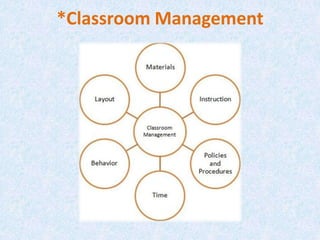
*Classroom Management
*Balance of Whole Group, Small
Group, 1-1
*Matching Texts
to Readers
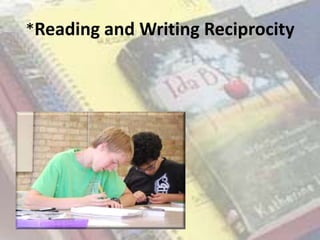
*Reading and Writing Reciprocity
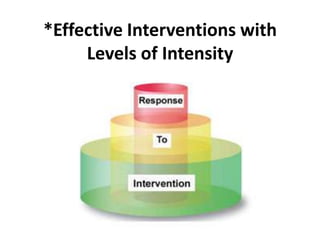
*Effective Interventions with
Levels of Intensity
(c) Frey & Fisher, 2008
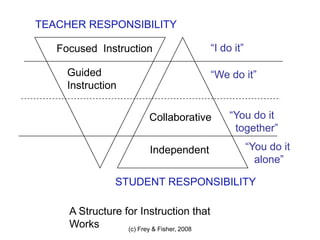
TEACHER RESPONSIBILITY
STUDENT RESPONSIBILITY
Focused Instruction
Guided
Instruction
“I do it”
“We do it”
“You do it
together”
Collaborative
Independent “You do it
alone”
A Structure for Instruction that
Works
(c) Frey & Fisher, 2008
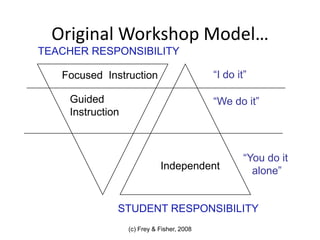
Original Workshop Model…
TEACHER RESPONSIBILITY
STUDENT RESPONSIBILITY
Guided
Instruction
“I do it”
“We do it”
Independent
“You do it
alone”
Focused Instruction
Learning Targets for Day 1
Teachers will…
• develop an understanding of classroom
workshop as a gradual release of responsibility
• understand how to create a collaborative
classroom environment that fosters a
community of learners
Workshop is Gradual
Release
Doug Fisher: GRR
Small Group
Activity
Review
Annotations
Answer Questions
What would you, as the teacher, be
doing in order to create an effective
ELA classroom that uses workshop?
What would you expect students to
be doing in an ELA classroom that
uses workshop?
Teacher Observation Activity
• Cut and paste questions provided
• Read the questions
• Observe the teacher in the lesson
• Record in your notebook
– Answers
– Thoughts
– New Questions
GRR: Focused Instruction Component
Purpose (Learning Target or Learning
Objective) and Modeling
Think Aloud
Demonstrations
Common Core State Standards
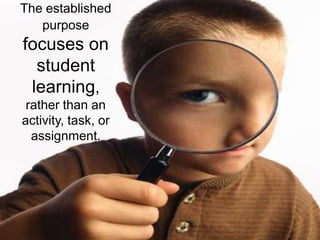
The established
purpose
focuses on
student
learning,
rather than an
activity, task, or
assignment.
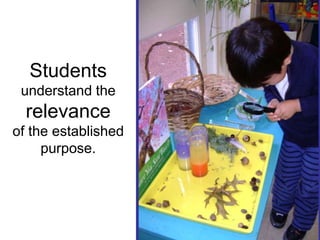
Students
understand the
relevance
of the established
purpose.
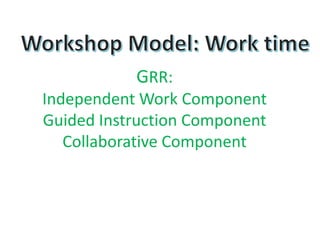
GRR:
Independent Work Component
Guided Instruction Component
Collaborative Component
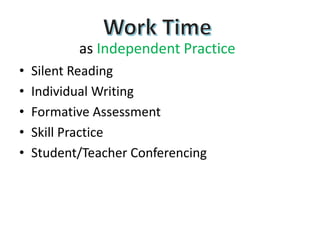
as Independent Practice
• Silent Reading
• Individual Writing
• Formative Assessment
• Skill Practice
• Student/Teacher Conferencing
No
“Shut Up”
sheets
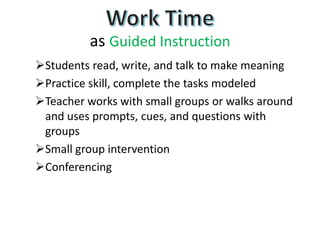
as Guided Instruction
Students read, write, and talk to make meaning
Practice skill, complete the tasks modeled
Teacher works with small groups or walks around
and uses prompts, cues, and questions with
groups
Small group intervention
Conferencing
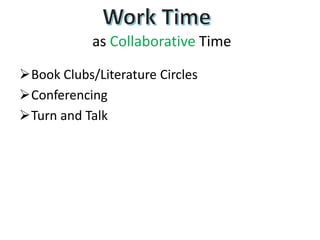
as Collaborative Time
Book Clubs/Literature Circles
Conferencing
Turn and Talk
• Closure
• Refer back to Learning Target
• Formative Assessment
• Share Out
• Learning Log
• Reflection
• Exit Ticket
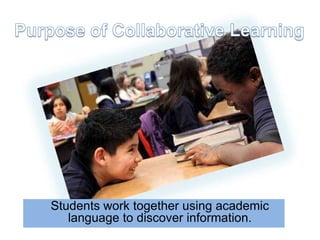
Students work together using academic
language to discover information.
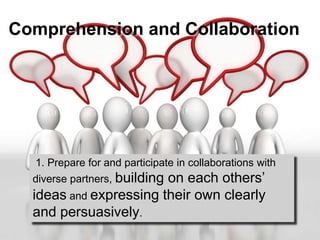
Comprehension and Collaboration
1. Prepare for and participate in collaborations with
diverse partners, building on each others’
ideas and expressing their own clearly
and persuasively.
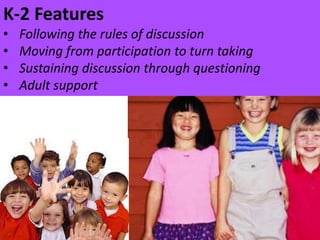
K-2 Features
• Following the rules of discussion
• Moving from participation to turn taking
• Sustaining discussion through questioning
• Adult support
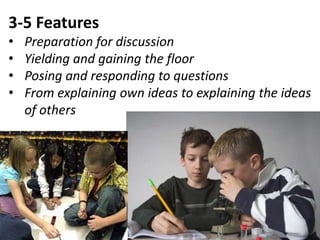
3-5 Features
• Preparation for discussion
• Yielding and gaining the floor
• Posing and responding to questions
• From explaining own ideas to explaining the ideas
of others
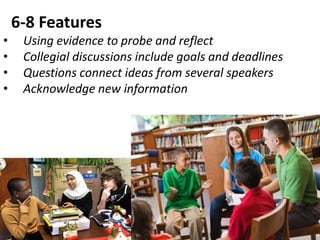
6-8 Features
• Using evidence to probe and reflect
• Collegial discussions include goals and deadlines
• Questions connect ideas from several speakers
• Acknowledge new information
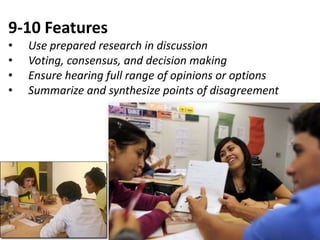
9-10 Features
• Use prepared research in discussion
• Voting, consensus, and decision making
• Ensure hearing full range of opinions or options
• Summarize and synthesize points of disagreement
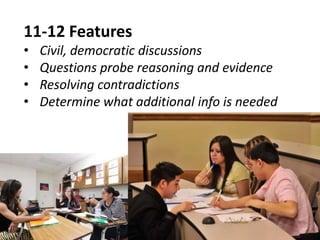
11-12 Features
• Civil, democratic discussions
• Questions probe reasoning and evidence
• Resolving contradictions
• Determine what additional info is needed
Talk occurs on
grade level
topics,
texts, and
issues.
How do we get there?
5 Essential Aspects of Classroom
Environment and Community:
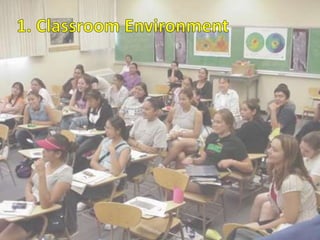
1. Classroom Environment (physical environment)
2. Community of Learners (social and emotional
environment)
3. Learning and Teaching (instructional
environment)
4. Independence (instructional environment)
5. Reflective Practice
Hill, B.C, and Ekey, C. Enriching Classroom Environments, 2010, pg. xiv
"I believe that classroom environments
are most effective when they are
literate and purposeful, organized and
accessible, and, most of all, authentic."
Debbie Miller, Teaching with
Intention, pg 23
"First impressions count. Classroom
environments vary, but they always
need to be welcoming places;
interesting, joyful places that beckon
kids and teachers to actively
participate in the pursuit of
knowledge.
Debbie Miller, Teaching with Intention, pg 30
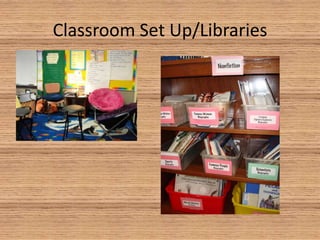
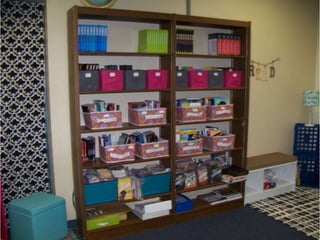
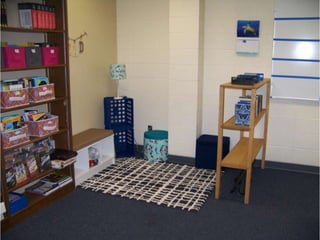
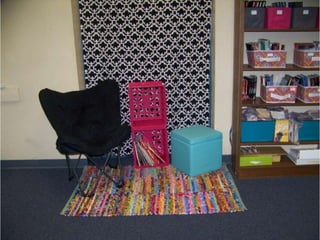
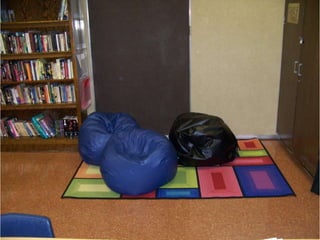
Classroom Set Up/Libraries
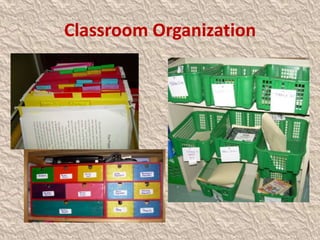
Classroom Organization
Needs, Wants, Wishes
What could your
classroom look
like?
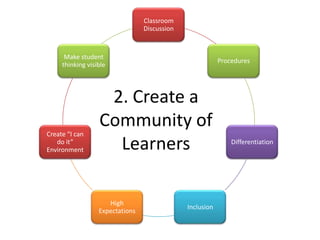
Classroom
Discussion
Procedures
Differentiation
Inclusion
High
Expectations
Create “I can
do it”
Environment
Make student
thinking visible
2. Create a
Community of
Learners
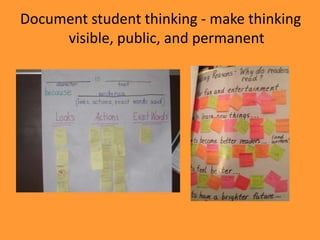
Document student thinking - make thinking
visible, public, and permanent
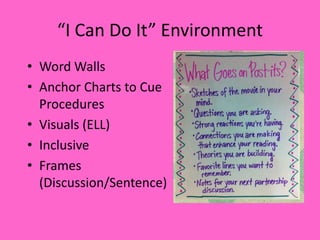
“I Can Do It” Environment
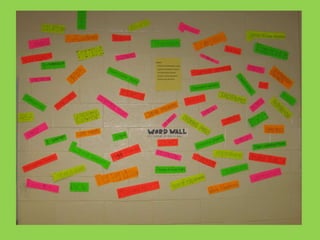
• Word Walls
• Anchor Charts to Cue
Procedures
• Visuals (ELL)
• Inclusive
• Frames
(Discussion/Sentence)
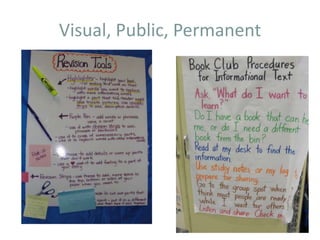
Visual, Public, Permanent
Teach Them!
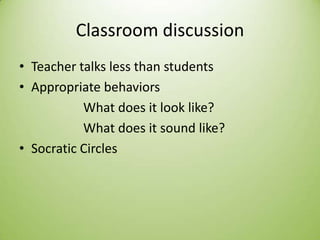
Classroom discussion
• Teacher talks less than students
• Appropriate behaviors
What does it look like?
What does it sound like?
• Socratic Circles
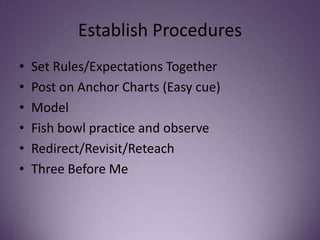
Establish Procedures
• Set Rules/Expectations Together
• Post on Anchor Charts (Easy cue)
• Model
• Fish bowl practice and observe
• Redirect/Revisit/Reteach
• Three Before Me
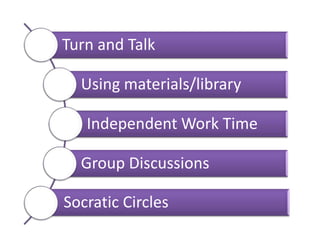
Turn and Talk
Using materials/library
Independent Work Time
Group Discussions
Socratic Circles
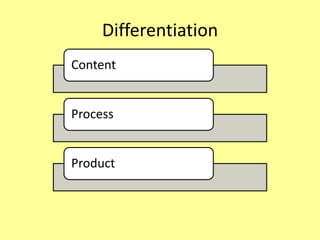
Differentiation
Content
Process
Product
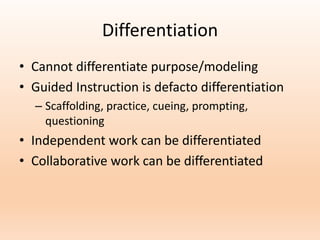
Differentiation
• Cannot differentiate purpose/modeling
• Guided Instruction is defacto differentiation
– Scaffolding, practice, cueing, prompting,
questioning
• Independent work can be differentiated
• Collaborative work can be differentiated
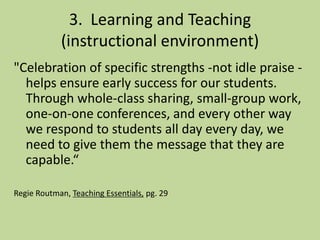
3. Learning and Teaching
(instructional environment)
"Celebration of specific strengths -not idle praise -
helps ensure early success for our students.
Through whole-class sharing, small-group work,
one-on-one conferences, and every other way
we respond to students all day every day, we
need to give them the message that they are
capable.“
Regie Routman, Teaching Essentials, pg. 29
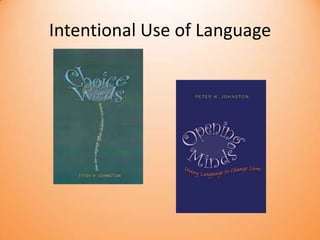
Intentional Use of Language
The way that we, as adults talk to children affects the
way that they view us, and the language that we use
to describe their actions can really affect the way
that they see themselves. Especially as
teachers…the things that are said to a student can be
interpreted differently through tone of voice…even
one word difference can change the meaning of a
whole sentence, therefore changing the way the
student takes the statement. This can mean the
difference between doubting themselves and their
competence and setting low future goals, to,
believing in themselves to choose challenging tasks
and set high goals.
Implications of Different Teacher
Responses to Social Transgression
Teacher Comment
Question Answered
by Comment
That group, get back
to work or you’ll be
staying in at lunch.
When you are loud
like that, it interferes
with the other
discussion groups and
I feel frustrated
This is not like you.
What is the problem
you have
encountered? Okay,
how can you solve it?
What are we doing
here?
Laboring. Living in cooperation. Living collaboratively.
Who are we? Slaves and owner. People who care
about others’ feelings.
Social problem
solvers. Normally
admirable people.
How do we relate to
one another?
Authoritarian control. Respectful with equal
rights.
Work out our
problems.
How do we relate to
what we are studying?
Do it only under
duress.
[no implication] [no implication]
~From Choice Words by Peter H. Johnston p. 6
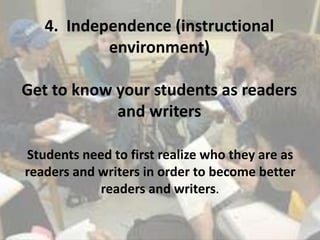
4. Independence (instructional
environment)
Get to know your students as readers
and writers
Students need to first realize who they are as
readers and writers in order to become better
readers and writers.
EXPLORE YOUR READING LIFE
JESSICA: A READERLY LIFE
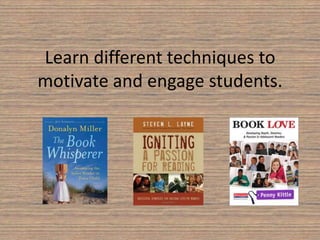
Learn different techniques to
motivate and engage students.
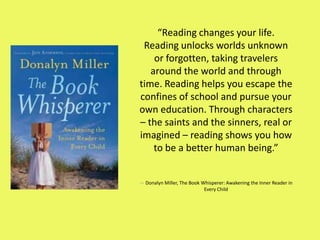
“Reading changes your life.
Reading unlocks worlds unknown
or forgotten, taking travelers
around the world and through
time. Reading helps you escape the
confines of school and pursue your
own education. Through characters
– the saints and the sinners, real or
imagined – reading shows you how
to be a better human being.”
― Donalyn Miller, The Book Whisperer: Awakening the Inner Reader in
Every Child
EXPLORING YOUR WRITING LIFE
Getting Started
• Check out our Livebinder
• Distribute Surveys
• Familiarize yourself with YA books
• Book Talk!
• Create a Shopping List/Goodreads Account
• Keep a Reading Record
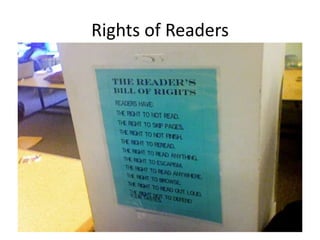
Rights of Readers
5. Reflective Practice
“Reflective teaching requires that teachers examine their values
and beliefs about teaching and learning…This practice frees
teachers from impulsive and routine activity and enables them
to act in a more deliberate and intentional manner. Experience
itself is actually not the greatest teacher, for we do not learn as
much from experience as we learn from reflecting on that
experience.”
Goal Setting
Working with Your Coaches
5. Reflective Practice: Think about your
classroom
• What do you need?
• What do you want?
• What do you wish?
• What are 2-3 small improvements you could make to
your current classroom environment?
6 12 day 1
6 12 day 1
6 12 day 1
6 12 day 1
6 12 day 1
6 12 day 1
6 12 day 1
6 12 day 1

6 12 day 1

  • 1.
  • 2.
    • Introductions • Name,Grade/Courses, Favorite Book • Dates/Sub requests etc. • Norms • Parking Lot • Agenda Why? GRR/Workshop Instructional Model Classroom Environment Collaboration Reflection
  • 4.
    (curriculum, instruction, and assessment)is: -Engaging and differentiated -Standards based -data driven -research and evidence based -Wisconsin RTI Center
  • 5.
    Curriculum, instruction, and assessmentthat are grounded in the culturally responsive practices of relevance, identity, belonging and community will serve to best engage all students. -Wisconsin RTI Center
  • 6.
    High expectations canhelp reduce delinquency and behavioral disturbances. ~Doug Fisher
  • 7.
    Research-Based Factors that InfluenceStudent Achievement ~Allington, R. (2005). Reading Today.
  • 8.
  • 9.
    *Balance of WholeGroup, Small Group, 1-1
  • 10.
  • 11.
  • 12.
  • 14.
    (c) Frey &Fisher, 2008 TEACHER RESPONSIBILITY STUDENT RESPONSIBILITY Focused Instruction Guided Instruction “I do it” “We do it” “You do it together” Collaborative Independent “You do it alone” A Structure for Instruction that Works
  • 15.
    (c) Frey &Fisher, 2008 Original Workshop Model… TEACHER RESPONSIBILITY STUDENT RESPONSIBILITY Guided Instruction “I do it” “We do it” Independent “You do it alone” Focused Instruction
  • 16.
    Learning Targets forDay 1 Teachers will… • develop an understanding of classroom workshop as a gradual release of responsibility • understand how to create a collaborative classroom environment that fosters a community of learners
  • 17.
  • 19.
  • 20.
    What would you,as the teacher, be doing in order to create an effective ELA classroom that uses workshop? What would you expect students to be doing in an ELA classroom that uses workshop?
  • 21.
    Teacher Observation Activity •Cut and paste questions provided • Read the questions • Observe the teacher in the lesson • Record in your notebook – Answers – Thoughts – New Questions
  • 23.
    GRR: Focused InstructionComponent Purpose (Learning Target or Learning Objective) and Modeling Think Aloud Demonstrations Common Core State Standards
  • 24.
  • 25.
  • 29.
    GRR: Independent Work Component GuidedInstruction Component Collaborative Component
  • 30.
    as Independent Practice •Silent Reading • Individual Writing • Formative Assessment • Skill Practice • Student/Teacher Conferencing
  • 31.
  • 32.
    as Guided Instruction Studentsread, write, and talk to make meaning Practice skill, complete the tasks modeled Teacher works with small groups or walks around and uses prompts, cues, and questions with groups Small group intervention Conferencing
  • 33.
    as Collaborative Time BookClubs/Literature Circles Conferencing Turn and Talk
  • 34.
    • Closure • Referback to Learning Target • Formative Assessment • Share Out • Learning Log • Reflection • Exit Ticket
  • 36.
    Students work togetherusing academic language to discover information.
  • 37.
    Comprehension and Collaboration 1.Prepare for and participate in collaborations with diverse partners, building on each others’ ideas and expressing their own clearly and persuasively.
  • 38.
    K-2 Features • Followingthe rules of discussion • Moving from participation to turn taking • Sustaining discussion through questioning • Adult support
  • 39.
    3-5 Features • Preparationfor discussion • Yielding and gaining the floor • Posing and responding to questions • From explaining own ideas to explaining the ideas of others
  • 40.
    6-8 Features • Usingevidence to probe and reflect • Collegial discussions include goals and deadlines • Questions connect ideas from several speakers • Acknowledge new information
  • 41.
    9-10 Features • Useprepared research in discussion • Voting, consensus, and decision making • Ensure hearing full range of opinions or options • Summarize and synthesize points of disagreement
  • 42.
    11-12 Features • Civil,democratic discussions • Questions probe reasoning and evidence • Resolving contradictions • Determine what additional info is needed
  • 43.
    Talk occurs on gradelevel topics, texts, and issues.
  • 44.
    How do weget there?
  • 45.
    5 Essential Aspectsof Classroom Environment and Community: 1. Classroom Environment (physical environment) 2. Community of Learners (social and emotional environment) 3. Learning and Teaching (instructional environment) 4. Independence (instructional environment) 5. Reflective Practice Hill, B.C, and Ekey, C. Enriching Classroom Environments, 2010, pg. xiv
  • 47.
    "I believe thatclassroom environments are most effective when they are literate and purposeful, organized and accessible, and, most of all, authentic." Debbie Miller, Teaching with Intention, pg 23
  • 48.
    "First impressions count.Classroom environments vary, but they always need to be welcoming places; interesting, joyful places that beckon kids and teachers to actively participate in the pursuit of knowledge. Debbie Miller, Teaching with Intention, pg 30
  • 49.
  • 50.
  • 51.
  • 52.
  • 53.
    Classroom Discussion Procedures Differentiation Inclusion High Expectations Create “I can doit” Environment Make student thinking visible 2. Create a Community of Learners
  • 54.
    Document student thinking- make thinking visible, public, and permanent
  • 55.
    “I Can DoIt” Environment • Word Walls • Anchor Charts to Cue Procedures • Visuals (ELL) • Inclusive • Frames (Discussion/Sentence)
  • 57.
  • 58.
  • 59.
    Classroom discussion • Teachertalks less than students • Appropriate behaviors What does it look like? What does it sound like? • Socratic Circles
  • 60.
    Establish Procedures • SetRules/Expectations Together • Post on Anchor Charts (Easy cue) • Model • Fish bowl practice and observe • Redirect/Revisit/Reteach • Three Before Me
  • 61.
    Turn and Talk Usingmaterials/library Independent Work Time Group Discussions Socratic Circles
  • 62.
  • 63.
    Differentiation • Cannot differentiatepurpose/modeling • Guided Instruction is defacto differentiation – Scaffolding, practice, cueing, prompting, questioning • Independent work can be differentiated • Collaborative work can be differentiated
  • 64.
    3. Learning andTeaching (instructional environment) "Celebration of specific strengths -not idle praise - helps ensure early success for our students. Through whole-class sharing, small-group work, one-on-one conferences, and every other way we respond to students all day every day, we need to give them the message that they are capable.“ Regie Routman, Teaching Essentials, pg. 29
  • 65.
  • 66.
    The way thatwe, as adults talk to children affects the way that they view us, and the language that we use to describe their actions can really affect the way that they see themselves. Especially as teachers…the things that are said to a student can be interpreted differently through tone of voice…even one word difference can change the meaning of a whole sentence, therefore changing the way the student takes the statement. This can mean the difference between doubting themselves and their competence and setting low future goals, to, believing in themselves to choose challenging tasks and set high goals.
  • 67.
    Implications of DifferentTeacher Responses to Social Transgression
  • 68.
    Teacher Comment Question Answered byComment That group, get back to work or you’ll be staying in at lunch. When you are loud like that, it interferes with the other discussion groups and I feel frustrated This is not like you. What is the problem you have encountered? Okay, how can you solve it? What are we doing here? Laboring. Living in cooperation. Living collaboratively. Who are we? Slaves and owner. People who care about others’ feelings. Social problem solvers. Normally admirable people. How do we relate to one another? Authoritarian control. Respectful with equal rights. Work out our problems. How do we relate to what we are studying? Do it only under duress. [no implication] [no implication] ~From Choice Words by Peter H. Johnston p. 6
  • 69.
    4. Independence (instructional environment) Getto know your students as readers and writers Students need to first realize who they are as readers and writers in order to become better readers and writers.
  • 70.
  • 71.
  • 73.
    Learn different techniquesto motivate and engage students.
  • 74.
    “Reading changes yourlife. Reading unlocks worlds unknown or forgotten, taking travelers around the world and through time. Reading helps you escape the confines of school and pursue your own education. Through characters – the saints and the sinners, real or imagined – reading shows you how to be a better human being.” ― Donalyn Miller, The Book Whisperer: Awakening the Inner Reader in Every Child
  • 75.
  • 76.
    Getting Started • Checkout our Livebinder • Distribute Surveys • Familiarize yourself with YA books • Book Talk! • Create a Shopping List/Goodreads Account • Keep a Reading Record
  • 77.
  • 78.
    5. Reflective Practice “Reflectiveteaching requires that teachers examine their values and beliefs about teaching and learning…This practice frees teachers from impulsive and routine activity and enables them to act in a more deliberate and intentional manner. Experience itself is actually not the greatest teacher, for we do not learn as much from experience as we learn from reflecting on that experience.”
  • 79.
  • 80.
    5. Reflective Practice:Think about your classroom • What do you need? • What do you want? • What do you wish? • What are 2-3 small improvements you could make to your current classroom environment?

Editor's Notes

  • #3 Tell us about yourself. Let’s get to know each other a little better.
  • #4 Self Assessment (Increase/Decrease)QISL Rubric Areas 1, 2, & 3
  • #7 Why GRR/ Research behind
  • #9 Established routines and procedures
  • #10 GRrDifferentiated to meet students needs
  • #11 Close Reading, Independent Reading, Managed Choice
  • #12 Building Connections, Balance, Writing before and after reading, processing thinking as well as adding the discussion piece
  • #13 Michelle-Small group interventions within the classroom/ there will be some outside as well
  • #14 Best way to make this happen is to use workshop model within the classroom
  • #18 Guiding questions. Notes, thoughts,
  • #20 Poster paper with questions already written on them
  • #24 Standards Based Presentation/GANAGh
  • #30 Purposely not displaying these in order of the triangle Keeping it simple
  • #36 Collaborative
  • #39 CCSS emphasis--Spirals
  • #52 Notebook: What did you see? Ideas? One thing you could change or add to your classroom tomorrow?
  • #54 Establish Routines, Safe and comfortable
  • #56 SWD
  • #65 Specific praise versus judgmental praise Connect it to Shelly’s feedback (One Teacher At A Time: Pollak) GANAG “You did…… that will help you when you’re reading” “ You helped yourself by checking the chart” model this with a situation Levels of Feedback – recall from math training….
  • #66 The way that we, as adults talk to children affects the way that they view us, and the language that we use to describe their actions can really affect the way that they see themselves.  Especially as teachers.  As I have learned through personal experience, the things that are said to a student can be interpreted differently through tone of voice.  But as Johnston describes throughout the book, even one word difference can change the meaning of a whole sentence, therefore changing the way the student takes the statement.  This can mean the difference between doubting themselves and their competence and setting low future goals, to, believing in themselves to choose challenging tasks and set high goals.
  • #79 It is much easier for us to complain about how bad something is (venting). This is not reflective practice. Reflection is acting on our own behaviors: inside and out of the classroom. Reflective teachers make a point of becoming aware of the factors that affect their practice so they can refine their teaching, and thereby positively influence our educational system we work in.BE A LIFELONG LEARNER….Characteristics of a person you know who is a LLL….BUZZ with descriptors for this person!
  • #88 Send off with a short excerpt “Where Do I Start” from That Workshop Book