Jennifer Evans
Assistant Director ELA
St. Clair County RESA
Evans.jennifer@sccresa.org
http://www.protopage.com/evans.jennifer
Formative
Assessment
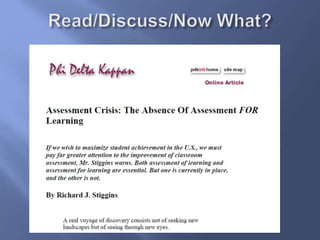
Article/Video
Study
Vocabulary Daily 5?
Are we all naturally inquisitive?
Do we continue as we enter elementary, middle,
and high school?
If so – why? If not - why not?
•What is Formative
Assessment?
•What is needed to support
formative assessment
practices in the Common
Core State Standards?
•What are formative
assessment classroom
strategies in vocabulary?
•What are our next steps?
Learning
Objectives:
 https://www.youtube.com/watch?v=89frRi8
GgGA (3 min. Brian Regan UPS video)
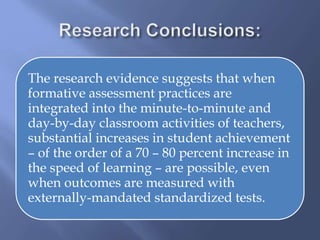
The research evidence suggests that when
formative assessment practices are
integrated into the minute-to-minute and
day-by-day classroom activities of teachers,
substantial increases in student achievement
– of the order of a 70 – 80 percent increase in
the speed of learning – are possible, even
when outcomes are measured with
externally-mandated standardized tests.
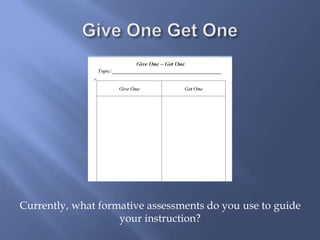
Currently, what formative assessments do you use to guide
your instruction?
Although formative assessment and interim
assessments could peacefully coexist with each
serving its respective purpose, in the current
NCLB context, the risk is great that interim
assessments will prevent implementation of real
formative assessment. Interim assessments are
easier to install than classroom-based formative
assessment practices. More significantly, when
labeled as formative assessment, purchasing
interim assessment data systems diverts
attention and resources that might otherwise be
directed toward professional development
needed to implement formative assessment
reforms.
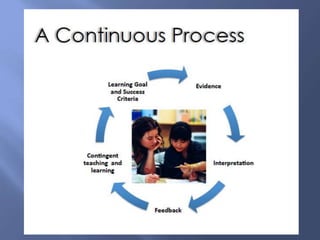
Formative assessment is defined as assessment carried out
during the instructional process for the purpose of improving
teaching or learning (Shepard, Hammerness, Darling-
Hammond, & Rust, 2005).
Similarly, OECD authors (2005) said that “Formative
assessment refers to frequent, interactive assessments of
student progress and understanding to identify learning
needs and adjust teaching appropriately”
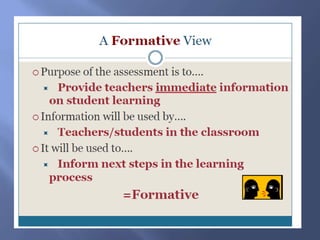
What makes formative assessment formative is that it is
immediately used to make adjustments so as to form new
learning.
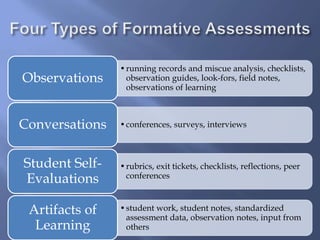
•running records and miscue analysis, checklists,
observation guides, look-fors, field notes,
observations of learning
Observations
•conferences, surveys, interviewsConversations
•rubrics, exit tickets, checklists, reflections, peer
conferences
Student Self-
Evaluations
•student work, student notes, standardized
assessment data, observation notes, input from
others
Artifacts of
Learning
 http://www.journeytoexcellence.org.uk/video
s/expertspeakers/formativeassessmentdylanw
iliam.asp
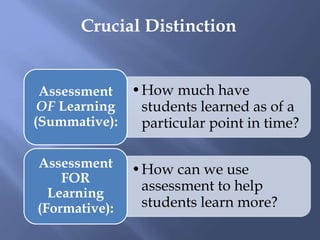
•How much have
students learned as of a
particular point in time?
Assessment
OF Learning
(Summative):
•How can we use
assessment to help
students learn more?
Assessment
FOR
Learning
(Formative):
Crucial Distinction
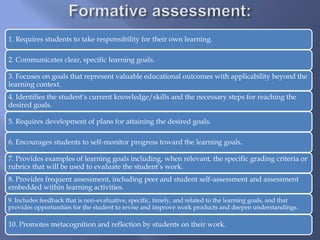
1. Requires students to take responsibility for their own learning.
2. Communicates clear, specific learning goals.
3. Focuses on goals that represent valuable educational outcomes with applicability beyond the
learning context.
4. Identifies the student’s current knowledge/skills and the necessary steps for reaching the
desired goals.
5. Requires development of plans for attaining the desired goals.
6. Encourages students to self-monitor progress toward the learning goals.
7. Provides examples of learning goals including, when relevant, the specific grading criteria or
rubrics that will be used to evaluate the student’s work.
8. Provides frequent assessment, including peer and student self-assessment and assessment
embedded within learning activities.
9. Includes feedback that is non-evaluative, specific, timely, and related to the learning goals, and that
provides opportunities for the student to revise and improve work products and deepen understandings.
10. Promotes metacognition and reflection by students on their work.
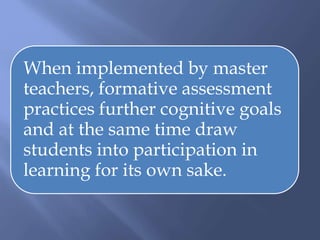
When implemented by master
teachers, formative assessment
practices further cognitive goals
and at the same time draw
students into participation in
learning for its own sake.
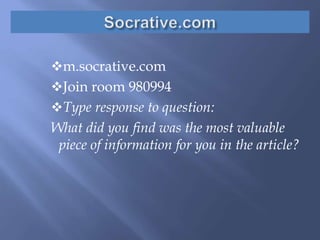
m.socrative.com
Join room 980994
Type response to question:
What did you find was the most valuable
piece of information for you in the article?
Introduction to
http://letsgeddit.com/
for formative
assessment
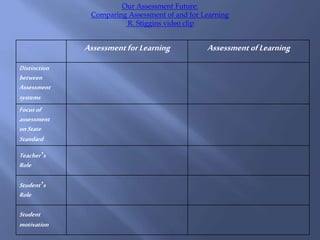
Our Assessment Future:
Comparing Assessment of and for Learning
R. Stiggins video clip
AssessmentforLearning AssessmentofLearning
Distinction
between
Assessment
systems
Focus of
assessment
onState
Standard
Teacher’s
Role
Student’s
Role
Student
motivation
 https://www.youtube.com/watch?v=dxAXJE
K--qk (2:57 – how she uses assessment in her classroom)
Table Discussion:
 As a table, discuss the big ideas about formative
assessment practices based on your notes from the
website, article and video clip(s).
 Choose one big idea about formative assessment
practices that is a need of yours, your grade level or
building to share with the whole group.
Whole Group Sharing:
Classroom practices must get
students on academic
“winning streaks” and keep
them there.
Six specific strategies applied
in this order can help with this:
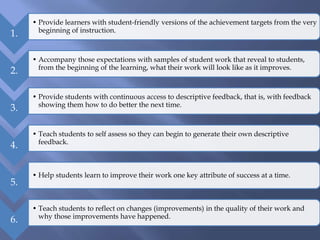
1.
• Provide learners with student-friendly versions of the achievement targets from the very
beginning of instruction.
2.
• Accompany those expectations with samples of student work that reveal to students,
from the beginning of the learning, what their work will look like as it improves.
3.
• Provide students with continuous access to descriptive feedback, that is, with feedback
showing them how to do better the next time.
4.
• Teach students to self assess so they can begin to generate their own descriptive
feedback.
5.
• Help students learn to improve their work one key attribute of success at a time.
6.
• Teach students to reflect on changes (improvements) in the quality of their work and
why those improvements have happened.
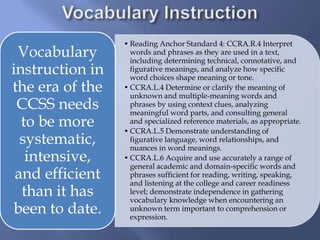
• Reading Anchor Standard 4: CCRA.R.4 Interpret
words and phrases as they are used in a text,
including determining technical, connotative, and
figurative meanings, and analyze how specific
word choices shape meaning or tone.
• CCRA.L.4 Determine or clarify the meaning of
unknown and multiple-meaning words and
phrases by using context clues, analyzing
meaningful word parts, and consulting general
and specialized reference materials, as appropriate.
• CCRA.L.5 Demonstrate understanding of
figurative language, word relationships, and
nuances in word meanings.
• CCRA.L.6 Acquire and use accurately a range of
general academic and domain-specific words and
phrases sufficient for reading, writing, speaking,
and listening at the college and career readiness
level; demonstrate independence in gathering
vocabulary knowledge when encountering an
unknown term important to comprehension or
expression.
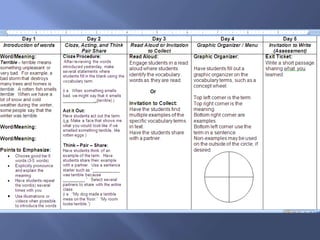
Vocabulary
instruction in
the era of the
CCSS needs
to be more
systematic,
intensive,
and efficient
than it has
been to date.
Effective research-based
techniques that can be used
with all texts, but especially
the complex texts called for by
the CCSS (Marzano/Archer –
Explicit Instruction)
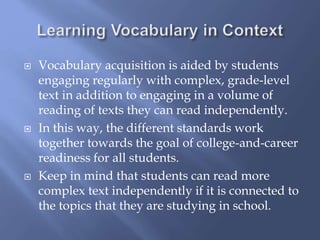
 Vocabulary acquisition is aided by students
engaging regularly with complex, grade-level
text in addition to engaging in a volume of
reading of texts they can read independently.
 In this way, the different standards work
together towards the goal of college-and-career
readiness for all students.
 Keep in mind that students can read more
complex text independently if it is connected to
the topics that they are studying in school.
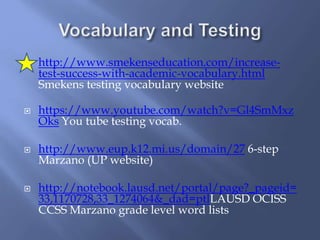
 http://www.smekenseducation.com/increase-
test-success-with-academic-vocabulary.html
Smekens testing vocabulary website
 https://www.youtube.com/watch?v=Gl4SmMxz
Oks You tube testing vocab.
 http://www.eup.k12.mi.us/domain/27 6-step
Marzano (UP website)
 http://notebook.lausd.net/portal/page?_pageid=
33,1170728,33_1274064&_dad=ptlLAUSD OCISS
CCSS Marzano grade level word lists
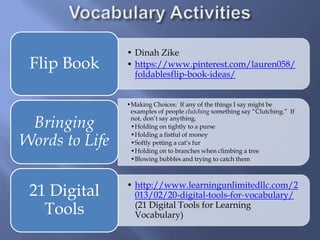
• Dinah Zike
• https://www.pinterest.com/lauren058/
foldablesflip-book-ideas/
Flip Book
•Making Choices: If any of the things I say might be
examples of people clutching something say “Clutching.” If
not, don’t say anything.
•Holding on tightly to a purse
•Holding a fistful of money
•Softly petting a cat’s fur
•Holding on to branches when climbing a tree
•Blowing bubbles and trying to catch them
Bringing
Words to Life
• http://www.learningunlimitedllc.com/2
013/02/20-digital-tools-for-vocabulary/
(21 Digital Tools for Learning
Vocabulary)
21 Digital
Tools
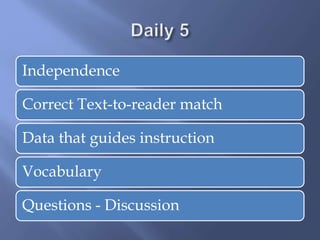
Independence
Correct Text-to-reader match
Data that guides instruction
Vocabulary
Questions - Discussion
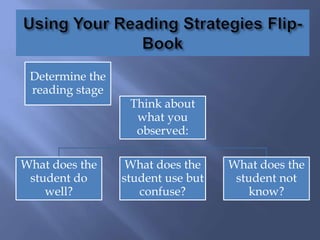
Determine the
reading stage
Think about
what you
observed:
What does the
student do
well?
What does the
student use but
confuse?
What does the
student not
know?
 https://www.youtube.com/watch?v=qEd-
mZsCVg8&list=PLFC2DC18916C8664E&index=10
 What stage of reading development?
 What behavior did you observe?
 What would you say?
 What instructional decisions would you make?
 1:23
What stage?
What did you observe?
What would you say?
What instructional decisions would
you make?1:40
Big Things
What stage?
What did you observe?
What would you say?
What instructional decisions would
you make?:46
I Like Food
What stage?
What did you observe?
What would you say?
What instructional decisions would
you make?2:10
What’s Up
What stage?
What did you observe?
What would you say?
What instructional decisions would
you make?1:40
I Caught A Fish
What stage?
What did you observe?
What would you say?
What instructional decisions would
you make?:40
Abby K.
What stage?
What did you observe?
What would you say?
What instructional decisions would
you make?3:39
Little Red Hen
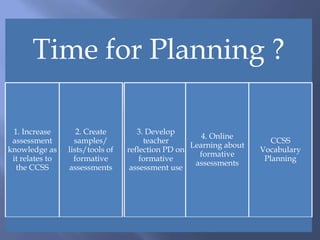
Time for Planning ?
1. Increase
assessment
knowledge as
it relates to
the CCSS
2. Create
samples/
lists/tools of
formative
assessments
3. Develop
teacher
reflection PD on
formative
assessment use
4. Online
Learning about
formative
assessments
CCSS
Vocabulary
Planning

K 2 formative assessments march 11

  • 1.
    Jennifer Evans Assistant DirectorELA St. Clair County RESA Evans.jennifer@sccresa.org http://www.protopage.com/evans.jennifer
  • 2.
  • 3.
    Are we allnaturally inquisitive? Do we continue as we enter elementary, middle, and high school? If so – why? If not - why not?
  • 4.
    •What is Formative Assessment? •Whatis needed to support formative assessment practices in the Common Core State Standards? •What are formative assessment classroom strategies in vocabulary? •What are our next steps? Learning Objectives:
  • 5.
  • 6.
    The research evidencesuggests that when formative assessment practices are integrated into the minute-to-minute and day-by-day classroom activities of teachers, substantial increases in student achievement – of the order of a 70 – 80 percent increase in the speed of learning – are possible, even when outcomes are measured with externally-mandated standardized tests.
  • 7.
    Currently, what formativeassessments do you use to guide your instruction?
  • 9.
    Although formative assessmentand interim assessments could peacefully coexist with each serving its respective purpose, in the current NCLB context, the risk is great that interim assessments will prevent implementation of real formative assessment. Interim assessments are easier to install than classroom-based formative assessment practices. More significantly, when labeled as formative assessment, purchasing interim assessment data systems diverts attention and resources that might otherwise be directed toward professional development needed to implement formative assessment reforms.
  • 12.
    Formative assessment isdefined as assessment carried out during the instructional process for the purpose of improving teaching or learning (Shepard, Hammerness, Darling- Hammond, & Rust, 2005). Similarly, OECD authors (2005) said that “Formative assessment refers to frequent, interactive assessments of student progress and understanding to identify learning needs and adjust teaching appropriately” What makes formative assessment formative is that it is immediately used to make adjustments so as to form new learning.
  • 13.
    •running records andmiscue analysis, checklists, observation guides, look-fors, field notes, observations of learning Observations •conferences, surveys, interviewsConversations •rubrics, exit tickets, checklists, reflections, peer conferences Student Self- Evaluations •student work, student notes, standardized assessment data, observation notes, input from others Artifacts of Learning
  • 14.
  • 15.
    •How much have studentslearned as of a particular point in time? Assessment OF Learning (Summative): •How can we use assessment to help students learn more? Assessment FOR Learning (Formative): Crucial Distinction
  • 20.
    1. Requires studentsto take responsibility for their own learning. 2. Communicates clear, specific learning goals. 3. Focuses on goals that represent valuable educational outcomes with applicability beyond the learning context. 4. Identifies the student’s current knowledge/skills and the necessary steps for reaching the desired goals. 5. Requires development of plans for attaining the desired goals. 6. Encourages students to self-monitor progress toward the learning goals. 7. Provides examples of learning goals including, when relevant, the specific grading criteria or rubrics that will be used to evaluate the student’s work. 8. Provides frequent assessment, including peer and student self-assessment and assessment embedded within learning activities. 9. Includes feedback that is non-evaluative, specific, timely, and related to the learning goals, and that provides opportunities for the student to revise and improve work products and deepen understandings. 10. Promotes metacognition and reflection by students on their work.
  • 21.
    When implemented bymaster teachers, formative assessment practices further cognitive goals and at the same time draw students into participation in learning for its own sake.
  • 23.
    m.socrative.com Join room 980994 Typeresponse to question: What did you find was the most valuable piece of information for you in the article?
  • 24.
  • 25.
    Our Assessment Future: ComparingAssessment of and for Learning R. Stiggins video clip AssessmentforLearning AssessmentofLearning Distinction between Assessment systems Focus of assessment onState Standard Teacher’s Role Student’s Role Student motivation
  • 26.
     https://www.youtube.com/watch?v=dxAXJE K--qk (2:57– how she uses assessment in her classroom)
  • 29.
    Table Discussion:  Asa table, discuss the big ideas about formative assessment practices based on your notes from the website, article and video clip(s).  Choose one big idea about formative assessment practices that is a need of yours, your grade level or building to share with the whole group. Whole Group Sharing:
  • 30.
    Classroom practices mustget students on academic “winning streaks” and keep them there. Six specific strategies applied in this order can help with this:
  • 31.
    1. • Provide learnerswith student-friendly versions of the achievement targets from the very beginning of instruction. 2. • Accompany those expectations with samples of student work that reveal to students, from the beginning of the learning, what their work will look like as it improves. 3. • Provide students with continuous access to descriptive feedback, that is, with feedback showing them how to do better the next time. 4. • Teach students to self assess so they can begin to generate their own descriptive feedback. 5. • Help students learn to improve their work one key attribute of success at a time. 6. • Teach students to reflect on changes (improvements) in the quality of their work and why those improvements have happened.
  • 34.
    • Reading AnchorStandard 4: CCRA.R.4 Interpret words and phrases as they are used in a text, including determining technical, connotative, and figurative meanings, and analyze how specific word choices shape meaning or tone. • CCRA.L.4 Determine or clarify the meaning of unknown and multiple-meaning words and phrases by using context clues, analyzing meaningful word parts, and consulting general and specialized reference materials, as appropriate. • CCRA.L.5 Demonstrate understanding of figurative language, word relationships, and nuances in word meanings. • CCRA.L.6 Acquire and use accurately a range of general academic and domain-specific words and phrases sufficient for reading, writing, speaking, and listening at the college and career readiness level; demonstrate independence in gathering vocabulary knowledge when encountering an unknown term important to comprehension or expression. Vocabulary instruction in the era of the CCSS needs to be more systematic, intensive, and efficient than it has been to date.
  • 35.
    Effective research-based techniques thatcan be used with all texts, but especially the complex texts called for by the CCSS (Marzano/Archer – Explicit Instruction)
  • 38.
     Vocabulary acquisitionis aided by students engaging regularly with complex, grade-level text in addition to engaging in a volume of reading of texts they can read independently.  In this way, the different standards work together towards the goal of college-and-career readiness for all students.  Keep in mind that students can read more complex text independently if it is connected to the topics that they are studying in school.
  • 39.
     http://www.smekenseducation.com/increase- test-success-with-academic-vocabulary.html Smekens testingvocabulary website  https://www.youtube.com/watch?v=Gl4SmMxz Oks You tube testing vocab.  http://www.eup.k12.mi.us/domain/27 6-step Marzano (UP website)  http://notebook.lausd.net/portal/page?_pageid= 33,1170728,33_1274064&_dad=ptlLAUSD OCISS CCSS Marzano grade level word lists
  • 43.
    • Dinah Zike •https://www.pinterest.com/lauren058/ foldablesflip-book-ideas/ Flip Book •Making Choices: If any of the things I say might be examples of people clutching something say “Clutching.” If not, don’t say anything. •Holding on tightly to a purse •Holding a fistful of money •Softly petting a cat’s fur •Holding on to branches when climbing a tree •Blowing bubbles and trying to catch them Bringing Words to Life • http://www.learningunlimitedllc.com/2 013/02/20-digital-tools-for-vocabulary/ (21 Digital Tools for Learning Vocabulary) 21 Digital Tools
  • 45.
    Independence Correct Text-to-reader match Datathat guides instruction Vocabulary Questions - Discussion
  • 49.
    Determine the reading stage Thinkabout what you observed: What does the student do well? What does the student use but confuse? What does the student not know?
  • 50.
     https://www.youtube.com/watch?v=qEd- mZsCVg8&list=PLFC2DC18916C8664E&index=10  Whatstage of reading development?  What behavior did you observe?  What would you say?  What instructional decisions would you make?  1:23
  • 51.
    What stage? What didyou observe? What would you say? What instructional decisions would you make?1:40 Big Things
  • 52.
    What stage? What didyou observe? What would you say? What instructional decisions would you make?:46 I Like Food
  • 53.
    What stage? What didyou observe? What would you say? What instructional decisions would you make?2:10 What’s Up
  • 54.
    What stage? What didyou observe? What would you say? What instructional decisions would you make?1:40 I Caught A Fish
  • 55.
    What stage? What didyou observe? What would you say? What instructional decisions would you make?:40 Abby K.
  • 56.
    What stage? What didyou observe? What would you say? What instructional decisions would you make?3:39 Little Red Hen
  • 60.
    Time for Planning? 1. Increase assessment knowledge as it relates to the CCSS 2. Create samples/ lists/tools of formative assessments 3. Develop teacher reflection PD on formative assessment use 4. Online Learning about formative assessments CCSS Vocabulary Planning

Editor's Notes

  • #3 All pieces tied to CCSS
  • #4 Talk about arm movements: how she allowed the other girl to lead her to a place where she was yelled at by a stranger (so she wasn’t going to let her touch and lead her again – movement makes it very clear); how she wants to sit in “this seat” and will problem solve her way (with or without her friend) to do it; the proud moment when she accomplishes her goal- all without support from anyone. What happens to our children when to go from this leadership/natural problem solving to not wishing to speak aloud in class or share ideas for fear of it “being wrong” rather than going through the natural learning process – following my friend didn’t accomplish what I wanted and had a negative response, so I’m going to make my selection to accomplish what I want and see if I can learn and do it…etc.
  • #6 What formative assessments cold be used to help him? What vocabulary?
  • #7 Concluding statement from article: “From Teachers to Schools: Scaling Up Professional Development for Formative Assessment” p. 15 Their design work (Tight but Loose) framework, was guided by a number of principles which previous work had suggested were important in supporting teachers in the development of their practice of formative assessment in particular: choice (of what area of professional development teachers wished to focus on), flexibility (see chart p. 7) where 5 key strategies of formative assessment provides a focal point for a range of related aspects of practice for teachers. By anchoring the techniques to at least one of the five key strategies, we provided a means by which teachers could modify the techniques, but still provide a reasonable assurance of fidelity to the original research. Small steps (in order for changes in practice to occur, they must be integrated into a teacher’s existing routine, and this takes time), Support and accountability (can be achieved through PLC’s)
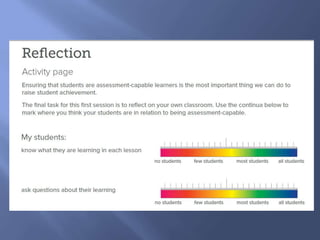
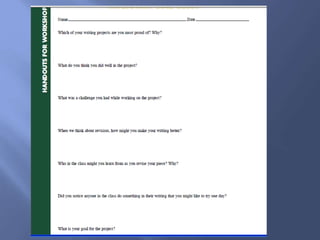
  • #9 Develop PD around this teacher reflection page…where will you go from here? Visible Learningplus Developing assessment-capable learners Workbook Content subject to copyright, photocopy with permission only
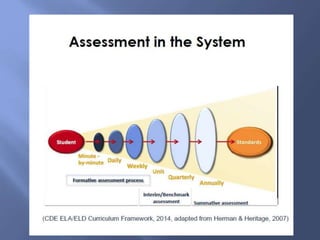
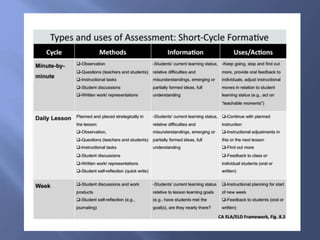
  • #10 Long-term cycle (NWEA; MEAP) ; Medium-term cycle (PLC formative assessments) Short-term cycle (minute-to-minute, day-to-day) – most effective
  • #11 From article: “Supporting Student Achievement of the Common Core State Standards Through Formative Assessment” by Margaret Heritage Sonoma County Office of Education – Santa Rosa, CA December 4, 2014
  • #12 From article: “Supporting Student Achievement of the Common Core State Standards Through Formative Assessment” by Margaret Heritage Sonoma County Office of Education – Santa Rosa, CA December 4, 2014
  • #14 These types of formative assessment fall into three types that contribute to the learning cycle: “On-the-fly” (those that happen during a lesson) “Planned-for-interaction” (those decided before instruction) “Curriculum-embedded” (embedded in the curriculum and used to gather data at significant points during the learning process) From article “NCTE Position Statement: Formative Assessment That Truly Informs Instruction” p. 3-5
  • #15 2 min. intro to formative assessment – Dylan Wiliam
  • #17 Review types of assessments Slide from Mi Assessment Conference
  • #18 Slide from Mi Assessment Conference
  • #19 Slide from Mi Assessment Conference
  • #20 From article: “Supporting Student Achievement of the Common Core State Standards Through Formative Assessment” by Margaret Heritage Sonoma County Office of Education – Santa Rosa, CA December 4, 2014
  • #21 Over 30 years of research suggest formative assessment is a vital curricular component, proven to be highly effective in increasing student learning (Black & Wiliam 1998). Cizek distilled this research, identifying 10 elements across the studies that researchers have noted as important features (Cizek 8). From article: “NCTE Position Statement: Formative Assessment That Truly Informs Instruction” p. 3
  • #23 Read p 4-6 starting with “A more powerful vision” and ending before “Relevant position statements” An Action Plan – Read article – annotate – 20 min. If we wish to maximize student achievement in the U.S., we must pay far greater attention to the improvement of classroom assessment. Both assessment of learning and assessment for learning are essential. One is in place; the other is not. Therefore, we must: * match every dollar invested in instruments and procedures intended for assessment of learning at national, state, and local levels with another dollar devoted to the development of assessment for learning; * launch a comprehensive, long-term professional development program at the national, state, and local levels to foster literacy in classroom assessment for teachers, allocating sufficient resources to provide them with the opportunity to learn and grow professionally; * launch a similar professional development program in effective large-scale and classroom assessment for state, district, and building administrators, teaching them how to provide leadership in this area of professional practice; * change teacher and administrator licensing standards in every state and in all national certification contexts to reflect an expectation of competence in assessment both of and for learning; and * require all teacher and administrator preparation programs to ensure that graduates are assessment literate -- in terms both of promoting and of documenting student learning.
  • #25 Click on the link and scroll down the main page at letsgeddit.com to show the intro. Video approx. 3 min.
  • #26 https://create.kahoot.it/#
  • #27 https://www.youtube.com/watch?v=EDVHuHyCGmg – Rick Stiggins: Assessment of and for learning 10:11 Fill out form as you watch the video – discuss – 10 min.
  • #30 From article: “Supporting Student Achievement of the Common Core State Standards Through Formative Assessment” by Margaret Heritage Sonoma County Office of Education – Santa Rosa, CA December 4, 2014
  • #31 From article: “Supporting Student Achievement of the Common Core State Standards Through Formative Assessment” by Margaret Heritage Sonoma County Office of Education – Santa Rosa, CA December 4, 2014
  • #32 30 min – use the information from this activity to work on in the afternoon Share out if time allows
  • #33 From article: “Assessing Students’ Affect Related to Assessment for Learning” by Rick Stiggins
  • #34 From article: “Assessing Students’ Affect Related to Assessment for Learning” by Rick Stiggins
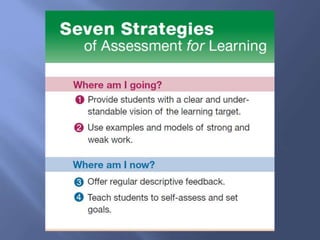
  • #35 Must follow this structure when teaching vocabulary Source:AdaptedwithpermissionfromR.Stiggins,J.Arter,J.Chappuis,andS.Chappuis,ClassroomAssessmentforStudentLearning:DoingItRight—UsingItWell (Portland,OR:PearsonAssessmentTrainingInstitute,2004),p.42. Great resource to start with – order book for staff “Seven Strategies of Assessment for Learning” by Jan Chappuis
  • #37 The Common Core State Standards (CCSS) place a premium on vocabulary in the reading, writing, and speaking and listening strands. Anchor reading standard 10 requires students to “read and comprehend complex literary and informational texts independently and proficiently” while reading standard 4 and language standards 4,5, and 6 all call for emphasis on vocabulary and word awareness at every grade level. We know that of the many features of complex text, difficult or uncommon vocabulary likely plays the largest role in causing student difficulty (Nelson et al 2012). We also know vocabulary is one of the primary causes of the achievement gap (Becker 1977, Baumann & Kameenui 1991, Stanovich 1986), and many students from low-income households enter school with smaller vocabularies than their more affluent peers (Hart and Risley 1995, Biemiller 2010).
  • #39  I combined Anita Archer’s Explicit Instruction with Marzano’s Six Step ProcessTeaching Academic Vocabulary : 1. Provide a description, explanation, or example of the new term. (Monday – Explicit Instruction) 2. Ask students to restate the description, explanation, or example in their own words. (Tuesday) 3. Ask students to construct a picture, symbol, or graphic representing the word. (Thursday) 4. Engage students periodically in activities that help them add to their knowledge of the terms in their notebooks. (Tuesday – Wednesday) 5. Periodically ask students to discuss the terms with one another. (Daily) 6. Involve students periodically in games that allow them to play with terms.(Tuesday – Friday)
  • #41 both methods—direct instruction and learning vocabulary in context—are necessary components of vocabulary instruction.
  • #42 http://www.smekenseducation.com/increase-test-success-with-academic-vocabulary.html - go to this site – show video; click on link “kid friendly terms” to show PP and blank template – use blank template for other CCSS vocab. instruction
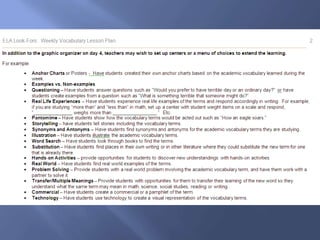
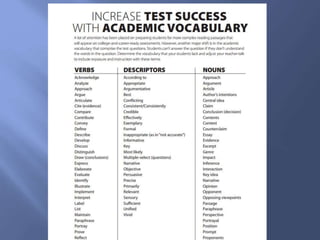
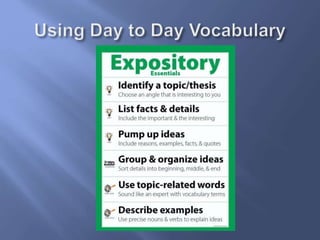
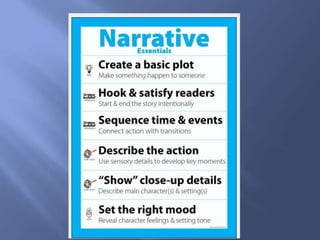
  • #44 Model how to pull specific vocab. from charts such as these and embed into daily vocab. instruction (ie. Angle, expert, precise,…)
  • #46 Share some other vocab. activities which could help students identify CCSS academic vocab. https://www.google.com/search?q=vocabulary+flip+book+template&espv=2&biw=1821&bih=902&tbm=isch&tbo=u&source=univ&sa=X&ei=Bnz_VM_XHMy7ggSlvoCgBg&ved=0CB0QsAQ&dpr=0.75 http://profehanson.weebly.com/templates-for-foldables.html http://www.southamptonschools.org/webpages/KPalumbo/foldables.cfm
  • #47 CCSS.ELA-LITERACY.L.1.6 Use words and phrases acquired through conversations, reading and being read to, and responding to texts, including using frequently occurring conjunctions to signal simple relationships (e.g., because).
  • #48 Show “Expanding Vocab.” from Daily 5 video file (Video_TS.IFO) How to confer with a student and expand his/her vocab.
  • #49 Time permitting – go into Daily 5/Café discussion and the importance of formative assessments to guide instruction. Teacher knowledge is key. If data/observation is not used to guide CCSS instruction – what/how are you instructing and meeting the CCSS? Many resources from a paid prescription to the Café website ($69/yr) or “Choice Literacy.com” ($99/yr)
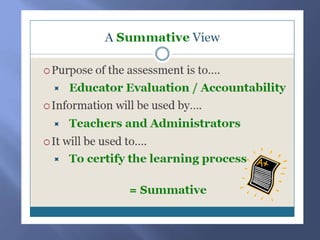
  • #50 Is this done? How long did it take? Who modeled? Was explicit instruction used? How does this work within the CCSS?
  • #51 Record keeping….
  • #52 How to you ensure correct text-to-reader match?
  • #53 Conferring is key in a reading/writing workshop. How do you do this? What types of records do you keep? How do you use the information from conferring to guide instruction?
  • #54 What would your teaching point for this student be? What area in the flip book would you look? What strategies could be suggested to move this student forward?
  • #55 Stage: Emergent – Child pays little attention to print in the world: Strategy: one-to-one matching; environmental print; work with names; read the room; etc. The ultimate goal of this workshop series is to provide teachers with the ability to make instructional decisions based on observations. To empower teachers to use data to guide instruction and to move all of their students to higher levels of literacy success.
  • #56 Emergent: a child does not recognize word units: Help the reader realize that print is made up of words that match speech (shared reading, writing, one-to-one matching, blending sounds into words and word parts)
  • #57 Emergent: using picture cues, doesn’t understand one-to-one correspondence, what would happen without the introduction? If a child does not recognize word units, then: one-to-one matching, writing, shared reading, blending sounds into words
  • #58 Early: a child reads words he knows but stops at every new or unfamiliar word: help child realize reading is not just reading words, help learn to use all three cueing systems – Doesn’t read all the way through ie. Nighttime was read as night Read “planes and bats and bugs…” when text said “bats, bugs, and airplanes”
  • #59 Early – longer text Uses and confuses one-to-one correspondence Pronunciation; caught – fish Bird –duck - relying on picture cues, prior knowledge Needs to use all of the cueing systems
  • #60 Transitional: (however, she doesn’t pay attention to ending punctuation – Early – and adds ending to words) A child reads quickly but inaccurately and with limited comprehension: help them read at a pace that supports comprehension- adjust and apply different rates to match text, cross check, Use phrasing, use punctuation,
  • #61 Early - “reads longer lines of text” Uses and confuses one-to-one correspondence until the format changes to a speech bubble, is not using initial sounds, uses picture cues If a child guesses at unknown words, using no graphic cues, then: help reader pay attention to the visual aspects of word identification while still using syntactic and semantic cues
  • #62 Formative assessment example for strategy instruction.
  • #63 Reflection – how do you help students to reflect on their work so they use metacognition to make appropriate choices while learning?
  • #64 Look at handout – lesson examples for each area of CAFÉ instruction (ie. Comprehension, accuracy, fluency, vocabulary)
  • #65 1. Increase Assessment Knowledge: http://www.michiganassessmentconsortium.org/sites/default/files/MAC%20AssessmentLiteracyStandardsFall2014.pdf (Teacher/Student Literacy standards) 2. Create Samples/tools: http://www.serve.org/uploads/publications/CAR.pdf (Competent Assessment in Reading PDF) https://nsformativeassessmentblog.files.wordpress.com/2014/05/60formativeassessment.pdf (Tools for Formative Assessment) http://www.isbe.net/common_core/pdf/da-form-asmt-chart.pdf (A Sampling of Formative Assessment) http://www.sde.idaho.gov/site/formativeInterim/docs/FormativeAssessmentTools.pdf (Formative Assessment Tools for 21 Century Learning) http://store.scholastic.com/content/stores/media/products/samples/21/9780545087421.pdf - 25 Quick Formative Assessments for a Differentiated Classroom http://wvde.state.wv.us/teach21/ExamplesofFormativeAssessment.html 3. Teacher PD – Reflection (handout) or refer to slide after give one get one activity – Incorporate 7 strategies of assessment for learning (handout) Solution Tree – Student Involvement-Assessment Worksheet (handout) 4. Online learning: http://www.ncte.org/library/NCTEFiles/Resources/Positions/formative-assessment_single.pdf http://ati.pearson.com/downloads/SevenStrategies_StudyGuide_web.pdf http://soltreemrls3.s3-website-us-west-2.amazonaws.com/solution-tree.com/media/pdf/study_guides/Study_Guide_EFA.pdf http://instructionalcoaching.com/resources/pdfs/HII_MM_FormativeAssessment.pdf https://drive.google.com/file/d/0B2_euqaCurPtMmR6TW1sSC1MUmM/view Free courses: http://www.pbs.org/teacherline/ Formative Assessment Links https://www.nwea.org/blog/2012/dylan-wiliam-the-5-formative-assessment-strategies-to-improve-student-learning/ (5 formative learning strategies) http://www.teachthought.com/teaching/10-assessments-you-can-perform-in-90-seconds/ http://larryferlazzo.edublogs.org/2010/08/22/the-best-resources-for-learning-about-formative-assessment/ https://www.nwea.org/blog/2013/22-easy-formative-assessment-techniques-for-measuring-student-learning/ http://digitalliteracy.us/formative/ http://readingyear.blogspot.com/2014/02/nctes-formative-assessment-that-truly.html https://www.teachingchannel.org/videos/student-daily-assessment https://www.teachingchannel.org/search?utf8=%E2%9C%93&q=formative+assessments&commit=Search http://readingrecovery.clemson.edu/index.php/reading/formative-assessment https://drive.google.com/file/d/0B2_euqaCurPtMmR6TW1sSC1MUmM/view (Supporting Student Achievement through Formative Assessment) http://www.montgomeryschoolsmd.org/departments/development/resources/video/ (staff development videos) http://www.naht.org.uk/welcome/news-and-media/key-topics/assessment/naht-assessment-framework-materials/ http://bswpservicelearningandinquiry.wikispaces.com/Teaching,+Discussion,+and+Formative+Assessment+Strategies http://www.learnnc.org/lp/pages/5212