Every Teacher is a Reading Teacher
It is Your Responsibility! You are not just a content area teacher… You are a teacher. If your kids can’t read, do not wait for someone else to fix the problem. You must be an advocate for the kids…no matter what subject you teach.
Two ways to support struggling readers… Effective Instruction of Comprehension  Vocabulary Strategies
Effective Comprehension  Instruction Think Alouds: Predict Note most important information in text Imagery Question Connect Clarify Summarize
Predictions What will happen next? What is the author trying to help me learn?
Imagery Can I see the characters, setting and action? Can I see images of cause effect or sequence? Can I see the process being described by the text? (water cycle, War of 1812, perimeter)
Questioning Does this new fact make sense? Why is the author talking about Huck Finn in this chapter on the Reconstruction period? Who, What, Where, When, Why and How?
Connecting Make a connection from what they are reading to prior knowledge and experience.
Connecting How is ________ like ___________? How is  the war in Iraq  like  the Revolutionary War? How is a  rectangle  like  a square ?
Clarifying When the information does not make sense, ask for clarification or reread. Do I have questions that can be answered if I reread the text? Read the sentence or paragraphs…Does it make sense? Can I recall what I just read?
Summarize Can I summarize the information that I just read?
Strategies to enhance comprehension  Teacher models the Think Aloud process. Continue process until students become proficient. Note taking while reading. Text mapping using graphic organizers. (Google graphic organizers) Partner read and discussion.
Comprehension…what it is and what it’s not. Comprehension is.. Becoming proficient in the Think Aloud process Becoming an actively engaged reader. Using metacognition by asking if I need more information in this area? Do I understand what I have just read? What have I learned? Comprehension is not… Just reading words of the text. Filling out worksheets!!! Students are not strategic in comprehension until they become active readers on their own. Our goal is to help create life long readers.
When students are taught effective  comprehension strategies they tend to want to read more.
Comprehension Information LARC  Literacy Achievement Research Center Zimmerman, S. & Hutches, C. (2003). 7 Keys to Comprehension: How to help kids read it and get it! New York. Three Rivers Press
Powerful influences in students vocabulary growth Reading, reading, reading!!!!!!! High interest reading materials. Wide variety of reading materials.
Effective Vocabulary Instruction Make learning words fun! Explain new vocabulary. Draw attention to distinctive features of written language. Encourage students to play with words to create interest and a desire to know more about words. Use an online thesaurus. Having students look up the word in the dictionary and write the definition is ineffective…instead… Have students draw pictures or use hand gestures to illustrate a new word or just talk about the word.
Effective Comprehension and Vocabulary Instruction…  Are essential for struggling readers. Should be intentional and purposeful. Must be taught in such a way so that all students have the opportunity to achieve academic success.
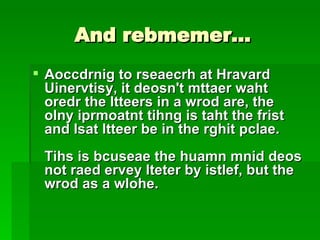
And rebmemer… Aoccdrnig to rseaecrh at Hravard Uinervtisy, it deosn't mttaer waht oredr the ltteers in a wrod are, the olny iprmoatnt tihng is taht the frist and lsat ltteer be in the rghit pclae.  Tihs is bcuseae the huamn mnid deos not raed ervey lteter by istlef, but the wrod as a wlohe.
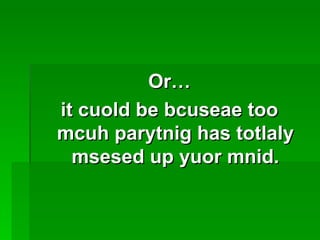
Or… it cuold be bcuseae too mcuh parytnig has totlaly msesed up yuor mnid.
Every Teacher is a Reading Teacher! Be a model for your kids…show them that reading is important. Bring literature into your content area…Remember those Anticipatory Sets!

Every Teacherisa Reading Teacher(Latest)

  • 1.
    Every Teacher isa Reading Teacher
  • 2.
    It is YourResponsibility! You are not just a content area teacher… You are a teacher. If your kids can’t read, do not wait for someone else to fix the problem. You must be an advocate for the kids…no matter what subject you teach.
  • 3.
    Two ways tosupport struggling readers… Effective Instruction of Comprehension Vocabulary Strategies
  • 4.
    Effective Comprehension Instruction Think Alouds: Predict Note most important information in text Imagery Question Connect Clarify Summarize
  • 5.
    Predictions What willhappen next? What is the author trying to help me learn?
  • 6.
    Imagery Can Isee the characters, setting and action? Can I see images of cause effect or sequence? Can I see the process being described by the text? (water cycle, War of 1812, perimeter)
  • 7.
    Questioning Does thisnew fact make sense? Why is the author talking about Huck Finn in this chapter on the Reconstruction period? Who, What, Where, When, Why and How?
  • 8.
    Connecting Make aconnection from what they are reading to prior knowledge and experience.
  • 9.
    Connecting How is________ like ___________? How is the war in Iraq like the Revolutionary War? How is a rectangle like a square ?
  • 10.
    Clarifying When theinformation does not make sense, ask for clarification or reread. Do I have questions that can be answered if I reread the text? Read the sentence or paragraphs…Does it make sense? Can I recall what I just read?
  • 11.
    Summarize Can Isummarize the information that I just read?
  • 12.
    Strategies to enhancecomprehension Teacher models the Think Aloud process. Continue process until students become proficient. Note taking while reading. Text mapping using graphic organizers. (Google graphic organizers) Partner read and discussion.
  • 13.
    Comprehension…what it isand what it’s not. Comprehension is.. Becoming proficient in the Think Aloud process Becoming an actively engaged reader. Using metacognition by asking if I need more information in this area? Do I understand what I have just read? What have I learned? Comprehension is not… Just reading words of the text. Filling out worksheets!!! Students are not strategic in comprehension until they become active readers on their own. Our goal is to help create life long readers.
  • 14.
    When students aretaught effective comprehension strategies they tend to want to read more.
  • 15.
    Comprehension Information LARC Literacy Achievement Research Center Zimmerman, S. & Hutches, C. (2003). 7 Keys to Comprehension: How to help kids read it and get it! New York. Three Rivers Press
  • 16.
    Powerful influences instudents vocabulary growth Reading, reading, reading!!!!!!! High interest reading materials. Wide variety of reading materials.
  • 17.
    Effective Vocabulary InstructionMake learning words fun! Explain new vocabulary. Draw attention to distinctive features of written language. Encourage students to play with words to create interest and a desire to know more about words. Use an online thesaurus. Having students look up the word in the dictionary and write the definition is ineffective…instead… Have students draw pictures or use hand gestures to illustrate a new word or just talk about the word.
  • 18.
    Effective Comprehension andVocabulary Instruction… Are essential for struggling readers. Should be intentional and purposeful. Must be taught in such a way so that all students have the opportunity to achieve academic success.
  • 19.
    And rebmemer… Aoccdrnigto rseaecrh at Hravard Uinervtisy, it deosn't mttaer waht oredr the ltteers in a wrod are, the olny iprmoatnt tihng is taht the frist and lsat ltteer be in the rghit pclae. Tihs is bcuseae the huamn mnid deos not raed ervey lteter by istlef, but the wrod as a wlohe.
  • 20.
    Or… it cuoldbe bcuseae too mcuh parytnig has totlaly msesed up yuor mnid.
  • 21.
    Every Teacher isa Reading Teacher! Be a model for your kids…show them that reading is important. Bring literature into your content area…Remember those Anticipatory Sets!