GOUT
Def.: Gout is a hereditary and metabolic disease
resulting from defective uric acid metabolism.
Cause: In this disease serum uric acid levels are raised
and urates (Monosodium urate) are deposited in the
cartilage and articular cartilage of the joints.
Classification of gout:
1. Primary gout: Due to abnormality of uric acid
production and metabolism.
2. Secondary gout: Excess uric acid production due to
excessive breakdown of nuclei secondary to some
disease (leukaemia, pernicious anaemia,hemolytic
anaemias and polycythemia) 1
2
Uric acid metabolism
In a normal subject uric is metabolized by two ways:
1. Endogenous uric acid: Uric acid is derived from purine
(Purine is derived from the breakdown or synthesis of
nucleoproteins). If the diet is free from purine about
300-600 miligram uric acid is derived from the
endogenous source and this amount of uric acid is
excreted through the urine of a normal adult person.
2. Exogenous uric acid: Diet with high purine and nucleic
acid content such as meat, fish and all other animal
tissues. The level of serum uric acid in normal subject
is about 3-6 mg/100ml.
2
3
URIC ACID LEVEL IN BLOOD IN GOUT IN
The level of serum uric acid level is generally high in
patients suffering from gout: 6-10mg/100ml .
The possible mechanisms for the high serum levels of uric
acid in gout are:
1. Increased production of uric acid: There is evidence
that in gout there is increased synthesis of purines in
the body, leading to increased production of uric acid
(polycythemia, leukaemia, psoriasis, idiopathic).
2. Diminished renal excretion of uric acid: There is also
evidence that uric acid excretion by the kidney is
diminished in gout. This abnormality in the kidneys are
seemed to be hereditary. Other causes include renal
failure, drugs, lead poisoning, lactic alcoholism, severe
vomiting.
4
METABOLIC DEFECT IN PATIENT WITH GOUT
The metabolic defects in the gout are as follow:
(1). Defective excretion of urate by the kidney (primary
renal gout where there is defect in renal tubule).
(2). Reduction in the enzyme hypoxyxanthine-guanine
phosphoribosyl tranferase (catalyses formation of
necleotides from free purines)
(3). Reduced urate binding capacity of plasma
5
CLINICAL PRESENTATION OF GOUT
Acute gout:
• Pain the Joint: The metaterso-phalangeal joint
of a great toe is the site acute gouty arthritis in
70 percent of the patients; the ankle, the knee,
the small joints of the feet and hands , the wrist
and elbow follow in decreasing order. The
affected joint is hot, red and swollen.
• Other symptoms: May have fever, anorexia,
nausea, change in the mood.
Some patients have only a single attack some
have recurrent attacks.
6
CLINICAL PRESENTATION OF GOUT
Chronic gout:
Recurrent acute attacks are followed by
progressive cartilage and bone erosion in
association with deposition of urate crystal and
secondary degenerative changes. Severe
functional impairment and gross joint deformities
may occur in chronic gout.
7
DIAGNOSIS AND TREATMENT OF GOUT
Diagnosis can made by examining
1. Serum uric acid level.
2. Synovial fluid of the joint
3. X-ray of the joint.
Treatment: NSAID are the drugs of choice. Among them
Indomethacin (50gm) or naproxen (500mg).
Treatment is continued by giving Colchicine (1mg followed
by 0.5 mg). Colchicine is highly effective but causes
vomiting and diarrhoea.
8
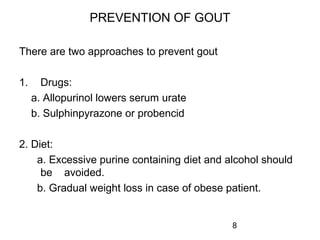
PREVENTION OF GOUT
There are two approaches to prevent gout
1. Drugs:
a. Allopurinol lowers serum urate
b. Sulphinpyrazone or probencid
2. Diet:
a. Excessive purine containing diet and alcohol should
be avoided.
b. Gradual weight loss in case of obese patient.
9
FOODSTUFFS CLASSIFIED ACCORDING TO THE CONTENT OF
PURINE
High Moderate Fair Low or absent
300-1000 mg/100gm 150-300mg/100gm 50-150mg/100gm below 50mg/100gm purine
Fish Meats Whole cereals Milk
Pulses Milk product
Sardines Chicken Vegetables Eggs
Herrings small fish -------- -------
Liver --------- --------- --------
Kidney ---------- ---------- ---------
Heart --------- ---------- ----------
Meat extracts -------- ---------- Sugar
10
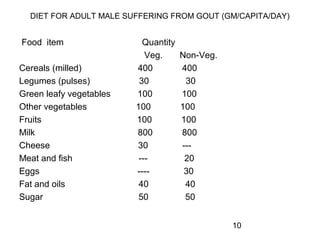
DIET FOR ADULT MALE SUFFERING FROM GOUT (GM/CAPITA/DAY)
Food item Quantity
Veg. Non-Veg.
Cereals (milled) 400 400
Legumes (pulses) 30 30
Green leafy vegetables 100 100
Other vegetables 100 100
Fruits 100 100
Milk 800 800
Cheese 30 ---
Meat and fish --- 20
Eggs ---- 30
Fat and oils 40 40
Sugar 50 50
11
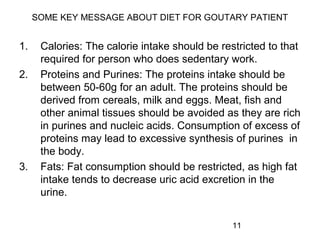
SOME KEY MESSAGE ABOUT DIET FOR GOUTARY PATIENT
1. Calories: The calorie intake should be restricted to that
required for person who does sedentary work.
2. Proteins and Purines: The proteins intake should be
between 50-60g for an adult. The proteins should be
derived from cereals, milk and eggs. Meat, fish and
other animal tissues should be avoided as they are rich
in purines and nucleic acids. Consumption of excess of
proteins may lead to excessive synthesis of purines in
the body.
3. Fats: Fat consumption should be restricted, as high fat
intake tends to decrease uric acid excretion in the
urine.
12
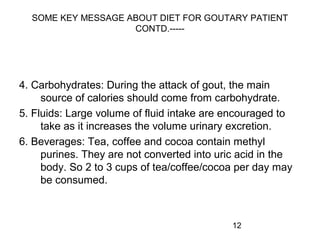
SOME KEY MESSAGE ABOUT DIET FOR GOUTARY PATIENT
CONTD.-----
4. Carbohydrates: During the attack of gout, the main
source of calories should come from carbohydrate.
5. Fluids: Large volume of fluid intake are encouraged to
take as it increases the volume urinary excretion.
6. Beverages: Tea, coffee and cocoa contain methyl
purines. They are not converted into uric acid in the
body. So 2 to 3 cups of tea/coffee/cocoa per day may
be consumed.

Gout

  • 1.
    GOUT Def.: Gout isa hereditary and metabolic disease resulting from defective uric acid metabolism. Cause: In this disease serum uric acid levels are raised and urates (Monosodium urate) are deposited in the cartilage and articular cartilage of the joints. Classification of gout: 1. Primary gout: Due to abnormality of uric acid production and metabolism. 2. Secondary gout: Excess uric acid production due to excessive breakdown of nuclei secondary to some disease (leukaemia, pernicious anaemia,hemolytic anaemias and polycythemia) 1
  • 2.
    2 Uric acid metabolism Ina normal subject uric is metabolized by two ways: 1. Endogenous uric acid: Uric acid is derived from purine (Purine is derived from the breakdown or synthesis of nucleoproteins). If the diet is free from purine about 300-600 miligram uric acid is derived from the endogenous source and this amount of uric acid is excreted through the urine of a normal adult person. 2. Exogenous uric acid: Diet with high purine and nucleic acid content such as meat, fish and all other animal tissues. The level of serum uric acid in normal subject is about 3-6 mg/100ml. 2
  • 3.
    3 URIC ACID LEVELIN BLOOD IN GOUT IN The level of serum uric acid level is generally high in patients suffering from gout: 6-10mg/100ml . The possible mechanisms for the high serum levels of uric acid in gout are: 1. Increased production of uric acid: There is evidence that in gout there is increased synthesis of purines in the body, leading to increased production of uric acid (polycythemia, leukaemia, psoriasis, idiopathic). 2. Diminished renal excretion of uric acid: There is also evidence that uric acid excretion by the kidney is diminished in gout. This abnormality in the kidneys are seemed to be hereditary. Other causes include renal failure, drugs, lead poisoning, lactic alcoholism, severe vomiting.
  • 4.
    4 METABOLIC DEFECT INPATIENT WITH GOUT The metabolic defects in the gout are as follow: (1). Defective excretion of urate by the kidney (primary renal gout where there is defect in renal tubule). (2). Reduction in the enzyme hypoxyxanthine-guanine phosphoribosyl tranferase (catalyses formation of necleotides from free purines) (3). Reduced urate binding capacity of plasma
  • 5.
    5 CLINICAL PRESENTATION OFGOUT Acute gout: • Pain the Joint: The metaterso-phalangeal joint of a great toe is the site acute gouty arthritis in 70 percent of the patients; the ankle, the knee, the small joints of the feet and hands , the wrist and elbow follow in decreasing order. The affected joint is hot, red and swollen. • Other symptoms: May have fever, anorexia, nausea, change in the mood. Some patients have only a single attack some have recurrent attacks.
  • 6.
    6 CLINICAL PRESENTATION OFGOUT Chronic gout: Recurrent acute attacks are followed by progressive cartilage and bone erosion in association with deposition of urate crystal and secondary degenerative changes. Severe functional impairment and gross joint deformities may occur in chronic gout.
  • 7.
    7 DIAGNOSIS AND TREATMENTOF GOUT Diagnosis can made by examining 1. Serum uric acid level. 2. Synovial fluid of the joint 3. X-ray of the joint. Treatment: NSAID are the drugs of choice. Among them Indomethacin (50gm) or naproxen (500mg). Treatment is continued by giving Colchicine (1mg followed by 0.5 mg). Colchicine is highly effective but causes vomiting and diarrhoea.
  • 8.
    8 PREVENTION OF GOUT Thereare two approaches to prevent gout 1. Drugs: a. Allopurinol lowers serum urate b. Sulphinpyrazone or probencid 2. Diet: a. Excessive purine containing diet and alcohol should be avoided. b. Gradual weight loss in case of obese patient.
  • 9.
    9 FOODSTUFFS CLASSIFIED ACCORDINGTO THE CONTENT OF PURINE High Moderate Fair Low or absent 300-1000 mg/100gm 150-300mg/100gm 50-150mg/100gm below 50mg/100gm purine Fish Meats Whole cereals Milk Pulses Milk product Sardines Chicken Vegetables Eggs Herrings small fish -------- ------- Liver --------- --------- -------- Kidney ---------- ---------- --------- Heart --------- ---------- ---------- Meat extracts -------- ---------- Sugar
  • 10.
    10 DIET FOR ADULTMALE SUFFERING FROM GOUT (GM/CAPITA/DAY) Food item Quantity Veg. Non-Veg. Cereals (milled) 400 400 Legumes (pulses) 30 30 Green leafy vegetables 100 100 Other vegetables 100 100 Fruits 100 100 Milk 800 800 Cheese 30 --- Meat and fish --- 20 Eggs ---- 30 Fat and oils 40 40 Sugar 50 50
  • 11.
    11 SOME KEY MESSAGEABOUT DIET FOR GOUTARY PATIENT 1. Calories: The calorie intake should be restricted to that required for person who does sedentary work. 2. Proteins and Purines: The proteins intake should be between 50-60g for an adult. The proteins should be derived from cereals, milk and eggs. Meat, fish and other animal tissues should be avoided as they are rich in purines and nucleic acids. Consumption of excess of proteins may lead to excessive synthesis of purines in the body. 3. Fats: Fat consumption should be restricted, as high fat intake tends to decrease uric acid excretion in the urine.
  • 12.
    12 SOME KEY MESSAGEABOUT DIET FOR GOUTARY PATIENT CONTD.----- 4. Carbohydrates: During the attack of gout, the main source of calories should come from carbohydrate. 5. Fluids: Large volume of fluid intake are encouraged to take as it increases the volume urinary excretion. 6. Beverages: Tea, coffee and cocoa contain methyl purines. They are not converted into uric acid in the body. So 2 to 3 cups of tea/coffee/cocoa per day may be consumed.