A S H L E Y M U L L E N
Huntington’s Disease
What Causes It?
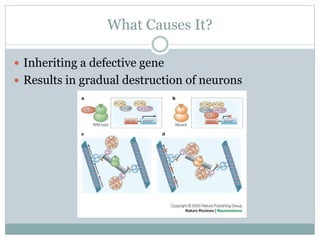
ď‚— Inheriting a defective gene
ď‚— Results in gradual destruction of neurons
How Is It Transmitted?
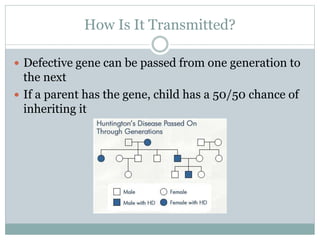
ď‚— Defective gene can be passed from one generation to
the next
ď‚— If a parent has the gene, child has a 50/50 chance of
inheriting it
Signs and Symptoms
ď‚— Appear between age 30-50
ď‚— Fidgeting
ď‚— Minor twitching in fingers and toes
ď‚— Excessive restlessness
ď‚— Some clumsiness
ď‚— Short-term memory loss
ď‚— Less ability to organize routine
ď‚— Periods of depression
ď‚— As HD progresses, all physical symptoms can make
basic tasks more difficult
How HD Affects Body
ď‚— Mind and body
ď‚— Rapid, jerking movements the person has no control
of
ď‚— Prone to falls
ď‚— Eye movement
ď‚— Trouble looking
ď‚— Affect the brain
ď‚— Forgetfulness
ď‚— Difficulty to concentrate
ď‚— Sensory symptoms: numbness or pain
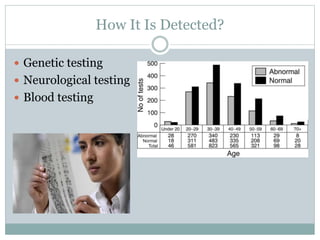
How It Is Detected?
ď‚— Genetic testing
ď‚— Neurological testing
ď‚— Blood testing
Treatment
ď‚— Drs. prescribe medications to control emotional and
movement problems
ď‚— Tetrabenazine is the first drug in the U.S. approved
to treat Huntington’s.
ď‚— Helps control involuntary movements
Works Cited
ď‚— Appai-Kubi, Linda. "Huntington's disease."
netdoctor.co.uk. NetDoctor.co.uk, 2010. Web. 18 October 2010.
<http://www.netdoctor.co.uk/diseases/facts/huntingtons.htm>.
ď‚— "Blood Tests." wrongdiagnosis.com. Health Grades Inc., 2010. Web. 18
October 2010. <http://www.wrongdiagnosis.com/test/blood_tests.htm>.
ď‚— "NINDS Huntington's Disease Information." www.ninds.nih.gov. National
Institute of Neurological Disorders and Stroke, 2010. Web. 18 October
2010. <http://www.ninds.nih.gov/disorders/huntington/huntington.htm>
.
ď‚— "What is Huntington's Disease?" ahdansw.asn.au. Australian Huntington's
Disease Association, 2009. Web. 18 October 2010.
<http://www.ahdansw.asn.au/information/huntingtons.html>.

Huntington's disease

  • 1.
    A S HL E Y M U L L E N Huntington’s Disease
  • 2.
    What Causes It? ď‚—Inheriting a defective gene ď‚— Results in gradual destruction of neurons
  • 3.
    How Is ItTransmitted? ď‚— Defective gene can be passed from one generation to the next ď‚— If a parent has the gene, child has a 50/50 chance of inheriting it
  • 4.
    Signs and Symptoms ď‚—Appear between age 30-50 ď‚— Fidgeting ď‚— Minor twitching in fingers and toes ď‚— Excessive restlessness ď‚— Some clumsiness ď‚— Short-term memory loss ď‚— Less ability to organize routine ď‚— Periods of depression ď‚— As HD progresses, all physical symptoms can make basic tasks more difficult
  • 5.
    How HD AffectsBody ď‚— Mind and body ď‚— Rapid, jerking movements the person has no control of ď‚— Prone to falls ď‚— Eye movement ď‚— Trouble looking ď‚— Affect the brain ď‚— Forgetfulness ď‚— Difficulty to concentrate ď‚— Sensory symptoms: numbness or pain
  • 6.
    How It IsDetected? ď‚— Genetic testing ď‚— Neurological testing ď‚— Blood testing
  • 7.
    Treatment  Drs. prescribemedications to control emotional and movement problems  Tetrabenazine is the first drug in the U.S. approved to treat Huntington’s.  Helps control involuntary movements
  • 8.
    Works Cited ď‚— Appai-Kubi,Linda. "Huntington's disease." netdoctor.co.uk. NetDoctor.co.uk, 2010. Web. 18 October 2010. <http://www.netdoctor.co.uk/diseases/facts/huntingtons.htm>. ď‚— "Blood Tests." wrongdiagnosis.com. Health Grades Inc., 2010. Web. 18 October 2010. <http://www.wrongdiagnosis.com/test/blood_tests.htm>. ď‚— "NINDS Huntington's Disease Information." www.ninds.nih.gov. National Institute of Neurological Disorders and Stroke, 2010. Web. 18 October 2010. <http://www.ninds.nih.gov/disorders/huntington/huntington.htm> . ď‚— "What is Huntington's Disease?" ahdansw.asn.au. Australian Huntington's Disease Association, 2009. Web. 18 October 2010. <http://www.ahdansw.asn.au/information/huntingtons.html>.