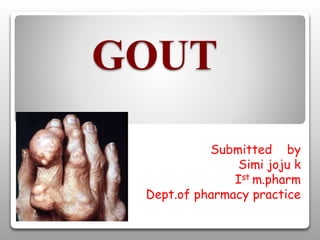
GOUT
Submitted by
Simi joju k
Ist m.pharm
Dept.of pharmacy practice
DEFINITION
A metabolic disease characterized by
recurrent attack of acute inflammatory
arthritis caused by elevated levels of uric
acid in the blood (hyperuricemia).
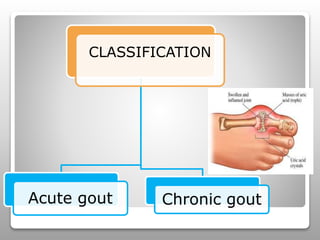
CLASSIFICATION
Acute gout Chronic gout
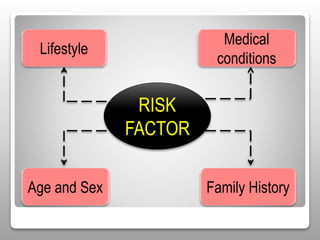
RISK
FACTOR
Lifestyle
Medical
conditions
Family HistoryAge and Sex
o Men > 40 years of age, often presenting
initially in the form of podagra (acute onset of
pain, erythema and swelling of the first
metatarsophalangeal joint).
o Women may develop gout later in life, and in
women it is more likely to involve the upper
extremities.
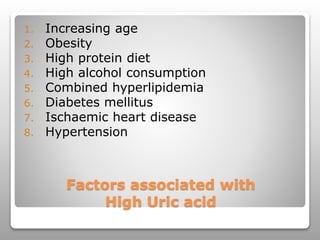
Factors associated with
High Uric acid
1. Increasing age
2. Obesity
3. High protein diet
4. High alcohol consumption
5. Combined hyperlipidemia
6. Diabetes mellitus
7. Ischaemic heart disease
8. Hypertension
Causes of hyperuricaemia
Impaired excretion of uric
acid
Increased production of
uric acid
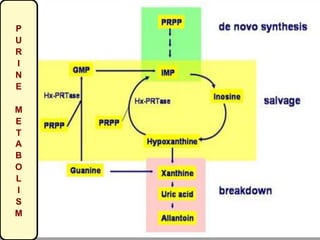
P
U
R
I
N
E
M
E
T
A
B
O
L
I
S
M
TREATMENT
The drugs used in gout are
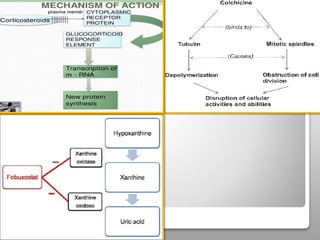
1)Drugs inhibiting polymorphonuclear leukocytes(PMN) migration into
the joint space:-colchicine.
2)Drugs inhibiting uric acid synthesis:-allopurinol, febuxostat.
3) Drugs increasing uric acid excretion (uricosuric agents):-probenecid,
sulfinpyrazone.
4) Drugs inhibiting prostaglandin synthesis:-NSAIDS, corticosteroids.
COLCHICINE
This is an alkaloid isolated from colchicum autumnale.
MOA:-
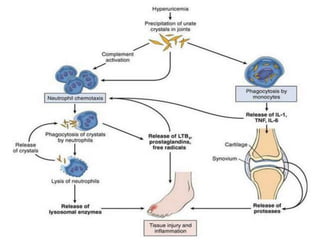
•Prevents migration of leukocytes and neutrophils into the joint and decreases
phagocytosis by binding to intracellular protein tubulin, resulting in the
depolymerisation of the microtubules and interfering with cell motility.
•Also prevent the production of inflammatory glycoprotein LTB4 by
MNP(mononuclear phagocytes) that have phagocytosed urate crystals.
DOSE:-
•Acute gout:- 0.5-1mg stat, followed by 0.5mg every 1-2 hours till pain is relieved.
•Prophylaxis of recurrent episodes of gout:- 0.5mg o.d to t.d.s
ADVERSE EFFECTS:-
Nausea, vomiting, abdominal pain, cramps, diarrhoea.
•Rarely GIT haemorrhage, rash,.
ALLOPURINOL
MOA:-
•Reduces the synthesis of uric acid by inhibiting xanthine
oxidase.
•Allopurinol is converted to alloxanthine by xanthine oxidase
and this metabolite which remains in the tissue for a
considerable time , is a non-competitive inhibitor of the
enzyme.
DOSE:-
100mg o.d, increase to 300mg daily. The patient is advised to
take plenty of fluids to prevent renal xanthine deposition.
ADVERSE EFFECTS:-
Nausea, vomiting, diarrhoea, rashes, hepatotoxicity, bone
marrow depression.
FEBUXOSTAT
MOA:-
First nonpurine inhibitor of xanthine oxidase; decreases formation of xanthine and uric
acid.
DOSE:- 80-120mg daily
ADVERSE EFFECTS:-
Liver function abnormalities, diarrhoea, headache, nausea.
URICOSURIC AGENTS (probenecid, sulfinpyrazone)
MOA:-
They increase uric acid excretion by a direct action on the renal tubule. Uric acid is
freely filtered at the glomerulus. It is both reabsorbed and secreted in the middle
segment of the proximal tubule. Uricosuric drugs affect these active transport sites so
that net absorption of uric acid in the proximal tubule is decreased.
DOSE:-
•Probenecid 250mg b.d or 500mg o.d, dose to be incr
•eased to 1gm daily after a week.
•Sulfinpyrazone 100-200mg o.d with food, increase to 400-800mg o.d
ADVERSE EFFECTS:-
•Sulfinpyrazone can cause GIT irritation, aplastic anaemia.
•Probenecid can cause skin rash, headache, sore gums.
NON-STEROIDALANTI-INFLAMMATORY DRUGS (NSAIDS)
•Treatment of choice for acute attack.
•Inhibit PG synthesis and lessen inflammation.
•All NSAIDS are effective except aspirin and tolmetin.
•Aspirin is not used because it causes renal retention of uric acid.
•Indomethacin is commonly used – 50mg 6 hourly to start with, then
•decrease to 25mg t.d.s or q.i.d for 5 days.
CORTICOSTEROIDS
•They are used in the treatment of severe symptomatic gout, by intra-
articular, systemic, or subcutaneous routes, depending on the degree of
pain and inflammation.
• The most commonly used oral corticosteroid is prednisone, the
recommended dose is 30-50mg/day for 1-2 days upto 7-10 days.
• Intra-articular injection of 10mg(small joints), 30mg(wrist, ankle,
elbow), and 40mg (knee) of triamcinolone is given if the patient is
unable to take oral medications.
RASBURICASE
•This is a recombinant form of the enzyme urate oxidase, which oxidises
uric acid to allantoin.
•Contraindicated in G6PD deficient patients.
•Adverse effects include nausea, vomiting, rashes and hypersensitivity
reactions.
•DOSE:-200mg/kg daily i.v. infusion.
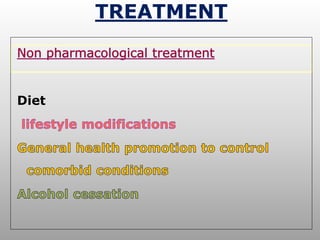
TREATMENT
Diet
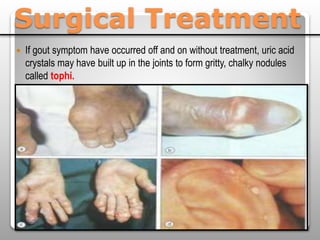
Surgical Treatment
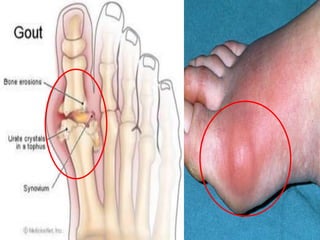
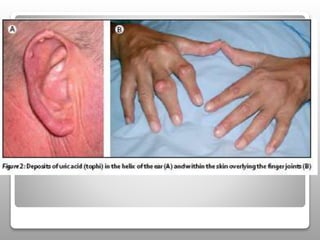
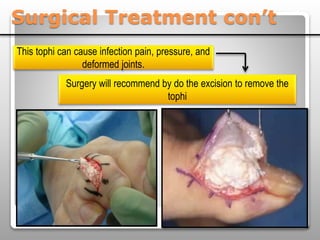
 If gout symptom have occurred off and on without treatment, uric acid
crystals may have built up in the joints to form gritty, chalky nodules
called tophi.
Surgical Treatment con’t
This tophi can cause infection pain, pressure, and
deformed joints.
Surgery will recommend by do the excision to remove the
tophi
Health Education
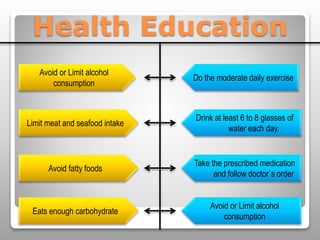
Eats enough carbohydrate
Avoid or Limit alcohol
consumption
Limit meat and seafood intake
Avoid fatty foods
Avoid or Limit alcohol
consumption
Do the moderate daily exercise
Drink at least 6 to 8 glasses of
water each day.
Take the prescribed medication
and follow doctor`s order
TREATMENT-ACUTE GOUT
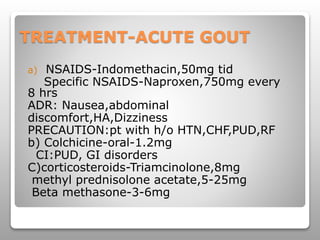
a) NSAIDS-Indomethacin,50mg tid
Specific NSAIDS-Naproxen,750mg every
8 hrs
ADR: Nausea,abdominal
discomfort,HA,Dizziness
PRECAUTION:pt with h/o HTN,CHF,PUD,RF
b) Colchicine-oral-1.2mg
CI:PUD, GI disorders
C)corticosteroids-Triamcinolone,8mg
methyl prednisolone acetate,5-25mg
Beta methasone-3-6mg
TREATMENT-ACUTE GOUT(contue)
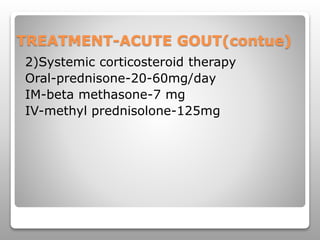
2)Systemic corticosteroid therapy
Oral-prednisone-20-60mg/day
IM-beta methasone-7 mg
IV-methyl prednisolone-125mg
gout

gout

  • 1.
    GOUT Submitted by Simi jojuk Ist m.pharm Dept.of pharmacy practice
  • 2.
    DEFINITION A metabolic diseasecharacterized by recurrent attack of acute inflammatory arthritis caused by elevated levels of uric acid in the blood (hyperuricemia).
  • 4.
  • 5.
  • 8.
    o Men >40 years of age, often presenting initially in the form of podagra (acute onset of pain, erythema and swelling of the first metatarsophalangeal joint). o Women may develop gout later in life, and in women it is more likely to involve the upper extremities.
  • 12.
    Factors associated with HighUric acid 1. Increasing age 2. Obesity 3. High protein diet 4. High alcohol consumption 5. Combined hyperlipidemia 6. Diabetes mellitus 7. Ischaemic heart disease 8. Hypertension
  • 13.
    Causes of hyperuricaemia Impairedexcretion of uric acid Increased production of uric acid
  • 14.
  • 16.
    TREATMENT The drugs usedin gout are 1)Drugs inhibiting polymorphonuclear leukocytes(PMN) migration into the joint space:-colchicine. 2)Drugs inhibiting uric acid synthesis:-allopurinol, febuxostat. 3) Drugs increasing uric acid excretion (uricosuric agents):-probenecid, sulfinpyrazone. 4) Drugs inhibiting prostaglandin synthesis:-NSAIDS, corticosteroids.
  • 17.
    COLCHICINE This is analkaloid isolated from colchicum autumnale. MOA:- •Prevents migration of leukocytes and neutrophils into the joint and decreases phagocytosis by binding to intracellular protein tubulin, resulting in the depolymerisation of the microtubules and interfering with cell motility. •Also prevent the production of inflammatory glycoprotein LTB4 by MNP(mononuclear phagocytes) that have phagocytosed urate crystals. DOSE:- •Acute gout:- 0.5-1mg stat, followed by 0.5mg every 1-2 hours till pain is relieved. •Prophylaxis of recurrent episodes of gout:- 0.5mg o.d to t.d.s ADVERSE EFFECTS:- Nausea, vomiting, abdominal pain, cramps, diarrhoea. •Rarely GIT haemorrhage, rash,.
  • 18.
    ALLOPURINOL MOA:- •Reduces the synthesisof uric acid by inhibiting xanthine oxidase. •Allopurinol is converted to alloxanthine by xanthine oxidase and this metabolite which remains in the tissue for a considerable time , is a non-competitive inhibitor of the enzyme. DOSE:- 100mg o.d, increase to 300mg daily. The patient is advised to take plenty of fluids to prevent renal xanthine deposition. ADVERSE EFFECTS:- Nausea, vomiting, diarrhoea, rashes, hepatotoxicity, bone marrow depression.
  • 19.
    FEBUXOSTAT MOA:- First nonpurine inhibitorof xanthine oxidase; decreases formation of xanthine and uric acid. DOSE:- 80-120mg daily ADVERSE EFFECTS:- Liver function abnormalities, diarrhoea, headache, nausea. URICOSURIC AGENTS (probenecid, sulfinpyrazone) MOA:- They increase uric acid excretion by a direct action on the renal tubule. Uric acid is freely filtered at the glomerulus. It is both reabsorbed and secreted in the middle segment of the proximal tubule. Uricosuric drugs affect these active transport sites so that net absorption of uric acid in the proximal tubule is decreased. DOSE:- •Probenecid 250mg b.d or 500mg o.d, dose to be incr •eased to 1gm daily after a week. •Sulfinpyrazone 100-200mg o.d with food, increase to 400-800mg o.d ADVERSE EFFECTS:- •Sulfinpyrazone can cause GIT irritation, aplastic anaemia. •Probenecid can cause skin rash, headache, sore gums.
  • 20.
    NON-STEROIDALANTI-INFLAMMATORY DRUGS (NSAIDS) •Treatmentof choice for acute attack. •Inhibit PG synthesis and lessen inflammation. •All NSAIDS are effective except aspirin and tolmetin. •Aspirin is not used because it causes renal retention of uric acid. •Indomethacin is commonly used – 50mg 6 hourly to start with, then •decrease to 25mg t.d.s or q.i.d for 5 days.
  • 21.
    CORTICOSTEROIDS •They are usedin the treatment of severe symptomatic gout, by intra- articular, systemic, or subcutaneous routes, depending on the degree of pain and inflammation. • The most commonly used oral corticosteroid is prednisone, the recommended dose is 30-50mg/day for 1-2 days upto 7-10 days. • Intra-articular injection of 10mg(small joints), 30mg(wrist, ankle, elbow), and 40mg (knee) of triamcinolone is given if the patient is unable to take oral medications.
  • 22.
    RASBURICASE •This is arecombinant form of the enzyme urate oxidase, which oxidises uric acid to allantoin. •Contraindicated in G6PD deficient patients. •Adverse effects include nausea, vomiting, rashes and hypersensitivity reactions. •DOSE:-200mg/kg daily i.v. infusion.
  • 23.
  • 24.
    Surgical Treatment  Ifgout symptom have occurred off and on without treatment, uric acid crystals may have built up in the joints to form gritty, chalky nodules called tophi.
  • 25.
    Surgical Treatment con’t Thistophi can cause infection pain, pressure, and deformed joints. Surgery will recommend by do the excision to remove the tophi
  • 26.
    Health Education Eats enoughcarbohydrate Avoid or Limit alcohol consumption Limit meat and seafood intake Avoid fatty foods Avoid or Limit alcohol consumption Do the moderate daily exercise Drink at least 6 to 8 glasses of water each day. Take the prescribed medication and follow doctor`s order
  • 28.
    TREATMENT-ACUTE GOUT a) NSAIDS-Indomethacin,50mgtid Specific NSAIDS-Naproxen,750mg every 8 hrs ADR: Nausea,abdominal discomfort,HA,Dizziness PRECAUTION:pt with h/o HTN,CHF,PUD,RF b) Colchicine-oral-1.2mg CI:PUD, GI disorders C)corticosteroids-Triamcinolone,8mg methyl prednisolone acetate,5-25mg Beta methasone-3-6mg
  • 29.
    TREATMENT-ACUTE GOUT(contue) 2)Systemic corticosteroidtherapy Oral-prednisone-20-60mg/day IM-beta methasone-7 mg IV-methyl prednisolone-125mg

Editor's Notes

  • #12 Bursa Fluid filled sac that provides friction free movement between bones & tendons or muscles around a joint Bursitis Inflammation of sac Due to repetitive use, trauma or systemic arthritis What is a bursa & what causes bursitis