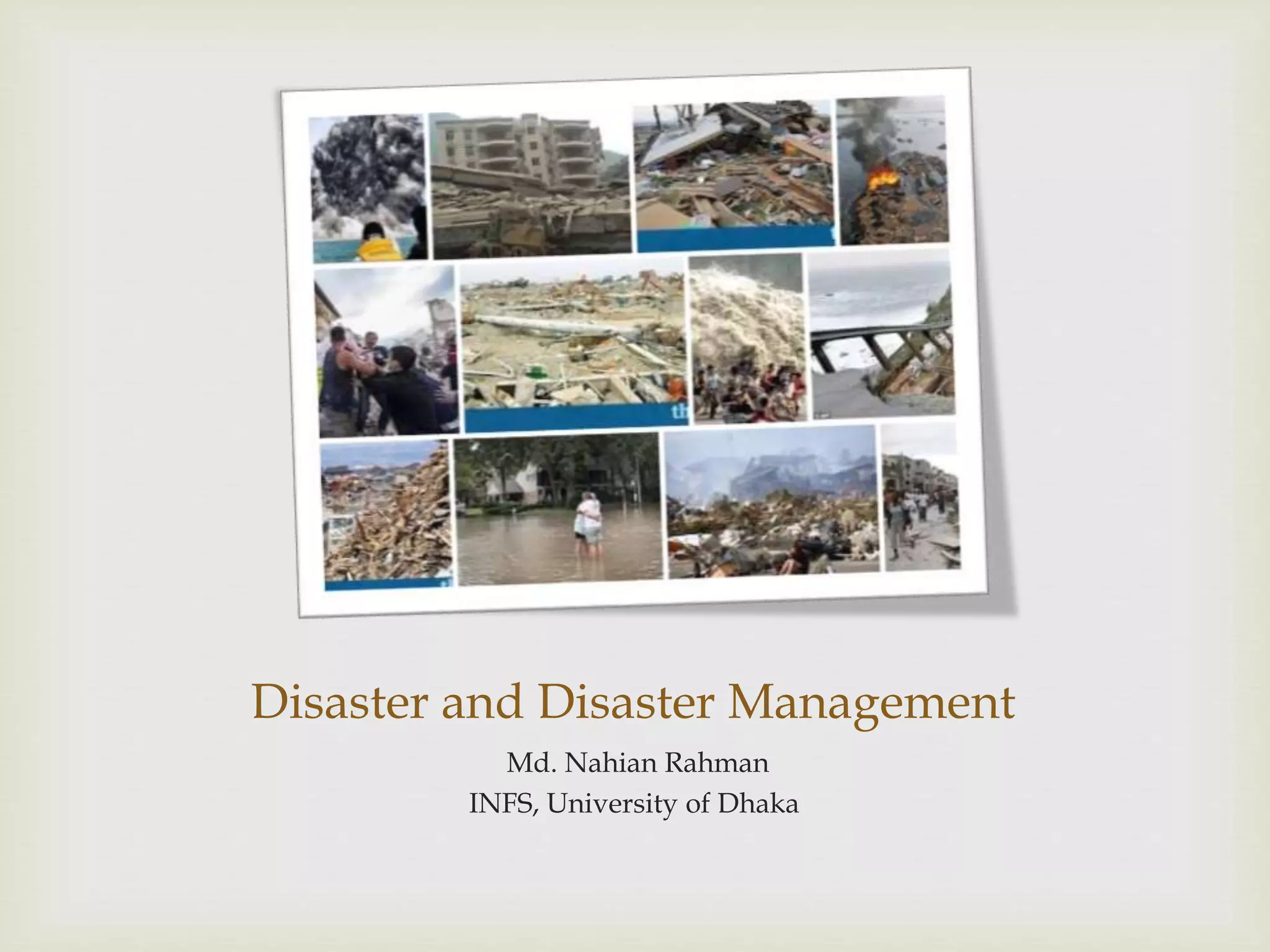
Disaster and Disaster Management
Md. Nahian Rahman
INFS, University of Dhaka

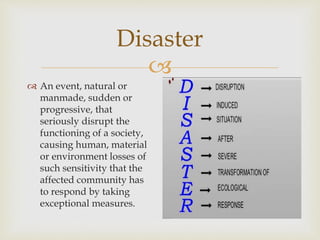
Disaster
 An event, natural or
manmade, sudden or
progressive, that
seriously disrupt the
functioning of a society,
causing human, material
or environment losses of
such sensitivity that the
affected community has
to respond by taking
exceptional measures.

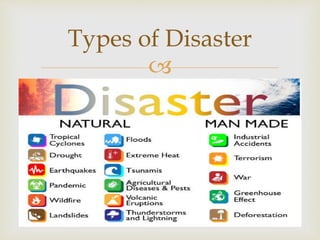
Types of Disaster

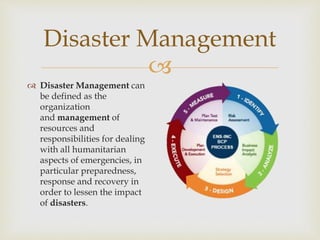
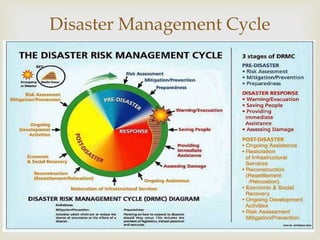
Disaster Management
 Disaster Management can
be defined as the
organization
and management of
resources and
responsibilities for dealing
with all humanitarian
aspects of emergencies, in
particular preparedness,
response and recovery in
order to lessen the impact
of disasters.

Disaster Management Cycle

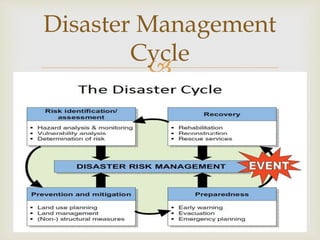
Disaster Management
Cycle

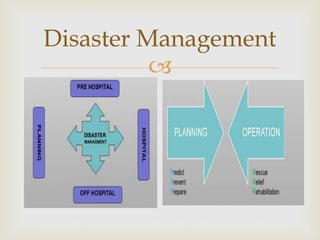
Disaster Management
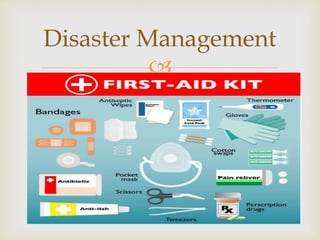

Disaster Management

 The term “nutritional emergency” describes any
situation natural or man-made in which large
number of population find themselves deprived of
their accustomed level of food supply to the extent
that considerable suffering will occur unless special
efforts are made to provide and distribute foods
among the individual/household.
Nutritional Emergency

 Short term emergency situation: Duration is short
ranging from few seconds to 1-2 days. Example -
tornado, earthquake, cyclone, tidal wave, tsunami
etc.
 Medium term emergency situation: Duration is few
weeks to few months. Example - flood, draught,
famine, river erosion etc.
 Long term emergency situation: Duration is more
than six months to year. Example - civil war, ethnic
problem, political unrest etc.
Types of emergency
situation

Impact on population:
 Destruction of infrastructure - roads, market etc.
 Large scale migration
 Break down of essential services - health, water,
sanitation etc.
 Loss of property and business - house, land, animals,
stocks etc.
 Social disruption
Impact of an emergency
on nutrition

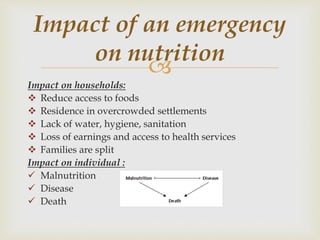
Impact on households:
 Reduce access to foods
 Residence in overcrowded settlements
 Lack of water, hygiene, sanitation
 Loss of earnings and access to health services
 Families are split
Impact on individual :
 Malnutrition
 Disease
 Death
Impact of an emergency
on nutrition

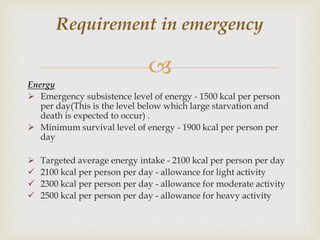
Energy
 Emergency subsistence level of energy - 1500 kcal per person
per day(This is the level below which large starvation and
death is expected to occur) .
 Minimum survival level of energy - 1900 kcal per person per
day
 Targeted average energy intake - 2100 kcal per person per day
 2100 kcal per person per day - allowance for light activity
 2300 kcal per person per day - allowance for moderate activity
 2500 kcal per person per day - allowance for heavy activity
Requirement in emergency

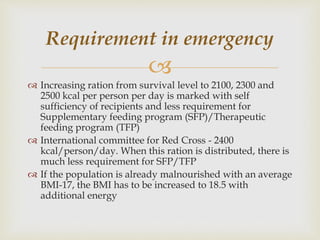
 Increasing ration from survival level to 2100, 2300 and
2500 kcal per person per day is marked with self
sufficiency of recipients and less requirement for
Supplementary feeding program (SFP)/Therapeutic
feeding program (TFP)
 International committee for Red Cross - 2400
kcal/person/day. When this ration is distributed, there is
much less requirement for SFP/TFP
 If the population is already malnourished with an average
BMI-17, the BMI has to be increased to 18.5 with
additional energy
Requirement in emergency

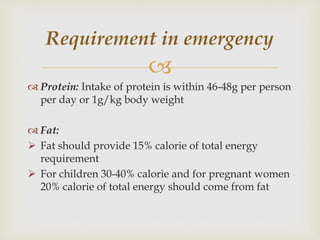
 Protein: Intake of protein is within 46-48g per person
per day or 1g/kg body weight
 Fat:
 Fat should provide 15% calorie of total energy
requirement
 For children 30-40% calorie and for pregnant women
20% calorie of total energy should come from fat
Requirement in emergency
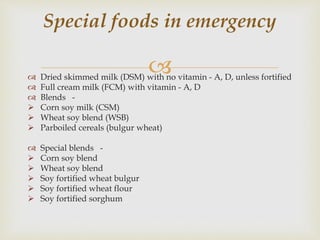
 Dried skimmed milk (DSM) with no vitamin - A, D, unless fortified
 Full cream milk (FCM) with vitamin - A, D
 Blends -
 Corn soy milk (CSM)
 Wheat soy blend (WSB)
 Parboiled cereals (bulgur wheat)
 Special blends -
 Corn soy blend
 Wheat soy blend
 Soy fortified wheat bulgur
 Soy fortified wheat flour
 Soy fortified sorghum
Special foods in emergency

 Two types of measures are taken during an
emergency situation
Nutritional measures:
 General relief distribution
 Mass feeding
 Selective feeding
 Supplementary feeding
 Therapeutic feeding
Nutritional Measures

 Provision of security
 Shelter
 Clean & abundant water
 Physical and mental health care
 Sanitation
 Vaccination
 Pest control
 Reuniting families
 Provision of information
 Care of victims of abuse & injury
 Programs for special groups - orphans, mentally ill etc.
Non nutritional measures

 Plenty of clean and safe water (at least 30 litres per person
per day)
 Foods must be protected from flies, insects, and dust, and
should not be reconstituted in advance
 The mothers or other carers should clean the children's
feeding plates and utensils after every meal
 Everyone who feeds the children must wash their hands
with soap first
 Latrine facilities must be available for patients and
personnel
Hygiene and food safety


Disaster and disaster management

  • 1.
    Disaster and DisasterManagement Md. Nahian Rahman INFS, University of Dhaka
  • 2.
     Disaster  An event,natural or manmade, sudden or progressive, that seriously disrupt the functioning of a society, causing human, material or environment losses of such sensitivity that the affected community has to respond by taking exceptional measures.
  • 3.
  • 4.
     Disaster Management  DisasterManagement can be defined as the organization and management of resources and responsibilities for dealing with all humanitarian aspects of emergencies, in particular preparedness, response and recovery in order to lessen the impact of disasters.
  • 5.
  • 6.
  • 7.
  • 8.
  • 9.
      The term“nutritional emergency” describes any situation natural or man-made in which large number of population find themselves deprived of their accustomed level of food supply to the extent that considerable suffering will occur unless special efforts are made to provide and distribute foods among the individual/household. Nutritional Emergency
  • 10.
      Short termemergency situation: Duration is short ranging from few seconds to 1-2 days. Example - tornado, earthquake, cyclone, tidal wave, tsunami etc.  Medium term emergency situation: Duration is few weeks to few months. Example - flood, draught, famine, river erosion etc.  Long term emergency situation: Duration is more than six months to year. Example - civil war, ethnic problem, political unrest etc. Types of emergency situation
  • 11.
     Impact on population: Destruction of infrastructure - roads, market etc.  Large scale migration  Break down of essential services - health, water, sanitation etc.  Loss of property and business - house, land, animals, stocks etc.  Social disruption Impact of an emergency on nutrition
  • 12.
     Impact on households: Reduce access to foods  Residence in overcrowded settlements  Lack of water, hygiene, sanitation  Loss of earnings and access to health services  Families are split Impact on individual :  Malnutrition  Disease  Death Impact of an emergency on nutrition
  • 13.
     Energy  Emergency subsistencelevel of energy - 1500 kcal per person per day(This is the level below which large starvation and death is expected to occur) .  Minimum survival level of energy - 1900 kcal per person per day  Targeted average energy intake - 2100 kcal per person per day  2100 kcal per person per day - allowance for light activity  2300 kcal per person per day - allowance for moderate activity  2500 kcal per person per day - allowance for heavy activity Requirement in emergency
  • 14.
      Increasing rationfrom survival level to 2100, 2300 and 2500 kcal per person per day is marked with self sufficiency of recipients and less requirement for Supplementary feeding program (SFP)/Therapeutic feeding program (TFP)  International committee for Red Cross - 2400 kcal/person/day. When this ration is distributed, there is much less requirement for SFP/TFP  If the population is already malnourished with an average BMI-17, the BMI has to be increased to 18.5 with additional energy Requirement in emergency
  • 15.
      Protein: Intakeof protein is within 46-48g per person per day or 1g/kg body weight  Fat:  Fat should provide 15% calorie of total energy requirement  For children 30-40% calorie and for pregnant women 20% calorie of total energy should come from fat Requirement in emergency
  • 16.
     Dried skimmedmilk (DSM) with no vitamin - A, D, unless fortified  Full cream milk (FCM) with vitamin - A, D  Blends -  Corn soy milk (CSM)  Wheat soy blend (WSB)  Parboiled cereals (bulgur wheat)  Special blends -  Corn soy blend  Wheat soy blend  Soy fortified wheat bulgur  Soy fortified wheat flour  Soy fortified sorghum Special foods in emergency
  • 17.
      Two typesof measures are taken during an emergency situation Nutritional measures:  General relief distribution  Mass feeding  Selective feeding  Supplementary feeding  Therapeutic feeding Nutritional Measures
  • 18.
      Provision ofsecurity  Shelter  Clean & abundant water  Physical and mental health care  Sanitation  Vaccination  Pest control  Reuniting families  Provision of information  Care of victims of abuse & injury  Programs for special groups - orphans, mentally ill etc. Non nutritional measures
  • 19.
      Plenty ofclean and safe water (at least 30 litres per person per day)  Foods must be protected from flies, insects, and dust, and should not be reconstituted in advance  The mothers or other carers should clean the children's feeding plates and utensils after every meal  Everyone who feeds the children must wash their hands with soap first  Latrine facilities must be available for patients and personnel Hygiene and food safety
  • 20.