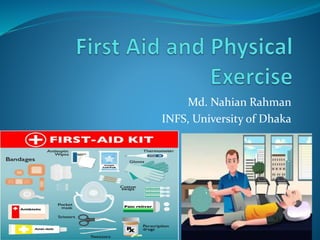

Md. Nahian Rahman
INFS, University of Dhaka
First Aid
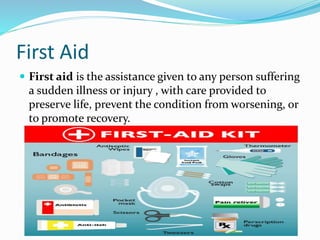
 First aid is the assistance given to any person suffering
a sudden illness or injury , with care provided to
preserve life, prevent the condition from worsening, or
to promote recovery.
Aims
 The key aims of first aid can be summarised in three
key points, sometimes known as 'the three P's‘
Preserve life
Prevent further harm
Promote recovery
Specific disciplines
 Aquatic/Marine first aid
 Battlefield first aid takes into account the specific needs
of treating wounded combatants and non-combatants
during armed conflict.
 Hyperbaric first aid may be practiced by SCUBA
diving professionals, who need to treat conditions such
as the bends.
 Oxygen first aid is the providing of oxygen to casualties
who suffer from conditions resulting in hypoxia.
 Wilderness first aid
 Mental health first aid
Contents
A First Aid Kit should have the following contents:
 first-aid manual different sizes
 adhesive tape
 adhesive bandages in several sizes
 elastic bandage
 a splint
 antiseptic wipes
 soap
 antibiotic ointment
 antiseptic solution (like hydrogen peroxide or saline)
 hydrocortisone cream (1%)
 acetaminophen and ibuprofen
 extra prescription medications (if traveling)
Contents
 tweezers
 sharp scissors
 safety pins
 disposable instant cold packs
 calamine lotion
 alcohol wipes or ethyl alcohol
 thermometer
 tooth preservation kit
Contents
 plastic non-latex gloves(at least 2 pairs)
 flashlight and extra batteries
 thermal shock blanket
 mouthpiece for administering CPR (can be obtained
from your local Red Cross)
 blanket (stored nearby)
 First Aid Card containing emergency personal
information, phone numbers, medications, manual,
 pocket defibrillator
Physical Therapy
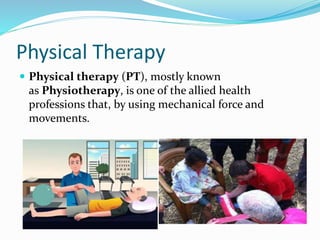
 Physical therapy (PT), mostly known
as Physiotherapy, is one of the allied health
professions that, by using mechanical force and
movements.
Specialty areas
 Cardiovascular and pulmonary physiotherapy
 Clinical electrophysiology
 Geriatric
 Integumentary(conditions involving the skin and all
its related organs)
 Neurological
 Orthopedic
 Pediatric etc.
Physical Exercise
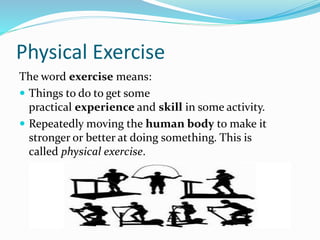
The word exercise means:
 Things to do to get some
practical experience and skill in some activity.
 Repeatedly moving the human body to make it
stronger or better at doing something. This is
called physical exercise.
Basic modes of physical exercises
There are three basic modes of physical exercises:
 Flexibility exercises help the human body in general
or its part in particular to be able to reach farther and
bend better.
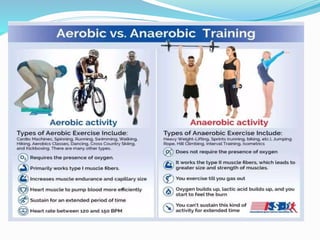
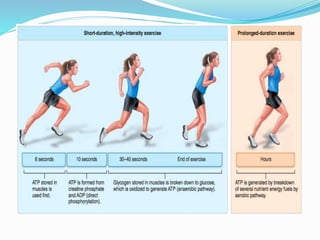
 Aerobic exercises help the body work hard for a long
time.
 Anaerobic exercises, like lifting weights, make the
arms and legs stronger.
Exercises can be an important part of physical therapy,
weight loss, or sports performance.
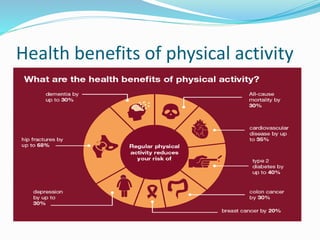
Health benefits of physical activity
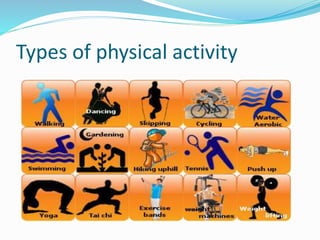
Types of physical activity
Physical activity level
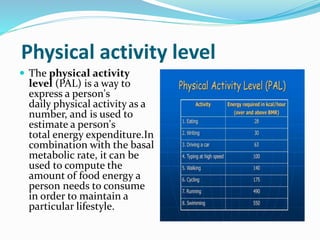
 The physical activity
level (PAL) is a way to
express a person's
daily physical activity as a
number, and is used to
estimate a person's
total energy expenditure.In
combination with the basal
metabolic rate, it can be
used to compute the
amount of food energy a
person needs to consume
in order to maintain a
particular lifestyle.
PAL value
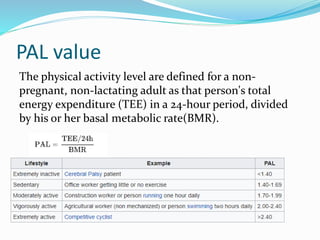
The physical activity level are defined for a non-
pregnant, non-lactating adult as that person's total
energy expenditure (TEE) in a 24-hour period, divided
by his or her basal metabolic rate(BMR).
BMR(Basal metabolic rate)
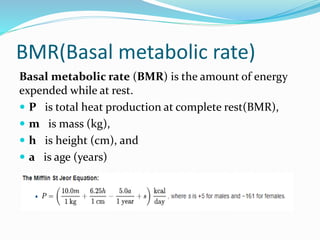
Basal metabolic rate (BMR) is the amount of energy
expended while at rest.
 P is total heat production at complete rest(BMR),
 m is mass (kg),
 h is height (cm), and
 a is age (years)
First aid and physical exercise

First aid and physical exercise

  • 1.
    Md. Nahian Rahman INFS,University of Dhaka
  • 2.
    First Aid  Firstaid is the assistance given to any person suffering a sudden illness or injury , with care provided to preserve life, prevent the condition from worsening, or to promote recovery.
  • 3.
    Aims  The keyaims of first aid can be summarised in three key points, sometimes known as 'the three P's‘ Preserve life Prevent further harm Promote recovery
  • 4.
    Specific disciplines  Aquatic/Marinefirst aid  Battlefield first aid takes into account the specific needs of treating wounded combatants and non-combatants during armed conflict.  Hyperbaric first aid may be practiced by SCUBA diving professionals, who need to treat conditions such as the bends.  Oxygen first aid is the providing of oxygen to casualties who suffer from conditions resulting in hypoxia.  Wilderness first aid  Mental health first aid
  • 5.
    Contents A First AidKit should have the following contents:  first-aid manual different sizes  adhesive tape  adhesive bandages in several sizes  elastic bandage  a splint  antiseptic wipes  soap  antibiotic ointment  antiseptic solution (like hydrogen peroxide or saline)  hydrocortisone cream (1%)  acetaminophen and ibuprofen  extra prescription medications (if traveling)
  • 6.
    Contents  tweezers  sharpscissors  safety pins  disposable instant cold packs  calamine lotion  alcohol wipes or ethyl alcohol  thermometer  tooth preservation kit
  • 7.
    Contents  plastic non-latexgloves(at least 2 pairs)  flashlight and extra batteries  thermal shock blanket  mouthpiece for administering CPR (can be obtained from your local Red Cross)  blanket (stored nearby)  First Aid Card containing emergency personal information, phone numbers, medications, manual,  pocket defibrillator
  • 8.
    Physical Therapy  Physicaltherapy (PT), mostly known as Physiotherapy, is one of the allied health professions that, by using mechanical force and movements.
  • 9.
    Specialty areas  Cardiovascularand pulmonary physiotherapy  Clinical electrophysiology  Geriatric  Integumentary(conditions involving the skin and all its related organs)  Neurological  Orthopedic  Pediatric etc.
  • 10.
    Physical Exercise The wordexercise means:  Things to do to get some practical experience and skill in some activity.  Repeatedly moving the human body to make it stronger or better at doing something. This is called physical exercise.
  • 11.
    Basic modes ofphysical exercises There are three basic modes of physical exercises:  Flexibility exercises help the human body in general or its part in particular to be able to reach farther and bend better.  Aerobic exercises help the body work hard for a long time.  Anaerobic exercises, like lifting weights, make the arms and legs stronger. Exercises can be an important part of physical therapy, weight loss, or sports performance.
  • 12.
    Health benefits ofphysical activity
  • 13.
  • 16.
    Physical activity level The physical activity level (PAL) is a way to express a person's daily physical activity as a number, and is used to estimate a person's total energy expenditure.In combination with the basal metabolic rate, it can be used to compute the amount of food energy a person needs to consume in order to maintain a particular lifestyle.
  • 17.
    PAL value The physicalactivity level are defined for a non- pregnant, non-lactating adult as that person's total energy expenditure (TEE) in a 24-hour period, divided by his or her basal metabolic rate(BMR).
  • 18.
    BMR(Basal metabolic rate) Basalmetabolic rate (BMR) is the amount of energy expended while at rest.  P is total heat production at complete rest(BMR),  m is mass (kg),  h is height (cm), and  a is age (years)