Gothic architecture
• Gothic architecture is a style of architecture that
flourished during the high and late medieval
period.
• It evolved from Romanesque architecture and
was succeeded by Renaissance architecture.
• Its characteristic features include
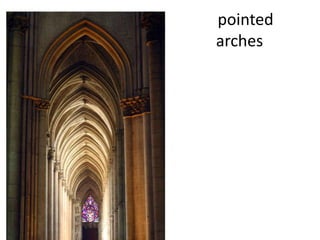
the pointed arch,
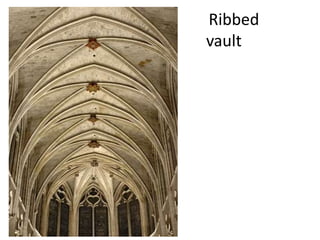
the ribbed vault and
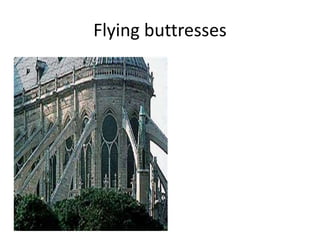
the flying buttress.
pointed
arches
Ribbed
vault
Flying buttresses
• Gothic architecture emphasizes verticality and light.
• This appearance was achieved by the development
of certain architectural features, which together
provided an engineering solution.
• The structural parts of the building ceased to be its
solid walls,
clustered columns,
pointed ribbed vaults
and flying buttresses.
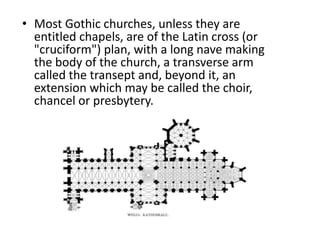
• Most Gothic churches, unless they are
entitled chapels, are of the Latin cross (or
"cruciform") plan, with a long nave making
the body of the church, a transverse arm
called the transept and, beyond it, an
extension which may be called the choir,
chancel or presbytery.
French gothic
• French Gothic architecture is a style of architecture prevalent in
France from 1140 until about 1500.
• The distinctive characteristic of French cathedrals, and those in
Germany and Belgium that were strongly influenced by them, is
their height and their impression of verticality.
• They are compact, with slight or no projection of the transepts and
subsidiary chapels.
• The west fronts are highly consistent, having three portals
surmounted by a rose window, and two large towers.
• Sometimes there are additional towers on the transept ends.
• The designations of styles in French Gothic
architecture are as follows:
 Early Gothic
 High Gothic
 Rayonnant
 Late Gothic or Flamboyant style
Early gothic
• This style began in 1140 and was characterized by
the adoption of the pointed arch and transition
from late Romanesque architecture.
• To heighten the wall, builders divided it into four
tiers: arcade (arches and piers), gallery,triforium
and clerestory.
• To support the higher wall builders invented
the flying buttresses, which reached maturity
only at High Gothic during the 13th century.
• The vaults were six ribbed sexpartite vaults.
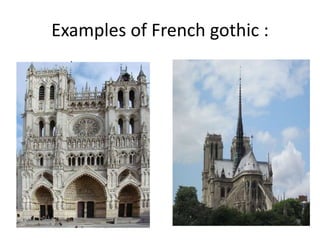
Examples of French gothic :
• Example :
English gothic
• English Gothic is defined by its
pointed arches, vaulted roofs, buttresses, large windows, and
spires.
• The distinctive characteristic of English cathedrals is their extreme
length, and their internal emphasis upon the horizontal, which may
be emphasized visually as much or more than the vertical lines.
• Unlike French cathedrals, English cathedrals sprawl across their
sites, with double transepts projecting strongly and Lady Chapels
tacked on at a later date.
• In the west front, the doors are not as significant as in France, the
usual congregational entrance being through a side porch.
• The West window is very large and never a rose, which are reserved
for the transept gables.
• The distinctive English east end is square, but
it may take a completely different form. Both
internally and externally, the stonework is
often richly decorated with carvings,
particularly the capitals.
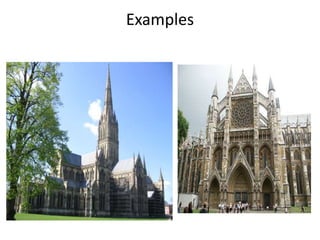
Examples

Gothic architecture

  • 1.
    Gothic architecture • Gothicarchitecture is a style of architecture that flourished during the high and late medieval period. • It evolved from Romanesque architecture and was succeeded by Renaissance architecture. • Its characteristic features include the pointed arch, the ribbed vault and the flying buttress.
  • 2.
  • 3.
  • 4.
  • 5.
    • Gothic architectureemphasizes verticality and light. • This appearance was achieved by the development of certain architectural features, which together provided an engineering solution. • The structural parts of the building ceased to be its solid walls, clustered columns, pointed ribbed vaults and flying buttresses.
  • 6.
    • Most Gothicchurches, unless they are entitled chapels, are of the Latin cross (or "cruciform") plan, with a long nave making the body of the church, a transverse arm called the transept and, beyond it, an extension which may be called the choir, chancel or presbytery.
  • 7.
    French gothic • FrenchGothic architecture is a style of architecture prevalent in France from 1140 until about 1500. • The distinctive characteristic of French cathedrals, and those in Germany and Belgium that were strongly influenced by them, is their height and their impression of verticality. • They are compact, with slight or no projection of the transepts and subsidiary chapels. • The west fronts are highly consistent, having three portals surmounted by a rose window, and two large towers. • Sometimes there are additional towers on the transept ends.
  • 8.
    • The designationsof styles in French Gothic architecture are as follows:  Early Gothic  High Gothic  Rayonnant  Late Gothic or Flamboyant style
  • 9.
    Early gothic • Thisstyle began in 1140 and was characterized by the adoption of the pointed arch and transition from late Romanesque architecture. • To heighten the wall, builders divided it into four tiers: arcade (arches and piers), gallery,triforium and clerestory. • To support the higher wall builders invented the flying buttresses, which reached maturity only at High Gothic during the 13th century. • The vaults were six ribbed sexpartite vaults.
  • 10.
    Examples of Frenchgothic : • Example :
  • 11.
    English gothic • EnglishGothic is defined by its pointed arches, vaulted roofs, buttresses, large windows, and spires. • The distinctive characteristic of English cathedrals is their extreme length, and their internal emphasis upon the horizontal, which may be emphasized visually as much or more than the vertical lines. • Unlike French cathedrals, English cathedrals sprawl across their sites, with double transepts projecting strongly and Lady Chapels tacked on at a later date. • In the west front, the doors are not as significant as in France, the usual congregational entrance being through a side porch. • The West window is very large and never a rose, which are reserved for the transept gables.
  • 12.
    • The distinctiveEnglish east end is square, but it may take a completely different form. Both internally and externally, the stonework is often richly decorated with carvings, particularly the capitals.
  • 13.