UNIT-2-a
Construction Techniques using clay
products
BUILDING CONSTRUCTION-II
SEMESTER-III
1
Clay Products
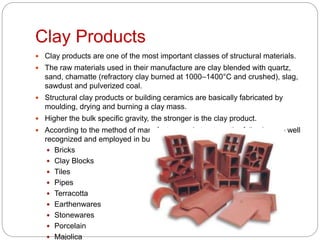
 Clay products are one of the most important classes of structural materials.
 The raw materials used in their manufacture are clay blended with quartz,
sand, chamatte (refractory clay burned at 1000–1400°C and crushed), slag,
sawdust and pulverized coal.
 Structural clay products or building ceramics are basically fabricated by
moulding, drying and burning a clay mass.
 Higher the bulk specific gravity, the stronger is the clay product.
 According to the method of manufacture and structure, the following are well
recognized and employed in building construction:
 Bricks
 Clay Blocks
 Tiles
 Pipes
 Terracotta
 Earthenwares
 Stonewares
 Porcelain
 Majolica
Bricks
 One of the oldest building material brick continues
to be a most popular and leading construction
material because of being cheap, durable and easy
to handle and work with.
 Clay bricks are used for building-up exterior and
interior walls, partitions, piers, footings and other
load bearing structures.
 A brick is rectangular in shape and of size that can
be conveniently handled with one hand.
 Brick may be made of burnt clay or mixture of sand
and lime or of Portland cement concrete.
 Clay bricks are commonly used since these are
economical and easily available. The length, width
and height of a brick are interrelated as below:
 Length of brick = 2 × width of brick + thickness of
mortar
 Height of brick = width of brick
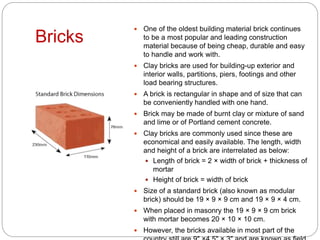
 Size of a standard brick (also known as modular
brick) should be 19 × 9 × 9 cm and 19 × 9 × 4 cm.
 When placed in masonry the 19 × 9 × 9 cm brick
with mortar becomes 20 × 10 × 10 cm.
 However, the bricks available in most part of the
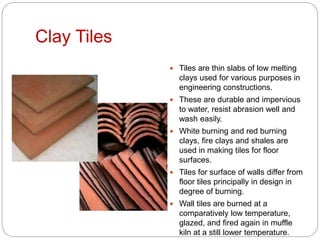
 Tiles are thin slabs of low melting
clays used for various purposes in
engineering constructions.
 These are durable and impervious
to water, resist abrasion well and
wash easily.
 White burning and red burning
clays, fire clays and shales are
used in making tiles for floor
surfaces.
 Tiles for surface of walls differ from
floor tiles principally in design in
degree of burning.
 Wall tiles are burned at a
comparatively low temperature,
glazed, and fired again in muffle
kiln at a still lower temperature.
Clay Tiles
Manufacture
 Tiles are made in the same
manner as bricks, but are
thinner and lighter, so require
greater care.
 These are manufactured from a
clay mass with or without
admixtures of colouring
impurities by moulding and
subsequent burning until baked,
up to about 1300 °C.
 The clay should be highly plastic
with lean admixtures and fusing
agents to lower the melting
point.
 These are moulded in machines
Flooring Tiles
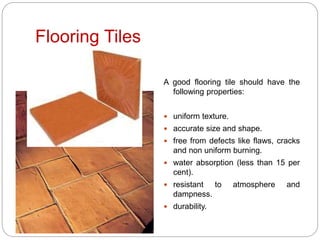
A good flooring tile should have the
following properties:
 uniform texture.
 accurate size and shape.
 free from defects like flaws, cracks
and non uniform burning.
 water absorption (less than 15 per
cent).
 resistant to atmosphere and
dampness.
 durability.
Roof Tiles
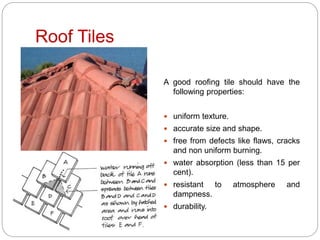
A good roofing tile should have the
following properties:
 uniform texture.
 accurate size and shape.
 free from defects like flaws, cracks
and non uniform burning.
 water absorption (less than 15 per
cent).
 resistant to atmosphere and
dampness.
 durability.
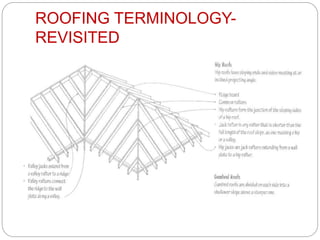
ROOFING TERMINOLOGY-
REVISITED
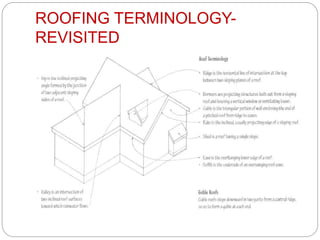
ROOFING TERMINOLOGY-
REVISITED
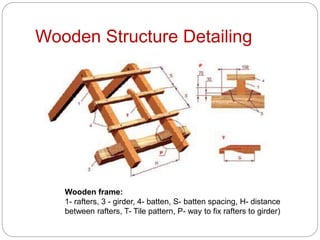
Wooden Structure Detailing
Wooden frame:
1- rafters, 3 - girder, 4- batten, S- batten spacing, H- distance
between rafters, T- Tile pattern, P- way to fix rafters to girder)
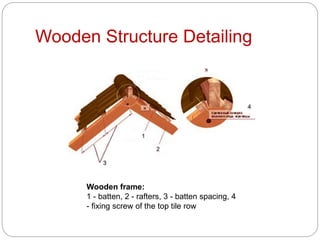
Wooden Structure Detailing
Wooden frame:
1 - batten, 2 - rafters, 3 - batten spacing, 4
- fixing screw of the top tile row
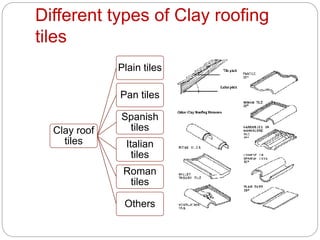
Different types of Clay roofing
tiles
Clay roof
tiles
Plain tiles
Pan tiles
Spanish
tiles
Italian
tiles
Roman
tiles
Others
UNITS
SCALE
NAME
YEAR/SEM
COLL
MAIN TITLE
UNIT NAME
DATE:
SHEET NO.:
BRICK CONS. TECH.12- BC SHEET SAMPLE
(PLEASE USE THIS FORMAT ONLY AS A SAMPLE REFER TO THE
DETAILS AND DO AS PER THE DESIGN PROBLEM GIVEN AND
FURNISH WITH ALL THE REQUIRED DIMENSIONING AND
LETTERING)
13

Construction Techniques using clay products

  • 1.
    UNIT-2-a Construction Techniques usingclay products BUILDING CONSTRUCTION-II SEMESTER-III 1
  • 2.
    Clay Products  Clayproducts are one of the most important classes of structural materials.  The raw materials used in their manufacture are clay blended with quartz, sand, chamatte (refractory clay burned at 1000–1400°C and crushed), slag, sawdust and pulverized coal.  Structural clay products or building ceramics are basically fabricated by moulding, drying and burning a clay mass.  Higher the bulk specific gravity, the stronger is the clay product.  According to the method of manufacture and structure, the following are well recognized and employed in building construction:  Bricks  Clay Blocks  Tiles  Pipes  Terracotta  Earthenwares  Stonewares  Porcelain  Majolica
  • 3.
    Bricks  One ofthe oldest building material brick continues to be a most popular and leading construction material because of being cheap, durable and easy to handle and work with.  Clay bricks are used for building-up exterior and interior walls, partitions, piers, footings and other load bearing structures.  A brick is rectangular in shape and of size that can be conveniently handled with one hand.  Brick may be made of burnt clay or mixture of sand and lime or of Portland cement concrete.  Clay bricks are commonly used since these are economical and easily available. The length, width and height of a brick are interrelated as below:  Length of brick = 2 × width of brick + thickness of mortar  Height of brick = width of brick  Size of a standard brick (also known as modular brick) should be 19 × 9 × 9 cm and 19 × 9 × 4 cm.  When placed in masonry the 19 × 9 × 9 cm brick with mortar becomes 20 × 10 × 10 cm.  However, the bricks available in most part of the
  • 4.
     Tiles arethin slabs of low melting clays used for various purposes in engineering constructions.  These are durable and impervious to water, resist abrasion well and wash easily.  White burning and red burning clays, fire clays and shales are used in making tiles for floor surfaces.  Tiles for surface of walls differ from floor tiles principally in design in degree of burning.  Wall tiles are burned at a comparatively low temperature, glazed, and fired again in muffle kiln at a still lower temperature. Clay Tiles
  • 5.
    Manufacture  Tiles aremade in the same manner as bricks, but are thinner and lighter, so require greater care.  These are manufactured from a clay mass with or without admixtures of colouring impurities by moulding and subsequent burning until baked, up to about 1300 °C.  The clay should be highly plastic with lean admixtures and fusing agents to lower the melting point.  These are moulded in machines
  • 6.
    Flooring Tiles A goodflooring tile should have the following properties:  uniform texture.  accurate size and shape.  free from defects like flaws, cracks and non uniform burning.  water absorption (less than 15 per cent).  resistant to atmosphere and dampness.  durability.
  • 7.
    Roof Tiles A goodroofing tile should have the following properties:  uniform texture.  accurate size and shape.  free from defects like flaws, cracks and non uniform burning.  water absorption (less than 15 per cent).  resistant to atmosphere and dampness.  durability.
  • 8.
  • 9.
  • 10.
    Wooden Structure Detailing Woodenframe: 1- rafters, 3 - girder, 4- batten, S- batten spacing, H- distance between rafters, T- Tile pattern, P- way to fix rafters to girder)
  • 11.
    Wooden Structure Detailing Woodenframe: 1 - batten, 2 - rafters, 3 - batten spacing, 4 - fixing screw of the top tile row
  • 12.
    Different types ofClay roofing tiles Clay roof tiles Plain tiles Pan tiles Spanish tiles Italian tiles Roman tiles Others
  • 13.
    UNITS SCALE NAME YEAR/SEM COLL MAIN TITLE UNIT NAME DATE: SHEETNO.: BRICK CONS. TECH.12- BC SHEET SAMPLE (PLEASE USE THIS FORMAT ONLY AS A SAMPLE REFER TO THE DETAILS AND DO AS PER THE DESIGN PROBLEM GIVEN AND FURNISH WITH ALL THE REQUIRED DIMENSIONING AND LETTERING) 13