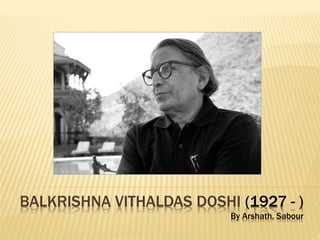
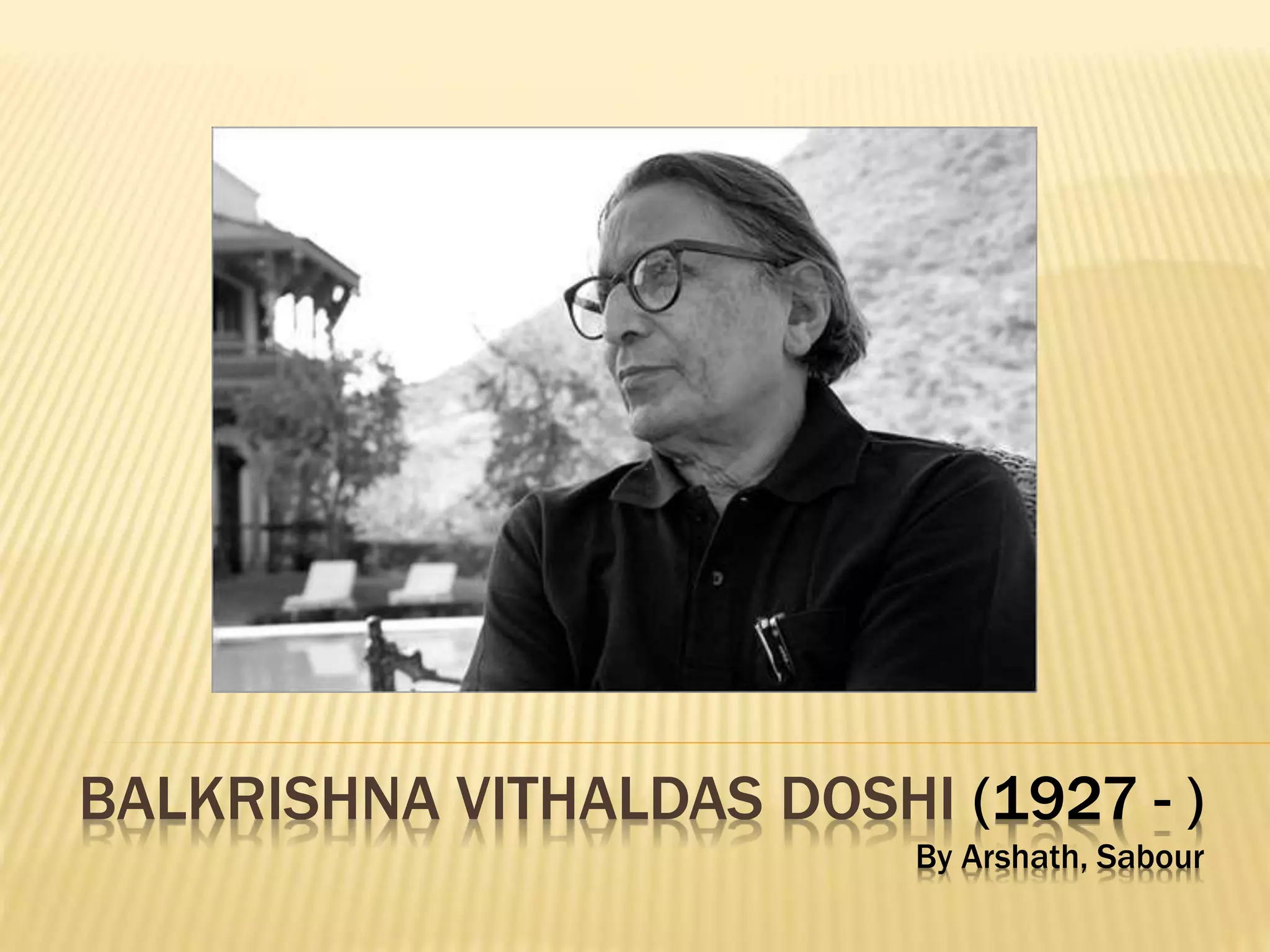
BALKRISHNA VITHALDAS DOSHI (1927 - )
By Arshath, Sabour
BACKGROUND
 BV Doshi studied at the Sir JJ School of
Architecture
 1951-4 – Worked for Le Corbusier in Paris
 1954-7 – Returned back to India as Site architect
for Chandigarh
 1964-72 – Worked for Louis I Khan as site
architect in IIM project
 1965 – Founded the Center for Environmental
Planning and Technology (CEPT) in Ahmedabad
PHILOSOPHY
 BV Doshi had a influence in Northern India as
educator and designer, not only as transmitter
of Le Corbusier’s and Louis I Khan’s
philosophy but also in providing exemplar of
work for others to follow.
 He was concerned with the Indian context to a
greater extent, providing a quality
environment rather than modern buildings
AWARDS
 He has received numerous international awards
and honors, including Padma Shri from the
Government of India, and an honorary doctorate
from the University of Pennsylvania, U.S.A.
 Professor Doshi served a member of the 1992
Award Master Jury, and was presented a 1995
Aga Khan Award for Architecture for the Aranya
Community Housing in Indore, India.
PROJECTS
1. Institute of Indology
Ahmadabad 1957-62
2. School of Architecture
Ahmadabad 1968
3. Gujarat State Fertilizers Corporation
Baroda 1964-69
4. Indian Institute of Management
Bangalore 1977-85
5. Madhya Pradesh Electricity Board
Jabalpur 1979-89
PROJECTS
6. Sangath
Ahmedabad 1979-81
7. Gandhi Labour Institute
Ahmedabad 1980-84
8. Aranya Low-cost Housing
Indore 1983-86
9. Husain-Doshi Gufa
Ahmedabad 1992-95
10. National Institute of Fashion Technology
New Delhi 1997
11.Bharat Diamond Bourse
Mumbai 1998
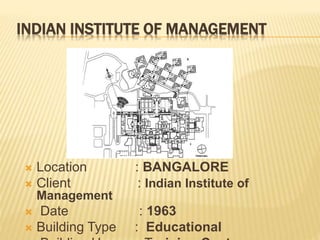
INDIAN INSTITUTE OF MANAGEMENT
 Location : BANGALORE
 Client : Indian Institute of
Management
 Date : 1963
 Building Type : Educational
INDIAN INSTITUTE OF MANAGEMENT
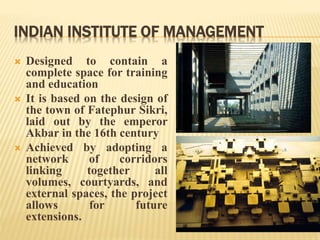
 Designed to contain a
complete space for training
and education
 It is based on the design of
the town of Fatephur Sikri,
laid out by the emperor
Akbar in the 16th century
 Achieved by adopting a
network of corridors
linking together all
volumes, courtyards, and
external spaces, the project
allows for future
extensions.
INDIAN INSTITUTE OF MANAGEMENT
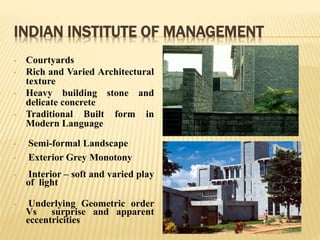
• Courtyards
• Rich and Varied Architectural
texture
• Heavy building stone and
delicate concrete
• Traditional Built form in
Modern Language
• Semi-formal Landscape
• Exterior Grey Monotony
• Interior – soft and varied play
of light
• Underlying Geometric order
Vs surprise and apparent
eccentricities
SANGATH, ARCHITECT’S OWN OFFICE
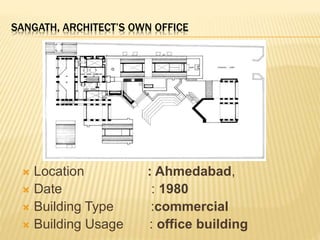
 Location : Ahmedabad,
 Date : 1980
 Building Type :commercial
 Building Usage : office building
SANGATH
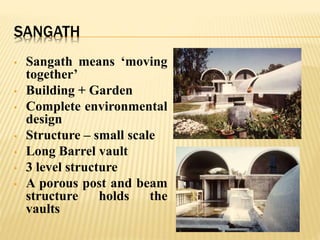
• Sangath means ‘moving
together’
• Building + Garden
• Complete environmental
design
• Structure – small scale
• Long Barrel vault
• 3 level structure
• A porous post and beam
structure holds the
vaults
SANGATH
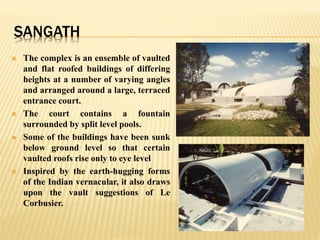
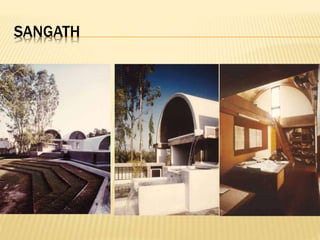
 The complex is an ensemble of vaulted
and flat roofed buildings of differing
heights at a number of varying angles
and arranged around a large, terraced
entrance court.
 The court contains a fountain
surrounded by split level pools.
 Some of the buildings have been sunk
below ground level so that certain
vaulted roofs rise only to eye level
 Inspired by the earth-hugging forms
of the Indian vernacular, it also draws
upon the vault suggestions of Le
Corbusier.
SANGATH
HUSAIN-DOSHI GUFA ART GALLERY
 Location : Ahmedabad
 Client : Maqbul Fida Husain
 Date : 1993
 Building Type : public/cultural
 Building Usage : art gallery
HUSAIN-DOSHI GUFA ART GALLERY
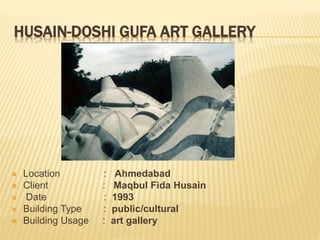
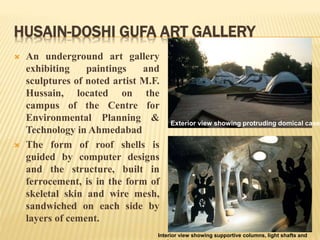
 An underground art gallery
exhibiting paintings and
sculptures of noted artist M.F.
Hussain, located on the
campus of the Centre for
Environmental Planning &
Technology in Ahmedabad
 The form of roof shells is
guided by computer designs
and the structure, built in
ferrocement, is in the form of
skeletal skin and wire mesh,
sandwiched on each side by
layers of cement.
Interior view showing supportive columns, light shafts and
Exterior view showing protruding domical caves
HUSAIN-DOSHI GUFA ART GALLERY
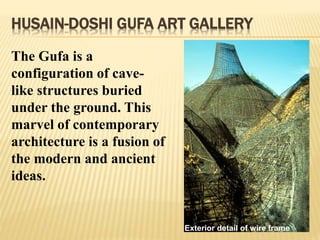
Exterior detail of wire frame
The Gufa is a
configuration of cave-
like structures buried
under the ground. This
marvel of contemporary
architecture is a fusion of
the modern and ancient
ideas.
HUSAIN-DOSHI GUFA ART GALLERY
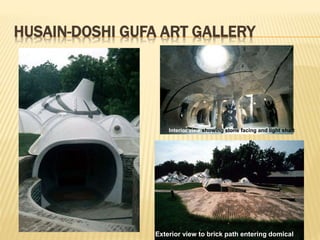
Interior view showing stone facing and light shaft
Exterior view to brick path entering domical
INFERENCE
 BV Doshi uses a mix of two philosophies
combined with his own research and application
of contextual factors – like economical viable
policy solutions, Ferro-cement and china- mosaic
etc..
BIBLIOGRAPHY
× www.archnet.org
× THE COMPLETE ARCHITECTURE OF
BALAKRISHNA DOSHI
BY JAMES STEELE

B.V. DOSHI

  • 1.
    BALKRISHNA VITHALDAS DOSHI(1927 - ) By Arshath, Sabour
  • 2.
    BACKGROUND  BV Doshistudied at the Sir JJ School of Architecture  1951-4 – Worked for Le Corbusier in Paris  1954-7 – Returned back to India as Site architect for Chandigarh  1964-72 – Worked for Louis I Khan as site architect in IIM project  1965 – Founded the Center for Environmental Planning and Technology (CEPT) in Ahmedabad
  • 3.
    PHILOSOPHY  BV Doshihad a influence in Northern India as educator and designer, not only as transmitter of Le Corbusier’s and Louis I Khan’s philosophy but also in providing exemplar of work for others to follow.  He was concerned with the Indian context to a greater extent, providing a quality environment rather than modern buildings
  • 4.
    AWARDS  He hasreceived numerous international awards and honors, including Padma Shri from the Government of India, and an honorary doctorate from the University of Pennsylvania, U.S.A.  Professor Doshi served a member of the 1992 Award Master Jury, and was presented a 1995 Aga Khan Award for Architecture for the Aranya Community Housing in Indore, India.
  • 5.
    PROJECTS 1. Institute ofIndology Ahmadabad 1957-62 2. School of Architecture Ahmadabad 1968 3. Gujarat State Fertilizers Corporation Baroda 1964-69 4. Indian Institute of Management Bangalore 1977-85 5. Madhya Pradesh Electricity Board Jabalpur 1979-89
  • 6.
    PROJECTS 6. Sangath Ahmedabad 1979-81 7.Gandhi Labour Institute Ahmedabad 1980-84 8. Aranya Low-cost Housing Indore 1983-86 9. Husain-Doshi Gufa Ahmedabad 1992-95 10. National Institute of Fashion Technology New Delhi 1997 11.Bharat Diamond Bourse Mumbai 1998
  • 7.
    INDIAN INSTITUTE OFMANAGEMENT  Location : BANGALORE  Client : Indian Institute of Management  Date : 1963  Building Type : Educational
  • 8.
    INDIAN INSTITUTE OFMANAGEMENT  Designed to contain a complete space for training and education  It is based on the design of the town of Fatephur Sikri, laid out by the emperor Akbar in the 16th century  Achieved by adopting a network of corridors linking together all volumes, courtyards, and external spaces, the project allows for future extensions.
  • 9.
    INDIAN INSTITUTE OFMANAGEMENT • Courtyards • Rich and Varied Architectural texture • Heavy building stone and delicate concrete • Traditional Built form in Modern Language • Semi-formal Landscape • Exterior Grey Monotony • Interior – soft and varied play of light • Underlying Geometric order Vs surprise and apparent eccentricities
  • 10.
    SANGATH, ARCHITECT’S OWNOFFICE  Location : Ahmedabad,  Date : 1980  Building Type :commercial  Building Usage : office building
  • 11.
    SANGATH • Sangath means‘moving together’ • Building + Garden • Complete environmental design • Structure – small scale • Long Barrel vault • 3 level structure • A porous post and beam structure holds the vaults
  • 12.
    SANGATH  The complexis an ensemble of vaulted and flat roofed buildings of differing heights at a number of varying angles and arranged around a large, terraced entrance court.  The court contains a fountain surrounded by split level pools.  Some of the buildings have been sunk below ground level so that certain vaulted roofs rise only to eye level  Inspired by the earth-hugging forms of the Indian vernacular, it also draws upon the vault suggestions of Le Corbusier.
  • 13.
  • 14.
    HUSAIN-DOSHI GUFA ARTGALLERY  Location : Ahmedabad  Client : Maqbul Fida Husain  Date : 1993  Building Type : public/cultural  Building Usage : art gallery
  • 15.
    HUSAIN-DOSHI GUFA ARTGALLERY  An underground art gallery exhibiting paintings and sculptures of noted artist M.F. Hussain, located on the campus of the Centre for Environmental Planning & Technology in Ahmedabad  The form of roof shells is guided by computer designs and the structure, built in ferrocement, is in the form of skeletal skin and wire mesh, sandwiched on each side by layers of cement. Interior view showing supportive columns, light shafts and Exterior view showing protruding domical caves
  • 16.
    HUSAIN-DOSHI GUFA ARTGALLERY Exterior detail of wire frame The Gufa is a configuration of cave- like structures buried under the ground. This marvel of contemporary architecture is a fusion of the modern and ancient ideas.
  • 17.
    HUSAIN-DOSHI GUFA ARTGALLERY Interior view showing stone facing and light shaft Exterior view to brick path entering domical
  • 18.
    INFERENCE  BV Doshiuses a mix of two philosophies combined with his own research and application of contextual factors – like economical viable policy solutions, Ferro-cement and china- mosaic etc..
  • 19.
    BIBLIOGRAPHY × www.archnet.org × THECOMPLETE ARCHITECTURE OF BALAKRISHNA DOSHI BY JAMES STEELE