Done by: Sugar Ruizo
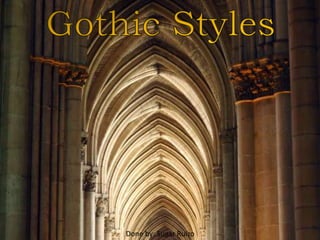
Gothic
Architecture
The style of architecture originating in France in the
12th century and existing in the western hall of Europe
through the middle of the 16th century, characterized by
building of great cathedrals, a progressive lightening of
structure, and the use of the pointed arch, ribbed vault
and a system of richly decorated fenestration.
•Three different phases of “The French Style”:
-- Early French Style
-- Rayonnant Style
-- Flamboyant Style
Early French
Styles
• The first three
phases of French
Gothic
architecture,
characterized by
the pointed arch
and geometry
tracery.
Saint Denis Basilica
Saint Denis
Basilica
Location: Paris, France
Commemorated by:
St. Denis the first bishop
in Paris
Completed :in 1144
Designed by: Abbé Suger
Abbé Suger
(French: [syʒe]; c. 1081 – 13
January 1151)
was one of the
last French abbot-statesmen,
a historian, and the
influential first patron
of Gothic architecture.
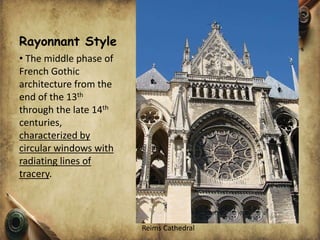
Rayonnant Style
• The middle phase of
French Gothic
architecture from the
end of the 13th
through the late 14th
centuries,
characterized by
circular windows with
radiating lines of
tracery.
Reims Cathedral
Notre-Dame de Reims
Architectural type: Church
Architectural style: French Gothic
Groundbreaking: 1211
Completed: 1275
Architects: Jean d'Orbais, Jean-
de Chelles, and Bernard de
Soissons
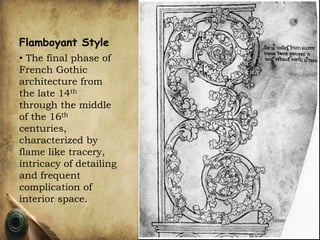
Flamboyant Style
• The final phase of
French Gothic
architecture from
the late 14th
through the middle
of the 16th
centuries,
characterized by
flame like tracery,
intricacy of detailing
and frequent
complication of
interior space.
Villard de Honnecourt (Wilars dehonecort, fol. 1v; Vilars de
Honecourt, fol. 15v) was a 13th-century artist
from Picardy in northern France. He is known to history
only through a surviving portfolio of 33 sheets
of parchment containing about 250 drawings dating from
the 1220s/1240s, now in the Bibliothèque
Nationale, Paris (MS Fr 19093). The great variety of subjects
(religious and secular figures suitable for sculpture,
and architectural plans, elevations and
details, ecclesiastical objects and mechanical devices, some
with annotations), makes it difficult to determine its
purpose. Other subjects such as animals and human
figures also appear.
Villard de Honnecourt
English Gothic Style
Early English Style
• The first of the
three phases of
English Gothic
architecture from
the late 12th
through the 13th
centuries,
characterized by the
lancet window and
plate tracery.
Decorated Style
• The second of the
three phases of
English Gothic
architecture from
the late 13th
through the late
14th centuries,
characterized by
rich tracery,
elaborate
ornamental
vaulting, and
refinement of stone
cutting techniques.
Durham cathedral
Durham Cathedral
Location: Durham, England
Length: 469 feet (143 m)
(interior)
Nave: width81 feet (25 m)
(inc aisles)
Nave: height73 feet (22 m)
Perpendicular Style
• The final phase of
English gothic
architecture
prevailing from the
late 14th through
the early 16th
centuries,
characterized by
perpendicular
tracery, fine
intricate stone work
and elaborate fan
vaults. Also called
Rectilinear Style.
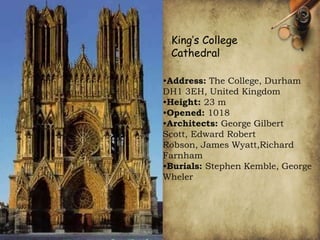
King’s College Cathedral
•Address: The College, Durham
DH1 3EH, United Kingdom
•Height: 23 m
•Opened: 1018
•Architects: George Gilbert
Scott, Edward Robert
Robson, James Wyatt,Richard
Farnham
•Burials: Stephen Kemble, George
Wheler
King’s College
Cathedral
Sir George Gilbert Scott,
styled Sir Gilbert Scott,
was an English Gothic
revival architect, chiefly
associated with the
design, building and
renovation of churches
and cathedrals, although
he started his career as a
leading designer of
workhouses.
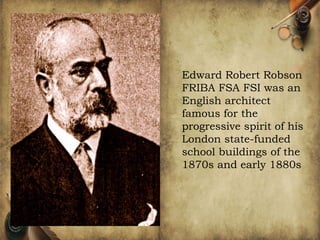
Edward Robert Robson
FRIBA FSA FSI was an
English architect
famous for the
progressive spirit of his
London state-funded
school buildings of the
1870s and early 1880s
James Wyatt
Gothic Revival
• A movement aimed at reviving the spirit and forms of Gothic
architecture, originating in the late 18th century and but
flourishing mainly in the 19th century in France, Germany,
England and to the lesser extent in U.S. Gothic remained the
accepted styles for churches well into the 20th century.
Victorian in this sense refers to a period in the mid-
to-late 19th century that features a series
of architectural revival styles. The name "Victorian"
refers to the reign of Queen Victoria (1837–1901),
called the Victorian era, during which period the
styles known as Victorian were used in construction.
The styles often included interpretations
and eclectic revivals of historic styles.
Victorian Gothic
Architecture
St. Pancras railway
station and Midland
Hotel in London, opened
in 1868, is an example
of the Gothic
Revival style of
architecture
with Ruskinian influenc
es. The station
eclectically combined
elements of Gothic
architecture and other
styles with materials
and scale made
possible by the
Industrial Revolution.

Gothic styles

  • 1.
  • 2.
    Gothic Architecture The style ofarchitecture originating in France in the 12th century and existing in the western hall of Europe through the middle of the 16th century, characterized by building of great cathedrals, a progressive lightening of structure, and the use of the pointed arch, ribbed vault and a system of richly decorated fenestration. •Three different phases of “The French Style”: -- Early French Style -- Rayonnant Style -- Flamboyant Style
  • 3.
    Early French Styles • Thefirst three phases of French Gothic architecture, characterized by the pointed arch and geometry tracery. Saint Denis Basilica
  • 4.
    Saint Denis Basilica Location: Paris,France Commemorated by: St. Denis the first bishop in Paris Completed :in 1144 Designed by: Abbé Suger
  • 5.
    Abbé Suger (French: [syʒe];c. 1081 – 13 January 1151) was one of the last French abbot-statesmen, a historian, and the influential first patron of Gothic architecture.
  • 6.
    Rayonnant Style • Themiddle phase of French Gothic architecture from the end of the 13th through the late 14th centuries, characterized by circular windows with radiating lines of tracery. Reims Cathedral
  • 7.
    Notre-Dame de Reims Architecturaltype: Church Architectural style: French Gothic Groundbreaking: 1211 Completed: 1275 Architects: Jean d'Orbais, Jean- de Chelles, and Bernard de Soissons
  • 8.
    Flamboyant Style • Thefinal phase of French Gothic architecture from the late 14th through the middle of the 16th centuries, characterized by flame like tracery, intricacy of detailing and frequent complication of interior space.
  • 9.
    Villard de Honnecourt(Wilars dehonecort, fol. 1v; Vilars de Honecourt, fol. 15v) was a 13th-century artist from Picardy in northern France. He is known to history only through a surviving portfolio of 33 sheets of parchment containing about 250 drawings dating from the 1220s/1240s, now in the Bibliothèque Nationale, Paris (MS Fr 19093). The great variety of subjects (religious and secular figures suitable for sculpture, and architectural plans, elevations and details, ecclesiastical objects and mechanical devices, some with annotations), makes it difficult to determine its purpose. Other subjects such as animals and human figures also appear.
  • 10.
  • 11.
  • 12.
    Early English Style •The first of the three phases of English Gothic architecture from the late 12th through the 13th centuries, characterized by the lancet window and plate tracery.
  • 13.
    Decorated Style • Thesecond of the three phases of English Gothic architecture from the late 13th through the late 14th centuries, characterized by rich tracery, elaborate ornamental vaulting, and refinement of stone cutting techniques. Durham cathedral
  • 14.
    Durham Cathedral Location: Durham,England Length: 469 feet (143 m) (interior) Nave: width81 feet (25 m) (inc aisles) Nave: height73 feet (22 m)
  • 15.
    Perpendicular Style • Thefinal phase of English gothic architecture prevailing from the late 14th through the early 16th centuries, characterized by perpendicular tracery, fine intricate stone work and elaborate fan vaults. Also called Rectilinear Style. King’s College Cathedral
  • 16.
    •Address: The College,Durham DH1 3EH, United Kingdom •Height: 23 m •Opened: 1018 •Architects: George Gilbert Scott, Edward Robert Robson, James Wyatt,Richard Farnham •Burials: Stephen Kemble, George Wheler King’s College Cathedral
  • 17.
    Sir George GilbertScott, styled Sir Gilbert Scott, was an English Gothic revival architect, chiefly associated with the design, building and renovation of churches and cathedrals, although he started his career as a leading designer of workhouses.
  • 18.
    Edward Robert Robson FRIBAFSA FSI was an English architect famous for the progressive spirit of his London state-funded school buildings of the 1870s and early 1880s
  • 19.
  • 20.
    Gothic Revival • Amovement aimed at reviving the spirit and forms of Gothic architecture, originating in the late 18th century and but flourishing mainly in the 19th century in France, Germany, England and to the lesser extent in U.S. Gothic remained the accepted styles for churches well into the 20th century.
  • 21.
    Victorian in thissense refers to a period in the mid- to-late 19th century that features a series of architectural revival styles. The name "Victorian" refers to the reign of Queen Victoria (1837–1901), called the Victorian era, during which period the styles known as Victorian were used in construction. The styles often included interpretations and eclectic revivals of historic styles. Victorian Gothic Architecture
  • 22.
    St. Pancras railway stationand Midland Hotel in London, opened in 1868, is an example of the Gothic Revival style of architecture with Ruskinian influenc es. The station eclectically combined elements of Gothic architecture and other styles with materials and scale made possible by the Industrial Revolution.