Role of Quality System and Audit in
Pharmaceutical
Manufacturing environment
CONTENTS
Introduction
Quality System Approach
Management Responsibilities
Resources
Reference
Introduction
• This presentation describes outlines and discusses the regulations
applicable to the QA function and unit, structure, function and
application of the unit in the pharmaceutical manufacturing
environment. In addition, it discusses additional quality – related
responsibilities that may result when manufactures move toward a
quality system approach to quality that incorporates current quality
system models to further improve quality and harmonize with inter-
national quality requirements.
• The QA audit are also described, including preparation, key items
interest, a typical checklist of the audit itself, corrective and prevent
actions following the audit, and suggested measures for assuring
successful operation of the unit.
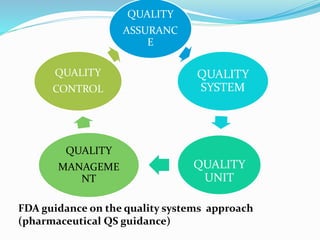
QUALITY
ASSURANC
E
QUALITY
SYSTEM
QUALITY
UNIT
QUALITY
MANAGEME
NT
QUALITY
CONTROL
FDA guidance on the quality systems approach
(pharmaceutical QS guidance)
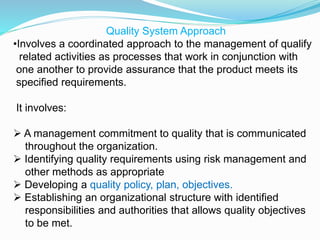
Quality System Approach
•Involves a coordinated approach to the management of qualify
related activities as processes that work in conjunction with
one another to provide assurance that the product meets its
specified requirements.
It involves:
 A management commitment to quality that is communicated
throughout the organization.
 Identifying quality requirements using risk management and
other methods as appropriate
 Developing a quality policy, plan, objectives.
 Establishing an organizational structure with identified
responsibilities and authorities that allows quality objectives
to be met.
 Providing the resources needed to meet quality objectives
 Developing the required systems and processes
 Establishing methods for the ongoing objectives evaluation of
the performance of systems and processes including quality
auditing
 Initiating corrective and preventive actions as needed to
assure that quality objectives are consistently and reliably
met.
• The use of risk management techniques
 Identifying product requirements
 Establishing processes and process control and monitoring
methods
 Evaluating quality data, identifying appropriate corrective &
preventive actions to address quality problems.
 and for other quality related activities can increase the overall
efficiency and effectiveness of the quality system,
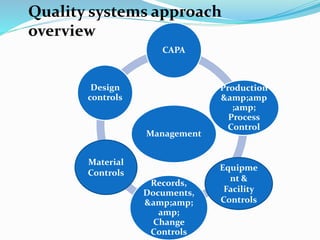
Quality systems approach
overview
Management
CAPA
Production
&amp
;amp;
Process
Control
Records,
Documents,
&
amp;
Change
Controls
Design
controls
Material
Controls
Equipme
nt &
Facility
Controls
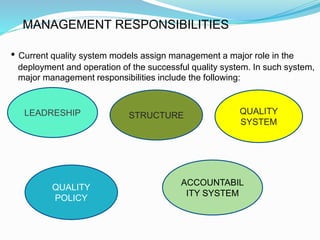
MANAGEMENT RESPONSIBILITIES
• Current quality system models assign management a major role in the
deployment and operation of the successful quality system. In such system,
major management responsibilities include the following:
LEADRESHIP STRUCTURE QUALITY
SYSTEM
QUALITY
POLICY
ACCOUNTABIL
ITY SYSTEM
5.6: MANAGEMENT REVIEW
5.1 Management Commitment
Top management shall provide evidence of its
Commitment to the development and implementation
of the QMS and continually improving its effectiveness
By:-
a) Communicating to the organization the importance
of meeting customer as well as statutory and
regulatory requirements.
b) Establishing the quality policy
c) Conducting management reviews.
d) Ensuring the availability of resources.
5.2 Customer focus
Top management shall ensure that customer requiremen
are determined and are met with the aim of enhancin
customer satisfaction.
Quality Policy
• Top management shall ensure that the quality policy:-
a) Is appropriate to the purpose of the organization
b) Provides a framework for establishing and reviewing quality
objectives
c) Is communicated and understood within the organization
d) Is reviewed for continuing suitability.
Quality Objectives
• Shall follow SMART Rules:
-Specific
-Measurable
-Attainable
-Relevent
-Time-framed
5.5.1 Responsibility and authority
Top management shall ensure that responsibilities and
Authorities are defined and communicated within the
Organization.
Internal Communication
Top management shall ensure that appropriate communication
processes are established within the organization and that
communication takes place regarding the effectiveness of
the quality management system.
Review input
Review shall include information on :-
a) Results of audits,
b) Customer feedback,
c) Process performance and product conformity,
d) Status of CAPA,
e) Follow-up actions from previous management reviews,
f) Recommendations for improvement.
Review output
• The output from the management review shall include any
decisions and actions related to………
a) Improvement of the effectiveness of the quality
b) Improvement of product related to customer requirements,
c) Resource needs
Resources
The major resources used by organizations are often
described as follow:
1. Human Resources
2. Financial Resources
3. Physical Resources
4. Information resources
Managers are responsible for acquiring and managing
the resources to accomplish goals.
Human Resources
 Ensuring adequacy particularly in respect of training
 Infrastructure
 Building, work space, equipment, vehicles, information systems etc.
 Environmental controls ( Aligned with ISO14000)
Financial Resources
The resources from which the enterprises obtain the funds
They need to finance their investments, capital and current
Activites.
E.g. Cash, Bank deposits etc.
Physical Resources
The physical resources of a business include all the
tangible resources owned and used by a company such
as Land, manufacturing equipment and office equipment.
Land, building, water and water right .
Machinery and manufacturing equipments.
Vehicles and distribution networks.
Information resources
It is the planning, budgeting, organizing, directing, training
and control associated with an organization’s information
The term encompasses both information itself and the
Reference
•Siegel E.B.; Barquest J.M.; et al, Pharmaceutical
Manufacturing Handbook, John Wiley Publication
Pg. No. 202 – 212
• Kaur J. Quality audit: Introduction, types and procedure.
Pharma Pathway; 2017. Available from: http://pharmapathway
.com/quality-audit-introductiontypes-and-procedure/.
Quality System and Audit.pptx

Quality System and Audit.pptx

  • 1.
    Role of QualitySystem and Audit in Pharmaceutical Manufacturing environment
  • 2.
  • 3.
    Introduction • This presentationdescribes outlines and discusses the regulations applicable to the QA function and unit, structure, function and application of the unit in the pharmaceutical manufacturing environment. In addition, it discusses additional quality – related responsibilities that may result when manufactures move toward a quality system approach to quality that incorporates current quality system models to further improve quality and harmonize with inter- national quality requirements. • The QA audit are also described, including preparation, key items interest, a typical checklist of the audit itself, corrective and prevent actions following the audit, and suggested measures for assuring successful operation of the unit.
  • 4.
  • 5.
    Quality System Approach •Involvesa coordinated approach to the management of qualify related activities as processes that work in conjunction with one another to provide assurance that the product meets its specified requirements. It involves:  A management commitment to quality that is communicated throughout the organization.  Identifying quality requirements using risk management and other methods as appropriate  Developing a quality policy, plan, objectives.  Establishing an organizational structure with identified responsibilities and authorities that allows quality objectives to be met.
  • 6.
     Providing theresources needed to meet quality objectives  Developing the required systems and processes  Establishing methods for the ongoing objectives evaluation of the performance of systems and processes including quality auditing  Initiating corrective and preventive actions as needed to assure that quality objectives are consistently and reliably met. • The use of risk management techniques  Identifying product requirements  Establishing processes and process control and monitoring methods  Evaluating quality data, identifying appropriate corrective & preventive actions to address quality problems.  and for other quality related activities can increase the overall efficiency and effectiveness of the quality system,
  • 7.
  • 8.
    MANAGEMENT RESPONSIBILITIES • Currentquality system models assign management a major role in the deployment and operation of the successful quality system. In such system, major management responsibilities include the following: LEADRESHIP STRUCTURE QUALITY SYSTEM QUALITY POLICY ACCOUNTABIL ITY SYSTEM
  • 9.
  • 10.
    5.1 Management Commitment Topmanagement shall provide evidence of its Commitment to the development and implementation of the QMS and continually improving its effectiveness By:- a) Communicating to the organization the importance of meeting customer as well as statutory and regulatory requirements. b) Establishing the quality policy c) Conducting management reviews. d) Ensuring the availability of resources.
  • 11.
    5.2 Customer focus Topmanagement shall ensure that customer requiremen are determined and are met with the aim of enhancin customer satisfaction.
  • 12.
    Quality Policy • Topmanagement shall ensure that the quality policy:- a) Is appropriate to the purpose of the organization b) Provides a framework for establishing and reviewing quality objectives c) Is communicated and understood within the organization d) Is reviewed for continuing suitability.
  • 13.
    Quality Objectives • Shallfollow SMART Rules: -Specific -Measurable -Attainable -Relevent -Time-framed
  • 14.
    5.5.1 Responsibility andauthority Top management shall ensure that responsibilities and Authorities are defined and communicated within the Organization.
  • 15.
    Internal Communication Top managementshall ensure that appropriate communication processes are established within the organization and that communication takes place regarding the effectiveness of the quality management system.
  • 16.
    Review input Review shallinclude information on :- a) Results of audits, b) Customer feedback, c) Process performance and product conformity, d) Status of CAPA, e) Follow-up actions from previous management reviews, f) Recommendations for improvement.
  • 17.
    Review output • Theoutput from the management review shall include any decisions and actions related to……… a) Improvement of the effectiveness of the quality b) Improvement of product related to customer requirements, c) Resource needs
  • 18.
    Resources The major resourcesused by organizations are often described as follow: 1. Human Resources 2. Financial Resources 3. Physical Resources 4. Information resources Managers are responsible for acquiring and managing the resources to accomplish goals.
  • 19.
    Human Resources  Ensuringadequacy particularly in respect of training  Infrastructure  Building, work space, equipment, vehicles, information systems etc.  Environmental controls ( Aligned with ISO14000) Financial Resources The resources from which the enterprises obtain the funds They need to finance their investments, capital and current Activites. E.g. Cash, Bank deposits etc.
  • 20.
    Physical Resources The physicalresources of a business include all the tangible resources owned and used by a company such as Land, manufacturing equipment and office equipment. Land, building, water and water right . Machinery and manufacturing equipments. Vehicles and distribution networks. Information resources It is the planning, budgeting, organizing, directing, training and control associated with an organization’s information The term encompasses both information itself and the
  • 21.
    Reference •Siegel E.B.; BarquestJ.M.; et al, Pharmaceutical Manufacturing Handbook, John Wiley Publication Pg. No. 202 – 212 • Kaur J. Quality audit: Introduction, types and procedure. Pharma Pathway; 2017. Available from: http://pharmapathway .com/quality-audit-introductiontypes-and-procedure/.