
Presented By
POOJA S. KESARI
 GMP regulations were introduced in the form of
amended Schedule M in 1988 has again been amended
in a major way by the Drug and Cosmetic Rules,2001.
 That embraces Rules71,74,76 and 78 under the Drug
and Cosmetic Rules,1945.
 This rules were not to apply to the manufacturers who
are licensed to manufacture drugs for period up to 31st
December,2004.
 The GMP guidelines are a means to assure the
QUALITY of the drug.
 Provides a high level assurance that medicines are
manufactured in a way that ensures their SAFETY,
EFFICACY and QUALITY.
 Medicines are manufactured such that they comply
with their marketing authorization.
 QUALITY is built in..
 Design and construct the facilities and equipments
properly.
 Follow written procedures instructions.
 Document work involves SOP,BMR,MFRetc.
 Validate work
 Monitor facilities and equipment
 Write step by step operating procedures and work on
instructions
 Design, an demonstrate job competence
 Protect against contamination.
 Control components and product related process
 Conduct planned and periodic audits
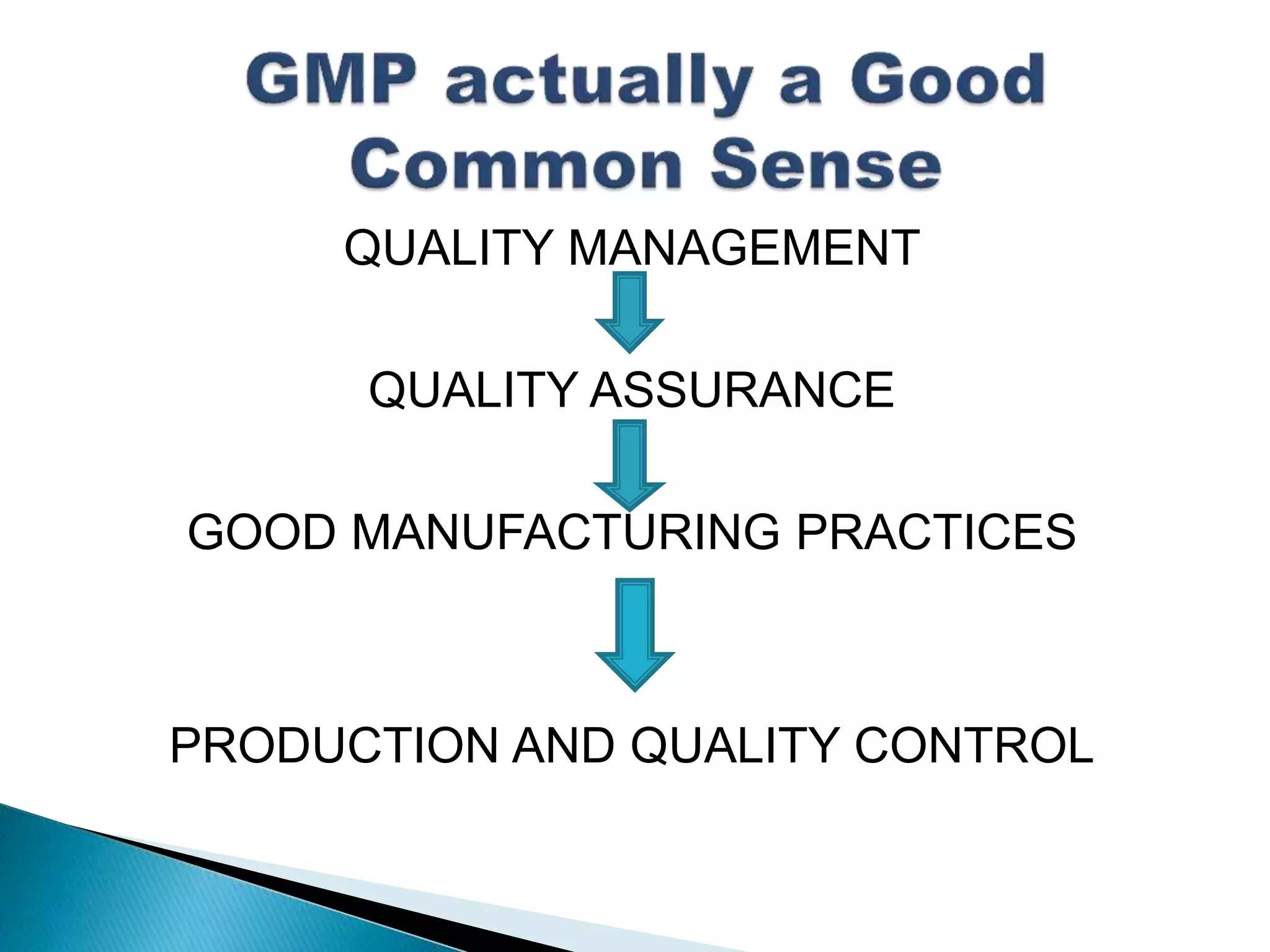
QUALITY MANAGEMENT
QUALITY ASSURANCE
GOOD MANUFACTURING PRACTICES
PRODUCTION AND QUALITY CONTROL
 General Requirements
-Location and Surroundings
-Buildings and Premises
-Water System
-Disposal of Waste
 Ware Housing Area
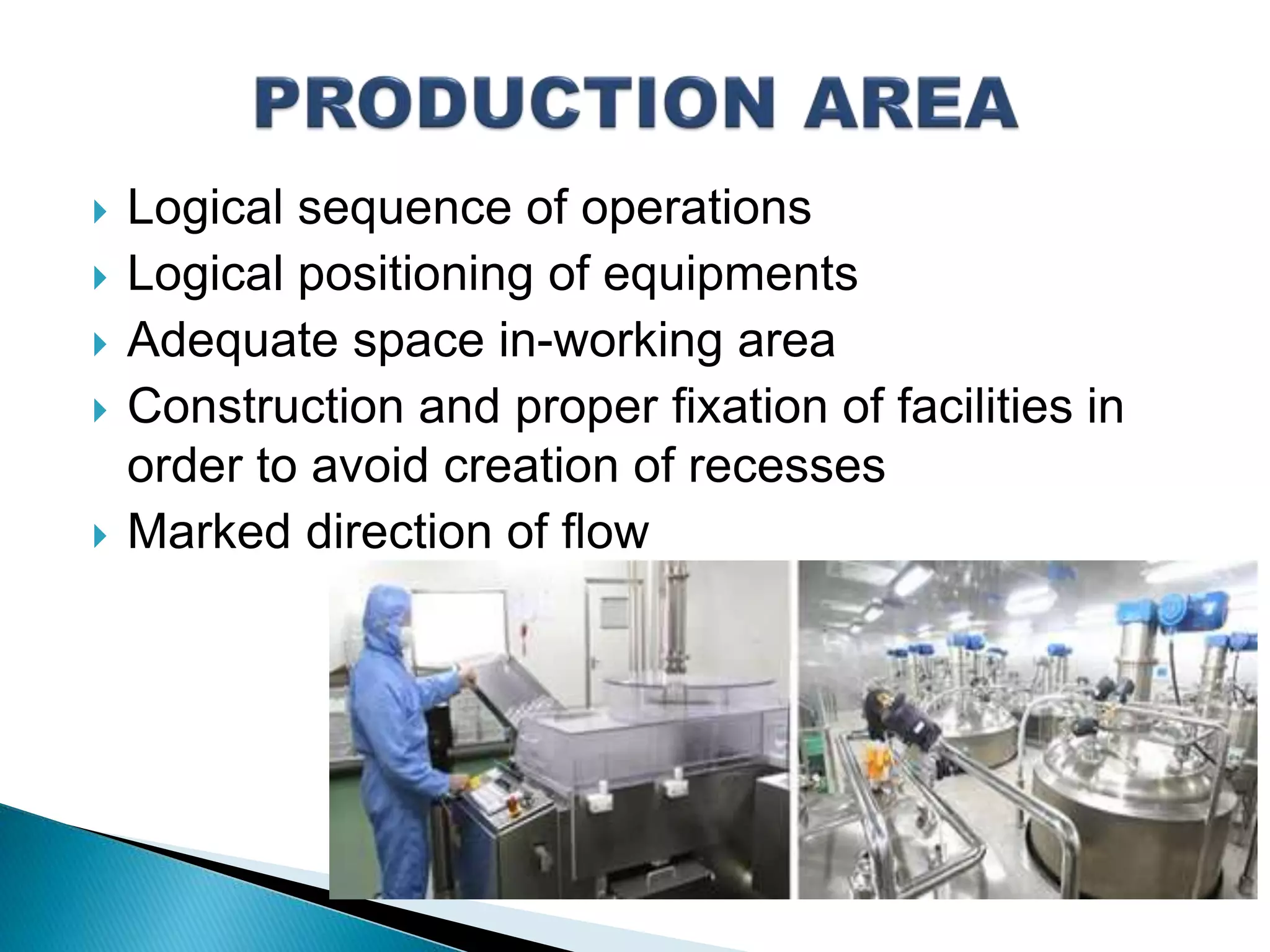
 Production Area
 Ancillary Area
 Quality Control Area
 Personnel
 Health, Clothing and Sanitation of Workers
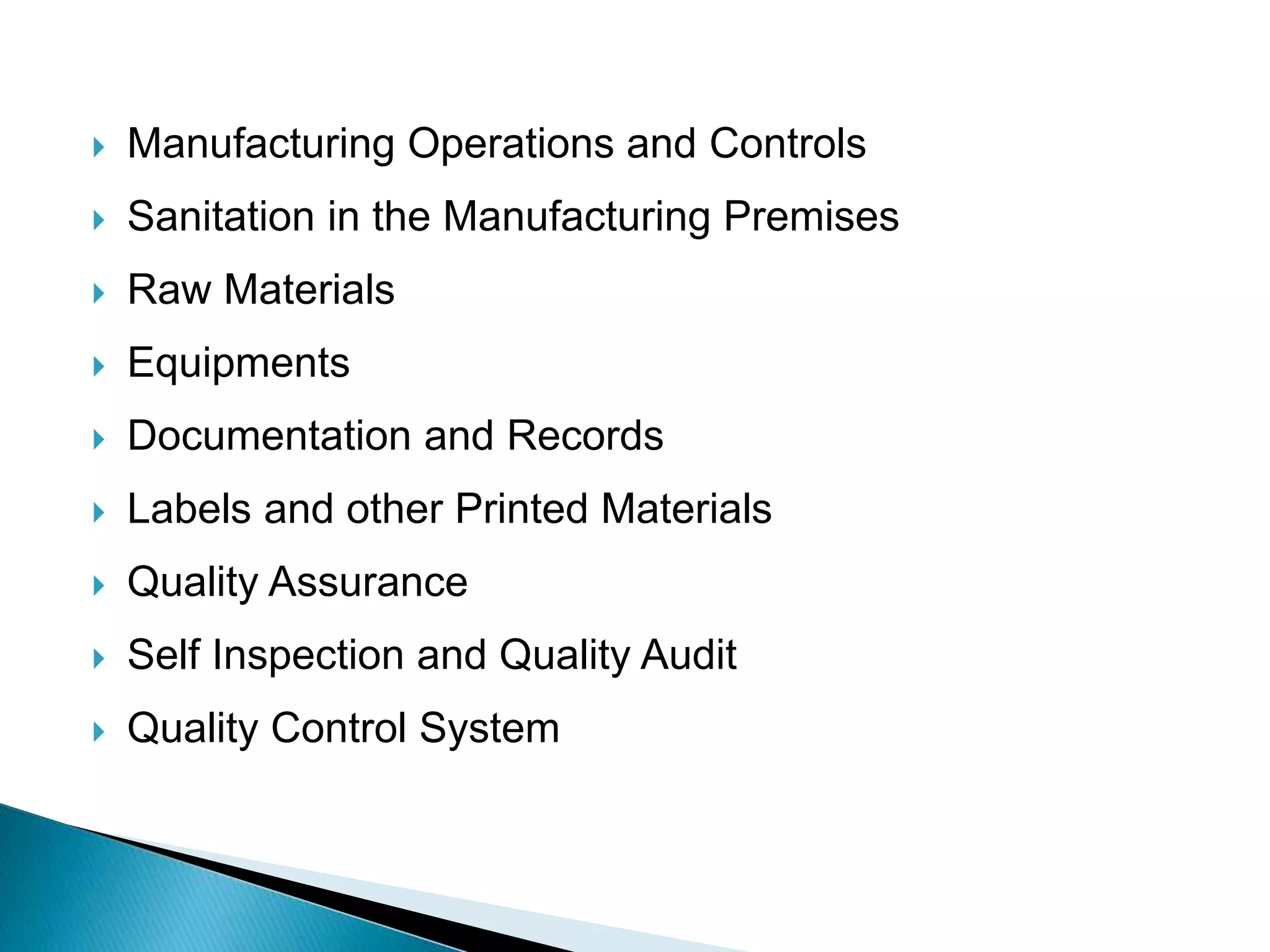
 Manufacturing Operations and Controls
 Sanitation in the Manufacturing Premises
 Raw Materials
 Equipments
 Documentation and Records
 Labels and other Printed Materials
 Quality Assurance
 Self Inspection and Quality Audit
 Quality Control System
 Master Formula Record
 Packaging Record
 Batch Packing Record
 Batch Processing Record
 Standard Operating Procedure
 Location and surroundings: Avoid risk of contamination from
external environment including open sewage, drain or another
factory producing fumes, smoke etc.
 Building and premises: production of drugs under hygienic
conditions, conforming to the conditions laid down in the
Factories Act, 1948
Water System: Purified Water conforming to Pharmacopoeia
specification
Disposal of waste: The disposal of sewage and effluents shall
conform with the requirements of Environment Pollution Control
Board / Bio-medical waste shall be destroyed as per the provisions
of the Bio-Medical Waste (Management and Handling) Rules, 1996
 Adequate area
 Good storage conditions
 Ensure quarantine status area
 Separate area for sampling of active/excipients
 Safe/secure area for poisonous/hazardous
substances.
 Separate area for printing/packaging
 Separate area for dispensing
hormones/cytotoxic.
 Separate aseptic area for sterile materials
 Pest control at least once in 1 year
 Logical sequence of operations
 Logical positioning of equipments
 Adequate space in-working area
 Construction and proper fixation of facilities in
order to avoid creation of recesses
 Marked direction of flow
 Separate rest/refreshment rooms from
manufacturing area.
 Written instruction for cleaning of washrooms
which should be easily assecible.
 Separate maintenance workshops
 Separate animal house: Rule 150-C(3) of the
Drugs and Cosmetics Rules, 1945
 Independent of production area
 Design approximately with adequate space
 Separate area for biological, microbiological and
radioisotopes
 Separate chemical, microbiological and
wherever required, biological testing is carried
out.
 Competent technical staff with prescribed
qualifications and practical experience
 Separate Head for QC lab not from
manufacturing unit.
 Suitably qualified person for QA and QC.
 Written duties of Technical & QC personnel
 Sufficient number of persons employed as per
work load.
 Regular in-service training
 High level of personal hygiene.
 Drug sensitivity tests e.g. penicillin
 Medical examination before employment
 Personnel hygiene training to all
 Sick persons not allowed in working area
 Clean body covering as per the duties
 Tobacco / Drinks not allowed
 Operations carried out under Supervision of
technical staff approved by Licensing authority.
 Proper labelling with the name of the product, batch
number, batch size and stage of manufacture.
 Products not prepared under aseptic conditions are
required to be free from pathogens like Salmonella,
Escherichia coli, Pyocyanea etc.
 A validated cleaning procedure
 Maintenance to avoid accumulation of waste.
 A routine written down sanitation program
 Adequate storage space for logical positioning
of equipments / materials
 Well lit, particularly where visual on-line controls
 Inventory of all raw materials
 Quarantined immediately after receipt
 Purchased from approved sources under valid
purchase vouchers
 Authorized staff to examine each consignment
 Each batch shall be considered as a separate
batch for sampling, testing.
 Appropriately labeled.
 Separate areas for materials under test,
approved and rejected.
 Shelf life certification by QC.
 Containers of raw materials should not be kept
directly on floors.
 Adequate location, layout and design of
equipment
 Accuracy / percision/ caliberation of measuring
equipments as per SOPs
 Wherever possible, non-toxic/edible grade
lubricants should be used.
 Documents essential part of QA system as well as to all
aspects of GMP.
 Documents shall be approved, signed and dated by
authorized persons.
 Records retained for at least one year after the expiry
date of the finished product
 Data may be recorded by electronic data processing
systems or other reliable means, but Master Formulae
and detailed operating procedures relating to the
system in use shall also be available in a hard copy to
facilitate checking of the accuracy of the records
 Appropriate labels
 Separate storage
 Labels to be checked by QC
 Record keeping of all the receipts
 Labels shall also shall indicate name of the
formulation,concentration, manufacturing date,
expiry date etc.
 GMP/GLP/GCP Compliant
 Arrangements for correct starting and packaging
materials.
 Adequate controls on starting materials,
intermediate products, and bulk products
 In-process controls, calibrations, and
validations
 Finished product released only after QC
assurance.
 Master Formula Record should be their relating to all
manufacturing procedures for each product and batch size to be
manufactured.
 It should contain:-
 Name of the product with reference code.
 The patent along with generic name.
 Description of dosage form, strength, composition of product and
batch size.
 Detail regarding starting materials.
 Statement of expected final yield with acceptable limit
 Methods for cleaning, assembling, caliberating of equipments.
 Packing details and specimen labels.
 Textbook of Forsenic Pharmacy by N.K.Jain,
Seventh Edition, Vallabh Prakashan, Pg.nos.83
 http://www.health.ed.ac.uk/CIDHP/ourreseac
h/DF/DESRetraps.htm
 http://www.picscheme.org
 http://www.albemarle.com
 http://www.who.int/prequal
Good Manufacturing Practices

Good Manufacturing Practices

  • 1.
  • 2.
     GMP regulationswere introduced in the form of amended Schedule M in 1988 has again been amended in a major way by the Drug and Cosmetic Rules,2001.  That embraces Rules71,74,76 and 78 under the Drug and Cosmetic Rules,1945.  This rules were not to apply to the manufacturers who are licensed to manufacture drugs for period up to 31st December,2004.
  • 3.
     The GMPguidelines are a means to assure the QUALITY of the drug.  Provides a high level assurance that medicines are manufactured in a way that ensures their SAFETY, EFFICACY and QUALITY.  Medicines are manufactured such that they comply with their marketing authorization.  QUALITY is built in..
  • 5.
     Design andconstruct the facilities and equipments properly.  Follow written procedures instructions.  Document work involves SOP,BMR,MFRetc.  Validate work  Monitor facilities and equipment  Write step by step operating procedures and work on instructions  Design, an demonstrate job competence  Protect against contamination.  Control components and product related process  Conduct planned and periodic audits
  • 7.
    QUALITY MANAGEMENT QUALITY ASSURANCE GOODMANUFACTURING PRACTICES PRODUCTION AND QUALITY CONTROL
  • 8.
     General Requirements -Locationand Surroundings -Buildings and Premises -Water System -Disposal of Waste  Ware Housing Area  Production Area  Ancillary Area  Quality Control Area  Personnel  Health, Clothing and Sanitation of Workers
  • 9.
     Manufacturing Operationsand Controls  Sanitation in the Manufacturing Premises  Raw Materials  Equipments  Documentation and Records  Labels and other Printed Materials  Quality Assurance  Self Inspection and Quality Audit  Quality Control System
  • 10.
     Master FormulaRecord  Packaging Record  Batch Packing Record  Batch Processing Record  Standard Operating Procedure
  • 11.
     Location andsurroundings: Avoid risk of contamination from external environment including open sewage, drain or another factory producing fumes, smoke etc.  Building and premises: production of drugs under hygienic conditions, conforming to the conditions laid down in the Factories Act, 1948 Water System: Purified Water conforming to Pharmacopoeia specification Disposal of waste: The disposal of sewage and effluents shall conform with the requirements of Environment Pollution Control Board / Bio-medical waste shall be destroyed as per the provisions of the Bio-Medical Waste (Management and Handling) Rules, 1996
  • 12.
     Adequate area Good storage conditions  Ensure quarantine status area  Separate area for sampling of active/excipients  Safe/secure area for poisonous/hazardous substances.  Separate area for printing/packaging  Separate area for dispensing hormones/cytotoxic.  Separate aseptic area for sterile materials  Pest control at least once in 1 year
  • 14.
     Logical sequenceof operations  Logical positioning of equipments  Adequate space in-working area  Construction and proper fixation of facilities in order to avoid creation of recesses  Marked direction of flow
  • 15.
     Separate rest/refreshmentrooms from manufacturing area.  Written instruction for cleaning of washrooms which should be easily assecible.  Separate maintenance workshops  Separate animal house: Rule 150-C(3) of the Drugs and Cosmetics Rules, 1945
  • 17.
     Independent ofproduction area  Design approximately with adequate space  Separate area for biological, microbiological and radioisotopes  Separate chemical, microbiological and wherever required, biological testing is carried out.
  • 18.
     Competent technicalstaff with prescribed qualifications and practical experience  Separate Head for QC lab not from manufacturing unit.  Suitably qualified person for QA and QC.  Written duties of Technical & QC personnel  Sufficient number of persons employed as per work load.  Regular in-service training
  • 19.
     High levelof personal hygiene.  Drug sensitivity tests e.g. penicillin  Medical examination before employment  Personnel hygiene training to all  Sick persons not allowed in working area  Clean body covering as per the duties  Tobacco / Drinks not allowed
  • 20.
     Operations carriedout under Supervision of technical staff approved by Licensing authority.  Proper labelling with the name of the product, batch number, batch size and stage of manufacture.  Products not prepared under aseptic conditions are required to be free from pathogens like Salmonella, Escherichia coli, Pyocyanea etc.
  • 21.
     A validatedcleaning procedure  Maintenance to avoid accumulation of waste.  A routine written down sanitation program  Adequate storage space for logical positioning of equipments / materials  Well lit, particularly where visual on-line controls
  • 22.
     Inventory ofall raw materials  Quarantined immediately after receipt  Purchased from approved sources under valid purchase vouchers  Authorized staff to examine each consignment  Each batch shall be considered as a separate batch for sampling, testing.  Appropriately labeled.  Separate areas for materials under test, approved and rejected.  Shelf life certification by QC.  Containers of raw materials should not be kept directly on floors.
  • 23.
     Adequate location,layout and design of equipment  Accuracy / percision/ caliberation of measuring equipments as per SOPs  Wherever possible, non-toxic/edible grade lubricants should be used.
  • 24.
     Documents essentialpart of QA system as well as to all aspects of GMP.  Documents shall be approved, signed and dated by authorized persons.  Records retained for at least one year after the expiry date of the finished product  Data may be recorded by electronic data processing systems or other reliable means, but Master Formulae and detailed operating procedures relating to the system in use shall also be available in a hard copy to facilitate checking of the accuracy of the records
  • 25.
     Appropriate labels Separate storage  Labels to be checked by QC  Record keeping of all the receipts  Labels shall also shall indicate name of the formulation,concentration, manufacturing date, expiry date etc.
  • 26.
     GMP/GLP/GCP Compliant Arrangements for correct starting and packaging materials.  Adequate controls on starting materials, intermediate products, and bulk products  In-process controls, calibrations, and validations  Finished product released only after QC assurance.
  • 27.
     Master FormulaRecord should be their relating to all manufacturing procedures for each product and batch size to be manufactured.  It should contain:-  Name of the product with reference code.  The patent along with generic name.  Description of dosage form, strength, composition of product and batch size.  Detail regarding starting materials.  Statement of expected final yield with acceptable limit  Methods for cleaning, assembling, caliberating of equipments.  Packing details and specimen labels.
  • 29.
     Textbook ofForsenic Pharmacy by N.K.Jain, Seventh Edition, Vallabh Prakashan, Pg.nos.83  http://www.health.ed.ac.uk/CIDHP/ourreseac h/DF/DESRetraps.htm  http://www.picscheme.org  http://www.albemarle.com  http://www.who.int/prequal