Good manufacturing practices
PRESENTED BY
RESHMA FATHIMA.K
Department of pharmaceutics
GMP is that part of Quality assurance which ensures that the products are consistently
manufactured and controlled to the Quality standards appropriate to their intended use.
GMP" - A set of principles and procedures which, when followed by manufacturers for
therapeutic goods, helps ensure that the products manufactured will have the required quality
US FDA GMP Regulation: Section 21 of the CFR contains most regulations
pertaining to food and drugs 21 Code of Federal Regulations Part 210: Current
Good Manufacturing Practice in Manufacturing Processing, packing, or Holding
of Drugs. 21 Code of Federal Regulations Part 211: Current Good Manufacturing
Practice for Finished Pharmaceuticals. ICH GMP Regulation: Q7 /Q&As Q7:
Good Manufacturing Practice Guide for Active Pharmaceutical Ingredients
GMP REGULATIONS IN INDIA • GMP regulations were introduced in the
form of amended schedule M in 1988. • Again amended by Drug & Cosmetics
Rules 2001 and embraces rules 71,74,76&78 under the D&C rules 1945 • Each
licensee shall evolve appropriate methodology systems and procedures, which
shall be documented and maintained for inspection and reference. • The
manufacturing premises shall be used exclusively for production of drugs and not
for any other manufacturing.
SCHEDULE M
PART -1 GMP for premises & materials
Part 1A: Specific requirements for manufacture of sterile products, parenteral
preparations, & sterile ophthalmic preparation
Part 1B: Specific requirements for manufacture of oral solid dosage forms
Part 1C: Specific requirements for manufacture of oral liquids
Part 1D: Specific requirements for manufacture of topical preparations
Part 1E: Specific requirements for manufacture of metered dose inhalers (MDI)
Part 1F: Specific requirements for manufacture of active pharmaceutical
ingredients
1. GENERAL REQUIREMENTS
1.1. Location and surroundings: The factory building(s) for manufacture of
drugs shall be so situated that it avoid risk of contamination from external
environmental including open sewage, drain, public lavatory
1.2. Building and premises: Buildings shall be designed, constructed, adapted
and maintained to permit production of drugs under hygienic conditions. They
shall conform to the conditions laid down in the Factories Act, 1948. The
premises used for manufacturing, processing, warehousing, packaging, labeling
and testing purposes shall be
i. compatible with other drug manufacturing operations
ii. Adequate working space to avoid the risk of mix-up between different
materials & avoid the possibilities of contamination and cross contamination
iii. Designed / constructed / maintained to prevent entry of insects, pests, birds,
and rodents
iv. Well illuminated, effectively ventilated, with proper Air Handling Units
1.3 Water System: There shall be validated system for treatment of water in
accordance with standards specified by the Bureau of Indian Standards or Local
Municipality or Pharmacopoeial specification. Water shall be stored in tanks,
which do not adversely affect quality of water and ensure freedom from
microbiological growth. The tank shall be cleaned periodically and records
maintained by the licensee in this behalf
1.4. Disposal of waste: The disposal of sewage and effluents (solid, liquid and
gas) be in conformity with the requirements of Environment Pollution Control
Board .All bio-medical waste shall be destroyed as per the provisions of the Bio-
Medical Waste (Management and Handling) Rules, 1996. Records shall be
maintained for all disposal of waste. Provisions shall be made for the proper and
safe storage of waste materials awaiting disposal.
2. WAREHOUSING AREA
2.1 Adequate areas to allow orderly warehousing of various categories of
materials.
2.2 Good storage conditions
2.3 There shall be a separate sampling for active raw materials and excipients
2.4. Segregation shall be provided for the storage of rejected, recalled or returned
materials or products
2.5 Highly hazardous, poisonous and explosive materials shall be stored in safe
and secure areas
3. PRODUCTION AREA
3.1. Separate dedicated and self-contained facilities shall be made available for
the production of sensitive pharmaceutical products
3.2. Orderly and logical positioning of equipment and materials and movement
of personnel to minimize risk of omission or wrong application of any
manufacturing and control measures
3.3. Services lines shall preferably be identified by colors and the nature of the
supply and direction of the flow shall be marked/indicated
4. ANCILLARY AREAS
4.1 Rest and refreshment rooms shall be separate from other areas. Facilities for
changing, storing clothes and for washing and toilet purposes shall be adequate
for the number of users.
4.2 Animal houses shall be those as prescribed in Rule 150-C(3) of the Drugs and
Cosmetics Rules, 1945 which shall be adopted for production purposes.
5. QUALITY CONTROL AREA
5.1. QC Lab shall be independent of the production areas. Separate areas each for
physico-chemical, biological, microbiological or radio-isotope analysis
5.2 Adequate space shall be provided to avoid mix-ups and proper storage for test
samples, retained samples, reference standards, reagents and records.
6. PERSONNEL
6.1. Qualifications and practical experience in the relevant field
6.2. Written duties of technical and Quality Control personnel shall be laid and
follow strictly
6.3. Number of personnel employed shall be adequate and in direct proportion to
the workload
7. HEALTH, CLOTHING AND SANITATION OF WORKERS
7.1 Prior to employment, all personnel, shall undergo medical examination and a
periodically examination is carried out, records are also maintained
7.2 Proper training shall be given to all employees to maintain personnel hygiene
and adequate facilities for personal cleanliness
7.3 Smoking, eating, drinking, chewing, food, drink and personal medicines not
permitted in production, laboratory, and storage area
8. MANUFACTURING OPERATIONS AND CONTROLS
8.1 All manufacturing operations shall be carried out under the supervision of
technical staff approved by the Licensing Authority
8.2. Precautions against mix-up and cross- contamination
1. By proper air handling system, pressure differential, segregation, status
labelling and cleaning. Proper records and SOP there of shall be maintained.
2. Processing of sensitive drugs and cytotoxic substances in segregated areas
3. Proper labeling of materials and equipments
4. Packaging lines shall be independent and adequately segregated
5. All printing and overprinting shall be authorized in writing
6. The manufacturing environment maintained at the required levels of
temperature, humidity and cleanliness
9. SANITATION IN THE MANUFACTURING PREMISES
9.1 The manufacturing premises shall be cleaned and in an orderly manner
9.2 The manufacturing areas shall not be used for other operations
9.3 A routine sanitation program shall be drawn up which shall be properly
recorded and which indicate
a) specific areas to be cleaned and cleaning intervals
b) cleaning procedure to be followed
c) personnel assigned to and responsible for the cleaning operation.
10. RAW MATERIALS
10.1 Keeping an inventory of all raw materials to be used and maintain records
as per Schedule U
10.2 Authorized staff who examine each consignment for its integrity
10.3 Labeling with the following information: a) Name of the product and the
internal code reference and analytical reference number b) Manufacturer’s name,
address and batch number c) The status of the contents (e.g. Quarantine, under
test, released, approved, rejected) d) The manufacturing date, expiry date and re-
test date.
11. EQUIPMENT
11.1 Equipment shall be located, designed, constructed, adapted to suit the
operations and log book is maintained
11.2 Equipment shall be calibrated and checked on a scheduled basis in
accordance to SOP and maintain records
11.3 Equipment shall be inert and defective are removed and labeled
12. DOCUMENTATION AND RECORDS
Documentation is an essential part of the Quality assurance system and Its aim is
to define the specifications for all materials, method of manufacture and control
to release a batch of drug for sale
12.1 Documents shall be approved, signed and dated by authorized persons
12.2 Documents shall specify : the title, nature and purpose laid out in an orderly
fashion & kept up to date
12.3 SOP shall be retained for at least one year after the expiry date of the finished
product
12.4 Data may be recorded by electronic data processing systems but Master
Formulae and detailed operating procedures relating to the system in use shall
also be available in a hard copy to facilitate checking of the accuracy of the
records
13. LABELS AND OTHER PRINTED MATERIALS
Labels are necessary for identification of the drugs and their use. The Printing
shall be done in bright colours and in a legible manner .The label shall carry all
the prescribed details about the product
13.1 All containers and equipment shall bear appropriate labels
13.2 Prior to release, all labels for containers shall be examined by the QC
Department
13.3 Records of receipt of all labeling and packaging materials shall be
maintained and unused coded, damaged labels and packaging materials shall be
destroyed and recorded.
14. QUALITY ASSURANCE
It is a wide-ranging concept concerning all matters that individually or
collectively influence the quality of a product. It shall ensure that
The pharmaceutical products are designed and developed in a way that takes
account of the requirement of GMP ,GLP and GCP . Adequate controls on
starting materials, intermediate products, and other in-process controls,
calibrations, and validations are carried out. Products are released after authorized
persons have certified
15. SELF INSPECTION AND QUALITY AUDIT
It is for the assessment of all or part of a system with the specific purpose of
improving it
15.1 The program is designed to detect shortcomings in the implementation of
GMP and to recommend the necessary corrective actions. • Self-inspections shall
be performed routinely and on specific occasions • The team responsible for self-
inspection shall consist of independent, experienced, qualified persons from
within or outside the company who can evaluate the implementation of GMP
objectively; all recommendations for corrective action shall be implemented.
15.2 The procedure for self-inspection shall be documented indicating self-
inspection results; evaluation, conclusions and recommended corrective actions
with effective follow up program.
16. QUALITY CONTROL SYSTEM •
Quality control shall be concerned with sampling, specifications, testing,
documentation, release procedures • Materials are not released for use, nor
products released for sale or supply until their quality has been judged to be
satisfactory
16.1 QC lab should have qualified and experience staff
16.2 QC lab may be divided into Chemical, Instrumentation, Microbiological and
Biological testing
16.3 The QC department shall conduct stability studies of the products to ensure
and assign their shelf life. All records of such studies shall be maintained
16.4 All instruments shall be calibrated and validated before adopted for routine
testing
16.5 Pharmacopoeia, reference standards, working standards, references spectra,
other reference materials and technical books, as required, shall be available in
the QC Laboratory
17. SPECIFICATION
17.1 For raw materials and packaging materials They shall include: a) The
designated name and internal code reference b) Reference, if any, to a
pharmacopoeial monograph c) Qualitative and quantitative requirements with
acceptance limits d) Name and address of manufacturer or supplier and original
manufacturer of the material e) Specimen of printed material f) Directions for
sampling and testing or reference to procedures g) Storage conditions and h)
Maximum period of storage before re-testing
17.2 For finished products. Appropriate specifications for finished products shall
include: a) The designated name of the product and the code reference b) The
formula or a reference to the formula and the pharmacopoeial reference c)
Directions for sampling and testing or a reference to procedures d) A description
of the dosage form and package details e) The storage conditions and precautions,
where applicable f) The shelf-life
18. MASTER FORMULA RECORDS
There shall be Master Formula records relating to all manufacturing procedures
for each product and batch size
These shall be prepared and endorsed by head of production and quality control
The master Formula shall include:
a) the name of the product together with product reference code relating to its
specifications
b) the patent or proprietary name of the product along with the generic name, a
description of the dosage form, strength, composition of the product and batch
size
c) name, quantity, and reference number of all the starting materials to be used
d) A statement of the processing location and the principal equipment to be used
e) detailed stepwise processing instructions and the time taken for each step
f) the instructions for in-process control with their limits
g) the requirements for storage conditions of the products, including the
container, labeling and special storage conditions where applicable
h) any special precautions to be observed
i) packing details and specimen labels
19. PACKING RECORDS There shall be authorised packaging instructions for
each product, pack size and type These shall include or have a reference to the
following: a) Name of the product b) Description of the dosage form, strength
and composition c) The pack size expressed in terms of the number of doses,
weight or volume of the product in the final container d) Special precautions to
be observed, including a careful examination of the area and equipment in order
to ascertain the line clearance before the operations begin.
20. BATCH PACKAGING RECORDS • A batch packaging record shall be
kept for each batch or part batch processed • It shall be based on the relevant parts
of the packaging instructions, and the method of preparation of such records shall
be designed to avoid transcription errors
21. BATCH PROCESSING RECORDS • There shall be Batch Processing
Record for each product • It shall be based on the relevant parts of the currently
approved Master Formula • The method of preparation of such records included
in the Master Formula shall be designed to avoid transcription errors
22. STANDARD OPERATING PROCEDURES (SOPs) There shall be
written SOP and records for the : • Receipt of each delivery of raw, primary and
printed material • Internal labeling, quarantine and storage of starting materials,
packaging materials and other materials, as appropriate • For each instrument and
equipment • Sampling which include the person(s) authorized to take the samples
• Describing the details of the batch numbering which ensure that each batch of
intermediate, bulk or finished product is identified with a specific batch number
• Testing materials and products at different stages of manufacture, describing the
methods and equipment to be used
23. REFERENCE SAMPLES
23.1 Each lot of every active ingredient, in a quality sufficient to carryout all the
tests, except sterility and pyrogens / Bacterial Endotoxin Test, shall be retained
for a period of 3 months after the date of expiry of the last batch produced from
that active ingredient
23.2. Samples of finished formulations shall be stored in the same or simulated
containers in which the drug has been actually marketed
24. REPROCESSING AND RECOVERIES: • Where reprocessing is
necessary, written procedures shall be established & approved by quality
assurance department • Recovery of product residue may be carried out , if
permitted, in the master production 25.DISTRIBUTION RECORDS: Records of
distribution shall be maintained in a manner such that finished batch of a drug
can be traced to the retain level to facilitate prompt and complete recall of the
batch, if and when necessary
26. VALIDATION AND PROCESS VALIDATION: • The process employed
has been optimized , so that data generated may be considered credible &
evaluated for consistency as well as relevance • Validation studies shall
conducted as per the pre-defined protocols • These shall include validation of
processing, testing and cleaning procedures 27. PRODUCT RECALLS: • A
prompt and effective product recall system of defective products shall be devised
for timely information of all concerned stockiest, wholesalers, suppliers, up to the
retail level within the shortest period • The licensee may make use of both print
and electronic media in this regard
28. COMPLAINTS AND ADVERSE REACTIONS: • All complaints thereof
concerning product quality shall be carefully reviewed and recorded according to
written procedures • Reports of serious adverse drug reactions resulting from the
use of a drug along with comments and documents shall be reported to the
concerned licensing authority
29. SITE MASTER FILE: • It contains specific and factual GMP about the
production and/or control of pharmaceutical manufacturing preparations carried
out in the licensed premises • It shall contain the following:-
Export of Drugs
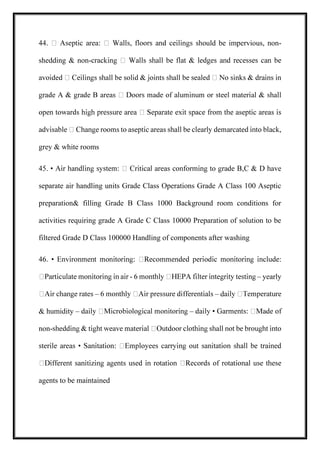
Sterile products being very critical & sensitive in nature, a high
standards for supply of water, air, active materials, maintenance of hygienic
conditions • Buildings and civil works
preparation areas, change areas and aseptic areas PART 1A: sterile products
uld be impervious, non-
shedding & non-
grey & white rooms
e
separate air handling units Grade Class Operations Grade A Class 100 Aseptic
preparation& filling Grade B Class 1000 Background room conditions for
activities requiring grade A Grade C Class 10000 Preparation of solution to be
filtered Grade D Class 100000 Handling of components after washing
- – yearly
– – d
& humidity – –
non-
agents to be maintained
47. • Include component washing machines, steam sterilizers, membrane filters,
liquid & powder filling machine , sealing & labelling machines etc Equipment •
Potable water – microbiological specification(<500cfu/ml) & • Absence of
individual pathogens per 100ml used for preparation of purified water • Steam
coming in contact with products primary containers shall be sterile & pyrogen
free Water and steam system • Bulk raw materials monitored for bio- burden
periodically • A limit of not more than 100cfu/ml is recommended • Finished
products shall be filled in continuous operation with great care Manufacturing
process
48. Sterilization • Terminal sterilization(filling of products) - grade A •
Preparation of solution(sterilized by filtration) - grade C • Sterilization process
should be validated • Biological/ chemical indicators – to monitor sterilization
Documentation • Records related to manufacture of products should be
maintained
air- -extraction system shall be provided with
d
Critical operating parameters like time &temperature shall be specified in master
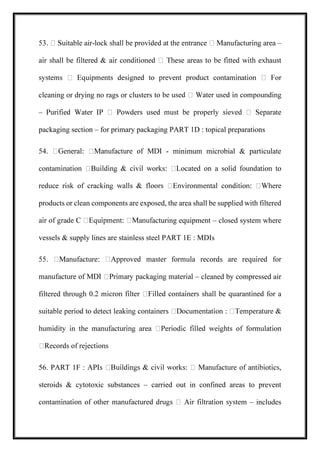
formula PART 1B: oral solid dosage forms
& coating solution- made, stored & used in a manner to minimize contamination
– effective dust control facilities
exhaust system & enviro
filtered & of suitable quantity
51. • Stored in conditions which ensure safety from effects of excessive heat &
moisture Filling of hard gelatin capsules • Special care must be taken to avoid
product mix-up during printing • Done using edible colors & suitable printing ink
Printing(tablets & Capsules) • Before packaging operation all ‘rogue’ tablets &
capsules are removed • Strips - inspected for defects such as misprint, cut on foil,
missing tablets & improper sealing Packaging
– minimize risk of contamination
& mix- – entry through double door air-
Parts of equipment – used
non- – air supply filtered through 5
micron filters & temperature not exceed 30ºC PART 1C : oral liquid dosage forms
le air- –
cleaning or drying no rags or clusters
–
packaging section – for primary packaging PART 1D : topical preparations
- minimum microbial & particulate
conta
products or clean components are exposed, the area shall be supplied with filtered
acturing equipment – closed system where
vessels & supply lines are stainless steel PART 1E : MDIs
– cleaned by compressed air
filtered throu
56. PART 1F :
steroids & cytotoxic substances – carried out in confined areas to prevent
– includes
pre-filters & particulate matter retention
include- filtration, crystallization & lyophilization
– serviced, cleaned & maintained
at appr - function or contamination of drug
processing, packaging or holding of API shall be adequate size, appropriate
to facilitate operations for its intended use & for its
- cleaned between successive batches
-
centration of reactant
ply with pharmacopoeial
specification • Containers & closures shall be non-reactive, additive, adsorptive
or leachable • To an extent that affects quality or purity of the drug
10
kettle(stainless container) • Mixer • A colloidal mill or suitable emulsifier • A
triple roller mill • Liquid filling equipment • Tube filling equipment PART II
Portable stirrer • A colloidal mill • Filtration equipment • Semi automatic filling
machine • Pilfer proof cap sealing machine • Water distillation unit deionizer •
Clarity testing inspection unit
department classified into four sections: Mixing, granulatio n & drying section
Tablet compressi on section Packaging section Coating section (wherever
required)
mixer • Granulator wherever required • Thermostatically controlled hot air oven
Punch & die storage cabinets • Tablet de-duster • Tablet inspection unit •
Dissolution test apparatus • In-process testing apparatus • Air conditioning &
dehumidifier
• Tablet counters • Air-
kettle • Coating pan • Polishing pan • Exhaust system • Air conditioner &
dehumidifier • Weighing balance
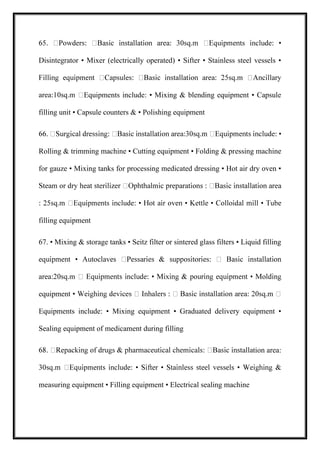
Disintegrator • Mixer (electrically operated) • Sifter • Stainless steel vessels •
Equipments include: • Mixing & blending equipment • Capsule
filling unit • Capsule counters & • Polishing equipment
Rolling & trimming machine • Cutting equipment • Folding & pressing machine
for gauze • Mixing tanks for processing medicated dressing • Hot air dry oven •
filling equipment
67. • Mixing & storage tanks • Seitz filter or sintered glass filters • Liquid filling
equipmen
Equipments include: • Mixing equipment • Graduated delivery equipment •
Sealing equipment of medicament during filling
tion area:
measuring equipment • Filling equipment • Electrical sealing machine
suitable sized cubicl
equipment
70. • Dust proof storage cabinet • Water still • Preparation & mixing tanks and
room: • Benches for filling & sealing • Bacteriological filters • Filling & sealing
equipment • Labelling & packaging unit • Storage equipment including cold
storage & refrigeration
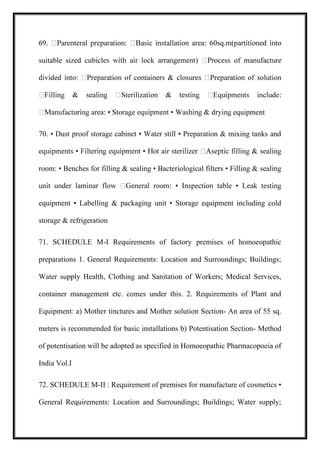
71. SCHEDULE M-I Requirements of factory premises of homoeopathic
preparations 1. General Requirements: Location and Surroundings; Buildings;
Water supply Health, Clothing and Sanitation of Workers; Medical Services,
container management etc. comes under this. 2. Requirements of Plant and
Equipment: a) Mother tinctures and Mother solution Section- An area of 55 sq.
meters is recommended for basic installations b) Potentisation Section- Method
of potentisation will be adopted as specified in Homoeopathic Pharmacopoeia of
India Vol.I
72. SCHEDULE M-II : Requirement of premises for manufacture of cosmetics •
General Requirements: Location and Surroundings; Buildings; Water supply;
Health, Clothing and Sanitation of Workers; Medical Services etc • Requirements
of Plant and Equipment: Specifications are given for only certain cosmetic
preparations like a) Powers b) Creams, lotions, emulsions, pastes, cleansing
milks, shampoos, pomade, brilliantine, shaving creams, and hair-oils etc c) Nail
Polishes and Nail lacquers d) Lipsticks and lip-gloss e) Depilatories f)
Preparations used for Eyes g) Aerosol h) Alcoholic Fragrance Solutions i) Hair
Dyes j) Toilet Soaps k) Tooth powders and toothpastes
73. SCHEDULE M-III Requirements of factory premises for manufacture of
medical devices General Requirements: Location and Surroundings; Buildings;
Water supply; Health, Clothing and Sanitation of Workers; Medical Services etc
comes under this Requirements for Manufacture Of Medical Devices: Shall be
conducted bat the licensed premises, and the process of manufacture is divided
into following separate operations/Sections- a) Moulding b) Assembling c) Raw
Materials d) Storage Area e) Washing, drying and sealing area f) Sterilization g)
Testing facilities
74. cGMP • What is cGMP ? : Usually see “cGMP” – where c = current, to
emphasize that the expectations are dynamic • In India it is established in 2000 &
amended from July 2004 • It is periodically reversed and updated

Gmp

  • 1.
    Good manufacturing practices PRESENTEDBY RESHMA FATHIMA.K Department of pharmaceutics
  • 2.
    GMP is thatpart of Quality assurance which ensures that the products are consistently manufactured and controlled to the Quality standards appropriate to their intended use. GMP" - A set of principles and procedures which, when followed by manufacturers for therapeutic goods, helps ensure that the products manufactured will have the required quality US FDA GMP Regulation: Section 21 of the CFR contains most regulations pertaining to food and drugs 21 Code of Federal Regulations Part 210: Current Good Manufacturing Practice in Manufacturing Processing, packing, or Holding of Drugs. 21 Code of Federal Regulations Part 211: Current Good Manufacturing Practice for Finished Pharmaceuticals. ICH GMP Regulation: Q7 /Q&As Q7: Good Manufacturing Practice Guide for Active Pharmaceutical Ingredients GMP REGULATIONS IN INDIA • GMP regulations were introduced in the form of amended schedule M in 1988. • Again amended by Drug & Cosmetics Rules 2001 and embraces rules 71,74,76&78 under the D&C rules 1945 • Each licensee shall evolve appropriate methodology systems and procedures, which shall be documented and maintained for inspection and reference. • The manufacturing premises shall be used exclusively for production of drugs and not for any other manufacturing. SCHEDULE M PART -1 GMP for premises & materials Part 1A: Specific requirements for manufacture of sterile products, parenteral preparations, & sterile ophthalmic preparation
  • 3.
    Part 1B: Specificrequirements for manufacture of oral solid dosage forms Part 1C: Specific requirements for manufacture of oral liquids Part 1D: Specific requirements for manufacture of topical preparations Part 1E: Specific requirements for manufacture of metered dose inhalers (MDI) Part 1F: Specific requirements for manufacture of active pharmaceutical ingredients 1. GENERAL REQUIREMENTS 1.1. Location and surroundings: The factory building(s) for manufacture of drugs shall be so situated that it avoid risk of contamination from external environmental including open sewage, drain, public lavatory 1.2. Building and premises: Buildings shall be designed, constructed, adapted and maintained to permit production of drugs under hygienic conditions. They shall conform to the conditions laid down in the Factories Act, 1948. The premises used for manufacturing, processing, warehousing, packaging, labeling and testing purposes shall be i. compatible with other drug manufacturing operations ii. Adequate working space to avoid the risk of mix-up between different materials & avoid the possibilities of contamination and cross contamination
  • 4.
    iii. Designed /constructed / maintained to prevent entry of insects, pests, birds, and rodents iv. Well illuminated, effectively ventilated, with proper Air Handling Units 1.3 Water System: There shall be validated system for treatment of water in accordance with standards specified by the Bureau of Indian Standards or Local Municipality or Pharmacopoeial specification. Water shall be stored in tanks, which do not adversely affect quality of water and ensure freedom from microbiological growth. The tank shall be cleaned periodically and records maintained by the licensee in this behalf 1.4. Disposal of waste: The disposal of sewage and effluents (solid, liquid and gas) be in conformity with the requirements of Environment Pollution Control Board .All bio-medical waste shall be destroyed as per the provisions of the Bio- Medical Waste (Management and Handling) Rules, 1996. Records shall be maintained for all disposal of waste. Provisions shall be made for the proper and safe storage of waste materials awaiting disposal. 2. WAREHOUSING AREA 2.1 Adequate areas to allow orderly warehousing of various categories of materials. 2.2 Good storage conditions 2.3 There shall be a separate sampling for active raw materials and excipients
  • 5.
    2.4. Segregation shallbe provided for the storage of rejected, recalled or returned materials or products 2.5 Highly hazardous, poisonous and explosive materials shall be stored in safe and secure areas 3. PRODUCTION AREA 3.1. Separate dedicated and self-contained facilities shall be made available for the production of sensitive pharmaceutical products 3.2. Orderly and logical positioning of equipment and materials and movement of personnel to minimize risk of omission or wrong application of any manufacturing and control measures 3.3. Services lines shall preferably be identified by colors and the nature of the supply and direction of the flow shall be marked/indicated 4. ANCILLARY AREAS 4.1 Rest and refreshment rooms shall be separate from other areas. Facilities for changing, storing clothes and for washing and toilet purposes shall be adequate for the number of users. 4.2 Animal houses shall be those as prescribed in Rule 150-C(3) of the Drugs and Cosmetics Rules, 1945 which shall be adopted for production purposes.
  • 6.
    5. QUALITY CONTROLAREA 5.1. QC Lab shall be independent of the production areas. Separate areas each for physico-chemical, biological, microbiological or radio-isotope analysis 5.2 Adequate space shall be provided to avoid mix-ups and proper storage for test samples, retained samples, reference standards, reagents and records. 6. PERSONNEL 6.1. Qualifications and practical experience in the relevant field 6.2. Written duties of technical and Quality Control personnel shall be laid and follow strictly 6.3. Number of personnel employed shall be adequate and in direct proportion to the workload 7. HEALTH, CLOTHING AND SANITATION OF WORKERS 7.1 Prior to employment, all personnel, shall undergo medical examination and a periodically examination is carried out, records are also maintained 7.2 Proper training shall be given to all employees to maintain personnel hygiene and adequate facilities for personal cleanliness 7.3 Smoking, eating, drinking, chewing, food, drink and personal medicines not permitted in production, laboratory, and storage area
  • 7.
    8. MANUFACTURING OPERATIONSAND CONTROLS 8.1 All manufacturing operations shall be carried out under the supervision of technical staff approved by the Licensing Authority 8.2. Precautions against mix-up and cross- contamination 1. By proper air handling system, pressure differential, segregation, status labelling and cleaning. Proper records and SOP there of shall be maintained. 2. Processing of sensitive drugs and cytotoxic substances in segregated areas 3. Proper labeling of materials and equipments 4. Packaging lines shall be independent and adequately segregated 5. All printing and overprinting shall be authorized in writing 6. The manufacturing environment maintained at the required levels of temperature, humidity and cleanliness 9. SANITATION IN THE MANUFACTURING PREMISES 9.1 The manufacturing premises shall be cleaned and in an orderly manner 9.2 The manufacturing areas shall not be used for other operations 9.3 A routine sanitation program shall be drawn up which shall be properly recorded and which indicate a) specific areas to be cleaned and cleaning intervals
  • 8.
    b) cleaning procedureto be followed c) personnel assigned to and responsible for the cleaning operation. 10. RAW MATERIALS 10.1 Keeping an inventory of all raw materials to be used and maintain records as per Schedule U 10.2 Authorized staff who examine each consignment for its integrity 10.3 Labeling with the following information: a) Name of the product and the internal code reference and analytical reference number b) Manufacturer’s name, address and batch number c) The status of the contents (e.g. Quarantine, under test, released, approved, rejected) d) The manufacturing date, expiry date and re- test date. 11. EQUIPMENT 11.1 Equipment shall be located, designed, constructed, adapted to suit the operations and log book is maintained 11.2 Equipment shall be calibrated and checked on a scheduled basis in accordance to SOP and maintain records 11.3 Equipment shall be inert and defective are removed and labeled
  • 9.
    12. DOCUMENTATION ANDRECORDS Documentation is an essential part of the Quality assurance system and Its aim is to define the specifications for all materials, method of manufacture and control to release a batch of drug for sale 12.1 Documents shall be approved, signed and dated by authorized persons 12.2 Documents shall specify : the title, nature and purpose laid out in an orderly fashion & kept up to date 12.3 SOP shall be retained for at least one year after the expiry date of the finished product 12.4 Data may be recorded by electronic data processing systems but Master Formulae and detailed operating procedures relating to the system in use shall also be available in a hard copy to facilitate checking of the accuracy of the records 13. LABELS AND OTHER PRINTED MATERIALS Labels are necessary for identification of the drugs and their use. The Printing shall be done in bright colours and in a legible manner .The label shall carry all the prescribed details about the product 13.1 All containers and equipment shall bear appropriate labels
  • 10.
    13.2 Prior torelease, all labels for containers shall be examined by the QC Department 13.3 Records of receipt of all labeling and packaging materials shall be maintained and unused coded, damaged labels and packaging materials shall be destroyed and recorded. 14. QUALITY ASSURANCE It is a wide-ranging concept concerning all matters that individually or collectively influence the quality of a product. It shall ensure that The pharmaceutical products are designed and developed in a way that takes account of the requirement of GMP ,GLP and GCP . Adequate controls on starting materials, intermediate products, and other in-process controls, calibrations, and validations are carried out. Products are released after authorized persons have certified 15. SELF INSPECTION AND QUALITY AUDIT It is for the assessment of all or part of a system with the specific purpose of improving it 15.1 The program is designed to detect shortcomings in the implementation of GMP and to recommend the necessary corrective actions. • Self-inspections shall be performed routinely and on specific occasions • The team responsible for self-
  • 11.
    inspection shall consistof independent, experienced, qualified persons from within or outside the company who can evaluate the implementation of GMP objectively; all recommendations for corrective action shall be implemented. 15.2 The procedure for self-inspection shall be documented indicating self- inspection results; evaluation, conclusions and recommended corrective actions with effective follow up program. 16. QUALITY CONTROL SYSTEM • Quality control shall be concerned with sampling, specifications, testing, documentation, release procedures • Materials are not released for use, nor products released for sale or supply until their quality has been judged to be satisfactory 16.1 QC lab should have qualified and experience staff 16.2 QC lab may be divided into Chemical, Instrumentation, Microbiological and Biological testing 16.3 The QC department shall conduct stability studies of the products to ensure and assign their shelf life. All records of such studies shall be maintained 16.4 All instruments shall be calibrated and validated before adopted for routine testing
  • 12.
    16.5 Pharmacopoeia, referencestandards, working standards, references spectra, other reference materials and technical books, as required, shall be available in the QC Laboratory 17. SPECIFICATION 17.1 For raw materials and packaging materials They shall include: a) The designated name and internal code reference b) Reference, if any, to a pharmacopoeial monograph c) Qualitative and quantitative requirements with acceptance limits d) Name and address of manufacturer or supplier and original manufacturer of the material e) Specimen of printed material f) Directions for sampling and testing or reference to procedures g) Storage conditions and h) Maximum period of storage before re-testing 17.2 For finished products. Appropriate specifications for finished products shall include: a) The designated name of the product and the code reference b) The formula or a reference to the formula and the pharmacopoeial reference c) Directions for sampling and testing or a reference to procedures d) A description of the dosage form and package details e) The storage conditions and precautions, where applicable f) The shelf-life 18. MASTER FORMULA RECORDS There shall be Master Formula records relating to all manufacturing procedures for each product and batch size
  • 13.
    These shall beprepared and endorsed by head of production and quality control The master Formula shall include: a) the name of the product together with product reference code relating to its specifications b) the patent or proprietary name of the product along with the generic name, a description of the dosage form, strength, composition of the product and batch size c) name, quantity, and reference number of all the starting materials to be used d) A statement of the processing location and the principal equipment to be used e) detailed stepwise processing instructions and the time taken for each step f) the instructions for in-process control with their limits g) the requirements for storage conditions of the products, including the container, labeling and special storage conditions where applicable h) any special precautions to be observed i) packing details and specimen labels 19. PACKING RECORDS There shall be authorised packaging instructions for each product, pack size and type These shall include or have a reference to the following: a) Name of the product b) Description of the dosage form, strength and composition c) The pack size expressed in terms of the number of doses,
  • 14.
    weight or volumeof the product in the final container d) Special precautions to be observed, including a careful examination of the area and equipment in order to ascertain the line clearance before the operations begin. 20. BATCH PACKAGING RECORDS • A batch packaging record shall be kept for each batch or part batch processed • It shall be based on the relevant parts of the packaging instructions, and the method of preparation of such records shall be designed to avoid transcription errors 21. BATCH PROCESSING RECORDS • There shall be Batch Processing Record for each product • It shall be based on the relevant parts of the currently approved Master Formula • The method of preparation of such records included in the Master Formula shall be designed to avoid transcription errors 22. STANDARD OPERATING PROCEDURES (SOPs) There shall be written SOP and records for the : • Receipt of each delivery of raw, primary and printed material • Internal labeling, quarantine and storage of starting materials, packaging materials and other materials, as appropriate • For each instrument and equipment • Sampling which include the person(s) authorized to take the samples • Describing the details of the batch numbering which ensure that each batch of intermediate, bulk or finished product is identified with a specific batch number • Testing materials and products at different stages of manufacture, describing the methods and equipment to be used
  • 15.
    23. REFERENCE SAMPLES 23.1Each lot of every active ingredient, in a quality sufficient to carryout all the tests, except sterility and pyrogens / Bacterial Endotoxin Test, shall be retained for a period of 3 months after the date of expiry of the last batch produced from that active ingredient 23.2. Samples of finished formulations shall be stored in the same or simulated containers in which the drug has been actually marketed 24. REPROCESSING AND RECOVERIES: • Where reprocessing is necessary, written procedures shall be established & approved by quality assurance department • Recovery of product residue may be carried out , if permitted, in the master production 25.DISTRIBUTION RECORDS: Records of distribution shall be maintained in a manner such that finished batch of a drug can be traced to the retain level to facilitate prompt and complete recall of the batch, if and when necessary 26. VALIDATION AND PROCESS VALIDATION: • The process employed has been optimized , so that data generated may be considered credible & evaluated for consistency as well as relevance • Validation studies shall conducted as per the pre-defined protocols • These shall include validation of processing, testing and cleaning procedures 27. PRODUCT RECALLS: • A prompt and effective product recall system of defective products shall be devised for timely information of all concerned stockiest, wholesalers, suppliers, up to the
  • 16.
    retail level withinthe shortest period • The licensee may make use of both print and electronic media in this regard 28. COMPLAINTS AND ADVERSE REACTIONS: • All complaints thereof concerning product quality shall be carefully reviewed and recorded according to written procedures • Reports of serious adverse drug reactions resulting from the use of a drug along with comments and documents shall be reported to the concerned licensing authority 29. SITE MASTER FILE: • It contains specific and factual GMP about the production and/or control of pharmaceutical manufacturing preparations carried out in the licensed premises • It shall contain the following:- Export of Drugs Sterile products being very critical & sensitive in nature, a high standards for supply of water, air, active materials, maintenance of hygienic conditions • Buildings and civil works preparation areas, change areas and aseptic areas PART 1A: sterile products
  • 17.
    uld be impervious,non- shedding & non- grey & white rooms e separate air handling units Grade Class Operations Grade A Class 100 Aseptic preparation& filling Grade B Class 1000 Background room conditions for activities requiring grade A Grade C Class 10000 Preparation of solution to be filtered Grade D Class 100000 Handling of components after washing - – yearly – – d & humidity – – non- agents to be maintained
  • 18.
    47. • Includecomponent washing machines, steam sterilizers, membrane filters, liquid & powder filling machine , sealing & labelling machines etc Equipment • Potable water – microbiological specification(<500cfu/ml) & • Absence of individual pathogens per 100ml used for preparation of purified water • Steam coming in contact with products primary containers shall be sterile & pyrogen free Water and steam system • Bulk raw materials monitored for bio- burden periodically • A limit of not more than 100cfu/ml is recommended • Finished products shall be filled in continuous operation with great care Manufacturing process 48. Sterilization • Terminal sterilization(filling of products) - grade A • Preparation of solution(sterilized by filtration) - grade C • Sterilization process should be validated • Biological/ chemical indicators – to monitor sterilization Documentation • Records related to manufacture of products should be maintained air- -extraction system shall be provided with d Critical operating parameters like time &temperature shall be specified in master formula PART 1B: oral solid dosage forms
  • 19.
    & coating solution-made, stored & used in a manner to minimize contamination – effective dust control facilities exhaust system & enviro filtered & of suitable quantity 51. • Stored in conditions which ensure safety from effects of excessive heat & moisture Filling of hard gelatin capsules • Special care must be taken to avoid product mix-up during printing • Done using edible colors & suitable printing ink Printing(tablets & Capsules) • Before packaging operation all ‘rogue’ tablets & capsules are removed • Strips - inspected for defects such as misprint, cut on foil, missing tablets & improper sealing Packaging – minimize risk of contamination & mix- – entry through double door air- Parts of equipment – used non- – air supply filtered through 5 micron filters & temperature not exceed 30ºC PART 1C : oral liquid dosage forms
  • 20.
    le air- – cleaningor drying no rags or clusters – packaging section – for primary packaging PART 1D : topical preparations - minimum microbial & particulate conta products or clean components are exposed, the area shall be supplied with filtered acturing equipment – closed system where vessels & supply lines are stainless steel PART 1E : MDIs – cleaned by compressed air filtered throu 56. PART 1F : steroids & cytotoxic substances – carried out in confined areas to prevent – includes
  • 21.
    pre-filters & particulatematter retention include- filtration, crystallization & lyophilization – serviced, cleaned & maintained at appr - function or contamination of drug processing, packaging or holding of API shall be adequate size, appropriate to facilitate operations for its intended use & for its - cleaned between successive batches - centration of reactant ply with pharmacopoeial specification • Containers & closures shall be non-reactive, additive, adsorptive or leachable • To an extent that affects quality or purity of the drug 10 kettle(stainless container) • Mixer • A colloidal mill or suitable emulsifier • A triple roller mill • Liquid filling equipment • Tube filling equipment PART II
  • 22.
    Portable stirrer •A colloidal mill • Filtration equipment • Semi automatic filling machine • Pilfer proof cap sealing machine • Water distillation unit deionizer • Clarity testing inspection unit department classified into four sections: Mixing, granulatio n & drying section Tablet compressi on section Packaging section Coating section (wherever required) mixer • Granulator wherever required • Thermostatically controlled hot air oven Punch & die storage cabinets • Tablet de-duster • Tablet inspection unit • Dissolution test apparatus • In-process testing apparatus • Air conditioning & dehumidifier • Tablet counters • Air- kettle • Coating pan • Polishing pan • Exhaust system • Air conditioner & dehumidifier • Weighing balance
  • 23.
    Disintegrator • Mixer(electrically operated) • Sifter • Stainless steel vessels • Equipments include: • Mixing & blending equipment • Capsule filling unit • Capsule counters & • Polishing equipment Rolling & trimming machine • Cutting equipment • Folding & pressing machine for gauze • Mixing tanks for processing medicated dressing • Hot air dry oven • filling equipment 67. • Mixing & storage tanks • Seitz filter or sintered glass filters • Liquid filling equipmen Equipments include: • Mixing equipment • Graduated delivery equipment • Sealing equipment of medicament during filling tion area: measuring equipment • Filling equipment • Electrical sealing machine
  • 24.
    suitable sized cubicl equipment 70.• Dust proof storage cabinet • Water still • Preparation & mixing tanks and room: • Benches for filling & sealing • Bacteriological filters • Filling & sealing equipment • Labelling & packaging unit • Storage equipment including cold storage & refrigeration 71. SCHEDULE M-I Requirements of factory premises of homoeopathic preparations 1. General Requirements: Location and Surroundings; Buildings; Water supply Health, Clothing and Sanitation of Workers; Medical Services, container management etc. comes under this. 2. Requirements of Plant and Equipment: a) Mother tinctures and Mother solution Section- An area of 55 sq. meters is recommended for basic installations b) Potentisation Section- Method of potentisation will be adopted as specified in Homoeopathic Pharmacopoeia of India Vol.I 72. SCHEDULE M-II : Requirement of premises for manufacture of cosmetics • General Requirements: Location and Surroundings; Buildings; Water supply;
  • 25.
    Health, Clothing andSanitation of Workers; Medical Services etc • Requirements of Plant and Equipment: Specifications are given for only certain cosmetic preparations like a) Powers b) Creams, lotions, emulsions, pastes, cleansing milks, shampoos, pomade, brilliantine, shaving creams, and hair-oils etc c) Nail Polishes and Nail lacquers d) Lipsticks and lip-gloss e) Depilatories f) Preparations used for Eyes g) Aerosol h) Alcoholic Fragrance Solutions i) Hair Dyes j) Toilet Soaps k) Tooth powders and toothpastes 73. SCHEDULE M-III Requirements of factory premises for manufacture of medical devices General Requirements: Location and Surroundings; Buildings; Water supply; Health, Clothing and Sanitation of Workers; Medical Services etc comes under this Requirements for Manufacture Of Medical Devices: Shall be conducted bat the licensed premises, and the process of manufacture is divided into following separate operations/Sections- a) Moulding b) Assembling c) Raw Materials d) Storage Area e) Washing, drying and sealing area f) Sterilization g) Testing facilities 74. cGMP • What is cGMP ? : Usually see “cGMP” – where c = current, to emphasize that the expectations are dynamic • In India it is established in 2000 & amended from July 2004 • It is periodically reversed and updated