Good Documentation Practice


                Dr. A. Amsavel
The Overview
•   Introduction
•   Requirements
•   Types of GMP Documentation
•   Purposes of GMP Documentation
•   The Structure of Document Management
•   Evaluation of the Documentation System
•   The Document Management Cycle
•   Tips to good documentation practices
•   Warning letters and observations
•   Summary & conclusion
What is Documentation ?
    To Document each Activity you perform


    Documentation is a Process, which comprises of the
    following :
-   Recording of Data
-   Review of Documents
-   Approval of Documents
-   Issuance and Disposal of Documents
-   Retrieval of Documents
-   Presentation of Documents
What are the Definitions ?
• GMP Documentation can be defined as:
  Any procedure, instruction, logbook, record, raw data,
  manual, or policy associated with the development,
  manufacture, testing, marketing, and distribution of a
  product required to demonstrate compliance with the
  GMPs and other regulatory requirements
• Or more shortly:
  A GMP document is any written record associated with
  the manufacture, control and distribution of the API or
  pharmaceutical product
WHY GMP DOCUMENTATION ?

“If it hasn't been documented, then it hasn't
               done or happened!”

   “If it is not documented, it is a rumour!”
      This is the FDA Inspection Attitude


The product considered as “Adulterated” if the
   procedure not followed/ not documented
                   properly.
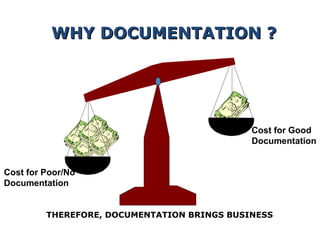
WHY DOCUMENTATION ?


                                             Cost for Good
                                             Documentation


Cost for Poor/No
Documentation


         THEREFORE, DOCUMENTATION BRINGS BUSINESS
GDP references
21 CFR 58 GLP:
 All data generated during performing of a study, (except
  automated data collection systems), shall be recorded
  directly, promptly, and legibly in ink.
 All data entries shall be dated on the date of entry and
  signed or initialed by the person entering the data.
 Any change in entries shall be made so as not to obscure
  the original entry, shall indicate the reason for such
  change, and shall be dated and signed or identified at the
  time of the change.
GDP references
21 CFR 211.188 (a) :
  Control & issue of production batch records.
21 CFR 211.194 (a)
  Verification of laboratory test data for “Accuracy,
   Completeness compliance with established
   standards”
ICH Q7 : Chapter–6 & other GMP guidelines
  Documentation and Records
Comments at the beginning
• GMP documentation is one critical aspect of our business and
  it is a legal requirement too!
• Inspection or audit observations frequently on poor
  documentation practices, outdated documents and
  inadequate version control,
• Quality can not be assured in a regulated industry without
  good documents and good documentation practices
  Keep in mind, after the product is distributed to the
     customer, what remains with us is documents.
Comments at the beginning
Why do people sometimes fail to document activities or
 events properly?
• People don’t understand the legal requirement of
  documentation.
• People do not relate records to auditing.
• People don’t clearly understand what , how or when to
  document.
• Procedures may not be completely understood or followed.
• People aren’t always held accountable.
• People will make mistakes.
• People don’t always make corrections properly.
Key Features of Good Documentation
• Careful design of documents should make them easy to read, easy
  to understand and easy to complete properly
• Just creating documents is not enough; must follow specific
  standards when doing so. Ensure user reads and understand exactly
  what it means.
• Master documents must be subject to appropriate controls to
  ensure that only one version is current. Such documents must be
  approved, signed and dated
• Modifications to master documents must be managed through
  change control
• There must be a periodic review of GMP documents to ensure that
  they are compliant with current regulatory files and GMP
  requirements.
Key Features of Good Documentation
• Original documents should be easily distinguishable from
  photocopies, and should have clear and concise information
• Good documents should have sufficient space for entries, to record
  variable information and signature and to attach print-outs etc.
• Data entries must be made or completed at the time the action is
  performed
• Entries in logbooks should be done in chronological order.
• It is necessary to document anything that directly impacts a
  product. Record every procedure you write, form you fill out, and
  test you perform. Using a standard format eliminates discrepancies
  between documents from different sources.
What should be recorded ?
• All important information that is generated during an
  operation or process must be recorded by who performed
  the operation and when it was carried out.
• Such information should be legible, accurate, dated,
  traceable, and accessible.
  “All documentation should be legible, clean, readily
  identifiable, retrievable and maintained in facilities that
  provide a suitable environment to minimize deterioration
  or damage and to prevent loss”
• This information should reflect the complete history of
  the manufacture, packaging and control of the product.
Where documentation ?
Documentation during
 Project Design,
 Construction Phase
 Commissioning and start-up
 Qualification and Validations
 Commercial Production,
 Testing and Release,
 Distribution
 Implementation of Quality system
 Regulatory submissions.
 And beyond…………
Types of GMP Documentation (1)
• This Documentation includes, but is not limited to the
  following Batch Related Records:
o   Master Batch Records (e.g. Processing & Packaging Instructions)
o   Batch Records (e.g. Batch manufacturing Records)
o   Raw Data Records (charts, chromatograms, etc.)
o   Laboratory Records
o   Distribution Records
o   Standard Operating Procedures (SOPs)
o   Specifications and Test Methods
o   Records of Raw Materials, Intermediates, Labelling and Packaging
    Materials
Types of GMP Documentation (2)
• Non Batch related Records
o   Qualification and Validation Documents
o   Change Control Documentation
o   Engineering Drawings
o   Maintenance and Calibration Records
o   Complaint, Returns and Recalls Records
o   Environmental Monitoring Records
o   Utility Monitoring Records
o   Line and Equipment Logs
o   Personnel Training Records
o   Quality Agreements (i.e. Technical Agreements)
o   Stability Records
Types of GMP Documentation (3)
    Non Batch related Records (continued):
o   Failure Investigation and Reporting Records
o   Cleaning and Sanitization Records
o   Entry Records for Controlled Areas
o   Pest Control Records
o   Audit and Regulatory Inspection Reports
o   Regulatory Files
Other documentation that must be ensured :
o   SOP Annexes
o   Computer files
o   Process Flow and other Diagrams, pictorial displays (e.g. gowning )
o   Technical Reports
o   Labels (room and equipment status, sampling, material status)
Purposes of GMP Documentation (1)
•   There are three main purposes for GMP documentation:
•   To meet legal requirements including all GMP expectations
•   To meet our business requirements
•   To form the basis of good scientific decision making

• Any type of product is developed and produced, it must be
  safe, effective and fit for its intended use.
• Quality characteristics are established in documents.
• Documents declare product standards and describe how to
  monitor, test and judge for compliance with these standards.
Purposes of GMP Documentation (2)
•   To understand what needs to be done (the process)
•   To understand how to do it (the method)
•   To understand why it needs to be done (the context)
•   To understand who must do it (the responsibility)
•   To understand when to do it (frequency, close out)
•   …. At the end: to ensure that there is an adequate
    record of who did what, when, how and why!
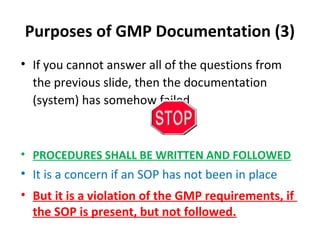
Purposes of GMP Documentation (3)
• If you cannot answer all of the questions from
  the previous slide, then the documentation
  (system) has somehow failed


• PROCEDURES SHALL BE WRITTEN AND FOLLOWED
• It is a concern if an SOP has not been in place
• But it is a violation of the GMP requirements, if
  the SOP is present, but not followed.
Purposes of GMP Documentation (4)
     Documenting Decisions and Rationales

• The regulators expect things to occasionally go wrong
  during manufacturing or testing
• However, we must ensure that we clearly document
  and sign off our decisions with a rationale behind
• In reality, this is one area of a general weakness
• During many audits, people can explain precisely why
  an action was taken, but rationale or justification was
  never documented/signed off at the time.
Strengths of Good Documentation
Clear Objective and scope of the document
Who should prepare ? Should know ?
Layout of the document
Explain the activity performed logically
Use short, simple, easy to understand sentences
Maintain flow of script
Match script to the sequence of events of the activity
Use correct data format
Draw neat and correct inference
Conclusion & Summary
Get your document edited by an expert
Document Management
• Document Administration Department
   – Centralized better than de-centralized?
   – Reporting Relationship
• Document Numbering System
   – Logical and easy to understand
   – Identifies revisions
   – No duplication
• Document Management Procedures
   –   Writing, reviewing, and approving
   –   Numbering and version control
   –   Issuing
   –   Retrieving
   –   Retention and Archiving
Document Retention and Archiving

21CFR 211.180(d) …These records or copies…shall be
subject to photocopying or other means of
reproduction as part of such inspection.

Records that can be immediately retrieved from
another location by computer or other electronic
means shall be considered as meeting the
requirements of this paragraph.”
Document Management
            Retention and Archiving
• 21CFR 211.180(d)…..
• Require clear procedures for archiving of documents
      Defined Retention Periods
      No loss of Information during retention (thermal printers)
      Fire and waterproof archives
      Access and Control of document archives
      Readily Retrievable (in case of compliant, recall, audit)
      Periodic Checks of archive
      Electronic Archives to be Qualified and Validated
      Document destruction
Evaluate the Documentation System
• Review whether our documentation system is working
  correctly or not
• It is easy to find out and classify the issues;
    “nobody fills out the documents correctly”
    “there are always problems with the documentation”
    “the particular system does not work”
• Collect and analyse real data
   –   Area of poor documentation
   –   Classify the type of issues
   –   Evaluate is it person dependent, system dependent
   –   Training or change required
   –   Monitor the improvement
• Improvements will occur If we are monitoring & measuring
  (people know some one is watching)
Evaluate the Documentation System
• Some examples of what we can review and evaluate:
    % SOP’s not reviewed within the required time frame
    % Batch Records with missing information during review
    % of logbooks not reviewed within the correct time frame
    % of outdated versions of SOPs versus the master copy
    % of superseded documents not retrieved
• Identify the priorities and the reasons
    Are there certain issues within specific departments?
    Are some systems badly out of control?
    Make the data transparent
    Ask users why they believe current system is not working
    Compare systems that work well with those that do not
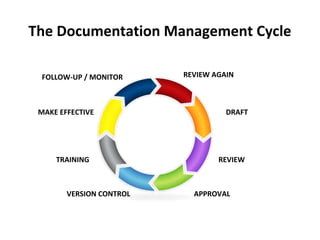
The Documentation Management Cycle

 FOLLOW-UP / MONITOR      REVIEW AGAIN


 MAKE EFFECTIVE                     DRAFT


     TRAINING                     REVIEW


        VERSION CONTROL     APPROVAL
The Documentation Management
             Document preparation
• Written procedures to be drafted to avoid errors/discrepancy:
       clear instructions
       written in sufficient detail
       well understandable
       defining the responsibilities
       easy to implement.
• The document is only useful if the person who should use it, actually
  understands it
• Therefore consider the following aspects;
       educational level
       cultural background
       linguistic ability
       comprehension ability
       Readability
       13 words per sentence.
The Documentation Management
               Document Review
• What can be reviewed and evaluated when checking
  individual documents?
     the information that is stated
     the information that is not stated/missing steps
     scientifically incorrect information/requirements
     conflicting requirements
     safety issues
     legal/regulatory issues
     the rationale for the document (is the document
      serving a useful purpose).
The Documentation Management
            Document Approval
• GMP Documentation is normally signed by the following
  persons:
    Author: a knowledgeable and trained person in the
     relevant
    topic within the relevant department (QA author for QA
     document)
    Reviewer: who is someone equally proficient as the author
    Approver: an appropriate level of management (QA
     manager).
• Quality Assurance main role is to review and approve that all
  GMP documents are in compliance with regulatory files and
  meets the GMP requirements.
Documentation Management: Training
• When New/Updated documents made: ensure that
  relevant people are informed/trained before the document
  becomes effective
• The document can be trained on a one to one basis or as
  group.
• The document can be read by the relevant people
• In some cases, there may be some short questions to
  answer to ensure that key aspects are understood.
• Training of documented could be s built into the system
• The documentation system must ensure that absentees are
  also trained upon their return to work
• Ensure that the training is recorded.
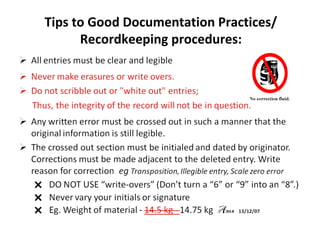
Tips to Good Documentation Practices/
      Recordkeeping procedures:
Tips to Good Documentation Practices
 When portions of a page or a complete page remain unused, a
  single line must be drawn angularly across the unused portion.
  Sign and date the crossed out section and provide an explanation
    Eg- Not applicable; Remining pages not used refer new note
     book
 Ensure the pagination (all pages to be numbered; could be page
  X of Y for loose sheets and page x.. For bound books)
 Make the required entries on the record as the work is
  performed.

    Do not record information on a separate
    piece of paper /temporary entry and
    enter on the record later
Tips to Good Documentation Practices
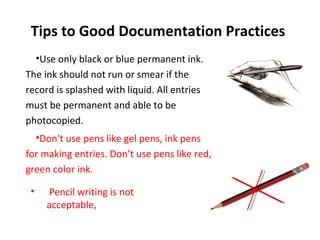
  •Use only black or blue permanent ink.
The ink should not run or smear if the
record is splashed with liquid. All entries
must be permanent and able to be
photocopied.
  •Don’t use pens like gel pens, ink pens
for making entries. Don’t use pens like red,
green color ink.

 •   Pencil writing is not
     acceptable,
Tips to Good Documentation Practices
 Use correct rounding off procedures and significant figures
 When a comment or explanation is required, make all
  statements objective. Avoid personal comments and opinions.
 When dating a signature, use the actual day the signature was
  signed.
 If the activity being recorded occurs on more than one day, the
  record must clearly indicate where the "break" occurred. This
  can be accomplished by drawing a horizontal line through the
  procedure at the break" and indicating the new date or making
  entries that are initiated and dated appropriately.
Tips to Good Documentation Practices
• Never sign your name for performance of a job for work
  actually performed by someone else.
• When one or more person complete a task, all must sign.
• When spaces or cells do not contain information, EACH must
  contain the appropriate “not applicable” entry.
• Spaces and cells cannot be left “blank”!
• Do not use titto, bracket/brace, arrow to link
• Don’t remove any pages or portions from a note book
• Do not change the paper size/quality/colour
• Use polyvinyl alcohol base gum or white glue for pasting of
  graphs etc
Tips to Good Documentation Practices
     BMRs are important documents reviewed by
     regulators, so ensure to fill correctly:
    Missing signatures & dates
    Over-writing without correction, sign, date
    No remarks for correction
    Control Number not recorded correctly
    Time/Date and PC Number recorded in BPR not matching
     with in-process production Log Books
    Every person must be trained to complete documents
     properly; improper use of the documents can lead to
     inaccurate, inadequate or incomplete documents
Tips to Good Documentation Practices/
           Recordkeeping procedures:
   Data may be attached to the page, however, it must be firmly
    attached. Label, sign and date the attachment.
   If a record becomes messy and extremely difficult to read or
    damaged, do not discard. Inform QA/supervisor and
    transcribing the data to a clean record sheet and attaching the
    original record sheet. Provide an explanation for the
    transcription.
   Use clear transparent tape for mending (patch-up).
   Computer print outs taken on thermal paper or easily fading
    inks should be photocopied and maintained.
Tips to Good Documentation Practices
             Review of records
• Proper review will prevent the Non-compliances/
  observation;
• Sincere and effective review shall be done; not just signing as
  reviewer;
• The following shall be reviewed but not limited to;
   –   Incomplete entries, signature
   –   missing records and out-prints
   –   Illegible entries / unacceptable corrections
   –   Traceability of relevant records /cross references
   –   Deviations, if any investigation the impact on the product
   –   Valid calibrations and service intervals of test equipment
   –   Compliance with specifications,
   –   Calculations
GDP:
Filling of BPR
 Missing signatures & dates
     Over-writing without correction, sign, date
     No remarks for correction
     Control Number not recorded correctly
     Time/Date and PC Number recorded in BPR not matching
      with in-process production Log Books
     Every person must be trained to complete documents
      properly; improper use of the documents can lead to
      inaccurate, inadequate or incomplete documents
    BPRs are major documents reviewed by regulators
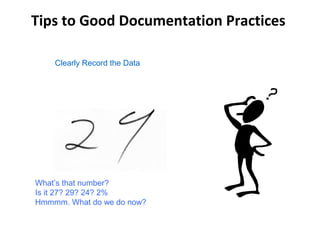
Tips to Good Documentation Practices

    Clearly Record the Data


What’s that number?
Is it 27? 29? 24? 2%
Hmmmm. What do we do now?
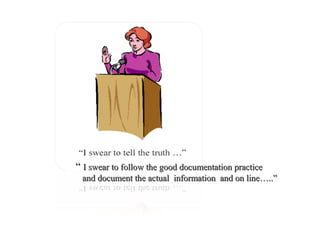
“ I swear to follow the good documentation practice
 and document the actual information and on line…..”
Observations on poor
                 documentation practices
•   Document error correction not signed/dated, and didn’t include a reason
    for the correction
•    Write-overs, multiple line-through and use of "White-out" or other
    masking device
•    Sample sequence table and audit trail not documented (if its not
    documented, it didn’t happen)
•    SOP related to production, calibration, storage and maintenance not
    authorized by the QA head
•    The delegation for the batch release, in case of absence of the QA
    manager, not recorded / documented
•    Out-of-specification (OOS) procedure not detailed enough; flow chart
    and /or check-list not available   .
Observations on poor
              documentation practices
Use of signature stamp
• US FDA Warning Letter UCM075960 to Scott A. Spiro, MD, 28-Jun-06. [16]
• US FDA Warning Letter UCM066113 to Medtronic, Inc., DEC 2 1997. [17]
Obscured original data
• US FDA Warning Letter UCM076246 to Gynetics Medical Products NV, JAN
   16 2007[19]
Use of pencil
Inaccurate records
• US FDA Warning Letter 320-01-02 to SOL Pharmaceuticals Limited, NOV
   21, 2000[18]
Hand changes not dated
• Form FDA 483 issued to L. Perrigo Co., NOV 7, 2008. [20]
Observations on poor
              documentation practices
• The records did not contain the complete raw data for all the
  laboratory testing performed.
• The periodic calibration of the laboratory instruments was not
  documented completely in the laboratory records.
• The records did not include the reason for the modification of a test
  method.
• The laboratory records did not include a statement on the identity
  of the reference standards used and on the method with which
  these were produced.
• The laboratory records did not include the initials or signature of a
  second person showing that the original records had been reviewed
  for accuracy, completeness, and compliance with established
  methods.
Summary and Conclusions (1)
• GMP Documentation is one critical aspect of our
  business.
• Documentation must be consistent and systematic
• Documentation practices must assure that records
  meet GMP requirements
• Documentation process must be controlled to
  minimize redundancies in the work flow
• Inspections and audits regularly identify issues with
  documentation system.
Summary and Conclusions (2)
• Document management system needs to be clear
  and logical
   Use a top down approach (QA must take the lead!)
   Use flow chart and other tools to define documentation
    needs
   Includes all types of documentation (including electronic)
   Ensure a robust document cycle from drafting to archiving
• Review and evaluate the performance of
  documentation system.
Thank You

Any Questions?

Good Documentation Pactise dr. amsavel

  • 1.
  • 2.
    The Overview • Introduction • Requirements • Types of GMP Documentation • Purposes of GMP Documentation • The Structure of Document Management • Evaluation of the Documentation System • The Document Management Cycle • Tips to good documentation practices • Warning letters and observations • Summary & conclusion
  • 3.
    What is Documentation? To Document each Activity you perform Documentation is a Process, which comprises of the following : - Recording of Data - Review of Documents - Approval of Documents - Issuance and Disposal of Documents - Retrieval of Documents - Presentation of Documents
  • 4.
    What are theDefinitions ? • GMP Documentation can be defined as: Any procedure, instruction, logbook, record, raw data, manual, or policy associated with the development, manufacture, testing, marketing, and distribution of a product required to demonstrate compliance with the GMPs and other regulatory requirements • Or more shortly: A GMP document is any written record associated with the manufacture, control and distribution of the API or pharmaceutical product
  • 5.
    WHY GMP DOCUMENTATION? “If it hasn't been documented, then it hasn't done or happened!” “If it is not documented, it is a rumour!” This is the FDA Inspection Attitude The product considered as “Adulterated” if the procedure not followed/ not documented properly.
  • 6.
    WHY DOCUMENTATION ? Cost for Good Documentation Cost for Poor/No Documentation THEREFORE, DOCUMENTATION BRINGS BUSINESS
  • 7.
    GDP references 21 CFR58 GLP:  All data generated during performing of a study, (except automated data collection systems), shall be recorded directly, promptly, and legibly in ink.  All data entries shall be dated on the date of entry and signed or initialed by the person entering the data.  Any change in entries shall be made so as not to obscure the original entry, shall indicate the reason for such change, and shall be dated and signed or identified at the time of the change.
  • 8.
    GDP references 21 CFR211.188 (a) : Control & issue of production batch records. 21 CFR 211.194 (a) Verification of laboratory test data for “Accuracy, Completeness compliance with established standards” ICH Q7 : Chapter–6 & other GMP guidelines Documentation and Records
  • 9.
    Comments at thebeginning • GMP documentation is one critical aspect of our business and it is a legal requirement too! • Inspection or audit observations frequently on poor documentation practices, outdated documents and inadequate version control, • Quality can not be assured in a regulated industry without good documents and good documentation practices Keep in mind, after the product is distributed to the customer, what remains with us is documents.
  • 10.
    Comments at thebeginning Why do people sometimes fail to document activities or events properly? • People don’t understand the legal requirement of documentation. • People do not relate records to auditing. • People don’t clearly understand what , how or when to document. • Procedures may not be completely understood or followed. • People aren’t always held accountable. • People will make mistakes. • People don’t always make corrections properly.
  • 11.
    Key Features ofGood Documentation • Careful design of documents should make them easy to read, easy to understand and easy to complete properly • Just creating documents is not enough; must follow specific standards when doing so. Ensure user reads and understand exactly what it means. • Master documents must be subject to appropriate controls to ensure that only one version is current. Such documents must be approved, signed and dated • Modifications to master documents must be managed through change control • There must be a periodic review of GMP documents to ensure that they are compliant with current regulatory files and GMP requirements.
  • 12.
    Key Features ofGood Documentation • Original documents should be easily distinguishable from photocopies, and should have clear and concise information • Good documents should have sufficient space for entries, to record variable information and signature and to attach print-outs etc. • Data entries must be made or completed at the time the action is performed • Entries in logbooks should be done in chronological order. • It is necessary to document anything that directly impacts a product. Record every procedure you write, form you fill out, and test you perform. Using a standard format eliminates discrepancies between documents from different sources.
  • 13.
    What should berecorded ? • All important information that is generated during an operation or process must be recorded by who performed the operation and when it was carried out. • Such information should be legible, accurate, dated, traceable, and accessible. “All documentation should be legible, clean, readily identifiable, retrievable and maintained in facilities that provide a suitable environment to minimize deterioration or damage and to prevent loss” • This information should reflect the complete history of the manufacture, packaging and control of the product.
  • 14.
    Where documentation ? Documentationduring  Project Design,  Construction Phase  Commissioning and start-up  Qualification and Validations  Commercial Production,  Testing and Release,  Distribution  Implementation of Quality system  Regulatory submissions.  And beyond…………
  • 15.
    Types of GMPDocumentation (1) • This Documentation includes, but is not limited to the following Batch Related Records: o Master Batch Records (e.g. Processing & Packaging Instructions) o Batch Records (e.g. Batch manufacturing Records) o Raw Data Records (charts, chromatograms, etc.) o Laboratory Records o Distribution Records o Standard Operating Procedures (SOPs) o Specifications and Test Methods o Records of Raw Materials, Intermediates, Labelling and Packaging Materials
  • 16.
    Types of GMPDocumentation (2) • Non Batch related Records o Qualification and Validation Documents o Change Control Documentation o Engineering Drawings o Maintenance and Calibration Records o Complaint, Returns and Recalls Records o Environmental Monitoring Records o Utility Monitoring Records o Line and Equipment Logs o Personnel Training Records o Quality Agreements (i.e. Technical Agreements) o Stability Records
  • 17.
    Types of GMPDocumentation (3) Non Batch related Records (continued): o Failure Investigation and Reporting Records o Cleaning and Sanitization Records o Entry Records for Controlled Areas o Pest Control Records o Audit and Regulatory Inspection Reports o Regulatory Files Other documentation that must be ensured : o SOP Annexes o Computer files o Process Flow and other Diagrams, pictorial displays (e.g. gowning ) o Technical Reports o Labels (room and equipment status, sampling, material status)
  • 18.
    Purposes of GMPDocumentation (1) • There are three main purposes for GMP documentation: • To meet legal requirements including all GMP expectations • To meet our business requirements • To form the basis of good scientific decision making • Any type of product is developed and produced, it must be safe, effective and fit for its intended use. • Quality characteristics are established in documents. • Documents declare product standards and describe how to monitor, test and judge for compliance with these standards.
  • 19.
    Purposes of GMPDocumentation (2) • To understand what needs to be done (the process) • To understand how to do it (the method) • To understand why it needs to be done (the context) • To understand who must do it (the responsibility) • To understand when to do it (frequency, close out) • …. At the end: to ensure that there is an adequate record of who did what, when, how and why!
  • 20.
    Purposes of GMPDocumentation (3) • If you cannot answer all of the questions from the previous slide, then the documentation (system) has somehow failed • PROCEDURES SHALL BE WRITTEN AND FOLLOWED • It is a concern if an SOP has not been in place • But it is a violation of the GMP requirements, if the SOP is present, but not followed.
  • 21.
    Purposes of GMPDocumentation (4) Documenting Decisions and Rationales • The regulators expect things to occasionally go wrong during manufacturing or testing • However, we must ensure that we clearly document and sign off our decisions with a rationale behind • In reality, this is one area of a general weakness • During many audits, people can explain precisely why an action was taken, but rationale or justification was never documented/signed off at the time.
  • 22.
    Strengths of GoodDocumentation Clear Objective and scope of the document Who should prepare ? Should know ? Layout of the document Explain the activity performed logically Use short, simple, easy to understand sentences Maintain flow of script Match script to the sequence of events of the activity Use correct data format Draw neat and correct inference Conclusion & Summary Get your document edited by an expert
  • 23.
    Document Management • DocumentAdministration Department – Centralized better than de-centralized? – Reporting Relationship • Document Numbering System – Logical and easy to understand – Identifies revisions – No duplication • Document Management Procedures – Writing, reviewing, and approving – Numbering and version control – Issuing – Retrieving – Retention and Archiving
  • 24.
    Document Retention andArchiving 21CFR 211.180(d) …These records or copies…shall be subject to photocopying or other means of reproduction as part of such inspection. Records that can be immediately retrieved from another location by computer or other electronic means shall be considered as meeting the requirements of this paragraph.”
  • 25.
    Document Management Retention and Archiving • 21CFR 211.180(d)….. • Require clear procedures for archiving of documents  Defined Retention Periods  No loss of Information during retention (thermal printers)  Fire and waterproof archives  Access and Control of document archives  Readily Retrievable (in case of compliant, recall, audit)  Periodic Checks of archive  Electronic Archives to be Qualified and Validated  Document destruction
  • 26.
    Evaluate the DocumentationSystem • Review whether our documentation system is working correctly or not • It is easy to find out and classify the issues;  “nobody fills out the documents correctly”  “there are always problems with the documentation”  “the particular system does not work” • Collect and analyse real data – Area of poor documentation – Classify the type of issues – Evaluate is it person dependent, system dependent – Training or change required – Monitor the improvement • Improvements will occur If we are monitoring & measuring (people know some one is watching)
  • 27.
    Evaluate the DocumentationSystem • Some examples of what we can review and evaluate:  % SOP’s not reviewed within the required time frame  % Batch Records with missing information during review  % of logbooks not reviewed within the correct time frame  % of outdated versions of SOPs versus the master copy  % of superseded documents not retrieved • Identify the priorities and the reasons  Are there certain issues within specific departments?  Are some systems badly out of control?  Make the data transparent  Ask users why they believe current system is not working  Compare systems that work well with those that do not
  • 28.
    The Documentation ManagementCycle FOLLOW-UP / MONITOR REVIEW AGAIN MAKE EFFECTIVE DRAFT TRAINING REVIEW VERSION CONTROL APPROVAL
  • 29.
    The Documentation Management Document preparation • Written procedures to be drafted to avoid errors/discrepancy:  clear instructions  written in sufficient detail  well understandable  defining the responsibilities  easy to implement. • The document is only useful if the person who should use it, actually understands it • Therefore consider the following aspects;  educational level  cultural background  linguistic ability  comprehension ability  Readability  13 words per sentence.
  • 30.
    The Documentation Management Document Review • What can be reviewed and evaluated when checking individual documents?  the information that is stated  the information that is not stated/missing steps  scientifically incorrect information/requirements  conflicting requirements  safety issues  legal/regulatory issues  the rationale for the document (is the document serving a useful purpose).
  • 31.
    The Documentation Management Document Approval • GMP Documentation is normally signed by the following persons:  Author: a knowledgeable and trained person in the relevant  topic within the relevant department (QA author for QA document)  Reviewer: who is someone equally proficient as the author  Approver: an appropriate level of management (QA manager). • Quality Assurance main role is to review and approve that all GMP documents are in compliance with regulatory files and meets the GMP requirements.
  • 32.
    Documentation Management: Training •When New/Updated documents made: ensure that relevant people are informed/trained before the document becomes effective • The document can be trained on a one to one basis or as group. • The document can be read by the relevant people • In some cases, there may be some short questions to answer to ensure that key aspects are understood. • Training of documented could be s built into the system • The documentation system must ensure that absentees are also trained upon their return to work • Ensure that the training is recorded.
  • 33.
    Tips to GoodDocumentation Practices/ Recordkeeping procedures:
  • 34.
    Tips to GoodDocumentation Practices  When portions of a page or a complete page remain unused, a single line must be drawn angularly across the unused portion. Sign and date the crossed out section and provide an explanation  Eg- Not applicable; Remining pages not used refer new note book  Ensure the pagination (all pages to be numbered; could be page X of Y for loose sheets and page x.. For bound books)  Make the required entries on the record as the work is performed. Do not record information on a separate piece of paper /temporary entry and enter on the record later
  • 35.
    Tips to GoodDocumentation Practices •Use only black or blue permanent ink. The ink should not run or smear if the record is splashed with liquid. All entries must be permanent and able to be photocopied. •Don’t use pens like gel pens, ink pens for making entries. Don’t use pens like red, green color ink. • Pencil writing is not acceptable,
  • 36.
    Tips to GoodDocumentation Practices  Use correct rounding off procedures and significant figures  When a comment or explanation is required, make all statements objective. Avoid personal comments and opinions.  When dating a signature, use the actual day the signature was signed.  If the activity being recorded occurs on more than one day, the record must clearly indicate where the "break" occurred. This can be accomplished by drawing a horizontal line through the procedure at the break" and indicating the new date or making entries that are initiated and dated appropriately.
  • 37.
    Tips to GoodDocumentation Practices • Never sign your name for performance of a job for work actually performed by someone else. • When one or more person complete a task, all must sign. • When spaces or cells do not contain information, EACH must contain the appropriate “not applicable” entry. • Spaces and cells cannot be left “blank”! • Do not use titto, bracket/brace, arrow to link • Don’t remove any pages or portions from a note book • Do not change the paper size/quality/colour • Use polyvinyl alcohol base gum or white glue for pasting of graphs etc
  • 38.
    Tips to GoodDocumentation Practices BMRs are important documents reviewed by regulators, so ensure to fill correctly:  Missing signatures & dates  Over-writing without correction, sign, date  No remarks for correction  Control Number not recorded correctly  Time/Date and PC Number recorded in BPR not matching with in-process production Log Books  Every person must be trained to complete documents properly; improper use of the documents can lead to inaccurate, inadequate or incomplete documents
  • 39.
    Tips to GoodDocumentation Practices/ Recordkeeping procedures:  Data may be attached to the page, however, it must be firmly attached. Label, sign and date the attachment.  If a record becomes messy and extremely difficult to read or damaged, do not discard. Inform QA/supervisor and transcribing the data to a clean record sheet and attaching the original record sheet. Provide an explanation for the transcription.  Use clear transparent tape for mending (patch-up).  Computer print outs taken on thermal paper or easily fading inks should be photocopied and maintained.
  • 40.
    Tips to GoodDocumentation Practices Review of records • Proper review will prevent the Non-compliances/ observation; • Sincere and effective review shall be done; not just signing as reviewer; • The following shall be reviewed but not limited to; – Incomplete entries, signature – missing records and out-prints – Illegible entries / unacceptable corrections – Traceability of relevant records /cross references – Deviations, if any investigation the impact on the product – Valid calibrations and service intervals of test equipment – Compliance with specifications, – Calculations
  • 41.
    GDP: Filling of BPR Missing signatures & dates  Over-writing without correction, sign, date  No remarks for correction  Control Number not recorded correctly  Time/Date and PC Number recorded in BPR not matching with in-process production Log Books  Every person must be trained to complete documents properly; improper use of the documents can lead to inaccurate, inadequate or incomplete documents BPRs are major documents reviewed by regulators
  • 42.
    Tips to GoodDocumentation Practices Clearly Record the Data What’s that number? Is it 27? 29? 24? 2% Hmmmm. What do we do now?
  • 43.
    “ I swearto follow the good documentation practice and document the actual information and on line…..”
  • 44.
    Observations on poor documentation practices • Document error correction not signed/dated, and didn’t include a reason for the correction • Write-overs, multiple line-through and use of "White-out" or other masking device • Sample sequence table and audit trail not documented (if its not documented, it didn’t happen) • SOP related to production, calibration, storage and maintenance not authorized by the QA head • The delegation for the batch release, in case of absence of the QA manager, not recorded / documented • Out-of-specification (OOS) procedure not detailed enough; flow chart and /or check-list not available .
  • 45.
    Observations on poor documentation practices Use of signature stamp • US FDA Warning Letter UCM075960 to Scott A. Spiro, MD, 28-Jun-06. [16] • US FDA Warning Letter UCM066113 to Medtronic, Inc., DEC 2 1997. [17] Obscured original data • US FDA Warning Letter UCM076246 to Gynetics Medical Products NV, JAN 16 2007[19] Use of pencil Inaccurate records • US FDA Warning Letter 320-01-02 to SOL Pharmaceuticals Limited, NOV 21, 2000[18] Hand changes not dated • Form FDA 483 issued to L. Perrigo Co., NOV 7, 2008. [20]
  • 46.
    Observations on poor documentation practices • The records did not contain the complete raw data for all the laboratory testing performed. • The periodic calibration of the laboratory instruments was not documented completely in the laboratory records. • The records did not include the reason for the modification of a test method. • The laboratory records did not include a statement on the identity of the reference standards used and on the method with which these were produced. • The laboratory records did not include the initials or signature of a second person showing that the original records had been reviewed for accuracy, completeness, and compliance with established methods.
  • 47.
    Summary and Conclusions(1) • GMP Documentation is one critical aspect of our business. • Documentation must be consistent and systematic • Documentation practices must assure that records meet GMP requirements • Documentation process must be controlled to minimize redundancies in the work flow • Inspections and audits regularly identify issues with documentation system.
  • 48.
    Summary and Conclusions(2) • Document management system needs to be clear and logical  Use a top down approach (QA must take the lead!)  Use flow chart and other tools to define documentation needs  Includes all types of documentation (including electronic)  Ensure a robust document cycle from drafting to archiving • Review and evaluate the performance of documentation system.
  • 49.