GOOD DOCUMENTATION
PRACTICE
By
Manpreet Kaur Arora
General Philosophy of Any Quality
System
Say What you do?
Do what you say ?
Prove what you say and do
The purpose of good documentation practices is to provide basic guideline
and standard ways for correction of errors in documentation
What is Documentation ?
Documentation is a process,
which comprises of following
:
- Recording of Data
- Approval of Documents
- Issuance and Disposal of
Documents
- Retrievability of Documents
- Presentation of Documents
- Review of Documents
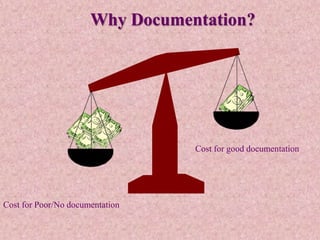
Why Documentation?
Cost for good documentation
Cost for Poor/No documentation
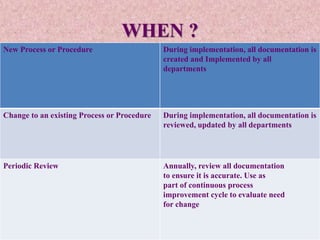
WHEN ?
New Process or Procedure During implementation, all documentation is
created and Implemented by all
departments
Change to an existing Process or Procedure During implementation, all documentation is
reviewed, updated by all departments
Periodic Review Annually, review all documentation
to ensure it is accurate. Use as
part of continuous process
improvement cycle to evaluate need
for change
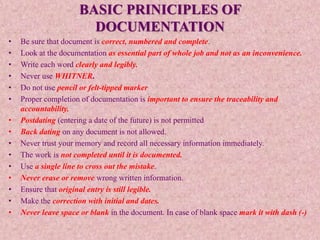
BASIC PRINICIPLES OF
DOCUMENTATION
• Be sure that document is correct, numbered and complete.
• Look at the documentation as essential part of whole job and not as an inconvenience.
• Write each word clearly and legibly.
• Never use WHITNER.
• Do not use pencil or felt-tipped marker
• Proper completion of documentation is important to ensure the traceability and
accountability.
• Postdating (entering a date of the future) is not permitted
• Back dating on any document is not allowed.
• Never trust your memory and record all necessary information immediately.
• The work is not completed until it is documented.
• Use a single line to cross out the mistake.
• Never erase or remove wrong written information.
• Ensure that original entry is still legible.
• Make the correction with initial and dates.
• Never leave space or blank in the document. In case of blank space mark it with dash (-)
RESPONSIBILITY
It is the responsibility of all
persons who are involved in
preparation, completion or
reviewing of documents to
implement these practices.
The Purpose of Documentation
• Proof of fact
• Record
• Regulatory requirement
• Quality maintenance and improvement
• Control the processes
• “Your documentation is an advertisement for your work”
• End User requirements
• To improve performance
• Enables important messages to be communicated clearly
and accurately.
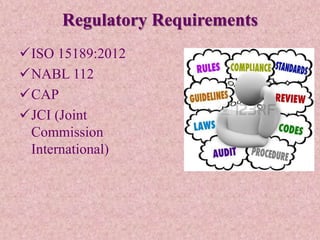
Regulatory Requirements
ISO 15189:2012
NABL 112
CAP
JCI (Joint
Commission
International)
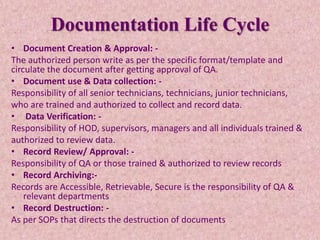
Documentation Life Cycle
• Document Creation & Approval: -
The authorized person write as per the specific format/template and
circulate the document after getting approval of QA.
• Document use & Data collection: -
Responsibility of all senior technicians, technicians, junior technicians,
who are trained and authorized to collect and record data.
• Data Verification: -
Responsibility of HOD, supervisors, managers and all individuals trained &
authorized to review data.
• Record Review/ Approval: -
Responsibility of QA or those trained & authorized to review records
• Record Archiving:-
Records are Accessible, Retrievable, Secure is the responsibility of QA &
relevant departments
• Record Destruction: -
As per SOPs that directs the destruction of documents
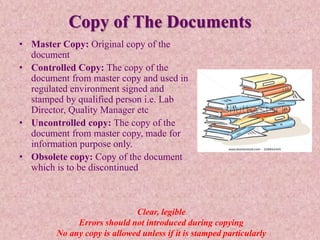
Copy of The Documents
• Master Copy: Original copy of the
document
• Controlled Copy: The copy of the
document from master copy and used in
regulated environment signed and
stamped by qualified person i.e. Lab
Director, Quality Manager etc
• Uncontrolled copy: The copy of the
document from master copy, made for
information purpose only.
• Obsolete copy: Copy of the document
which is to be discontinued
Clear, legible
Errors should not introduced during copying
No any copy is allowed unless if it is stamped particularly
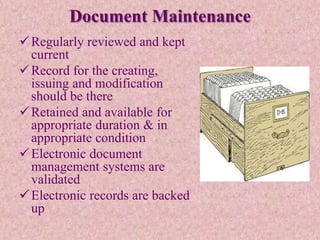
Document Maintenance
Regularly reviewed and kept
current
Record for the creating,
issuing and modification
should be there
Retained and available for
appropriate duration & in
appropriate condition
Electronic document
management systems are
validated
Electronic records are backed
up
Document Review
• Document review will focus on the document's content
and context
• The document quality attributes of concern document
review are correctness, usability, appropriateness and
maintainability.
• Review factors and criteria are :
 Adherence to standards
 Consistency and traceability
 Readability, comprehensibility, and general
understandability
 Technical adequacy and feasibility of approach
 Degree of completeness
 Testability of requirements
 Use of appropriate requirement, design, or coding
techniques
 Appropriate level of details
Document Revision
• All documents shall have a Amendment date & latest document should
accessible to all
• Two type of the revision
1. Routine revision :
- QM/HOD will review and if there is no any change then QM/HOD shall
document that this document doesn't need revision.
2.Technical or editorial revision :
This type of the revision shall be carried out by Document change control
procedure and recorded.
- Every piece of a document shall be marked with the page number as well as
the total number of pages in the documents. X of Y.
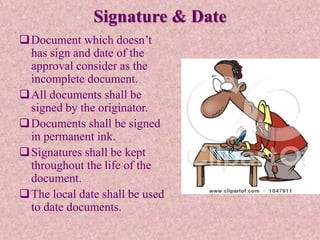
Signature & Date
Document which doesn’t
has sign and date of the
approval consider as the
incomplete document.
All documents shall be
signed by the originator.
Documents shall be signed
in permanent ink.
Signatures shall be kept
throughout the life of the
document.
The local date shall be used
to date documents.
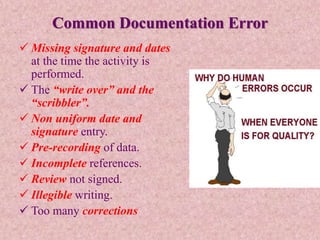
Common Documentation Error
 Missing signature and dates
at the time the activity is
performed.
 The “write over” and the
“scribbler”.
 Non uniform date and
signature entry.
 Pre-recording of data.
 Incomplete references.
 Review not signed.
 Illegible writing.
 Too many corrections
Benefits of Good Documentation
 Unlock the potential of
individual using the document
 Amplify the value of your
work
 Build confidence in your
quality
 Reduce the efforts to
compliance with regulatory
bodies
 Good documentation enables
to achieve the results that you
are seeking for.
Good Documentation Practice is One of the
way to be excellent…

Good Documentation Practice

  • 1.
  • 2.
    General Philosophy ofAny Quality System Say What you do? Do what you say ? Prove what you say and do The purpose of good documentation practices is to provide basic guideline and standard ways for correction of errors in documentation
  • 3.
    What is Documentation? Documentation is a process, which comprises of following : - Recording of Data - Approval of Documents - Issuance and Disposal of Documents - Retrievability of Documents - Presentation of Documents - Review of Documents
  • 4.
    Why Documentation? Cost forgood documentation Cost for Poor/No documentation
  • 5.
    WHEN ? New Processor Procedure During implementation, all documentation is created and Implemented by all departments Change to an existing Process or Procedure During implementation, all documentation is reviewed, updated by all departments Periodic Review Annually, review all documentation to ensure it is accurate. Use as part of continuous process improvement cycle to evaluate need for change
  • 6.
    BASIC PRINICIPLES OF DOCUMENTATION •Be sure that document is correct, numbered and complete. • Look at the documentation as essential part of whole job and not as an inconvenience. • Write each word clearly and legibly. • Never use WHITNER. • Do not use pencil or felt-tipped marker • Proper completion of documentation is important to ensure the traceability and accountability. • Postdating (entering a date of the future) is not permitted • Back dating on any document is not allowed. • Never trust your memory and record all necessary information immediately. • The work is not completed until it is documented. • Use a single line to cross out the mistake. • Never erase or remove wrong written information. • Ensure that original entry is still legible. • Make the correction with initial and dates. • Never leave space or blank in the document. In case of blank space mark it with dash (-)
  • 7.
    RESPONSIBILITY It is theresponsibility of all persons who are involved in preparation, completion or reviewing of documents to implement these practices.
  • 8.
    The Purpose ofDocumentation • Proof of fact • Record • Regulatory requirement • Quality maintenance and improvement • Control the processes • “Your documentation is an advertisement for your work” • End User requirements • To improve performance • Enables important messages to be communicated clearly and accurately.
  • 9.
    Regulatory Requirements ISO 15189:2012 NABL112 CAP JCI (Joint Commission International)
  • 10.
    Documentation Life Cycle •Document Creation & Approval: - The authorized person write as per the specific format/template and circulate the document after getting approval of QA. • Document use & Data collection: - Responsibility of all senior technicians, technicians, junior technicians, who are trained and authorized to collect and record data. • Data Verification: - Responsibility of HOD, supervisors, managers and all individuals trained & authorized to review data. • Record Review/ Approval: - Responsibility of QA or those trained & authorized to review records • Record Archiving:- Records are Accessible, Retrievable, Secure is the responsibility of QA & relevant departments • Record Destruction: - As per SOPs that directs the destruction of documents
  • 11.
    Copy of TheDocuments • Master Copy: Original copy of the document • Controlled Copy: The copy of the document from master copy and used in regulated environment signed and stamped by qualified person i.e. Lab Director, Quality Manager etc • Uncontrolled copy: The copy of the document from master copy, made for information purpose only. • Obsolete copy: Copy of the document which is to be discontinued Clear, legible Errors should not introduced during copying No any copy is allowed unless if it is stamped particularly
  • 12.
    Document Maintenance Regularly reviewedand kept current Record for the creating, issuing and modification should be there Retained and available for appropriate duration & in appropriate condition Electronic document management systems are validated Electronic records are backed up
  • 13.
    Document Review • Documentreview will focus on the document's content and context • The document quality attributes of concern document review are correctness, usability, appropriateness and maintainability. • Review factors and criteria are :  Adherence to standards  Consistency and traceability  Readability, comprehensibility, and general understandability  Technical adequacy and feasibility of approach  Degree of completeness  Testability of requirements  Use of appropriate requirement, design, or coding techniques  Appropriate level of details
  • 14.
    Document Revision • Alldocuments shall have a Amendment date & latest document should accessible to all • Two type of the revision 1. Routine revision : - QM/HOD will review and if there is no any change then QM/HOD shall document that this document doesn't need revision. 2.Technical or editorial revision : This type of the revision shall be carried out by Document change control procedure and recorded. - Every piece of a document shall be marked with the page number as well as the total number of pages in the documents. X of Y.
  • 15.
    Signature & Date Documentwhich doesn’t has sign and date of the approval consider as the incomplete document. All documents shall be signed by the originator. Documents shall be signed in permanent ink. Signatures shall be kept throughout the life of the document. The local date shall be used to date documents.
  • 16.
    Common Documentation Error Missing signature and dates at the time the activity is performed.  The “write over” and the “scribbler”.  Non uniform date and signature entry.  Pre-recording of data.  Incomplete references.  Review not signed.  Illegible writing.  Too many corrections
  • 17.
    Benefits of GoodDocumentation  Unlock the potential of individual using the document  Amplify the value of your work  Build confidence in your quality  Reduce the efforts to compliance with regulatory bodies  Good documentation enables to achieve the results that you are seeking for.
  • 18.
    Good Documentation Practiceis One of the way to be excellent…