Sushant Sardana
Objective
 To enhance the level of awareness on the importance of
good documentation in making pharmaceutical and health
care products
GMP Documentation can be applicable to:
Procedure, instruction, logbook, record, raw data, manual,
or policy associated with the development, manufacture,
testing, marketing, and distribution of a product required to
demonstrate compliance with the GMPs and other regulatory
requirements.
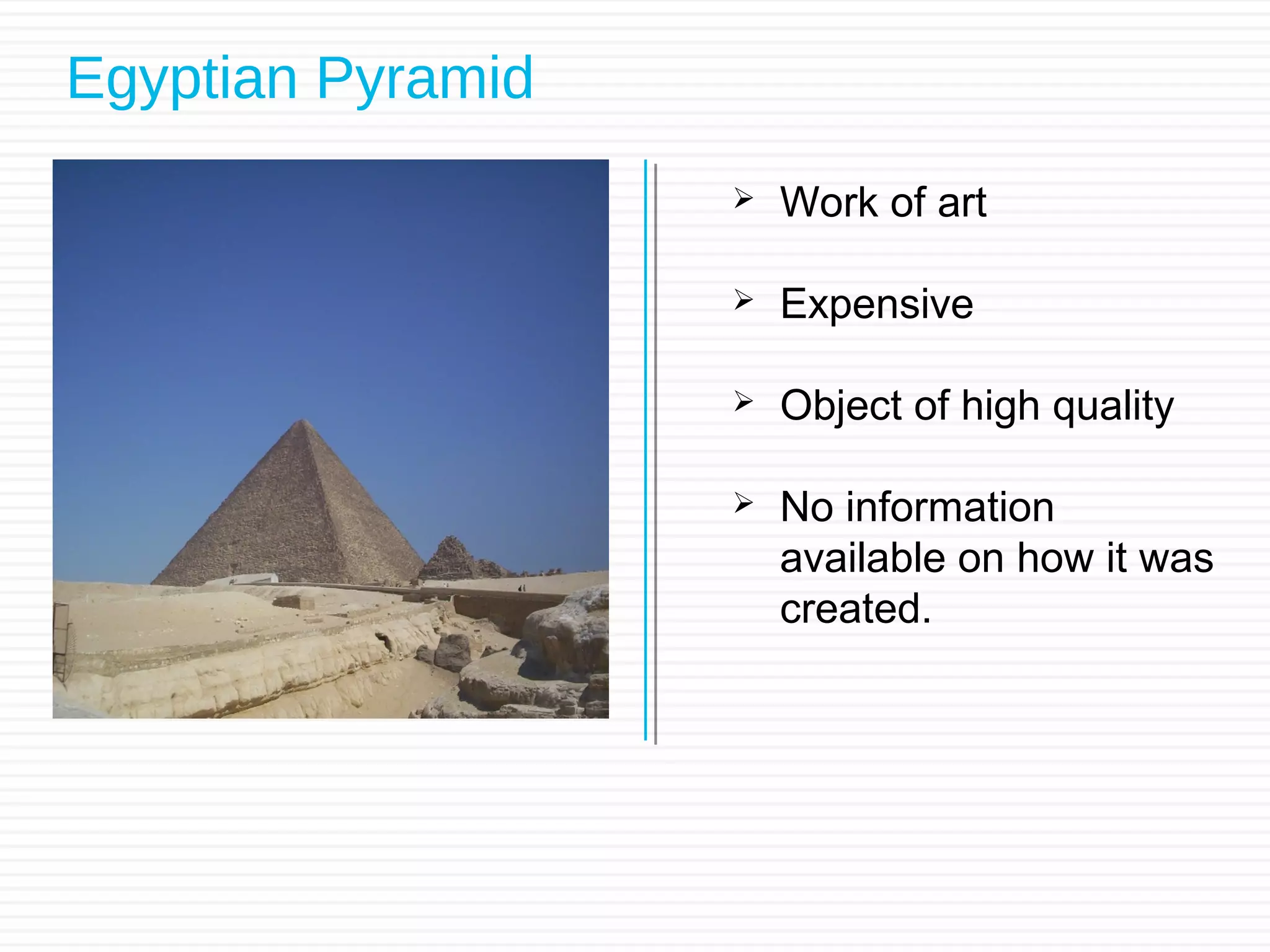
Egyptian Pyramid
 Work of art
 Expensive
 Object of high quality
 No information
available on how it was
created.
Purposes of Documentation
 It’s required by LAW!!!
 Keep track of activities.
 Create legal documents.
 Provide a historical record.
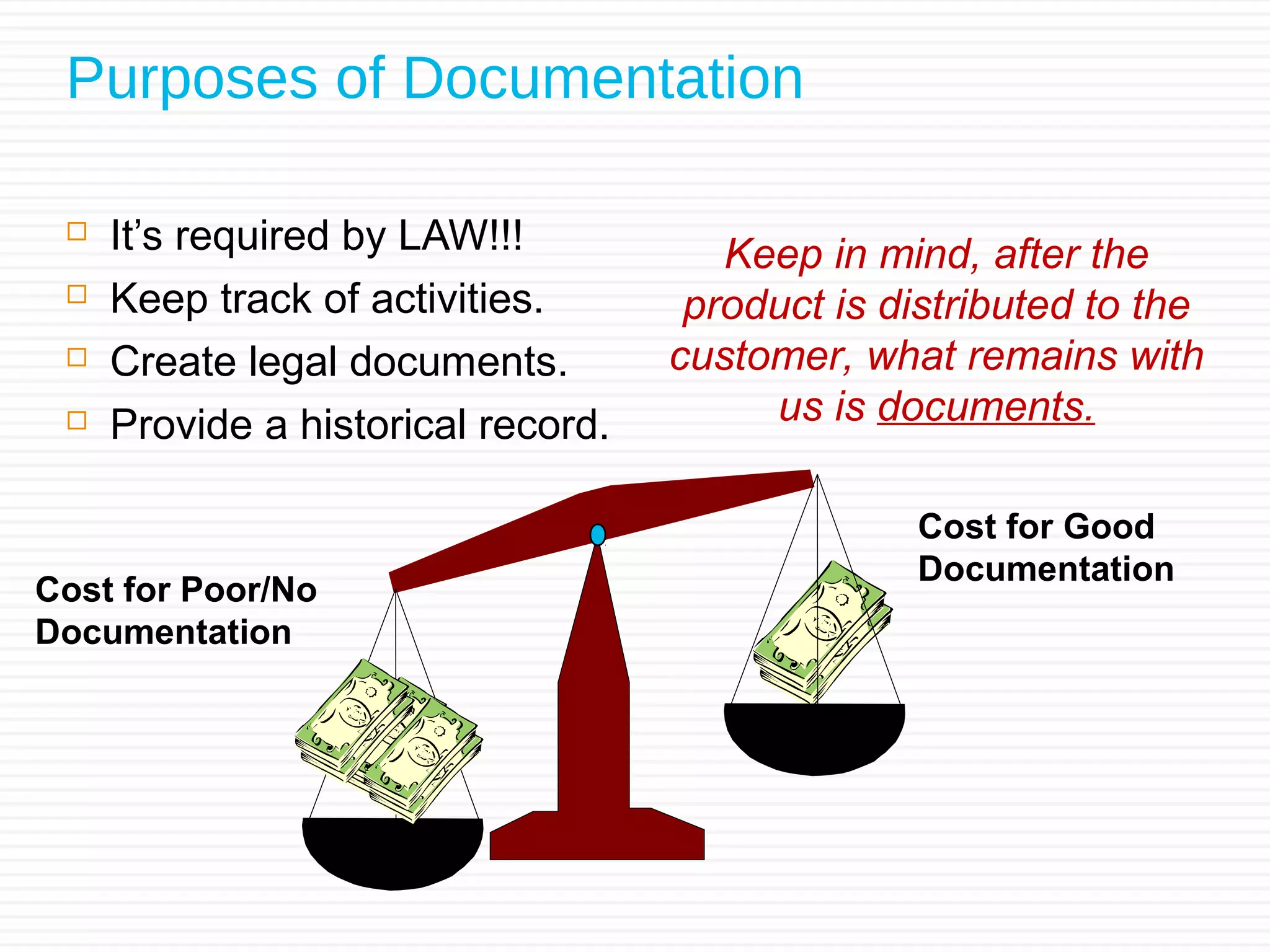
Cost for Good
Documentation
Cost for Poor/No
Documentation
Keep in mind, after the
product is distributed to the
customer, what remains with
us is documents.
Purposes of Documentation
 To understand what needs to be done (the process)
 To understand how to do it (the method)
 To understand why it needs to be done (the context)
 To understand who must do it (the responsibility)
 To understand when to do it (frequency, close out)
 …. At the end: to ensure that there is an adequate record
of who did what, when, how and why!
Comments at the beginning
Why do people sometimes fail to document activities or events
properly?
 People don’t understand the legal requirement of documentation.
 People do not relate records to auditing.
 People don’t clearly understand what , how or when to document.
 Procedures may not be completely understood or followed.
 People aren’t always held accountable.
 People will make mistakes.
 People don’t always make corrections properly.
Batch Records are major documents reviewed by regulators
Nine Characteristics of a Quality GMP
Record
 Permanent.
 Legible
 Accurate
 Prompt
 Clear
 Consistent
 Complete
 Direct
 Truthful
Good Documentation Practices
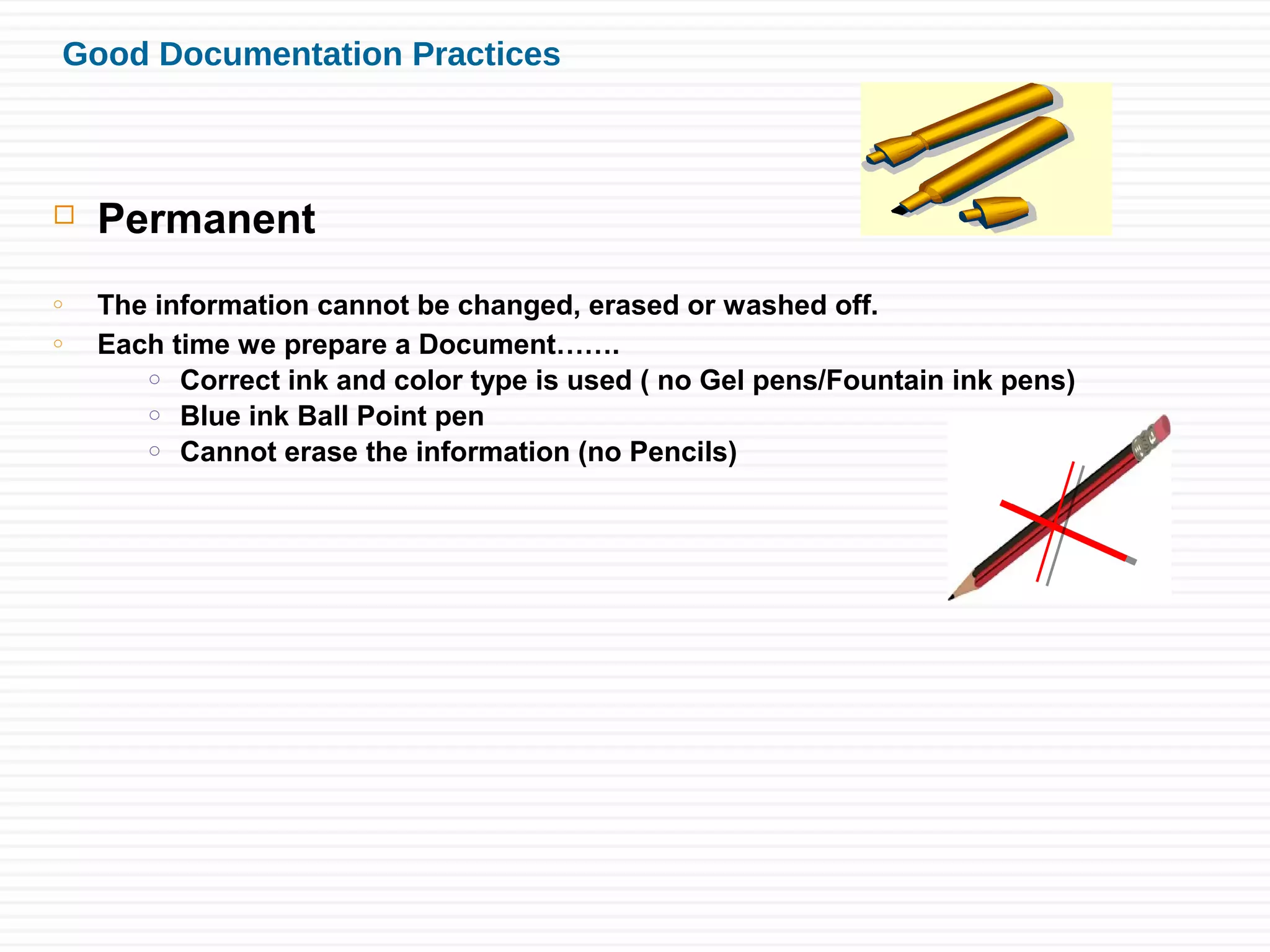
 Permanent
o The information cannot be changed, erased or washed off.
o Each time we prepare a Document…….
o Correct ink and color type is used ( no Gel pens/Fountain ink pens)
o Blue ink Ball Point pen
o Cannot erase the information (no Pencils)
Good Documentation Practices
 Legible
o The information can be easily read.
o Each time we prepare a Document…….
o Printing and handwriting can be easily read.
o Errors are properly corrected with one line through the original entry, correct
entry, initialed and dated. Explained where required…..
o Do not erase, overwrite, scribble or “white out” original entries
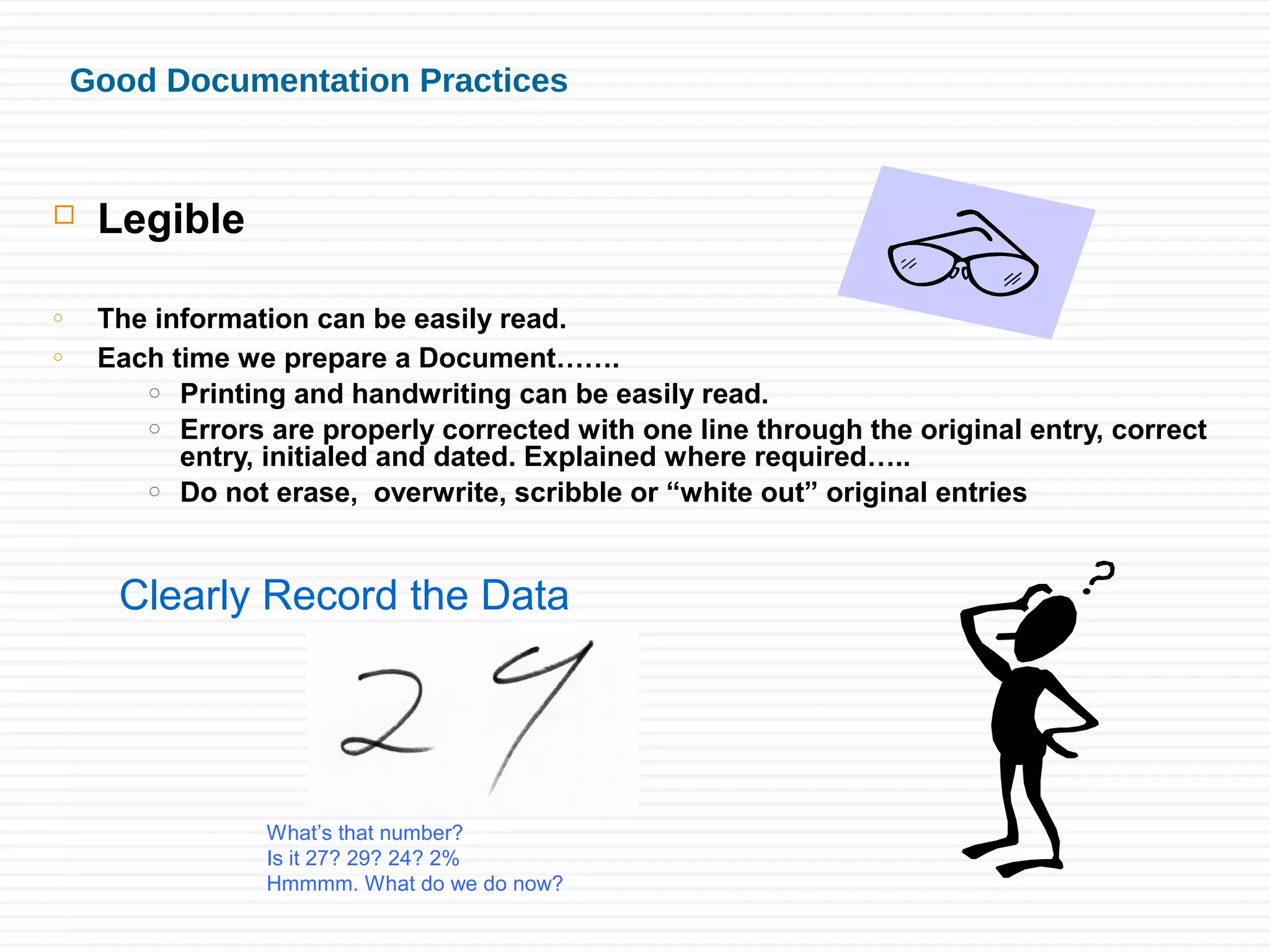
Clearly Record the Data
What’s that number?
Is it 27? 29? 24? 2%
Hmmmm. What do we do now?
Good Documentation Practices
 Accurate
o Calculations are correct and other information is recorded with care.
o Each time we prepare a Document…….
o Entries are reviewed and verified by someone else
o Spelling of product names and other words are correct
Good Documentation Practices
 Prompt
o Information is recorded in a timely way.
o Actions are documented immediately after they are performed, never before.
o Each time we prepare a Document…….
o Information is recorded immediately as it is obtained -Online Documentation.
o Do not post date or pre-date
Good Documentation Practices
 Clear
o Everyone who reads the document has the same understanding of what it means.
o Each time we prepare a Document…….
o Just the facts!
o Five years from now, someone reading the document will be able to reliably and
easily recreate the event or process.
Good Documentation Practices
 Consistent
o All information, such as dates, times, abbreviations etc should be standardized so
there is no room for confusion.
o Each time we prepare a Document…….
o The proper formats for date and time are used
o Lot code and expiration date are recorded using the correct format (e.g. Date
shall be entered in DD/MM/YYYY format.
o Time (A.M. or PM)
Good Documentation Practices
 Complete
o All required information is included.
o Each time we prepare a Document…….
o Blank spaces should be lined out, write “Not Applicable,” initial and date.
o For multiple spaces, one line throughout is acceptable, write “Not Applicable,”
initial and date.
o Do not use “ditto” marks or lines with downward arrows.
Good Documentation Practices
 Direct
o Information is recorded immediately onto the proper form - Batch Records, Log
Book/Sheets, laboratory notebook.
o Each time we prepare a Document…….
o The original entry is made into the official word
o No writing on “post its,” “Paper slips” etc.
Good Documentation Practices
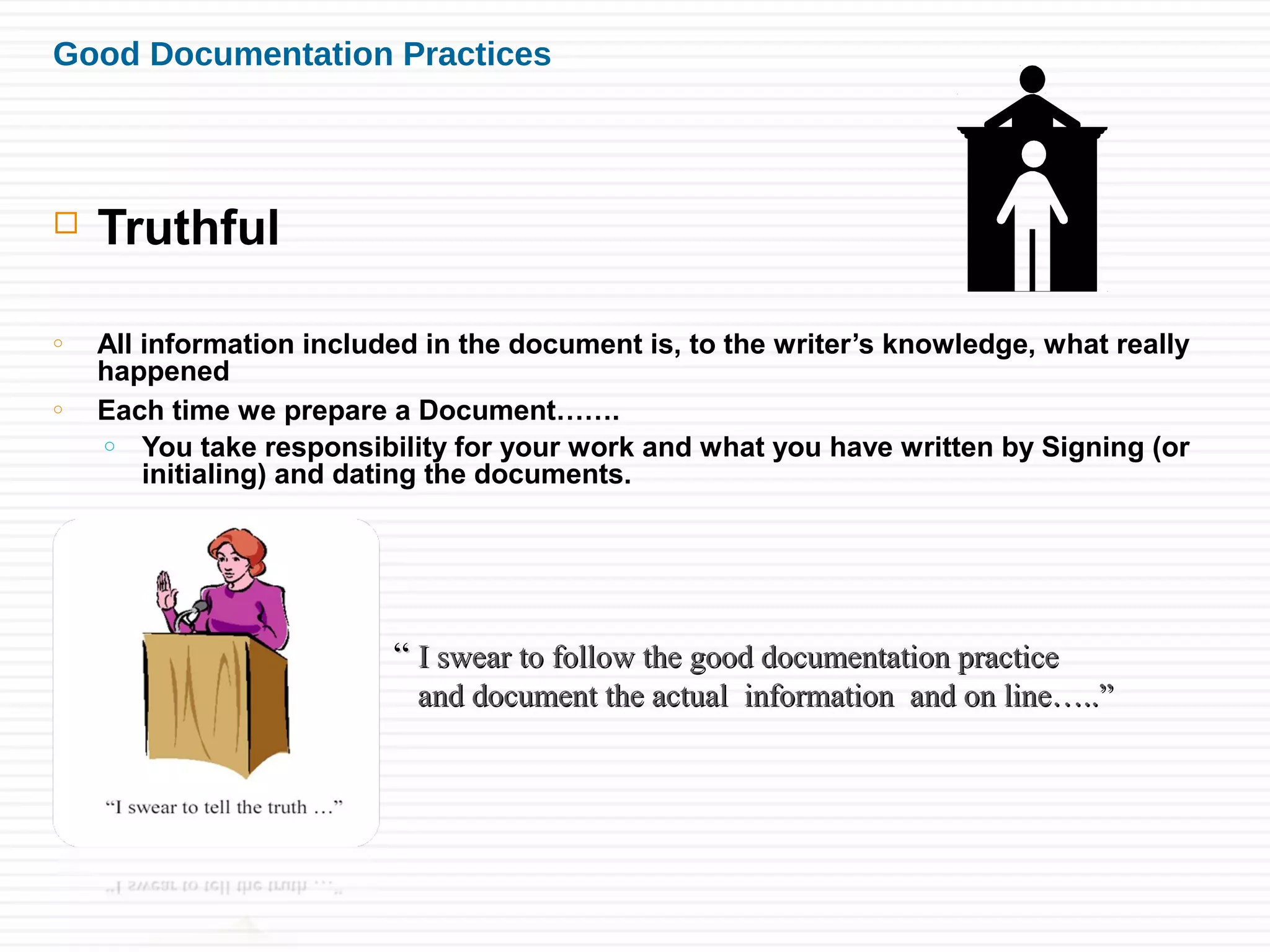
 Truthful
o All information included in the document is, to the writer’s knowledge, what really
happened
o Each time we prepare a Document…….
o You take responsibility for your work and what you have written by Signing (or
initialing) and dating the documents.
““ I swear to follow the good documentation practiceI swear to follow the good documentation practice
and document the actual information and on line…..”and document the actual information and on line…..”
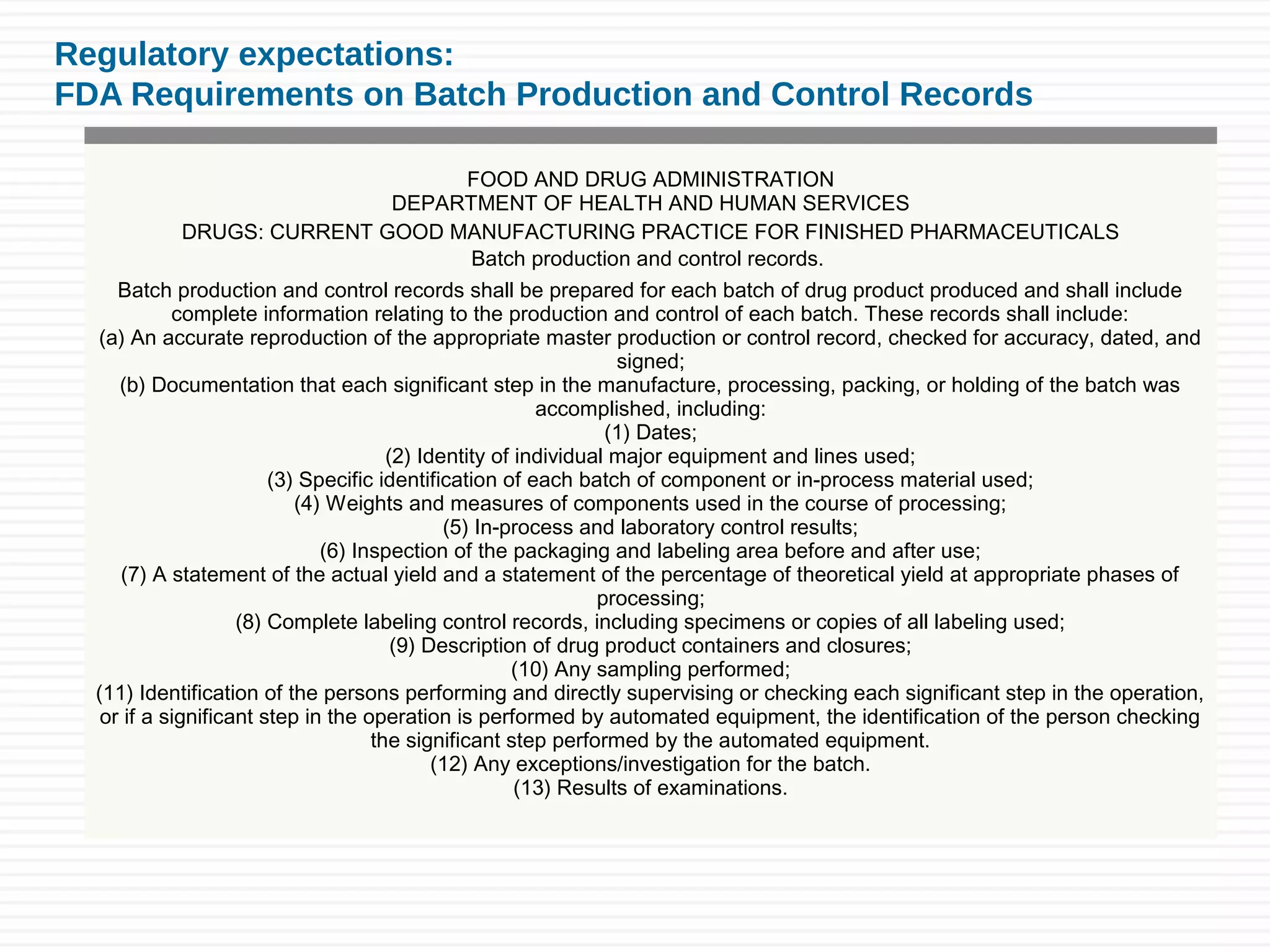
Regulatory expectations:
FDA Requirements on Batch Production and Control Records
FOOD AND DRUG ADMINISTRATION
DEPARTMENT OF HEALTH AND HUMAN SERVICES
DRUGS: CURRENT GOOD MANUFACTURING PRACTICE FOR FINISHED PHARMACEUTICALS
Batch production and control records.
Batch production and control records shall be prepared for each batch of drug product produced and shall include
complete information relating to the production and control of each batch. These records shall include:
(a) An accurate reproduction of the appropriate master production or control record, checked for accuracy, dated, and
signed;
(b) Documentation that each significant step in the manufacture, processing, packing, or holding of the batch was
accomplished, including:
(1) Dates;
(2) Identity of individual major equipment and lines used;
(3) Specific identification of each batch of component or in-process material used;
(4) Weights and measures of components used in the course of processing;
(5) In-process and laboratory control results;
(6) Inspection of the packaging and labeling area before and after use;
(7) A statement of the actual yield and a statement of the percentage of theoretical yield at appropriate phases of
processing;
(8) Complete labeling control records, including specimens or copies of all labeling used;
(9) Description of drug product containers and closures;
(10) Any sampling performed;
(11) Identification of the persons performing and directly supervising or checking each significant step in the operation,
or if a significant step in the operation is performed by automated equipment, the identification of the person checking
the significant step performed by the automated equipment.
(12) Any exceptions/investigation for the batch.
(13) Results of examinations.
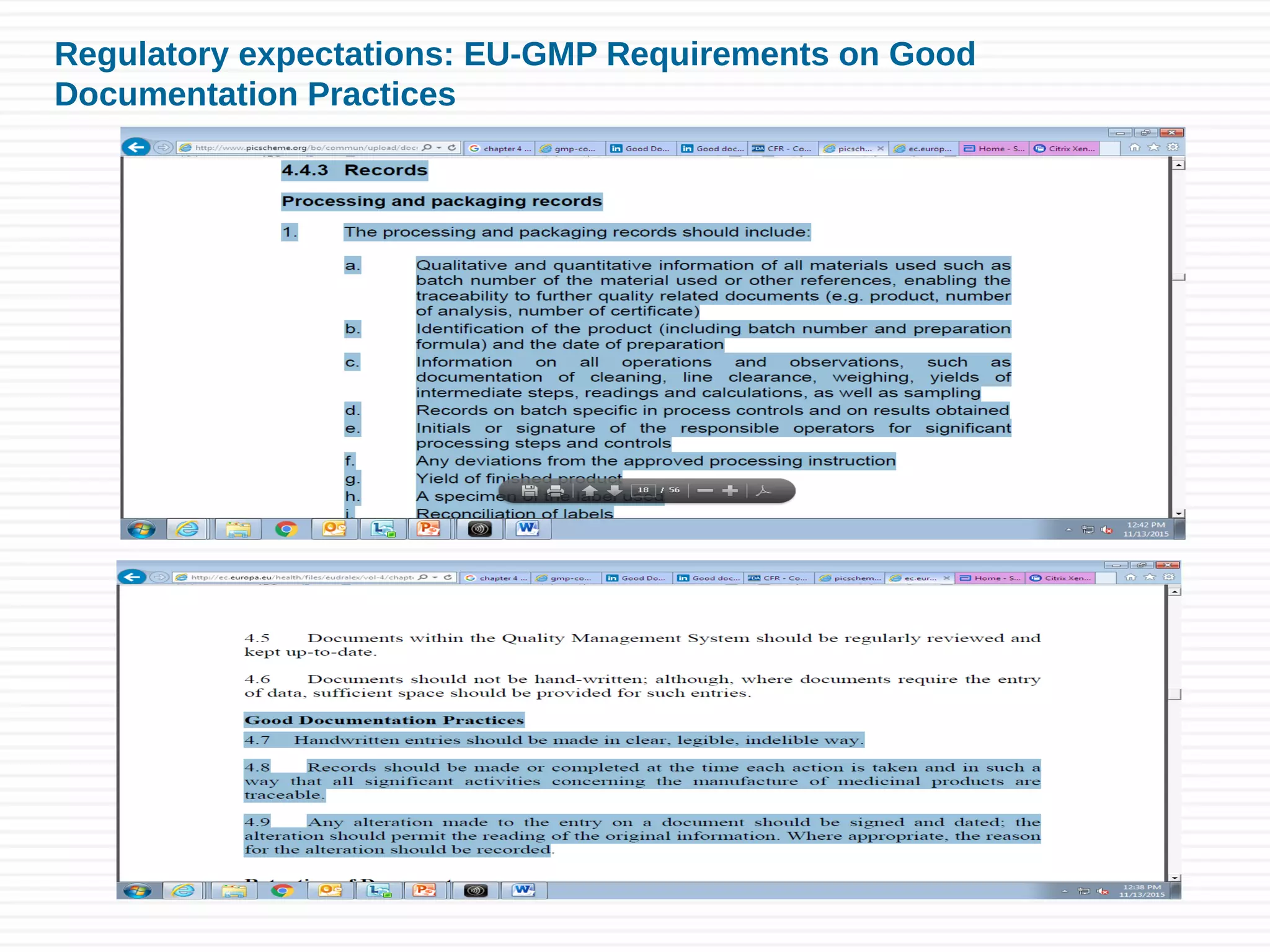
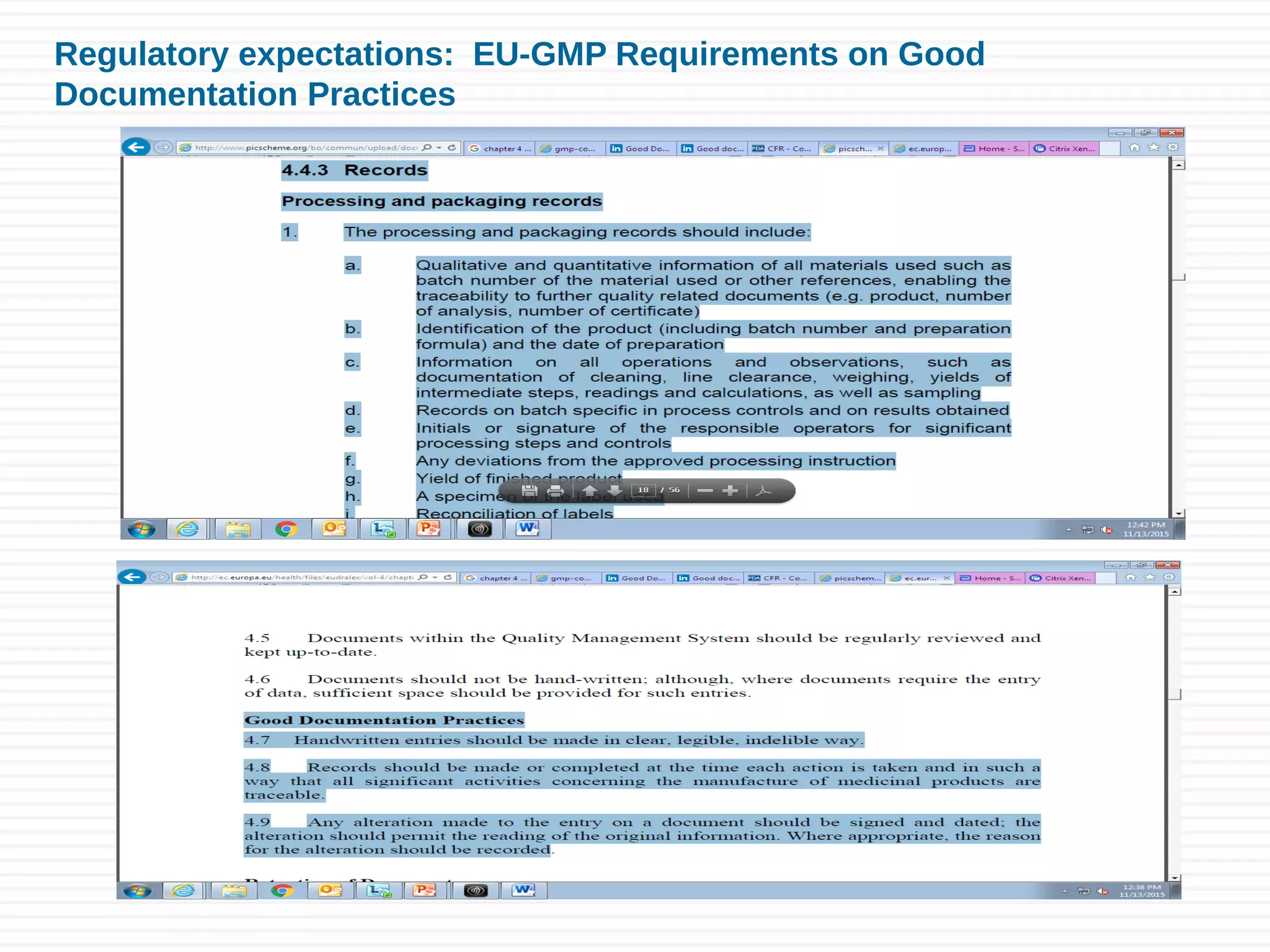
Regulatory expectations: EU-GMP Requirements on Good
Documentation Practices
Regulatory expectations: EU-GMP Requirements on Good
Documentation Practices
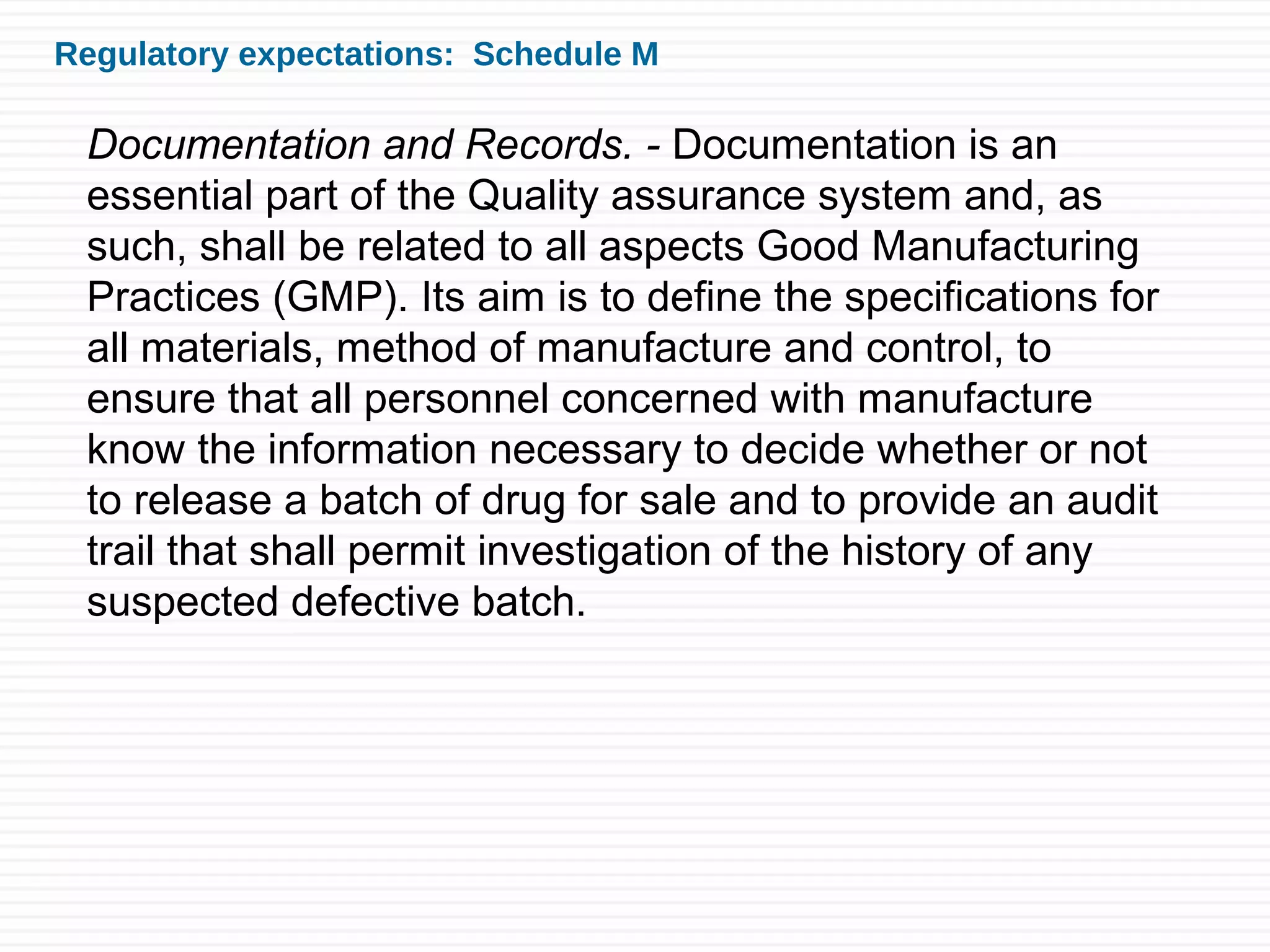
Regulatory expectations: Schedule M
Documentation and Records. - Documentation is an
essential part of the Quality assurance system and, as
such, shall be related to all aspects Good Manufacturing
Practices (GMP). Its aim is to define the specifications for
all materials, method of manufacture and control, to
ensure that all personnel concerned with manufacture
know the information necessary to decide whether or not
to release a batch of drug for sale and to provide an audit
trail that shall permit investigation of the history of any
suspected defective batch.
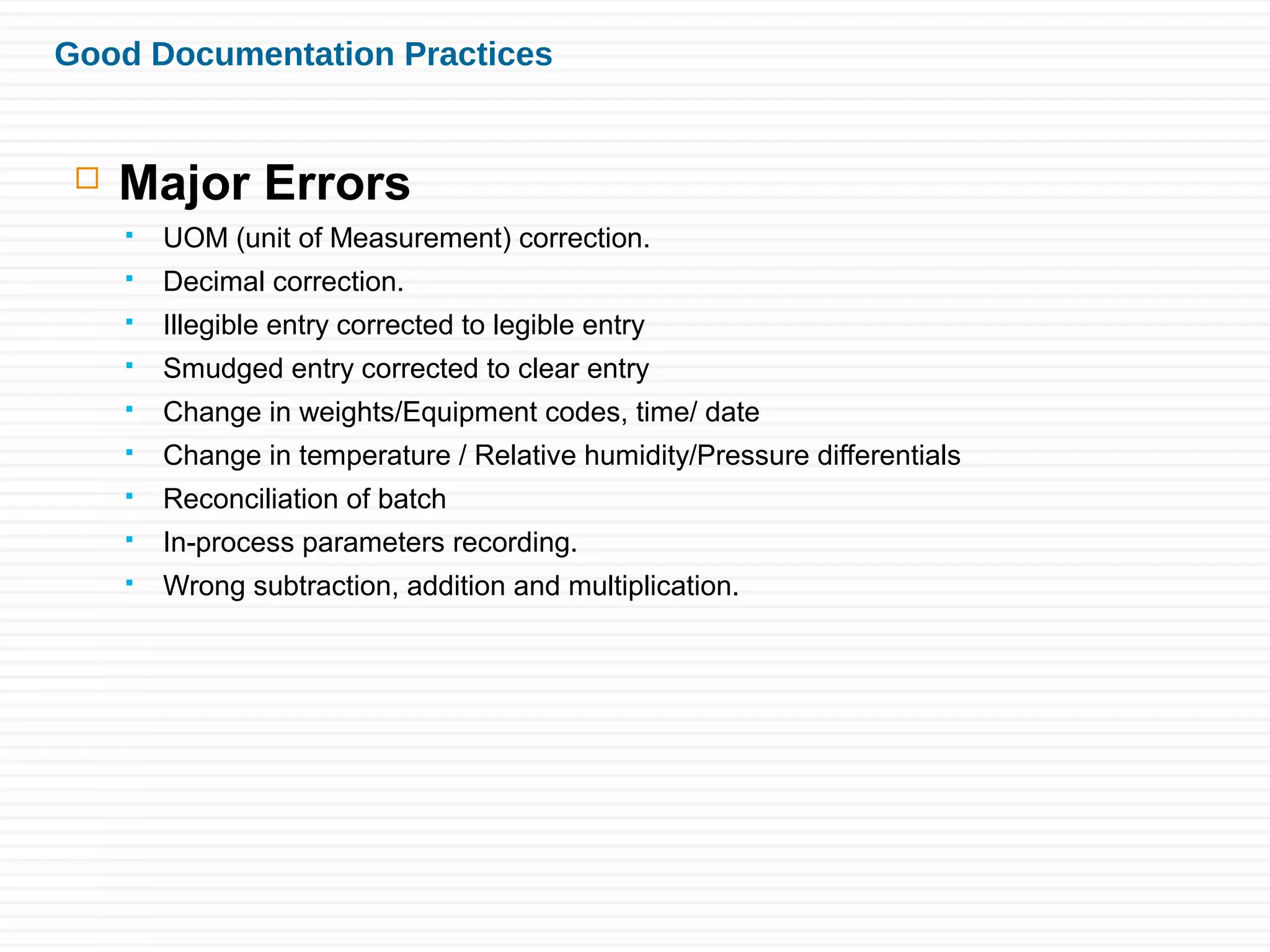
Good Documentation Practices
 Major Errors
 UOM (unit of Measurement) correction.
 Decimal correction.
 Illegible entry corrected to legible entry
 Smudged entry corrected to clear entry
 Change in weights/Equipment codes, time/ date
 Change in temperature / Relative humidity/Pressure differentials
 Reconciliation of batch
 In-process parameters recording.
 Wrong subtraction, addition and multiplication.
In Summary…
 Documenting your work is just as important as the information,
product, or service you produce.
 The documents you prepare should allow someone in the future to
reliably, clearly, completely, and easily re-create an activity, event, or
process.
 The better the documents we produce, the better it is for the users of
our products, our organization, and ourselves.
 It takes less time and energy to produce a quality document than to
deal with frustration. Problems and potential regulatory issues that
result from inadequate documentation.
 The records you produce must meet the 9 characteristics of a well-
made document
If it is not Documented, it
Did not Happen
First witness the things
yourself then write in
document
Write when it happens. Do
not write late or all
together

Good documentation practices

  • 1.
  • 2.
    Objective  To enhancethe level of awareness on the importance of good documentation in making pharmaceutical and health care products GMP Documentation can be applicable to: Procedure, instruction, logbook, record, raw data, manual, or policy associated with the development, manufacture, testing, marketing, and distribution of a product required to demonstrate compliance with the GMPs and other regulatory requirements.
  • 3.
    Egyptian Pyramid  Workof art  Expensive  Object of high quality  No information available on how it was created.
  • 4.
    Purposes of Documentation It’s required by LAW!!!  Keep track of activities.  Create legal documents.  Provide a historical record. Cost for Good Documentation Cost for Poor/No Documentation Keep in mind, after the product is distributed to the customer, what remains with us is documents.
  • 5.
    Purposes of Documentation To understand what needs to be done (the process)  To understand how to do it (the method)  To understand why it needs to be done (the context)  To understand who must do it (the responsibility)  To understand when to do it (frequency, close out)  …. At the end: to ensure that there is an adequate record of who did what, when, how and why!
  • 6.
    Comments at thebeginning Why do people sometimes fail to document activities or events properly?  People don’t understand the legal requirement of documentation.  People do not relate records to auditing.  People don’t clearly understand what , how or when to document.  Procedures may not be completely understood or followed.  People aren’t always held accountable.  People will make mistakes.  People don’t always make corrections properly. Batch Records are major documents reviewed by regulators
  • 7.
    Nine Characteristics ofa Quality GMP Record  Permanent.  Legible  Accurate  Prompt  Clear  Consistent  Complete  Direct  Truthful
  • 8.
    Good Documentation Practices Permanent o The information cannot be changed, erased or washed off. o Each time we prepare a Document……. o Correct ink and color type is used ( no Gel pens/Fountain ink pens) o Blue ink Ball Point pen o Cannot erase the information (no Pencils)
  • 9.
    Good Documentation Practices Legible o The information can be easily read. o Each time we prepare a Document……. o Printing and handwriting can be easily read. o Errors are properly corrected with one line through the original entry, correct entry, initialed and dated. Explained where required….. o Do not erase, overwrite, scribble or “white out” original entries Clearly Record the Data What’s that number? Is it 27? 29? 24? 2% Hmmmm. What do we do now?
  • 10.
    Good Documentation Practices Accurate o Calculations are correct and other information is recorded with care. o Each time we prepare a Document……. o Entries are reviewed and verified by someone else o Spelling of product names and other words are correct
  • 11.
    Good Documentation Practices Prompt o Information is recorded in a timely way. o Actions are documented immediately after they are performed, never before. o Each time we prepare a Document……. o Information is recorded immediately as it is obtained -Online Documentation. o Do not post date or pre-date
  • 12.
    Good Documentation Practices Clear o Everyone who reads the document has the same understanding of what it means. o Each time we prepare a Document……. o Just the facts! o Five years from now, someone reading the document will be able to reliably and easily recreate the event or process.
  • 13.
    Good Documentation Practices Consistent o All information, such as dates, times, abbreviations etc should be standardized so there is no room for confusion. o Each time we prepare a Document……. o The proper formats for date and time are used o Lot code and expiration date are recorded using the correct format (e.g. Date shall be entered in DD/MM/YYYY format. o Time (A.M. or PM)
  • 14.
    Good Documentation Practices Complete o All required information is included. o Each time we prepare a Document……. o Blank spaces should be lined out, write “Not Applicable,” initial and date. o For multiple spaces, one line throughout is acceptable, write “Not Applicable,” initial and date. o Do not use “ditto” marks or lines with downward arrows.
  • 15.
    Good Documentation Practices Direct o Information is recorded immediately onto the proper form - Batch Records, Log Book/Sheets, laboratory notebook. o Each time we prepare a Document……. o The original entry is made into the official word o No writing on “post its,” “Paper slips” etc.
  • 16.
    Good Documentation Practices Truthful o All information included in the document is, to the writer’s knowledge, what really happened o Each time we prepare a Document……. o You take responsibility for your work and what you have written by Signing (or initialing) and dating the documents. ““ I swear to follow the good documentation practiceI swear to follow the good documentation practice and document the actual information and on line…..”and document the actual information and on line…..”
  • 17.
    Regulatory expectations: FDA Requirementson Batch Production and Control Records FOOD AND DRUG ADMINISTRATION DEPARTMENT OF HEALTH AND HUMAN SERVICES DRUGS: CURRENT GOOD MANUFACTURING PRACTICE FOR FINISHED PHARMACEUTICALS Batch production and control records. Batch production and control records shall be prepared for each batch of drug product produced and shall include complete information relating to the production and control of each batch. These records shall include: (a) An accurate reproduction of the appropriate master production or control record, checked for accuracy, dated, and signed; (b) Documentation that each significant step in the manufacture, processing, packing, or holding of the batch was accomplished, including: (1) Dates; (2) Identity of individual major equipment and lines used; (3) Specific identification of each batch of component or in-process material used; (4) Weights and measures of components used in the course of processing; (5) In-process and laboratory control results; (6) Inspection of the packaging and labeling area before and after use; (7) A statement of the actual yield and a statement of the percentage of theoretical yield at appropriate phases of processing; (8) Complete labeling control records, including specimens or copies of all labeling used; (9) Description of drug product containers and closures; (10) Any sampling performed; (11) Identification of the persons performing and directly supervising or checking each significant step in the operation, or if a significant step in the operation is performed by automated equipment, the identification of the person checking the significant step performed by the automated equipment. (12) Any exceptions/investigation for the batch. (13) Results of examinations.
  • 18.
    Regulatory expectations: EU-GMPRequirements on Good Documentation Practices
  • 19.
    Regulatory expectations: EU-GMPRequirements on Good Documentation Practices
  • 20.
    Regulatory expectations: ScheduleM Documentation and Records. - Documentation is an essential part of the Quality assurance system and, as such, shall be related to all aspects Good Manufacturing Practices (GMP). Its aim is to define the specifications for all materials, method of manufacture and control, to ensure that all personnel concerned with manufacture know the information necessary to decide whether or not to release a batch of drug for sale and to provide an audit trail that shall permit investigation of the history of any suspected defective batch.
  • 21.
    Good Documentation Practices Major Errors  UOM (unit of Measurement) correction.  Decimal correction.  Illegible entry corrected to legible entry  Smudged entry corrected to clear entry  Change in weights/Equipment codes, time/ date  Change in temperature / Relative humidity/Pressure differentials  Reconciliation of batch  In-process parameters recording.  Wrong subtraction, addition and multiplication.
  • 22.
    In Summary…  Documentingyour work is just as important as the information, product, or service you produce.  The documents you prepare should allow someone in the future to reliably, clearly, completely, and easily re-create an activity, event, or process.  The better the documents we produce, the better it is for the users of our products, our organization, and ourselves.  It takes less time and energy to produce a quality document than to deal with frustration. Problems and potential regulatory issues that result from inadequate documentation.  The records you produce must meet the 9 characteristics of a well- made document
  • 23.
    If it isnot Documented, it Did not Happen First witness the things yourself then write in document Write when it happens. Do not write late or all together