SMIT PATEL
Quality Executive      (GMP)
Himalya
  International ltd.
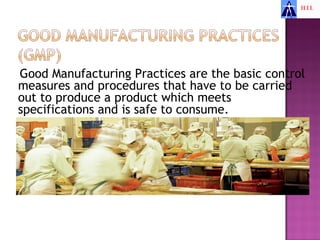
Good Manufacturing Practices are the basic control
measures and procedures that have to be carried
out to produce a product which meets
specifications and is safe to consume.
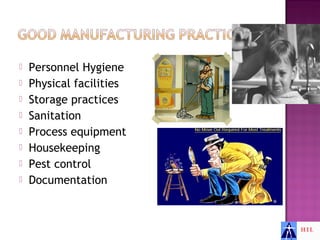
   Personnel Hygiene
   Physical facilities
   Storage practices
   Sanitation
   Process equipment
   Housekeeping
   Pest control
   Documentation
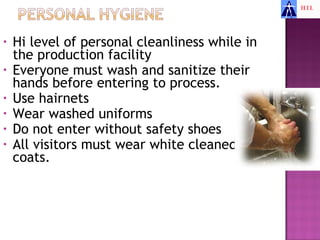
•   Hi level of personal cleanliness while in
    the production facility
•   Everyone must wash and sanitize their
    hands before entering to process.
•   Use hairnets
•   Wear washed uniforms
•   Do not enter without safety shoes
•   All visitors must wear white cleaned Lab
    coats.
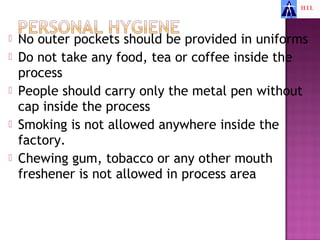
   No outer pockets should be provided in uniforms
   Do not take any food, tea or coffee inside the
    process
   People should carry only the metal pen without
    cap inside the process
   Smoking is not allowed anywhere inside the
    factory.
   Chewing gum, tobacco or any other mouth
    freshener is not allowed in process area
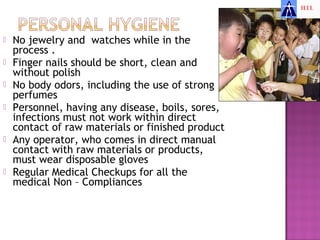
   No jewelry and watches while in the
    process .
   Finger nails should be short, clean and
    without polish
   No body odors, including the use of strong
    perfumes
   Personnel, having any disease, boils, sores,
    infections must not work within direct
    contact of raw materials or finished product
   Any operator, who comes in direct manual
    contact with raw materials or products,
    must wear disposable gloves
   Regular Medical Checkups for all the
    medical Non – Compliances
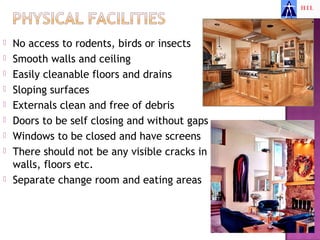
   No access to rodents, birds or insects
   Smooth walls and ceiling
   Easily cleanable floors and drains
   Sloping surfaces
   Externals clean and free of debris
   Doors to be self closing and without gaps
   Windows to be closed and have screens
   There should not be any visible cracks in
    walls, floors etc.
   Separate change room and eating areas
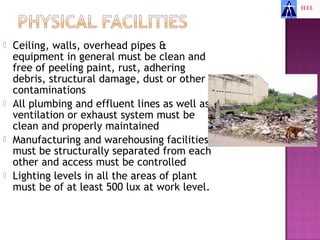
   Ceiling, walls, overhead pipes &
    equipment in general must be clean and
    free of peeling paint, rust, adhering
    debris, structural damage, dust or other
    contaminations
   All plumbing and effluent lines as well as
    ventilation or exhaust system must be
    clean and properly maintained
   Manufacturing and warehousing facilities
    must be structurally separated from each
    other and access must be controlled
   Lighting levels in all the areas of plant
    must be of at least 500 lux at work level.
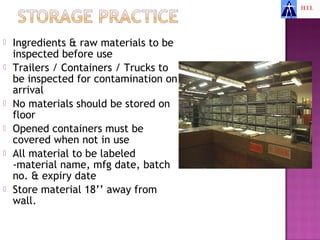
   Ingredients & raw materials to be
    inspected before use
   Trailers / Containers / Trucks to
    be inspected for contamination on
    arrival
   No materials should be stored on
    floor
   Opened containers must be
    covered when not in use
   All material to be labeled
    -material name, mfg date, batch
    no. & expiry date
   Store material 18’’ away from
    wall.
   All weighing and any other measuring devices must be properly
    maintained and calibrated.
   There should not be any glass material in the storage
   Stacking height of containers must not exceed the safety load,
    no deformation of stocking units
   If contamination is suspected or the package of raw and
    packaging materials delivered in poor condition, the lot should
    be separated and returned
   Continuous Temperature Monitoring Device
    should be applied to any critical storage area,
    like cold storage
   Plant must have a separate and clearly
    identified area for questionable or rejected raw
    materials and products
   Rejected goods must be disposed off at regular
    frequencies and record of rejection and disposal
    must be kept
   Material of construction to be stainless steel
   No equipments should be contaminated with any dirt, grease
   Supply of clean air for running any pneumatic equipments
   Equipments should be easy to clean and accessible
   Tagging of Equipments
   Rubber / plastic parts – to food grade standards
   Calibrated thermometers and pressure gauges
   No loose live electrical cables anywhere in the process
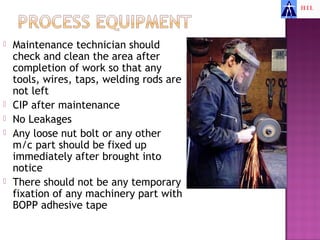
   Maintenance technician should
    check and clean the area after
    completion of work so that any
    tools, wires, taps, welding rods are
    not left
   CIP after maintenance
   No Leakages
   Any loose nut bolt or any other
    m/c part should be fixed up
    immediately after brought into
    notice
   There should not be any temporary
    fixation of any machinery part with
    BOPP adhesive tape
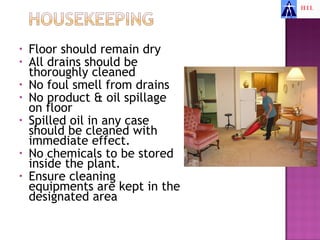
•   Floor should remain dry
•   All drains should be
    thoroughly cleaned
•   No foul smell from drains
•   No product & oil spillage
    on floor
•   Spilled oil in any case
    should be cleaned with
    immediate effect.
•   No chemicals to be stored
    inside the plant.
•   Ensure cleaning
    equipments are kept in the
    designated area
•   No unwanted materials, equipments in the
    process area
•   Cleaning hoses should be rolled properly and
    put in place
•   Ensure all materials are retuned to store
    after processing is over.
•   There should not be cob webs any where in
    the production facility
•   Waste materials are disposed off at regular
    intervals, waste bins should not be
    overflowing.
   Cleaning of equipment by either dry / or wet method
   Dry cleaning means collection, removal and disposal of dust
   Compressed air not recommended for cleaning
   Avoid wet cleaning in dry cleaning area
   Wet cleaning designed according to equipment
   Protect electrical cable and control panel during wet cleaning
   Cleaning must precede disinfection
   Personal safety is important
   Visual inspection after cleaning
   Cleaning efficiency check
   Drains to be cleaned regularly disinfected
Pest is a group of animals or insects which may
    be harmful to human beings or food products.

   Plant should be free form any kind of pest and
    insects like house fly, cockroaches, spider, moths,
    cricket, weevils, grasshopper, ants etc.
   There should not be any rodents, lizards, birds,
    cats inside the production facility.
   A complete pest control program should be inside
    the plant.
   People should notify immediately in case any
    trace of infestation is visible inside the plant
   Basic philosophy of pest control program is to
    deny entry, deny food and deny shelter to any
    pest, flying insects, rodents, birds.
   Do not keep open any doors and shutters open for
    their entry.
   Do not keep any food material open in the process
    which can attract all these pest.
   Do not keep any area dirty with unnecessary
    things which can harbour rodents and pests.
   There should not be any chemical bait stations for
    rodents in the process, packaging, Dry store and
    receiving area.
   Only Mechanical bait stations are to be placed in
    these areas.
   Standard operation procedures
   Manufacturing instruction sheet
   Batch production record
   Lot traceability
   All laboratory / production data to be legible
   All mistakes to be crossed out leaving original figures
    visible
   Record of consumer complaints & follow up action
   A batching sheet must be available for every
    production process performed within the plant,
    showing all the details
   Documentation of all testing and inspection must be
    maintained
   Sample must be kept for periods not shorter than the
    expected shelf life
   All procedure ( Manufacturing, Hygiene, Safety,
    Packaging, Storage, Services etc.) must be
    documented
   All record must be kept in an easily readable manner
    with it’s access restricted to persons who need to
    know.
GMP Training
GMP Training

GMP Training

  • 1.
    SMIT PATEL Quality Executive (GMP) Himalya International ltd.
  • 2.
    Good Manufacturing Practicesare the basic control measures and procedures that have to be carried out to produce a product which meets specifications and is safe to consume.
  • 3.
    Personnel Hygiene  Physical facilities  Storage practices  Sanitation  Process equipment  Housekeeping  Pest control  Documentation
  • 4.
    Hi level of personal cleanliness while in the production facility • Everyone must wash and sanitize their hands before entering to process. • Use hairnets • Wear washed uniforms • Do not enter without safety shoes • All visitors must wear white cleaned Lab coats.
  • 5.
    No outer pockets should be provided in uniforms  Do not take any food, tea or coffee inside the process  People should carry only the metal pen without cap inside the process  Smoking is not allowed anywhere inside the factory.  Chewing gum, tobacco or any other mouth freshener is not allowed in process area
  • 6.
    No jewelry and watches while in the process .  Finger nails should be short, clean and without polish  No body odors, including the use of strong perfumes  Personnel, having any disease, boils, sores, infections must not work within direct contact of raw materials or finished product  Any operator, who comes in direct manual contact with raw materials or products, must wear disposable gloves  Regular Medical Checkups for all the medical Non – Compliances
  • 7.
    No access to rodents, birds or insects  Smooth walls and ceiling  Easily cleanable floors and drains  Sloping surfaces  Externals clean and free of debris  Doors to be self closing and without gaps  Windows to be closed and have screens  There should not be any visible cracks in walls, floors etc.  Separate change room and eating areas
  • 8.
    Ceiling, walls, overhead pipes & equipment in general must be clean and free of peeling paint, rust, adhering debris, structural damage, dust or other contaminations  All plumbing and effluent lines as well as ventilation or exhaust system must be clean and properly maintained  Manufacturing and warehousing facilities must be structurally separated from each other and access must be controlled  Lighting levels in all the areas of plant must be of at least 500 lux at work level.
  • 9.
    Ingredients & raw materials to be inspected before use  Trailers / Containers / Trucks to be inspected for contamination on arrival  No materials should be stored on floor  Opened containers must be covered when not in use  All material to be labeled -material name, mfg date, batch no. & expiry date  Store material 18’’ away from wall.
  • 10.
    All weighing and any other measuring devices must be properly maintained and calibrated.  There should not be any glass material in the storage  Stacking height of containers must not exceed the safety load, no deformation of stocking units  If contamination is suspected or the package of raw and packaging materials delivered in poor condition, the lot should be separated and returned
  • 11.
    Continuous Temperature Monitoring Device should be applied to any critical storage area, like cold storage  Plant must have a separate and clearly identified area for questionable or rejected raw materials and products  Rejected goods must be disposed off at regular frequencies and record of rejection and disposal must be kept
  • 12.
    Material of construction to be stainless steel  No equipments should be contaminated with any dirt, grease  Supply of clean air for running any pneumatic equipments  Equipments should be easy to clean and accessible  Tagging of Equipments  Rubber / plastic parts – to food grade standards  Calibrated thermometers and pressure gauges  No loose live electrical cables anywhere in the process
  • 13.
    Maintenance technician should check and clean the area after completion of work so that any tools, wires, taps, welding rods are not left  CIP after maintenance  No Leakages  Any loose nut bolt or any other m/c part should be fixed up immediately after brought into notice  There should not be any temporary fixation of any machinery part with BOPP adhesive tape
  • 14.
    Floor should remain dry • All drains should be thoroughly cleaned • No foul smell from drains • No product & oil spillage on floor • Spilled oil in any case should be cleaned with immediate effect. • No chemicals to be stored inside the plant. • Ensure cleaning equipments are kept in the designated area
  • 15.
    No unwanted materials, equipments in the process area • Cleaning hoses should be rolled properly and put in place • Ensure all materials are retuned to store after processing is over. • There should not be cob webs any where in the production facility • Waste materials are disposed off at regular intervals, waste bins should not be overflowing.
  • 16.
    Cleaning of equipment by either dry / or wet method  Dry cleaning means collection, removal and disposal of dust  Compressed air not recommended for cleaning  Avoid wet cleaning in dry cleaning area  Wet cleaning designed according to equipment  Protect electrical cable and control panel during wet cleaning  Cleaning must precede disinfection  Personal safety is important  Visual inspection after cleaning  Cleaning efficiency check  Drains to be cleaned regularly disinfected
  • 17.
    Pest is agroup of animals or insects which may be harmful to human beings or food products.  Plant should be free form any kind of pest and insects like house fly, cockroaches, spider, moths, cricket, weevils, grasshopper, ants etc.  There should not be any rodents, lizards, birds, cats inside the production facility.  A complete pest control program should be inside the plant.  People should notify immediately in case any trace of infestation is visible inside the plant
  • 18.
    Basic philosophy of pest control program is to deny entry, deny food and deny shelter to any pest, flying insects, rodents, birds.  Do not keep open any doors and shutters open for their entry.  Do not keep any food material open in the process which can attract all these pest.  Do not keep any area dirty with unnecessary things which can harbour rodents and pests.  There should not be any chemical bait stations for rodents in the process, packaging, Dry store and receiving area.  Only Mechanical bait stations are to be placed in these areas.
  • 19.
    Standard operation procedures  Manufacturing instruction sheet  Batch production record  Lot traceability  All laboratory / production data to be legible  All mistakes to be crossed out leaving original figures visible  Record of consumer complaints & follow up action  A batching sheet must be available for every production process performed within the plant, showing all the details
  • 20.
    Documentation of all testing and inspection must be maintained  Sample must be kept for periods not shorter than the expected shelf life  All procedure ( Manufacturing, Hygiene, Safety, Packaging, Storage, Services etc.) must be documented  All record must be kept in an easily readable manner with it’s access restricted to persons who need to know.