DOCUMENTATION
Presented by
BINU ANAND
FIRST YEAR M.PHARM
NAZARETH COLLEGE OFPHARMACY
Introduction
2
• “Document” is a written report or record that provides
information especially of an official or legal nature.
• The term derived from Latin “documentum” and “doceo”
refers to “an example meant to teach, both for giving
instructions and for warning purposes.”
• “Documentation” is a method of preparing a written material,
which describes the process in terms of specification,
instructions etc.”
Aims of Documentation
3
 To define the specifications and procedures for all materials.
 To define methods of manufacture and control.
 To ensure that all personal concern with manufacture know
what to do and when to do it.
 To ensure that authorized persons have all the information
necessary to decide whether or not to realize a batch of a drug
for sale.
 To ensure the availability of the data needed for validation ,
review and statistical analysis.
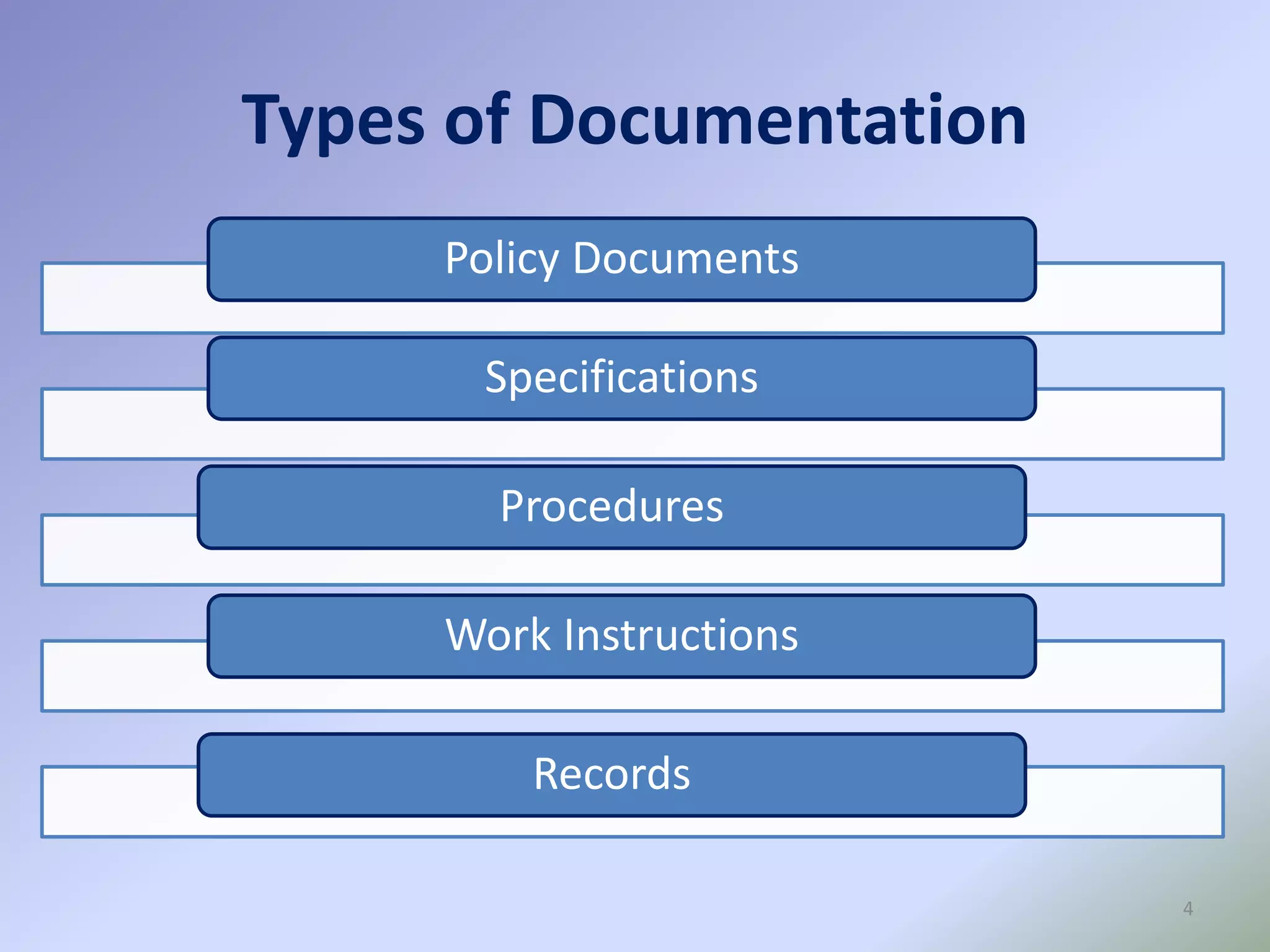
Types of Documentation
4
Policy Documents
Specifications
Procedures
Work Instructions
Records
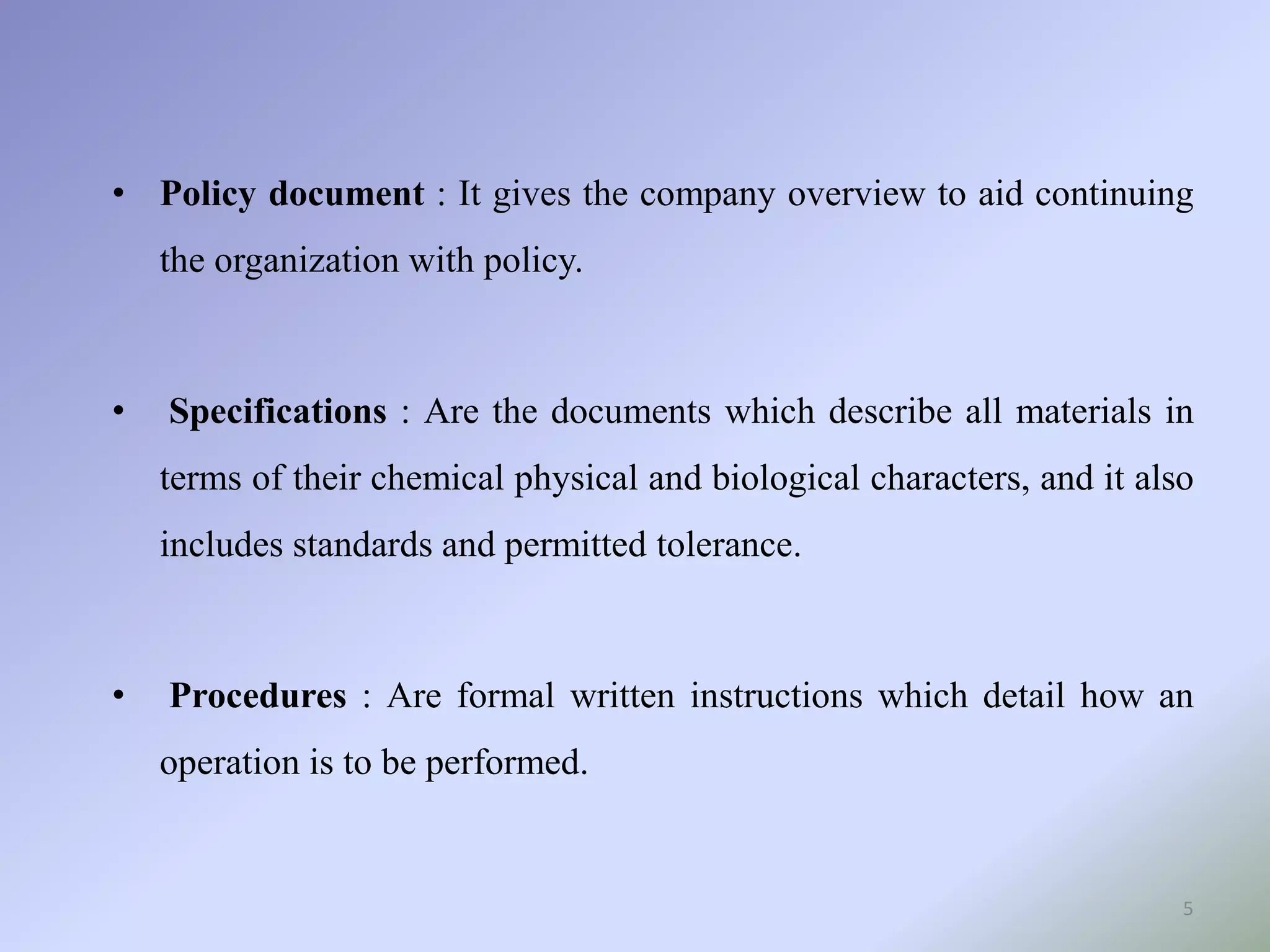
• Policy document : It gives the company overview to aid continuing
the organization with policy.
• Specifications : Are the documents which describe all materials in
terms of their chemical physical and biological characters, and it also
includes standards and permitted tolerance.
• Procedures : Are formal written instructions which detail how an
operation is to be performed.
5
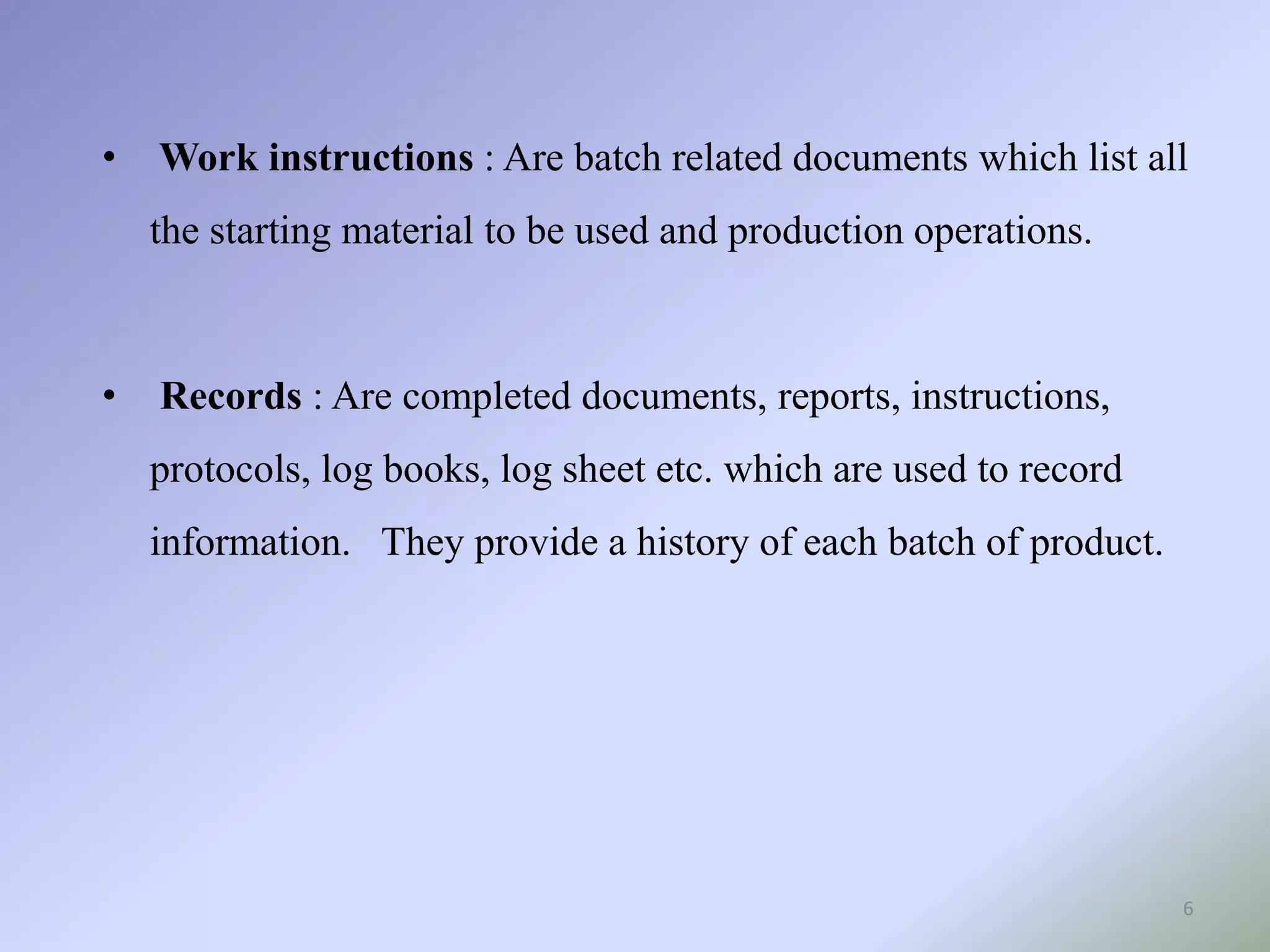
• Work instructions : Are batch related documents which list all
the starting material to be used and production operations.
• Records : Are completed documents, reports, instructions,
protocols, log books, log sheet etc. which are used to record
information. They provide a history of each batch of product.
6
7
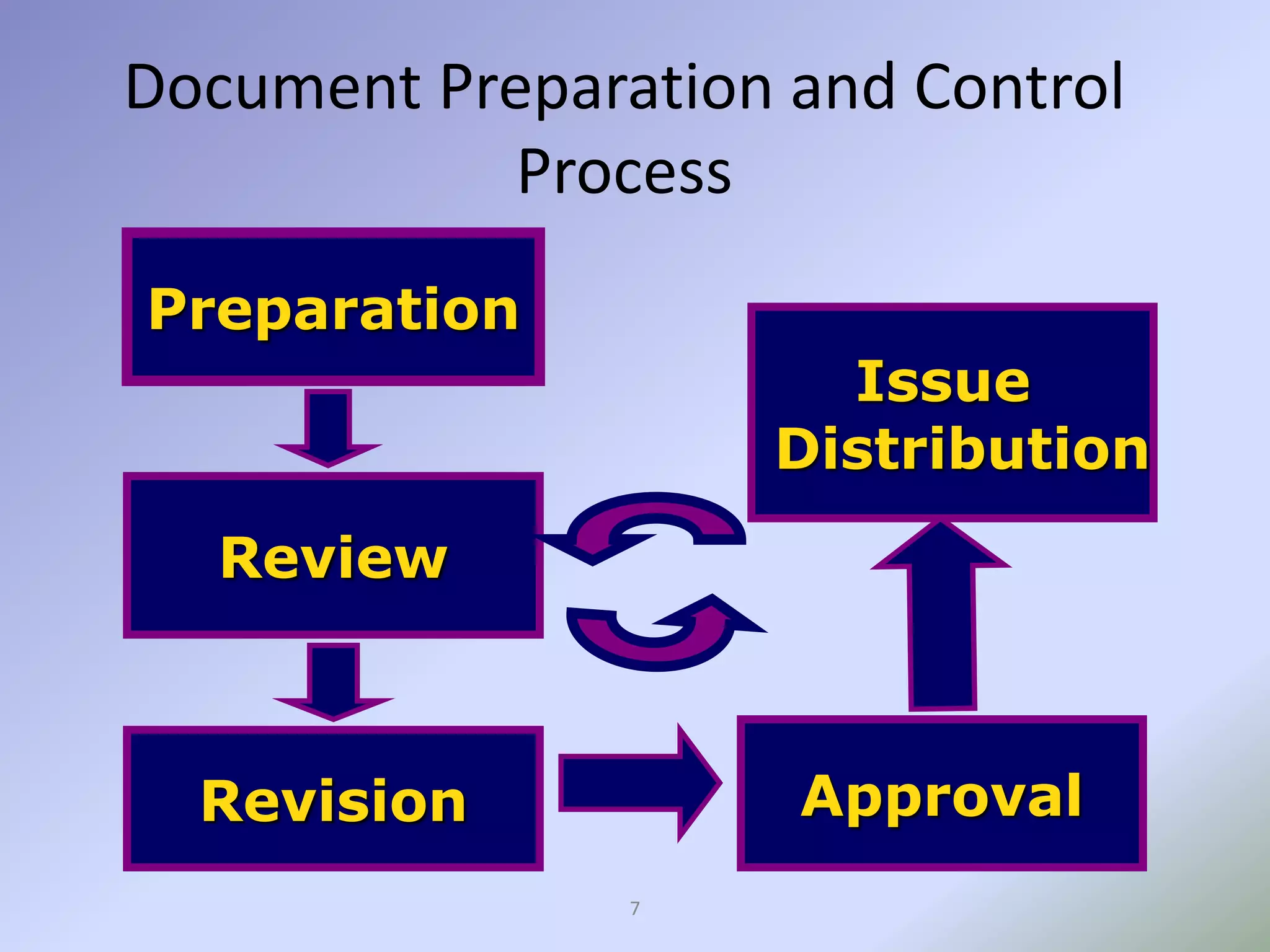
Document Preparation and Control
Process
Preparation
Review
Issue
Distribution
Revision Approval
Procedure For Documentation
8
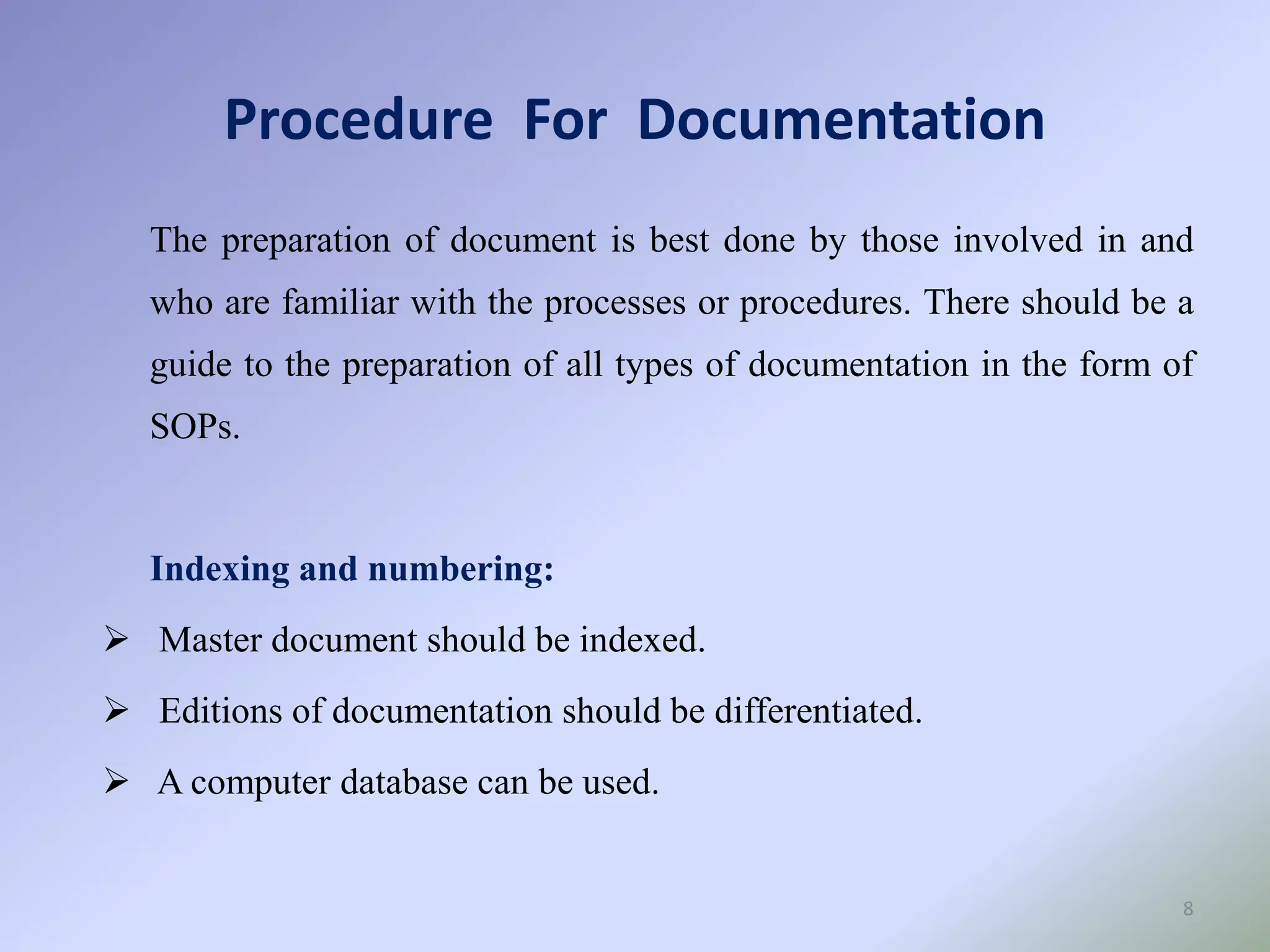
The preparation of document is best done by those involved in and
who are familiar with the processes or procedures. There should be a
guide to the preparation of all types of documentation in the form of
SOPs.
Indexing and numbering:
 Master document should be indexed.
 Editions of documentation should be differentiated.
 A computer database can be used.
9
Approval of documentation
• Approved by authorized persons.
• The level of authority of approvers will depend on the
document in question, and the scope of their approval.
Distribution and control of copies
• Copies of procedures should be available in the relevant
departments.
• Should be reviewed and updated.
10
• There should be method of authenticating official copies and
maintaining a list of recipients and issue and return date.
Documentation review
• For regular updating of all procedures.
• Carried out by those who are directly involved.
• Batch related documentation should be reviewed frequently.
• Changes should be approved.
11
Organization
• One department should have control of documentation and
archiving.
Storage and archiving
• Done by using hard copy, magnetic disc, micro film or optical
disc.
• Duplicate copies should be made and kept in separate location.
• Batch related documentation should be stored at least 6 years
beyond the manufacture date of the batch.
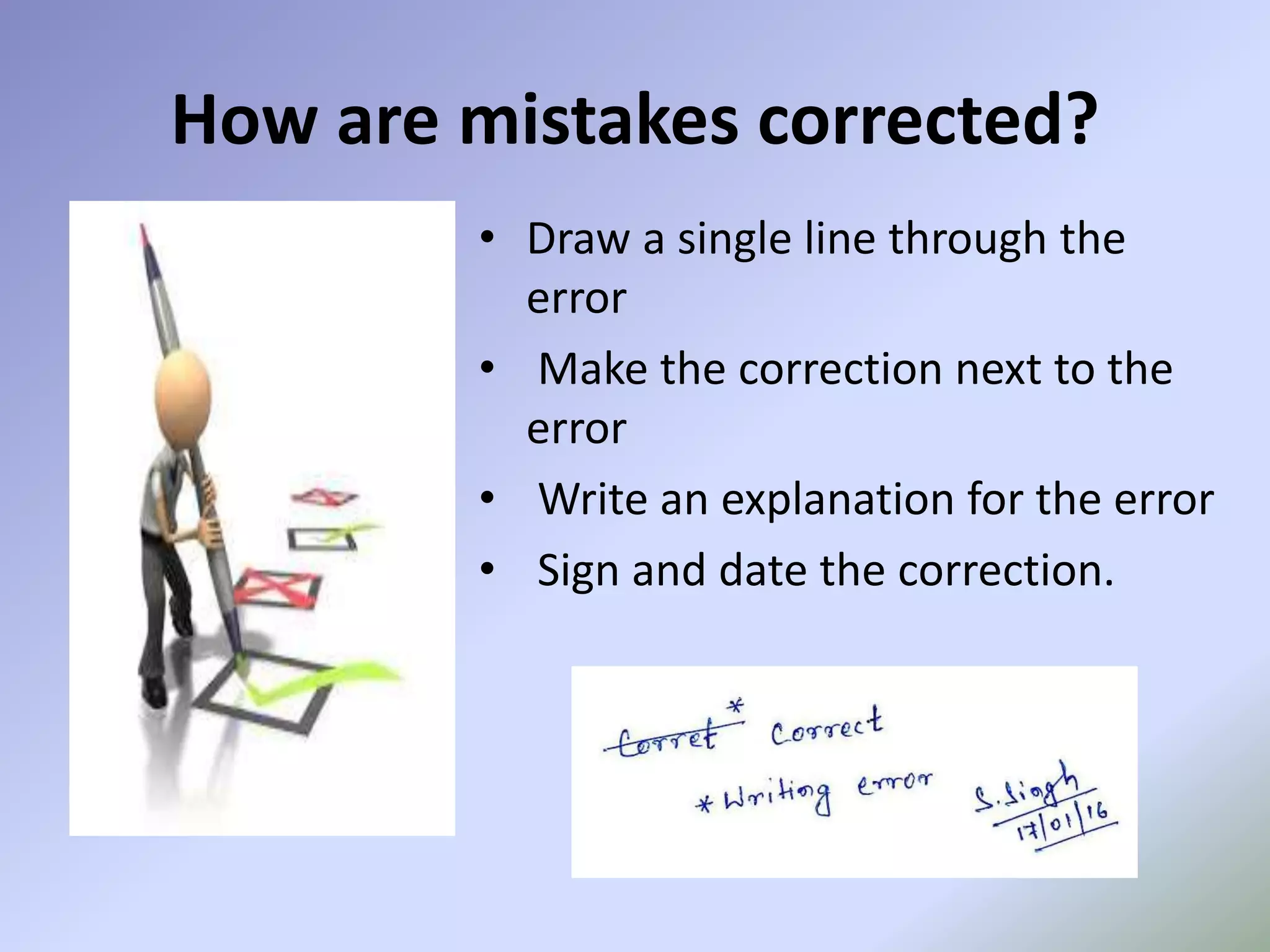
• Draw a single line through the
error
• Make the correction next to the
error
• Write an explanation for the error
• Sign and date the correction.
How are mistakes corrected?
CONCLUSION
• Documentation helps to build up a detailed picture of what a
manufacturing function has done in the past and what it is
doing now and, thus, it provides a basis for planning what it is
going to do in the future.
• In a GMP environment documentation needs to meet certain
requirements to ensure product quality and product safety.
REFERENCES
14
• Pharmaceutical Production and Management, CVS Subrahmanyam,
Page no. 443-445.
• Berger David “Procedures and Documentation”, retrieved 15 June
2009.
• An Article Of Pharmaceutical Documentation Monograph, 1995,
The Institute Of Quality Assurance.
Documentation

Documentation

  • 1.
    DOCUMENTATION Presented by BINU ANAND FIRSTYEAR M.PHARM NAZARETH COLLEGE OFPHARMACY
  • 2.
    Introduction 2 • “Document” isa written report or record that provides information especially of an official or legal nature. • The term derived from Latin “documentum” and “doceo” refers to “an example meant to teach, both for giving instructions and for warning purposes.” • “Documentation” is a method of preparing a written material, which describes the process in terms of specification, instructions etc.”
  • 3.
    Aims of Documentation 3 To define the specifications and procedures for all materials.  To define methods of manufacture and control.  To ensure that all personal concern with manufacture know what to do and when to do it.  To ensure that authorized persons have all the information necessary to decide whether or not to realize a batch of a drug for sale.  To ensure the availability of the data needed for validation , review and statistical analysis.
  • 4.
    Types of Documentation 4 PolicyDocuments Specifications Procedures Work Instructions Records
  • 5.
    • Policy document: It gives the company overview to aid continuing the organization with policy. • Specifications : Are the documents which describe all materials in terms of their chemical physical and biological characters, and it also includes standards and permitted tolerance. • Procedures : Are formal written instructions which detail how an operation is to be performed. 5
  • 6.
    • Work instructions: Are batch related documents which list all the starting material to be used and production operations. • Records : Are completed documents, reports, instructions, protocols, log books, log sheet etc. which are used to record information. They provide a history of each batch of product. 6
  • 7.
    7 Document Preparation andControl Process Preparation Review Issue Distribution Revision Approval
  • 8.
    Procedure For Documentation 8 Thepreparation of document is best done by those involved in and who are familiar with the processes or procedures. There should be a guide to the preparation of all types of documentation in the form of SOPs. Indexing and numbering:  Master document should be indexed.  Editions of documentation should be differentiated.  A computer database can be used.
  • 9.
    9 Approval of documentation •Approved by authorized persons. • The level of authority of approvers will depend on the document in question, and the scope of their approval. Distribution and control of copies • Copies of procedures should be available in the relevant departments. • Should be reviewed and updated.
  • 10.
    10 • There shouldbe method of authenticating official copies and maintaining a list of recipients and issue and return date. Documentation review • For regular updating of all procedures. • Carried out by those who are directly involved. • Batch related documentation should be reviewed frequently. • Changes should be approved.
  • 11.
    11 Organization • One departmentshould have control of documentation and archiving. Storage and archiving • Done by using hard copy, magnetic disc, micro film or optical disc. • Duplicate copies should be made and kept in separate location. • Batch related documentation should be stored at least 6 years beyond the manufacture date of the batch.
  • 12.
    • Draw asingle line through the error • Make the correction next to the error • Write an explanation for the error • Sign and date the correction. How are mistakes corrected?
  • 13.
    CONCLUSION • Documentation helpsto build up a detailed picture of what a manufacturing function has done in the past and what it is doing now and, thus, it provides a basis for planning what it is going to do in the future. • In a GMP environment documentation needs to meet certain requirements to ensure product quality and product safety.
  • 14.
    REFERENCES 14 • Pharmaceutical Productionand Management, CVS Subrahmanyam, Page no. 443-445. • Berger David “Procedures and Documentation”, retrieved 15 June 2009. • An Article Of Pharmaceutical Documentation Monograph, 1995, The Institute Of Quality Assurance.