Labeling of GM plants
and
products
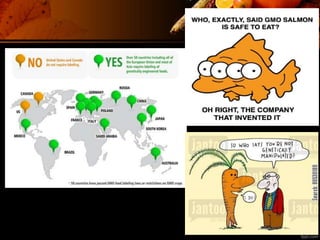
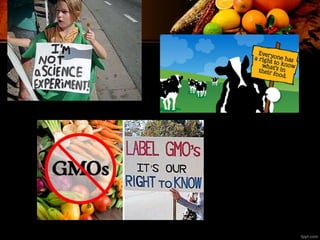
GMO Labeling
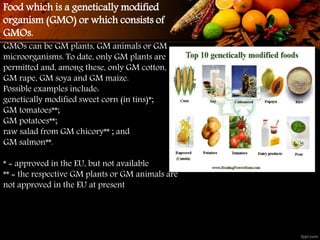
• GMO labeling was introduced to give consumers the
freedom to choose between GMOs and conventional
products.
• If a foodstuff is produced using genetic engineering, this
must be indicated on its label.
• If a food contains or consists of genetically modified
organisms (GMOs), or contains ingredients produced
from GMOs, this must be indicated on the label.
• For GM products sold 'loose', information must be
displayed immediately next to the food to indicate that it
is GM.
 On 18 April 2004, new rules for GM labeling came into force in all EU
Member States.
 The GM Food and Feed Regulation (EC) No. 1829/2003 lays down rules
to cover all GM food and animal feed, regardless of the presence of any
GM material in the final product.
 This means products such as flour, oils and glucose syrups have to be
labeled as GM if they are from a GM source.
 Products produced with GM technology (cheese produced with GM
enzymes, for example) do not have to be labeled.
 Products such as meat, milk and eggs from animals fed on GM animal
feed also do not need to be labeled.
 GM – genetically modified
 GMM – genetically modified micro-organism
 Food or feed produced by a fermentation process using a GMM that is
kept under contained conditions and is not present in the final product
does not fall within the scope of this regulation.
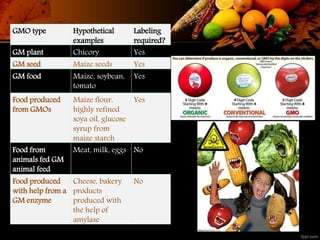
GMO type Hypothetical
examples
Labeling
required?
GM plant Chicory Yes
GM seed Maize seeds Yes
GM food Maize, soybean,
tomato
Yes
Food produced
from GMOs
Maize flour,
highly refined
soya oil, glucose
syrup from
maize starch
Yes
Food from
animals fed GM
animal feed
Meat, milk, eggs No
Food produced
with help from a
GM enzyme
Cheese, bakery
products
produced with
the help of
amylase
No
 Labeling provides information for consumers and allows them to make an
informed choice.
 In the case of pre-packaged GM food/feed products, the list of ingredients must
indicate "genetically modified" or "produced from genetically modified [name of
the organism]".
 In the case of products without packaging these words must still be clearly
displayed in close proximity to the product (e.g a note on the supermarket
shelf).
 These labeling requirements do not apply to GM food/feed products in a
proportion no higher than 0.9 percent of the food/feed ingredients considered
individually and if this presence is adventitious or technically unavoidable.
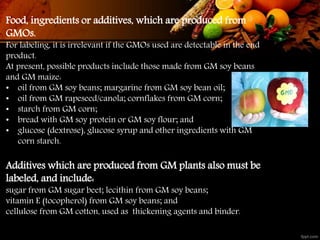
GMOs can be GM plants, GM animals or GM
microorganisms. To date, only GM plants are
permitted and, among these, only GM cotton,
GM rape, GM soya and GM maize.
Possible examples include:
genetically modified sweet corn (in tins)*;
GM tomatoes**;
GM potatoes**;
raw salad from GM chicory** ; and
GM salmon**.
* = approved in the EU, but not available
** = the respective GM plants or GM animals are
not approved in the EU at present
Food which is a genetically modified
organism (GMO) or which consists of
GMOs.
Food, ingredients or additives, which are produced from
GMOs.
For labeling, it is irrelevant if the GMOs used are detectable in the end
product.
At present, possible products include those made from GM soy beans
and GM maize:
• oil from GM soy beans; margarine from GM soy bean oil;
• oil from GM rapeseed/canola; cornflakes from GM corn;
• starch from GM corn;
• bread with GM soy protein or GM soy flour; and
• glucose (dextrose), glucose syrup and other ingredients with GM
corn starch.
Additives which are produced from GM plants also must be
labeled, and include:
sugar from GM sugar beet; lecithin from GM soy beans;
vitamin E (tocopherol) from GM soy beans; and
cellulose from GM cotton, used as thickening agents and binder.
• There exist "GM-free labels" pointing out that, in addition to what is laid down
by the EU legislation on GMOs, specific measures have been taken on a
voluntary basis to strictly exclude the presence or the use of GMOs in some
food or feed products.
• Such voluntary labels are possible provided that they are not misleading for
the consumer.
• A study was performed by an external consultant for the Commission, in order
to take stock of existing GM free labels in place or in development in the EU,
and to analyze their respective features.
GM-free labeling
A GMO – e.g. a transgenic plant – can only receive authorization in the EU if
customized tests exist to detect it.
 Each authorized genetically modified plant requires its own test custom
tailored to that specific GM plant, e.g. Bt11 maize, MON812 maize, or GR73
rapeseed.
 The company submitting a GMO for approval is required to provide the
necessary information needed develop a test specific to that particular GMO.
All operators involved, i.e. farmers or food and feed producers who introduce a
product in the supply chain or purchases such a product must be able to identify
their supplier and the companies to which the products have been delivered.
 Operators must provide their customers with the following information, in
writing:
 an indication that the product - or certain ingredients – contains, consists of, or
is obtained from GMOs
 information on the unique identifier(s) for these GMOs
 In the case of products consisting of or containing mixtures of GMOs to be used
only as food or feed or for processing, this information may be replaced by a
declaration of use by the operator. It has to be accompanied by a list of the
unique identifiers for all those GMOs that have been used to constitute the
mixture
 Operators must also ensure that the information is passed on in writing to those
who are next in the supply chain.
 For a period of five years after every transaction within the supply chain, every
operator must keep a record of this information and be able to identify the
operator from whom they bought the products and the one to whom he or she
Who ensures traceability?
GM labeling_Dr. Sonia

GM labeling_Dr. Sonia

  • 1.
    Labeling of GMplants and products
  • 2.
    GMO Labeling • GMOlabeling was introduced to give consumers the freedom to choose between GMOs and conventional products. • If a foodstuff is produced using genetic engineering, this must be indicated on its label. • If a food contains or consists of genetically modified organisms (GMOs), or contains ingredients produced from GMOs, this must be indicated on the label. • For GM products sold 'loose', information must be displayed immediately next to the food to indicate that it is GM.
  • 3.
     On 18April 2004, new rules for GM labeling came into force in all EU Member States.  The GM Food and Feed Regulation (EC) No. 1829/2003 lays down rules to cover all GM food and animal feed, regardless of the presence of any GM material in the final product.  This means products such as flour, oils and glucose syrups have to be labeled as GM if they are from a GM source.  Products produced with GM technology (cheese produced with GM enzymes, for example) do not have to be labeled.  Products such as meat, milk and eggs from animals fed on GM animal feed also do not need to be labeled.  GM – genetically modified  GMM – genetically modified micro-organism  Food or feed produced by a fermentation process using a GMM that is kept under contained conditions and is not present in the final product does not fall within the scope of this regulation.
  • 4.
    GMO type Hypothetical examples Labeling required? GMplant Chicory Yes GM seed Maize seeds Yes GM food Maize, soybean, tomato Yes Food produced from GMOs Maize flour, highly refined soya oil, glucose syrup from maize starch Yes Food from animals fed GM animal feed Meat, milk, eggs No Food produced with help from a GM enzyme Cheese, bakery products produced with the help of amylase No
  • 6.
     Labeling providesinformation for consumers and allows them to make an informed choice.  In the case of pre-packaged GM food/feed products, the list of ingredients must indicate "genetically modified" or "produced from genetically modified [name of the organism]".  In the case of products without packaging these words must still be clearly displayed in close proximity to the product (e.g a note on the supermarket shelf).  These labeling requirements do not apply to GM food/feed products in a proportion no higher than 0.9 percent of the food/feed ingredients considered individually and if this presence is adventitious or technically unavoidable.
  • 7.
    GMOs can beGM plants, GM animals or GM microorganisms. To date, only GM plants are permitted and, among these, only GM cotton, GM rape, GM soya and GM maize. Possible examples include: genetically modified sweet corn (in tins)*; GM tomatoes**; GM potatoes**; raw salad from GM chicory** ; and GM salmon**. * = approved in the EU, but not available ** = the respective GM plants or GM animals are not approved in the EU at present Food which is a genetically modified organism (GMO) or which consists of GMOs.
  • 8.
    Food, ingredients oradditives, which are produced from GMOs. For labeling, it is irrelevant if the GMOs used are detectable in the end product. At present, possible products include those made from GM soy beans and GM maize: • oil from GM soy beans; margarine from GM soy bean oil; • oil from GM rapeseed/canola; cornflakes from GM corn; • starch from GM corn; • bread with GM soy protein or GM soy flour; and • glucose (dextrose), glucose syrup and other ingredients with GM corn starch. Additives which are produced from GM plants also must be labeled, and include: sugar from GM sugar beet; lecithin from GM soy beans; vitamin E (tocopherol) from GM soy beans; and cellulose from GM cotton, used as thickening agents and binder.
  • 9.
    • There exist"GM-free labels" pointing out that, in addition to what is laid down by the EU legislation on GMOs, specific measures have been taken on a voluntary basis to strictly exclude the presence or the use of GMOs in some food or feed products. • Such voluntary labels are possible provided that they are not misleading for the consumer. • A study was performed by an external consultant for the Commission, in order to take stock of existing GM free labels in place or in development in the EU, and to analyze their respective features. GM-free labeling A GMO – e.g. a transgenic plant – can only receive authorization in the EU if customized tests exist to detect it.  Each authorized genetically modified plant requires its own test custom tailored to that specific GM plant, e.g. Bt11 maize, MON812 maize, or GR73 rapeseed.  The company submitting a GMO for approval is required to provide the necessary information needed develop a test specific to that particular GMO.
  • 10.
    All operators involved,i.e. farmers or food and feed producers who introduce a product in the supply chain or purchases such a product must be able to identify their supplier and the companies to which the products have been delivered.  Operators must provide their customers with the following information, in writing:  an indication that the product - or certain ingredients – contains, consists of, or is obtained from GMOs  information on the unique identifier(s) for these GMOs  In the case of products consisting of or containing mixtures of GMOs to be used only as food or feed or for processing, this information may be replaced by a declaration of use by the operator. It has to be accompanied by a list of the unique identifiers for all those GMOs that have been used to constitute the mixture  Operators must also ensure that the information is passed on in writing to those who are next in the supply chain.  For a period of five years after every transaction within the supply chain, every operator must keep a record of this information and be able to identify the operator from whom they bought the products and the one to whom he or she Who ensures traceability?