Agriculture Today


Genetically Engineered
Agricultural Practices


        Jennifer Kitchen
          HW220-01
         May 24, 2011
Agriculture as We Know It
• The production of crops, livestock, or
  poultry.
• The cultivating of land and rearing of
  crops and livestock.
• Farming!
What is Biotechnology?
• The use of microorganisms, such as bacteria
  or yeasts, or biological substances, such as
  enzymes, to perform specific industrial or
  manufacturing processes.
   – Applications include production of;
      • Pharmaceuticals
      • Synthetic hormones
      • Foodstuffs
      • Fibers
      • Animal feeds
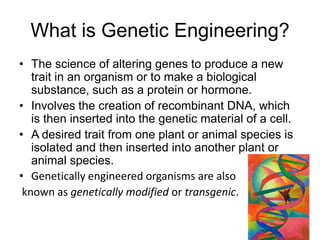
What is Genetic Engineering?
• The science of altering genes to produce a new
   trait in an organism or to make a biological
   substance, such as a protein or hormone.
• Involves the creation of recombinant DNA, which
   is then inserted into the genetic material of a cell.
• A desired trait from one plant or animal species is
   isolated and then inserted into another plant or
   animal species.
• Genetically engineered organisms are also
 known as genetically modified or transgenic.
Pros of GMOs
•   Sustainability.
•   Food security.
•   Increased production yields.
•   Drought resistant crops.
•   Crops that use soil nutrients more efficiently.
•   Crops with higher nutritional content.
•   Plants that produce pharmaceuticals.
•   Herbicide tolerant crops.
•   Pest resistant crops.
•   Reduced erosion.
    (Biotechnology Industry Organization, 2010)
Cons of GMOs
•   Allergic reaction.
•   Antibiotic resistance.
•   Loss of nutrition.
•   Damage to environment.
•   Gene mutation.
•   Gene pollution.
•   Cross-pollination (super-weeds).
       (Sustainable Table, n.d.)
Some Genetically Engineered
            Foods
1. Rapeseed (canola)   13. Flax
2. Corn                14. Squash
3. Sweet corn          15. Chicory
4. Cotton              16. Tobacco
5. Soybean             17. Peas
6. Rice                18. Meat
7. Papaya              19. Dairy products
8. Tomatoes            20. Honey
9. Cherry Tomatoes     21. Alfalfa
10. Sugar Cane         22. Sugar beet
11. Potatoes                      (Butcher, 2009)

12. Strawberries
Who Makes these Foods?
             Corporations
• Monsanto- the makers of Roundup and
  other herbicides.
• DuPont- the makers of a variety of
  insecticides and herbicides
• Dow Chemical Corporation- the makers of
  chemicals, plastics, oil and gas, and many
  other modern products.
               (Monsanto, DuPont, Dow Chemical corporation)
• 4 countries grow 99% of the world’s GM
  crops…
• US (68%)
• Argentina (22%)
• Canada (6%)
• China (3%)
    (Sustainable Table, 2011).


      The 3 most common GM foods;
o Soybeans
o Rapeseed
o Sweet corn
     (Bionet, 2011).
Who Regulates these New Foods?
• Food & Drug Administration (FDA).
• US Department of Agriculture (USDA).
• Environmental Protection Agency (EPA).
                            (Schlenker & Roth, 2011)
Do You Know What You Are
                  Eating?

You may not know if you are
 eating a product that contains
 ingredients from a GM source.
GM food sources do not require
 labeling unless the modification;
   increased the allergenicity
   reduced the nutrient content
               (Schlenker & Roth, 2011).
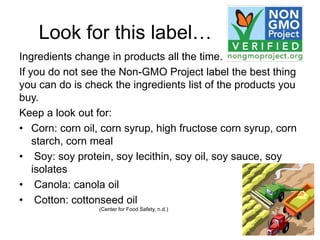
Look for this label…
Ingredients change in products all the time.
If you do not see the Non-GMO Project label the best thing
you can do is check the ingredients list of the products you
buy.
Keep a look out for:
• Corn: corn oil, corn syrup, high fructose corn syrup, corn
    starch, corn meal
• Soy: soy protein, soy lecithin, soy oil, soy sauce, soy
    isolates
• Canola: canola oil
• Cotton: cottonseed oil
                 (Center for Food Safety, n.d.)
What Can You Do?
•   Vote with your fork!
•   Buy organic!
•   Demand labeling!
•   Petition for a GMO-free World!
•   Look for foods that are labeled GMO free!
•   Visit
    – sustanabletable.org
    – truefoodnow.org
    – responsibletechnology.org
References
•     Bionet, (2002). Future Food. Retrieved from http://www.bionetonline.org/english/content/ff_cont1.htm .
•     Biotechnology Industry Organization (BIO), (2010). Food & Agriculture. Retrieved from
    http://www.bio.org/foodag/ .
•     Butcher, M. (2009). Genetically Modified Food - GM Foods List and Information. Retrieved from
    http://www.disabled-world.com/fitness/gm-foods.php .
•     Center for Food Safety, (n.d.). The True Food Shoppers’ Guide to Avoiding GMOs. Retrieved from
    http://truefoodnow.org/shoppers-guide/
•     Dow Chemical Corporation, (2011). Dow website. Retrieved from http://www.dow.com/ .
•     DuPont, (2011). DuPont website. Retrieved from http://www2.dupont.com/DuPont_Home/en_US/index.html .
•     Institute for Responsible Technology, (2010). Non-GMO Shopping Guide: How to avoid foods made with
    genetically modified organisms. Retrieved from http://nongmoshoppingguide.com/Non-GMO-Shopping-
    Guide.pdf .
•     Monsanto, (2011). Monsanto website. Retrieved from http://www.monsanto.com/Pages/default.aspx .
•     Schlenker, E. and Roth, S., (2011). Williams’ Essentials of Nutrition and Diet Therapy. Missouri; Elsevier
    Mosby.
•     Sustainable Table, (n.d.). The Issues: Genetic Engineering. Retrieved from
    http://www.sustainabletable.org/issues/ge/ .
•     Pictures from Microsoft Office Program Clipart.
•     Definitions from http://dictionary.reference.com/ .

Jennifer kitchen hw220-01-unit5gm-os

  • 1.
    Agriculture Today Genetically Engineered AgriculturalPractices Jennifer Kitchen HW220-01 May 24, 2011
  • 2.
    Agriculture as WeKnow It • The production of crops, livestock, or poultry. • The cultivating of land and rearing of crops and livestock. • Farming!
  • 3.
    What is Biotechnology? •The use of microorganisms, such as bacteria or yeasts, or biological substances, such as enzymes, to perform specific industrial or manufacturing processes. – Applications include production of; • Pharmaceuticals • Synthetic hormones • Foodstuffs • Fibers • Animal feeds
  • 4.
    What is GeneticEngineering? • The science of altering genes to produce a new trait in an organism or to make a biological substance, such as a protein or hormone. • Involves the creation of recombinant DNA, which is then inserted into the genetic material of a cell. • A desired trait from one plant or animal species is isolated and then inserted into another plant or animal species. • Genetically engineered organisms are also known as genetically modified or transgenic.
  • 5.
    Pros of GMOs • Sustainability. • Food security. • Increased production yields. • Drought resistant crops. • Crops that use soil nutrients more efficiently. • Crops with higher nutritional content. • Plants that produce pharmaceuticals. • Herbicide tolerant crops. • Pest resistant crops. • Reduced erosion. (Biotechnology Industry Organization, 2010)
  • 6.
    Cons of GMOs • Allergic reaction. • Antibiotic resistance. • Loss of nutrition. • Damage to environment. • Gene mutation. • Gene pollution. • Cross-pollination (super-weeds). (Sustainable Table, n.d.)
  • 7.
    Some Genetically Engineered Foods 1. Rapeseed (canola) 13. Flax 2. Corn 14. Squash 3. Sweet corn 15. Chicory 4. Cotton 16. Tobacco 5. Soybean 17. Peas 6. Rice 18. Meat 7. Papaya 19. Dairy products 8. Tomatoes 20. Honey 9. Cherry Tomatoes 21. Alfalfa 10. Sugar Cane 22. Sugar beet 11. Potatoes (Butcher, 2009) 12. Strawberries
  • 8.
    Who Makes theseFoods? Corporations • Monsanto- the makers of Roundup and other herbicides. • DuPont- the makers of a variety of insecticides and herbicides • Dow Chemical Corporation- the makers of chemicals, plastics, oil and gas, and many other modern products. (Monsanto, DuPont, Dow Chemical corporation)
  • 9.
    • 4 countriesgrow 99% of the world’s GM crops… • US (68%) • Argentina (22%) • Canada (6%) • China (3%) (Sustainable Table, 2011). The 3 most common GM foods; o Soybeans o Rapeseed o Sweet corn (Bionet, 2011).
  • 10.
    Who Regulates theseNew Foods? • Food & Drug Administration (FDA). • US Department of Agriculture (USDA). • Environmental Protection Agency (EPA). (Schlenker & Roth, 2011)
  • 11.
    Do You KnowWhat You Are Eating? You may not know if you are eating a product that contains ingredients from a GM source. GM food sources do not require labeling unless the modification;  increased the allergenicity  reduced the nutrient content (Schlenker & Roth, 2011).
  • 12.
    Look for thislabel… Ingredients change in products all the time. If you do not see the Non-GMO Project label the best thing you can do is check the ingredients list of the products you buy. Keep a look out for: • Corn: corn oil, corn syrup, high fructose corn syrup, corn starch, corn meal • Soy: soy protein, soy lecithin, soy oil, soy sauce, soy isolates • Canola: canola oil • Cotton: cottonseed oil (Center for Food Safety, n.d.)
  • 13.
    What Can YouDo? • Vote with your fork! • Buy organic! • Demand labeling! • Petition for a GMO-free World! • Look for foods that are labeled GMO free! • Visit – sustanabletable.org – truefoodnow.org – responsibletechnology.org
  • 14.
    References • Bionet, (2002). Future Food. Retrieved from http://www.bionetonline.org/english/content/ff_cont1.htm . • Biotechnology Industry Organization (BIO), (2010). Food & Agriculture. Retrieved from http://www.bio.org/foodag/ . • Butcher, M. (2009). Genetically Modified Food - GM Foods List and Information. Retrieved from http://www.disabled-world.com/fitness/gm-foods.php . • Center for Food Safety, (n.d.). The True Food Shoppers’ Guide to Avoiding GMOs. Retrieved from http://truefoodnow.org/shoppers-guide/ • Dow Chemical Corporation, (2011). Dow website. Retrieved from http://www.dow.com/ . • DuPont, (2011). DuPont website. Retrieved from http://www2.dupont.com/DuPont_Home/en_US/index.html . • Institute for Responsible Technology, (2010). Non-GMO Shopping Guide: How to avoid foods made with genetically modified organisms. Retrieved from http://nongmoshoppingguide.com/Non-GMO-Shopping- Guide.pdf . • Monsanto, (2011). Monsanto website. Retrieved from http://www.monsanto.com/Pages/default.aspx . • Schlenker, E. and Roth, S., (2011). Williams’ Essentials of Nutrition and Diet Therapy. Missouri; Elsevier Mosby. • Sustainable Table, (n.d.). The Issues: Genetic Engineering. Retrieved from http://www.sustainabletable.org/issues/ge/ . • Pictures from Microsoft Office Program Clipart. • Definitions from http://dictionary.reference.com/ .

Editor's Notes

  • #2 Today, I will be talking about the new way to grow foods in the United Stated.
  • #3 Agriculture is working the land to grow fruits, vegetables, nuts, and grains. Agriculture is raising livestock and poultry. We even farm fish. Farming has been the major source of food for ages.
  • #4 Biotechnology has been around for a very long time and has many great uses.Food we produce in the field can be altered in form as a way to create new food products and medicines. Humankind has made beers and wines since ancient times by using yeast with other ingredients such as juices of fruits and a concoction of grains. Humankind has come up with innovative ways to produce medicines by expelling essence from plants and by growing molds.
  • #5 Now we have a new biotechnology called genetic engineering. With genetic engineering humankind can now produce new foods by inserting a specific gene directly into the DNA of the product they want to change. A desired trait is taken from one species and inserted into another species.The ability to alter the genetics of a plant or animal without having to go through generations of breeding for the desired trait opens up a whole new World.
  • #6 These are some of the great things that could be brought about by creating genetically engineered organisms.A plant can be given a gene to help produce more nutrients.An animal can be given a gene to help it produce a specific vitamin or mineral.Cows can be made to produce the vitamins that are now added.Humankind can also make a plant that originally needs a humid environment more adaptable to drier weather.
  • #7 But most of the GMO foods being made today are made for only a few of those reasons.Herbicide and pesticide resistance is the most commonly added trait to food crops today.Plants that are pest resistant have a natural pesticide gene and may kill off helpful insects as well as the harmful ones.People may have allergic reactions when one plant food gets the trait of a plant food that may cause a reaction in some people, such as peanut or soy genes in a very unsuspecting guise of a strawberry. GE plants cannot be contained from contaminating the native population because of the simple fact that pollination is not something humans can control.Birds and insects help to fertilize plants, as does the wind.We walk through a field and seeds attach themselves to our pant legs and we carry them with us to where they need to go.The science of GE seems like it could have some good uses but being able to control the effects on the environment seems beyond human capability.Not to mention there is no solid information that states GE foods are safe for human consumption in the long run. Minimal studies are done before these foods are put on the market.Take rBGH (a GE hormone) which has been given to cows for decades is now being considered bad for our health. When they started giving this hormone to cows to boost milk production people were told it was completely safe.
  • #8 These are just some of the foods that have been genetically engineered.The first five are the most commonly grown and are used in many of the products people buy regularly.Not all of these foods have made it to the market yet but many are in the process.
  • #9 Corporations that have been making chemical products for generations are now in the business of making seeds.These companies sell seeds, as well as the herbicides, pesticides, and even equipment, to farmers around the World.
  • #10 The US not only grows the majority of GE products they also use the majority of these products.The 3 most common GM foods are also the 3 most used oils in the American kitchen.
  • #11 The government does regulate GE products.FDA has the responsibility to ensure the safety of the GE foods and any food ingredients derived from genetic engineering. USDA and EPA are responsible for ensuring the safety of GE agriculture on animals and the environment.
  • #12 None of us can be certain that what we are eating contains no GMOs. Although these foods are regulated they are not required to be labeled, unless they have an increased chance of causing an allergic reaction or they have lost nutritional value due to the modification.
  • #13 Some companies have chosen to label their foods non-GMO because they want people to know they are not using GMOs.But not all products are labeled and the only way to know you are limiting your intake of a potentially harmful GE food is to look for the 4 most common foods that are in prepackaged products we buy regularly.
  • #14 The best thing any of us can do is become aware of what is going on in the food industry. As the saying goes, “knowledge is power.” If we refuse to buy questionable foods, we are demanding labeling by voting with our fork.Once we have labeling we will know what we want to buy and what we would rather leave on the shelf.If we refuse to eat foods that are genetically engineered we can stop this new way of agriculture and save our World for future generations.