Vinegar Production
I N T E R N A T I O N A L U N I V E R S I T Y , H C M C
C O U R S E : E N Z Y M E & F O O D
F E R M E N T A T I O N
S T U D E N T ’ S N A M E : N G U Y E N Q . H A I Y E N
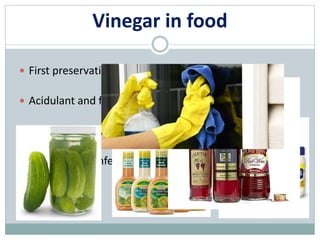
Vinegar in food
 First preservative ever
 Acidulant and flavoring agents
 Diluted vinegar: beverage
 Non-food: disinfectant, cleaning agent, comestic…
What is vinegar?
 Definition
 [ethanol] < 0.5%
 [acetic acid] ≥ 4%
 pH 2-3.5
 Vinegar ≠ chemical synthesis
Production of vinegar
Contents
 Principles
 Materials
 Substrate
 Microorganism
 3 methods to produce vinegar
 Post processing
Principles of vinegar production
 2 processes
1. Ethanolic fermentation
 Sugar (glucose, fructose…) ethanol
2. Acetogenic fermentation
 Ethanol acetic acid (vinegar)
yeast
(anaerobic)
acetic acid bacteria
(aerobic)
Materials for fermentation
 Substrate
 In Europe: grape, apple cider, peach, grain or malt…
 In Asia: rice
different aroma, flavor and quality
 Microorganism
 Acetic acid bacteria: Acetobacter, Gluconobacter and
Gluconoacetobacter
 Inhabitant:
• Plant material rich in sugar (fruit, nectar…)
• Alcohol containing solution (wine, beer…)
Fermentation by acetic acid bact.
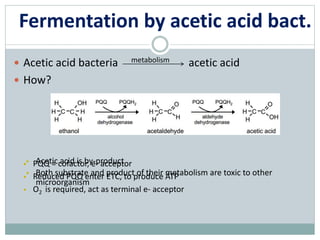
 Acetic acid bacteria acetic acid
 How?
 PQQ = cofactor, e- acceptor
 Reduced PQQ enter ETC, to produce ATP
 O2 is required, act as terminal e- acceptor
metabolism
 Acetic acid is by-product
 Both substrate and product of their metabolism are toxic to other
microorganism
Fermentation by acetic acid bact.
 Note that:
 This pathway is incomplete oxidation
ethanol acetic acid
o Complete oxidation: ethanol CO2 + H2O
 An amount of ethanol must always present
 Absent of ethanol -> complete oxidation occur -> lost in yield
Fermentation by acetic acid bact.
 Note that:
 Other alcohol and aldehyde (propanol, glycerol…) can also serve as
substrate, contribute to flavor and aroma
Fermentation by acetic acid bact.
 Note that:
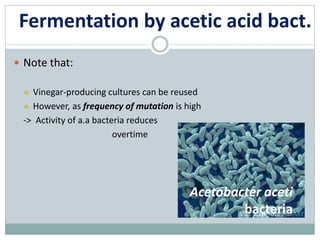
 Vinegar-producing cultures can be reused
 However, as frequency of mutation is high
-> Activity of a.a bacteria reduces
overtime
Acetobacter aceti
bacteria
3 methods to produce vinegar
 Starting with ethanol-containing substrate
 Next step: ethanol -> acetic acid
1. Open vat method (Orleans process)
2. Trickling generator process
3. Submerged fermentation
Open vat method (Orleans)
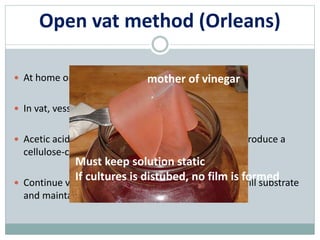
 At home or to produce high quality vinegar
 In vat, vessel, barrel, jar…
 Acetic acid bacteria growth on surface of solution, produce a
cellulose-containing film at liquid-air interface
 Continue vinegar production by remove product, refill substrate
and maintain surface film
mother of vinegar
Must keep solution static
If cultures is distubed, no film is formed
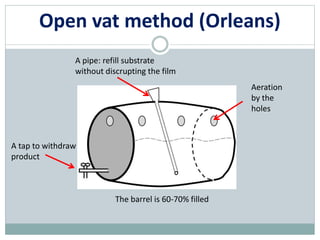
Open vat method (Orleans)
Aeration
by the
holes
A pipe: refill substrate
without discrupting the film
A tap to withdraw
product
The barrel is 60-70% filled
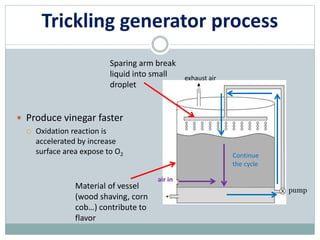
Trickling generator process
Material of vessel
(wood shaving, corn
cob…) contribute to
flavor
 Produce vinegar faster
 Oxidation reaction is
accelerated by increase
surface area expose to O2
Sparing arm break
liquid into small
droplet
pump
Continue
the cycle
air in
exhaust air
Submerged fermentation
 Industry
 Stainless steel equipment = clean, easy to sanitize
 Fastest, most effective, easy to control the process
(temp,pH, O2…)
 Temperature: ethanol oxidation is exothermic, heat released could
affect fermentation productivity
Submerged fermentation
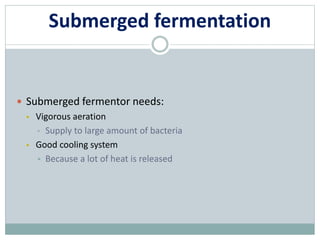
 Submerged fermentor needs:
 Vigorous aeration
• Supply to large amount of bacteria
 Good cooling system
 Because a lot of heat is released
 Fring acetator
 Produce most of the world’s vinegar
 Occupy less space, productivity 10X higher, and easier automation than
trickling generator
 However, high power consumption
 The tower fermentor
 For beer, wine, citric acid… production, but also for vinegar
Submerged fermentation
Agitator
Air is dispersed
and distributed
throughout the
liquid
Air in
-> Effective aeration
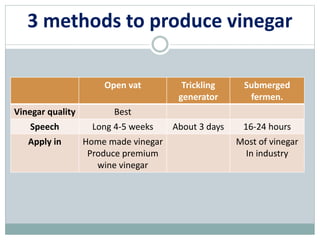
Open vat Trickling
generator
Submerged
fermen.
Vinegar quality Best
Speech Long 4-5 weeks About 3 days 16-24 hours
Apply in Home made vinegar
Produce premium
wine vinegar
Most of vinegar
In industry
3 methods to produce vinegar
Post processing
 Turbid clear vinegar
 Submerged vinegar is more turbid then trickling, due to high bacteria
content
 Pasteurize vinegar to inactivate bacteria, yeast and fungi
 For high quality vinegar, final product needs to be aged
filtration
Some types of vinegar
 Adulterated vinegar
 Chemical synthesis, then be diluted
 Can only distinguish by measure chemical constituent (mineral,
alcohol, volatile compounds…)
 Vinegar from different substrates
 Cider vinegar: from fermented apple juice or non-grape juice
 Spirit vinegar: from distilled alcohol -> no flavor, aroma
 Premium vinegar
 Expensive as wine
 Sour and slightly sweet taste, complex aroma
 Complicated production, several processes
Some types of vinegar
Balsamic vinegar
 The end. Thank you for listening

Vinegar production

  • 1.
    Vinegar Production I NT E R N A T I O N A L U N I V E R S I T Y , H C M C C O U R S E : E N Z Y M E & F O O D F E R M E N T A T I O N S T U D E N T ’ S N A M E : N G U Y E N Q . H A I Y E N
  • 2.
    Vinegar in food First preservative ever  Acidulant and flavoring agents  Diluted vinegar: beverage  Non-food: disinfectant, cleaning agent, comestic…
  • 3.
    What is vinegar? Definition  [ethanol] < 0.5%  [acetic acid] ≥ 4%  pH 2-3.5  Vinegar ≠ chemical synthesis
  • 4.
    Production of vinegar Contents Principles  Materials  Substrate  Microorganism  3 methods to produce vinegar  Post processing
  • 5.
    Principles of vinegarproduction  2 processes 1. Ethanolic fermentation  Sugar (glucose, fructose…) ethanol 2. Acetogenic fermentation  Ethanol acetic acid (vinegar) yeast (anaerobic) acetic acid bacteria (aerobic)
  • 6.
    Materials for fermentation Substrate  In Europe: grape, apple cider, peach, grain or malt…  In Asia: rice different aroma, flavor and quality  Microorganism  Acetic acid bacteria: Acetobacter, Gluconobacter and Gluconoacetobacter  Inhabitant: • Plant material rich in sugar (fruit, nectar…) • Alcohol containing solution (wine, beer…)
  • 7.
    Fermentation by aceticacid bact.  Acetic acid bacteria acetic acid  How?  PQQ = cofactor, e- acceptor  Reduced PQQ enter ETC, to produce ATP  O2 is required, act as terminal e- acceptor metabolism  Acetic acid is by-product  Both substrate and product of their metabolism are toxic to other microorganism
  • 8.
    Fermentation by aceticacid bact.  Note that:  This pathway is incomplete oxidation ethanol acetic acid o Complete oxidation: ethanol CO2 + H2O  An amount of ethanol must always present  Absent of ethanol -> complete oxidation occur -> lost in yield
  • 9.
    Fermentation by aceticacid bact.  Note that:  Other alcohol and aldehyde (propanol, glycerol…) can also serve as substrate, contribute to flavor and aroma
  • 10.
    Fermentation by aceticacid bact.  Note that:  Vinegar-producing cultures can be reused  However, as frequency of mutation is high -> Activity of a.a bacteria reduces overtime Acetobacter aceti bacteria
  • 11.
    3 methods toproduce vinegar  Starting with ethanol-containing substrate  Next step: ethanol -> acetic acid 1. Open vat method (Orleans process) 2. Trickling generator process 3. Submerged fermentation
  • 12.
    Open vat method(Orleans)  At home or to produce high quality vinegar  In vat, vessel, barrel, jar…  Acetic acid bacteria growth on surface of solution, produce a cellulose-containing film at liquid-air interface  Continue vinegar production by remove product, refill substrate and maintain surface film mother of vinegar Must keep solution static If cultures is distubed, no film is formed
  • 13.
    Open vat method(Orleans) Aeration by the holes A pipe: refill substrate without discrupting the film A tap to withdraw product The barrel is 60-70% filled
  • 14.
    Trickling generator process Materialof vessel (wood shaving, corn cob…) contribute to flavor  Produce vinegar faster  Oxidation reaction is accelerated by increase surface area expose to O2 Sparing arm break liquid into small droplet pump Continue the cycle air in exhaust air
  • 15.
    Submerged fermentation  Industry Stainless steel equipment = clean, easy to sanitize  Fastest, most effective, easy to control the process (temp,pH, O2…)  Temperature: ethanol oxidation is exothermic, heat released could affect fermentation productivity
  • 16.
    Submerged fermentation  Submergedfermentor needs:  Vigorous aeration • Supply to large amount of bacteria  Good cooling system  Because a lot of heat is released
  • 17.
     Fring acetator Produce most of the world’s vinegar  Occupy less space, productivity 10X higher, and easier automation than trickling generator  However, high power consumption  The tower fermentor  For beer, wine, citric acid… production, but also for vinegar Submerged fermentation Agitator Air is dispersed and distributed throughout the liquid Air in -> Effective aeration
  • 18.
    Open vat Trickling generator Submerged fermen. Vinegarquality Best Speech Long 4-5 weeks About 3 days 16-24 hours Apply in Home made vinegar Produce premium wine vinegar Most of vinegar In industry 3 methods to produce vinegar
  • 19.
    Post processing  Turbidclear vinegar  Submerged vinegar is more turbid then trickling, due to high bacteria content  Pasteurize vinegar to inactivate bacteria, yeast and fungi  For high quality vinegar, final product needs to be aged filtration
  • 20.
    Some types ofvinegar  Adulterated vinegar  Chemical synthesis, then be diluted  Can only distinguish by measure chemical constituent (mineral, alcohol, volatile compounds…)  Vinegar from different substrates  Cider vinegar: from fermented apple juice or non-grape juice  Spirit vinegar: from distilled alcohol -> no flavor, aroma
  • 21.
     Premium vinegar Expensive as wine  Sour and slightly sweet taste, complex aroma  Complicated production, several processes Some types of vinegar Balsamic vinegar
  • 22.
     The end.Thank you for listening