Rachel Martin, Leah Bordenga, Heather Kamback, Rachel Kehoe, Lauren Lyons, Rachel Bernstein


        OUT OF THE
        BOX                                                                                   1
genetically modified
                     food
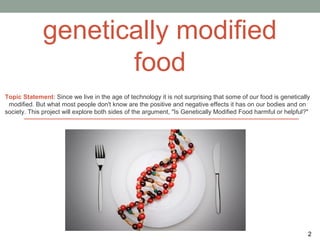
Topic Statement: Since we live in the age of technology it is not surprising that some of our food is genetically
 modified. But what most people don't know are the positive and negative effects it has on our bodies and on
society. This project will explore both sides of the argument, "Is Genetically Modified Food harmful or helpful?"


                                                                                                                2
What is genetically modified food?
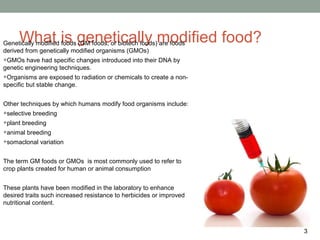
Genetically modified foods (GM foods, or biotech foods) are foods
derived from genetically modified organisms (GMOs)
•GMOs have had specific changes introduced into their DNA by
genetic engineering techniques.
•Organisms are exposed to radiation or chemicals to create a non-
specific but stable change.


Other techniques by which humans modify food organisms include:
•selective breeding
•plant breeding
•animal breeding
•somaclonal variation
The term GM foods or GMOs is most commonly used to refer to
crop plants created for human or animal consumption


These plants have been modified in the laboratory to enhance
desired traits such increased resistance to herbicides or improved
nutritional content.


                                                                     3
Why is it done?
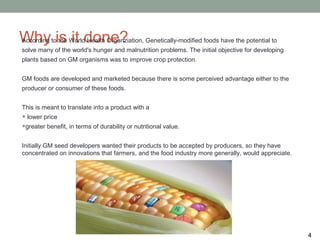
According to the World Health Organziation, Genetically-modified foods have the potential to
solve many of the world's hunger and malnutrition problems. The initial objective for developing
plants based on GM organisms was to improve crop protection.


GM foods are developed and marketed because there is some perceived advantage either to the
producer or consumer of these foods.


This is meant to translate into a product with a
• lower price
•greater benefit, in terms of durability or nutritional value.
Initially GM seed developers wanted their products to be accepted by producers, so they have
concentrated on innovations that farmers, and the food industry more generally, would appreciate.


                                                                                                    4
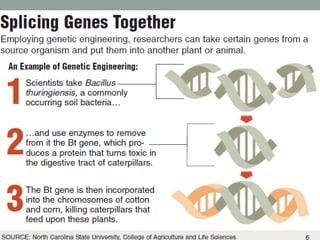
How is it accomplished ?
•   Genetically modified foods are created using
    biotechnology to change their genetic
    material
Techniques include...
    o   Benign bacterial or viral infection
    o   Gene splicing
    o   Gene "silencing"
    o   Biolistics
    o   Calcium phosphate precipitation
    o   Electroporation

                                                   5
6
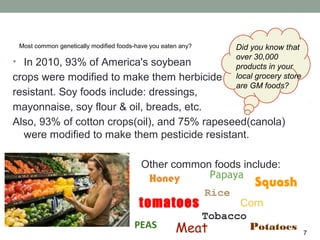
Most common genetically modified foods-have you eaten any?   Did you know that
                                                              over 30,000
• In 2010, 93% of America's soybean                           products in your
crops were modified to make them herbicide                    local grocery store
                                                              are GM foods?
resistant. Soy foods include: dressings,
mayonnaise, soy flour & oil, breads, etc.
Also, 93% of cotton crops(oil), and 75% rapeseed(canola)
  were modified to make them pesticide resistant.

                                        Other common foods include:
                                          Honey     Papaya
                                                              Squash
                                                   Rice
                                        tomatoes          Corn
                                                  Tobacco
                                       PEAS    Meat          Potatoes               7
Benefits
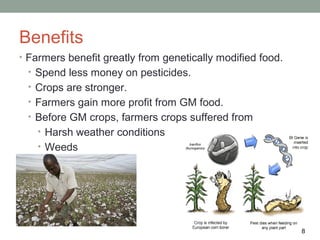
•   Farmers benefit greatly from genetically modified food.
    • Spend less money on pesticides.
    • Crops are stronger.
    • Farmers gain more profit from GM food.
    • Before GM crops, farmers crops suffered from
      • Harsh weather conditions
      • Weeds
      • Bugs/animals


                                                              8
Benefits cont...
• Surprisingly GM Food has
  health benefits!
• Crops are modified to be
  more nutritional.
   o   In developing countries,
       where nutrition is lacking,
       crops can be modified to
       contain the needed
       nutrients.
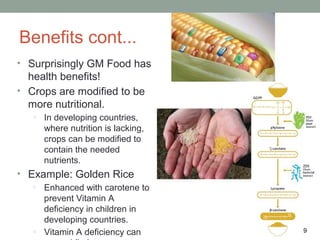
• Example: Golden Rice
   o   Enhanced with carotene to
       prevent Vitamin A
       deficiency in children in
       developing countries.
   o   Vitamin A deficiency can      9
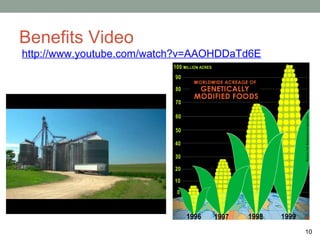
Benefits Video
http://www.youtube.com/watch?v=AAOHDDaTd6E


                                             10
•   Antibiotic Health Risks
     HarmsHuman
                Resistance:
    •   GM foods are often developed to fight off certain pesticides and
        herbicides-> higher risk that people who eat GM foods may be
        more resistant to antibiotics
•   New Diseases:
    •   Viruses and bacteria are used in the process of modifying foods->
        possibility that they could lead to the development of new diseases
•   Allergens and Toxins:
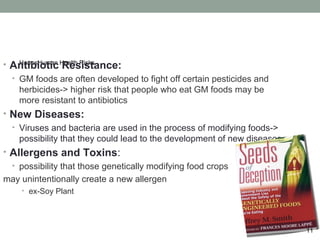
   possibility that those genetically modifying food crops
    •
may unintentionally create a new allergen
        •   ex-Soy Plant


                                                                              11
Harms
  Environmental/Ecological Problems
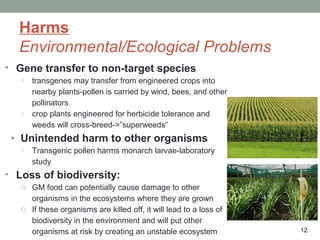
• Gene transfer to non-target species
   o   transgenes may transfer from engineered crops into
       nearby plants-pollen is carried by wind, bees, and other
       pollinators
   o   crop plants engineered for herbicide tolerance and
       weeds will cross-breed->”superweeds”
 • Unintended harm to other organisms
   o   Transgenic pollen harms monarch larvae-laboratory
       study
• Loss of biodiversity:
   o GM food can potentially cause damage to other
     organisms in the ecosystems where they are grown
   o If these organisms are killed off, it will lead to a loss of
     biodiversity in the environment and will put other
     organisms at risk by creating an unstable ecosystem            12
Government and regulation
Proposition 37
Proposition 37 would:
 -Require labeling on raw or processed food sold to consumers if made from
plants or animals with genetic material changed in specific ways.
-Prohibits labeling or advertising such food, or other processed food, as
"natural," "naturally made," naturally grown," and "all natural."
Similar proposals are also being formed in other states such as Vermont,
Connecticut and Washington.
Labeling of genetically modified foods has already been acted upon in over 60
countries worldwide including most of Europe, Japan, China and India.

In California there is a movement currently underway for the labeling of genetically engineered foods
    titled Proposition 37.


                                                                                                   13
Government and regulation
Argument in Favor
 -You have a right to know what is in your food
-Food will be labeled accurately
-Protecting your health as well as your family's will be
easier
-There are no long-term health studies that have proven
that genetically engineered food is safe for humans
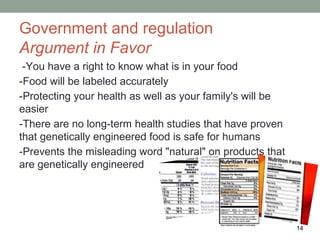
-Prevents the misleading word "natural" on products that
are genetically engineered


                                                           14
Government and regulation
Argument Against

-Many believe it would mean higher food
 costs for both farmers and consumers

-Opens the door for various lawsuits to ensue if labeling is
 incorrect or consumers come to harm from a product that
 was genetically modified.


                                                               15
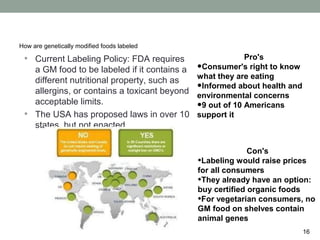
How are genetically modified foods labeled

 • Current Labeling Policy: FDA requires                   Pro's
     a GM food to be labeled if it contains a• Consumer's right to know
                                              what they are eating
     different nutritional property, such as
                                             • Informed about health and
     allergins, or contains a toxicant beyond environmental concerns
     acceptable limits.
                                             • 9 out of 10 Americans
 •   The USA has proposed laws in over 10 support it
     states, but not enacted.

                                                           Con's
                                             •Labeling would raise prices
                                             for all consumers
                                             •They already have an option:
                                             buy certified organic foods
                                             •For vegetarian consumers, no
                                             GM food on shelves contain
                                             animal genes
                                                                           16
Bibliography
        "Genetically Modified Foods - Techniques." Home. N.p., n.d. Web. 20 Oct. 2012.
<http://www.betterhealth.vic.gov.au/bhcv2/bhcarticles.nsf/pages/Genetically_modified_foods_techniques>.


       GM Science Review First Report, Prepared by the UK GM Science Review panel (July 2003).
       Chairman Professor Sir David King, Chief Scientific Advisor to the UK Government, P 9

      Disabled World News. "Genetically modified foods information including list of GM foods" by Mavis Butcher. 22
September 2009. Web Oct. 20 2012. <http://www.disabled-world.com/fitness/gm-foods.php>

              Colorado State University Extension.. "Labeling of Genetically Engineered Foods" by P. Bryne. September 2010.
Web Oct. 19, 2012. <http://www.ext.colostate.edu/pubs/foodnut/09371.html>

       Whitman, Deborah B. "Genetically Modified Foods: Harmful or Helpful?" Genetically Modified Foods: Harmful or
Helpful? N.p., Apr. 2000. Web. 15 Oct. 2012. <http://www.csa.com/discoveryguides/gmfood/overview.php>.

        Ackerman, Jennifer. "Food: How Altered?" National Geographic. N.p., n.d. Web. 23 Oct. 2012.
<http://environment.nationalgeographic.com/environment/global-warming/food-how-altered/>.

       Henshaw, Ashley. "Pros And Cons Of Genetically Modified Foods." Symptomfind.com. N.p., 21 Mar. 2012. Web. 20 Oct.
2012. <http://www.symptomfind.com/nutrition-supplements/pros-and-cons-of-genetically-modified-foods/>.

                                                                                                                              17
        Palfreman, Jon. "Harvest of Fear." PBS. N.p., 24 Apr. 2001. Web. 18 Oct. 2012.
<http://www.pbs.org/wgbh/harvest/exist/arguments.html>.
•    "California General Election." Proposition 37 Arguments and Rebuttals. N.p., n.d. Web. 28 Oct. 2012.
Bibliography continued..
      <http://voterguide.sos.ca.gov/propositions/37/arguments-rebuttals.htm>.


  •    General, Attorney. "California General Election." Proposition 37 Title and Summary. N.p., n.d. Web. 28 Oct. 2012.
       <http://voterguide.sos.ca.gov/propositions/37/title-summary.htm>.


  •    http://www.pakalertpress.com/2012/10/09/political-and-corporate-elite-shun-gm-food-on-their-own-plate/


  •    http://www.guardian.co.uk/environment/2012/jan/05/gm-food-crops-demand-prices


  •    http://www.twotheroot.com/problem-with-gmo/


  •    http://www.seedsofdeception.com/


                                                                                                                           18

Genetically modified food

  • 1.
    Rachel Martin, LeahBordenga, Heather Kamback, Rachel Kehoe, Lauren Lyons, Rachel Bernstein OUT OF THE BOX 1
  • 2.
    genetically modified food Topic Statement: Since we live in the age of technology it is not surprising that some of our food is genetically modified. But what most people don't know are the positive and negative effects it has on our bodies and on society. This project will explore both sides of the argument, "Is Genetically Modified Food harmful or helpful?" 2
  • 3.
    What is geneticallymodified food? Genetically modified foods (GM foods, or biotech foods) are foods derived from genetically modified organisms (GMOs) •GMOs have had specific changes introduced into their DNA by genetic engineering techniques. •Organisms are exposed to radiation or chemicals to create a non- specific but stable change. Other techniques by which humans modify food organisms include: •selective breeding •plant breeding •animal breeding •somaclonal variation The term GM foods or GMOs is most commonly used to refer to crop plants created for human or animal consumption These plants have been modified in the laboratory to enhance desired traits such increased resistance to herbicides or improved nutritional content. 3
  • 4.
    Why is itdone? According to the World Health Organziation, Genetically-modified foods have the potential to solve many of the world's hunger and malnutrition problems. The initial objective for developing plants based on GM organisms was to improve crop protection. GM foods are developed and marketed because there is some perceived advantage either to the producer or consumer of these foods. This is meant to translate into a product with a • lower price •greater benefit, in terms of durability or nutritional value. Initially GM seed developers wanted their products to be accepted by producers, so they have concentrated on innovations that farmers, and the food industry more generally, would appreciate. 4
  • 5.
    How is itaccomplished ? • Genetically modified foods are created using biotechnology to change their genetic material Techniques include... o Benign bacterial or viral infection o Gene splicing o Gene "silencing" o Biolistics o Calcium phosphate precipitation o Electroporation 5
  • 6.
  • 7.
    Most common geneticallymodified foods-have you eaten any? Did you know that over 30,000 • In 2010, 93% of America's soybean products in your crops were modified to make them herbicide local grocery store are GM foods? resistant. Soy foods include: dressings, mayonnaise, soy flour & oil, breads, etc. Also, 93% of cotton crops(oil), and 75% rapeseed(canola) were modified to make them pesticide resistant. Other common foods include: Honey Papaya Squash Rice tomatoes Corn Tobacco PEAS Meat Potatoes 7
  • 8.
    Benefits • Farmers benefit greatly from genetically modified food. • Spend less money on pesticides. • Crops are stronger. • Farmers gain more profit from GM food. • Before GM crops, farmers crops suffered from • Harsh weather conditions • Weeds • Bugs/animals 8
  • 9.
    Benefits cont... • SurprisinglyGM Food has health benefits! • Crops are modified to be more nutritional. o In developing countries, where nutrition is lacking, crops can be modified to contain the needed nutrients. • Example: Golden Rice o Enhanced with carotene to prevent Vitamin A deficiency in children in developing countries. o Vitamin A deficiency can 9
  • 10.
  • 11.
    • Antibiotic Health Risks HarmsHuman Resistance: • GM foods are often developed to fight off certain pesticides and herbicides-> higher risk that people who eat GM foods may be more resistant to antibiotics • New Diseases: • Viruses and bacteria are used in the process of modifying foods-> possibility that they could lead to the development of new diseases • Allergens and Toxins: possibility that those genetically modifying food crops • may unintentionally create a new allergen • ex-Soy Plant 11
  • 12.
    Harms Environmental/EcologicalProblems • Gene transfer to non-target species o transgenes may transfer from engineered crops into nearby plants-pollen is carried by wind, bees, and other pollinators o crop plants engineered for herbicide tolerance and weeds will cross-breed->”superweeds” • Unintended harm to other organisms o Transgenic pollen harms monarch larvae-laboratory study • Loss of biodiversity: o GM food can potentially cause damage to other organisms in the ecosystems where they are grown o If these organisms are killed off, it will lead to a loss of biodiversity in the environment and will put other organisms at risk by creating an unstable ecosystem 12
  • 13.
    Government and regulation Proposition37 Proposition 37 would: -Require labeling on raw or processed food sold to consumers if made from plants or animals with genetic material changed in specific ways. -Prohibits labeling or advertising such food, or other processed food, as "natural," "naturally made," naturally grown," and "all natural." Similar proposals are also being formed in other states such as Vermont, Connecticut and Washington. Labeling of genetically modified foods has already been acted upon in over 60 countries worldwide including most of Europe, Japan, China and India. In California there is a movement currently underway for the labeling of genetically engineered foods titled Proposition 37. 13
  • 14.
    Government and regulation Argumentin Favor -You have a right to know what is in your food -Food will be labeled accurately -Protecting your health as well as your family's will be easier -There are no long-term health studies that have proven that genetically engineered food is safe for humans -Prevents the misleading word "natural" on products that are genetically engineered 14
  • 15.
    Government and regulation ArgumentAgainst -Many believe it would mean higher food costs for both farmers and consumers -Opens the door for various lawsuits to ensue if labeling is incorrect or consumers come to harm from a product that was genetically modified. 15
  • 16.
    How are geneticallymodified foods labeled • Current Labeling Policy: FDA requires Pro's a GM food to be labeled if it contains a• Consumer's right to know what they are eating different nutritional property, such as • Informed about health and allergins, or contains a toxicant beyond environmental concerns acceptable limits. • 9 out of 10 Americans • The USA has proposed laws in over 10 support it states, but not enacted. Con's •Labeling would raise prices for all consumers •They already have an option: buy certified organic foods •For vegetarian consumers, no GM food on shelves contain animal genes 16
  • 17.
    Bibliography "Genetically Modified Foods - Techniques." Home. N.p., n.d. Web. 20 Oct. 2012. <http://www.betterhealth.vic.gov.au/bhcv2/bhcarticles.nsf/pages/Genetically_modified_foods_techniques>. GM Science Review First Report, Prepared by the UK GM Science Review panel (July 2003). Chairman Professor Sir David King, Chief Scientific Advisor to the UK Government, P 9 Disabled World News. "Genetically modified foods information including list of GM foods" by Mavis Butcher. 22 September 2009. Web Oct. 20 2012. <http://www.disabled-world.com/fitness/gm-foods.php> Colorado State University Extension.. "Labeling of Genetically Engineered Foods" by P. Bryne. September 2010. Web Oct. 19, 2012. <http://www.ext.colostate.edu/pubs/foodnut/09371.html> Whitman, Deborah B. "Genetically Modified Foods: Harmful or Helpful?" Genetically Modified Foods: Harmful or Helpful? N.p., Apr. 2000. Web. 15 Oct. 2012. <http://www.csa.com/discoveryguides/gmfood/overview.php>. Ackerman, Jennifer. "Food: How Altered?" National Geographic. N.p., n.d. Web. 23 Oct. 2012. <http://environment.nationalgeographic.com/environment/global-warming/food-how-altered/>. Henshaw, Ashley. "Pros And Cons Of Genetically Modified Foods." Symptomfind.com. N.p., 21 Mar. 2012. Web. 20 Oct. 2012. <http://www.symptomfind.com/nutrition-supplements/pros-and-cons-of-genetically-modified-foods/>. 17 Palfreman, Jon. "Harvest of Fear." PBS. N.p., 24 Apr. 2001. Web. 18 Oct. 2012. <http://www.pbs.org/wgbh/harvest/exist/arguments.html>.
  • 18.
    • "California General Election." Proposition 37 Arguments and Rebuttals. N.p., n.d. Web. 28 Oct. 2012. Bibliography continued.. <http://voterguide.sos.ca.gov/propositions/37/arguments-rebuttals.htm>. • General, Attorney. "California General Election." Proposition 37 Title and Summary. N.p., n.d. Web. 28 Oct. 2012. <http://voterguide.sos.ca.gov/propositions/37/title-summary.htm>. • http://www.pakalertpress.com/2012/10/09/political-and-corporate-elite-shun-gm-food-on-their-own-plate/ • http://www.guardian.co.uk/environment/2012/jan/05/gm-food-crops-demand-prices • http://www.twotheroot.com/problem-with-gmo/ • http://www.seedsofdeception.com/ 18