Genetically modified organisms-
acceptance by scientist & public
Dr. N. Yuvaraj
Assistant Professor
Achariya Arts and Science College
Villianur , Puducherry
What is GM crops/ food?
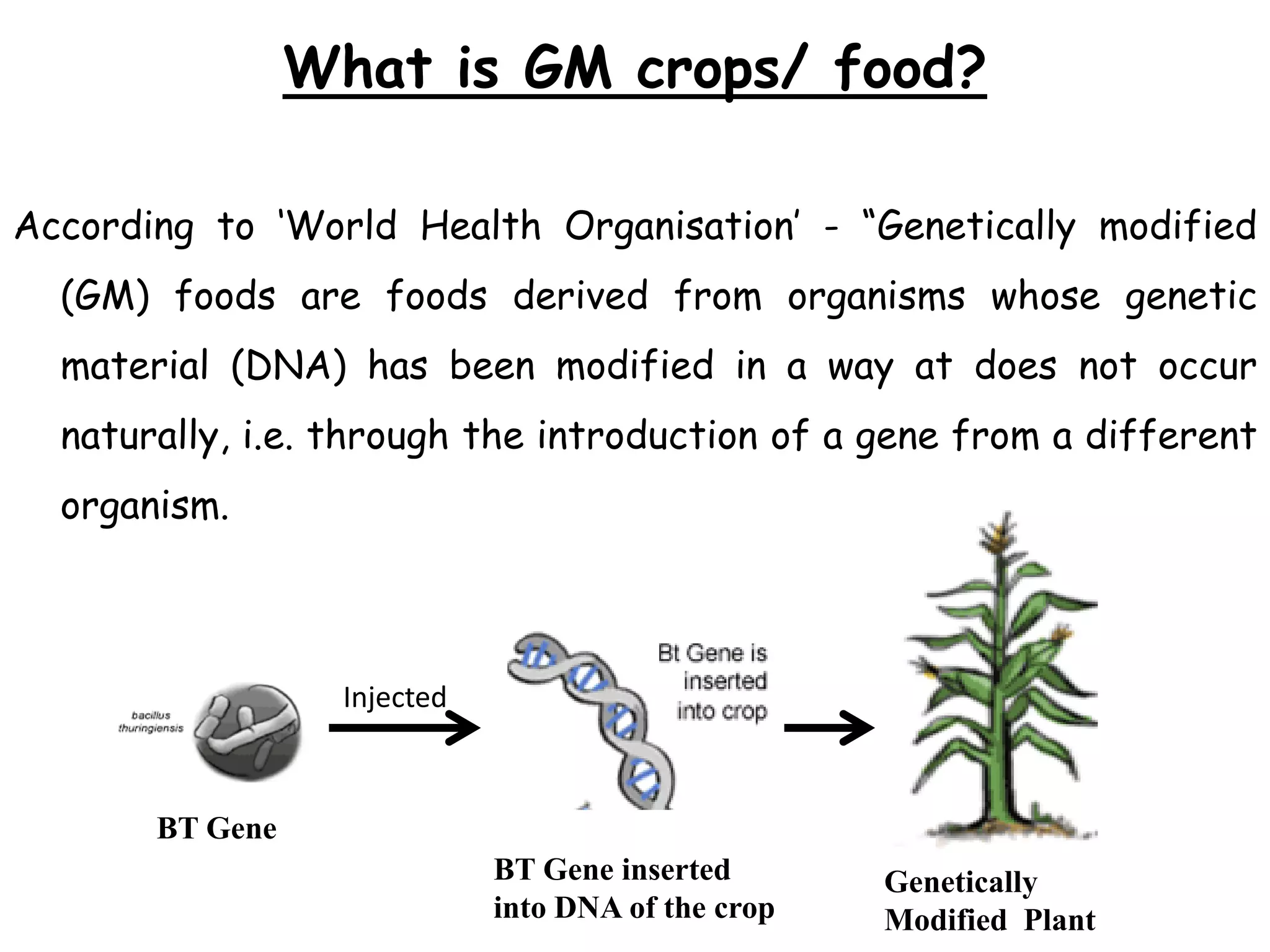
According to „World Health Organisation‟ - “Genetically modified
(GM) foods are foods derived from organisms whose genetic
material (DNA) has been modified in a way at does not occur
naturally, i.e. through the introduction of a gene from a different
organism.
BT Gene
BT Gene inserted
into DNA of the crop
Genetically
Modified Plant
Injected
GM Crops are described by many different names –
Genetically Engineered crops(GE)
Transgenic or Biotech crops
Genetically Modified Organism(GMO)
In development since 1982
First commercially available crops hit market in 1994
GM Crops grown commercially by 8.5 million farmers on 250
million acres spread over 21 countries
Up from 4.3 million acres in 1996
Global acreage increased 20% in 2004, but new R and D
slowing:
¾ of U.S. federal crop approvals between 1995 and 1999
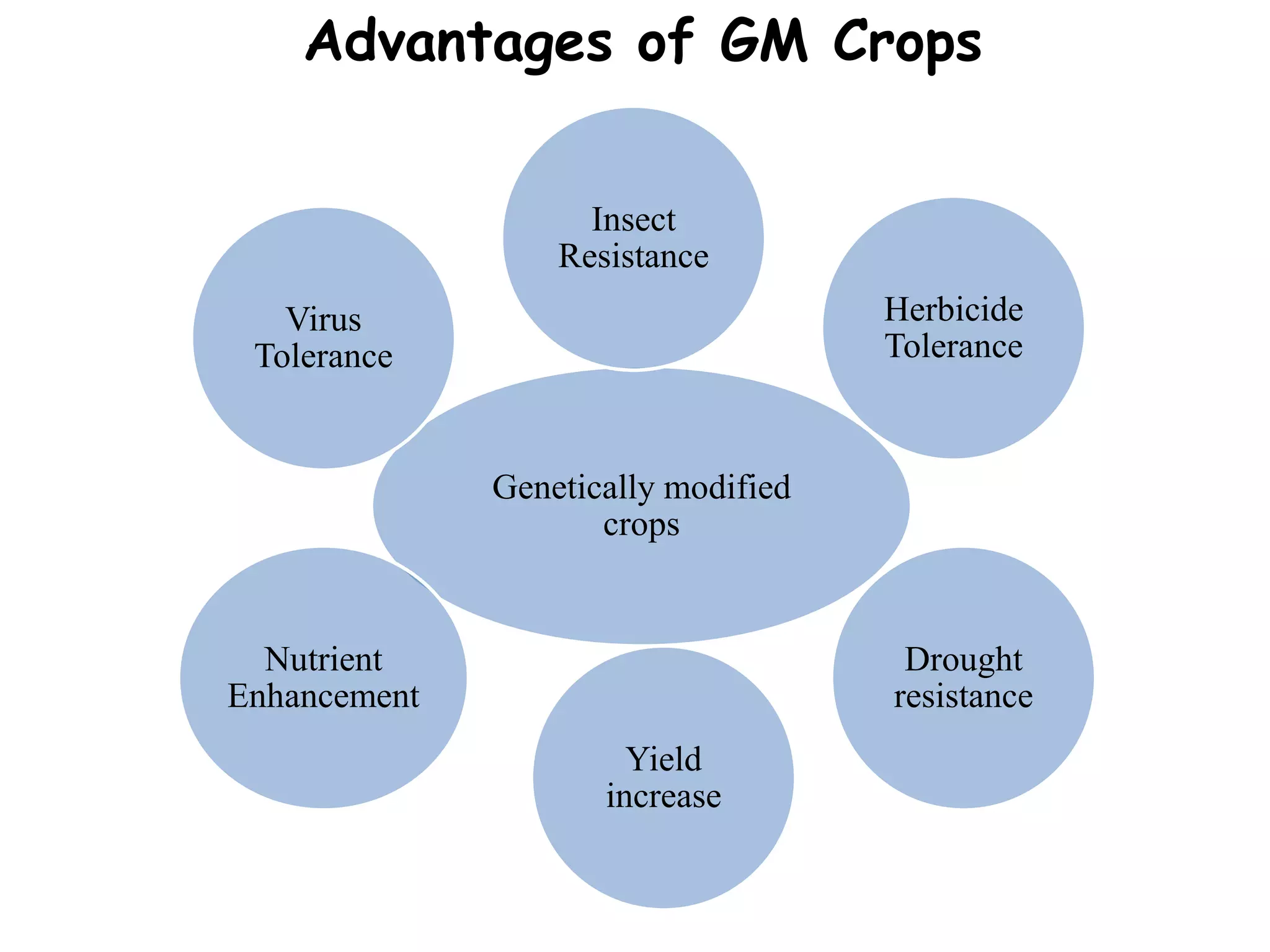
Genetically modified
crops
Insect
Resistance
Herbicide
Tolerance
Drought
resistance
Yield
increase
Nutrient
Enhancement
Virus
Tolerance
Advantages of GM Crops
Top producers:
United States - 59%
Argentina - 20%
Canada - 6%
Brazil - 6%
China - 5%
Account for 96% of global cultivation
Europe – only small amounts in Spain
60-70% of processed foods available in the U.S. today come
from GM crops
Hawaii: biodiversity vs. biotech
Today 10 corporations control 49% of the world seed market
mid-1970s: none of the 7,000 seed companies controlled
over 0.5% of world seed market.
Major agricultural biotech companies also pharmaceutical
companies:
Monsanto
$993 million profit on $8.5 billion revenues in 2007 – 4th
straight year of record-breaking profits
90% of GM seeds sold by Monsanto or by competitors
that license Monsanto genes in their own seeds
Major agricultural biotech companies also pharmaceutical
companies:
Novartis Seeds
Aventis CropScience
Bayer CropScience
Syngenta
Dow
Companies sponsor professorships, academic research institutes
Purposes: increase growth rate/enhance ripening, prevent
spoilage, enhance nutritional quality, change appearance,
provide resistance to herbicides and drought, alter freezing
properties
Tobacco industry attempting to develop GE-tobacco to enhance
nicotine delivery.
68% herbicide-resistant
19% produce their own pesticide
13% produce their own pesticide and are herbicide-resistant
“Golden Rice”: The Poster Child of GE
 Purported to be the solution to the problem of Vitamin A
deficiency in developing countries
 Developed in 1999 by Swiss and German scientists
 Produced by splicing two daffodil and one bacterial gene
into japonica rice, a variety adapted for temperate
climates
Herbicide Tolerance
Over 63% of Gm crops grown globally have herbicide tolerance traits.
 Herbicide tolerance is achieved through the introduction of a gene
from a bacterium conveying resistance to some herbicides.
In situations where weed pressure is high, the use of such crops has
resulted in a reduction in the quantity of the herbicides used.
GM crop
GM Crop
(Unaffected)
Weed KilledWeed
Herbicide Spray
Result Of
Herbicide Spray
Virus Resistance
Virus resistance makes plants less susceptible to diseases caused by
such viruses, resulting in higher crop yields.
For Example- Hawaiian Papaya- Hawaiian papaya is made resistant to
the devastating effects of Papaya Ring Spot Virus (PRSV).
Hawaiian Papaya
Papaya Ring Spot Virus
Disadvantages of GM crops
Allergenicity
Gene transfer
Outcrossing
Super Weeds
Allergenicity
In India, hundreds of laborers picking cotton and working in
cotton ginning factories developed allergic reactions when handling
the BT cotton.
This didn‟t happen with the non-Bt varieties.
Hospital records: “ Show that victims of itching have increased
massively and all of them are related to BT cotton farming.
Itching all over the body, eruptions,
Out-crossing
The movement of genes from GM plants into conventional crops or
related species in the wild (referred to as “out crossing”), as well as the
mixing of crops derived from conventional seeds with those grown using
GM crops, may have an indirect effect on food safety and food security.
pollens
Direction of
wind
GM Crops Conventional crops
The National Uniformity for Food Act
 Supported by the “National Uniformity for Food Coalition,”
an industry group started by the Grocery Manufacturers
Association
 Since 1999, shortly after the uniformity campaign began,
food-related industries have contributed $81 million to
congressional candidates
Food Labeling in the U.S.
 Vitamin, mineral, caloric and fat content
 Sulfites (allergies)
 Source of proteins (vegetarians)
 President GW Bush opposes labeling of GM foodstuffs;
APHA favors labeling
COOL: Country of Origin Labeling
 2002 Farm Bill mandated USDA to begin COOL in 9/2004
 85% favor COOL, 74% support Congress making COOL
mandatory, 55% have “little or not much trust” in industry
to provide voluntary COOL.
 COOL for seafood went into effect in 4/05
 Congress has delayed implementation of COOL twice
(current expected rollout = 9/08)
 Heavy industry lobbying and large campaigns to fight
mandatory COOL / support voluntary COOL
 Trade Associations / Big Agribusiness and grocers
Cloned Meats
 Approved by the FDA, 2008
 No requirement for labeling
 Problems:
 Very expensive? growth potential?
 2007: 90% pre-natal failure rate
 Surrogate suffering – spontaneous abortions, “large
offspring syndrome” leading to early-term and
stressful C-sections
Cloned Meats
 Problems
 Post-natal health problems: enlarged tongues,
heart/lung/liver/brain damage, kidney failure
 High doses of hormones, antibiotics required (pre- and
post-natally)
 NAS (2004): It is “impossible to draw conclusions about
the safety of food from cloned animals”
GE Food Labeling Worldwide
 European Union has required since 1998
 Japan, China, Australia, Brazil, Malaysia, and many other
countries also require labels.
 Many countries ban planting and the importation of GE
foods from the U.S. and elsewhere
 EU lifted ban in 2003 due in part to
U.S./Canada/Argentine lawsuit against EU through
WTO
 NSW government banned until 2006
WTO ruled against EU (2006)
– Details of secret proceedings leaked to press
– WTO acknowledged that their decision based on trade, and
that they were not qualified nor obligated to consider
health and environmental consequences
 Swiss banned GMO crops, 164 local governments in EU have
banned or come out against GE crops
 European public strongly opposed to GMO foods
 But, since 2005, at least 12 GM seeds approved for planting
in various EU countries
Government and Industry
 Revolving door between industry and federal regulatory
agencies
 Silencing dissent; firing dissenters
 Pseudoscience
Benefits of Labeling GE Foods
 Prevent allergic reactions
 Soybeans modified with Brazil nut genes (noted pre-
marketing, never commercialized)
 Allow vegetarians to avoid animal genes
 Tomatoes with flounder genes (Flavr Savr tomato - antifreeze
properties, consumer demand low in test-marketing)
 Ice cream with ocean pout gene (“smoother and creamier” –
from Unilever…subsidiary Ben and Jerry‟s opposing)
Benefits of Labeling GE Foods
 Permit concerned individuals to avoid milk from rBGH-
treated cattle
 Risks to humans, cattle and the environment
 Heighten public awareness of genetic engineering
 Millions of Americans eat GM foods every day without
knowing it
 Only 26% of Americans believe they have eaten GM foods
Benefits of Labeling GE Foods
 Grant people freedom to choose what they eat based on
individual willingness to confront risk.
 Ensure healthy public debate over the merits of genetic
modification of foodstuffs
Health and Environmental Risks of GE Foods
• Allergies and toxicities from new proteins entering the food
supply
– EMS from Showa Denko‟s GE-L-tryptophan supplements in
1980s
• FDA covered up
– Bt corn increases sensitivity of mammals to other allergens
– Bt corn toxic to caddis flies, a food resource for fish and
amphibians
– GM peas (with bean gene) cause lung inflammation in mice –
trial stopped
– New, allergenic proteins in GE soy in South Korea

Genetically modified organisms

  • 1.
    Genetically modified organisms- acceptanceby scientist & public Dr. N. Yuvaraj Assistant Professor Achariya Arts and Science College Villianur , Puducherry
  • 2.
    What is GMcrops/ food? According to „World Health Organisation‟ - “Genetically modified (GM) foods are foods derived from organisms whose genetic material (DNA) has been modified in a way at does not occur naturally, i.e. through the introduction of a gene from a different organism. BT Gene BT Gene inserted into DNA of the crop Genetically Modified Plant Injected
  • 3.
    GM Crops aredescribed by many different names – Genetically Engineered crops(GE) Transgenic or Biotech crops Genetically Modified Organism(GMO) In development since 1982 First commercially available crops hit market in 1994 GM Crops grown commercially by 8.5 million farmers on 250 million acres spread over 21 countries Up from 4.3 million acres in 1996 Global acreage increased 20% in 2004, but new R and D slowing: ¾ of U.S. federal crop approvals between 1995 and 1999
  • 4.
  • 5.
    Top producers: United States- 59% Argentina - 20% Canada - 6% Brazil - 6% China - 5% Account for 96% of global cultivation Europe – only small amounts in Spain 60-70% of processed foods available in the U.S. today come from GM crops Hawaii: biodiversity vs. biotech
  • 6.
    Today 10 corporationscontrol 49% of the world seed market mid-1970s: none of the 7,000 seed companies controlled over 0.5% of world seed market. Major agricultural biotech companies also pharmaceutical companies: Monsanto $993 million profit on $8.5 billion revenues in 2007 – 4th straight year of record-breaking profits 90% of GM seeds sold by Monsanto or by competitors that license Monsanto genes in their own seeds
  • 7.
    Major agricultural biotechcompanies also pharmaceutical companies: Novartis Seeds Aventis CropScience Bayer CropScience Syngenta Dow Companies sponsor professorships, academic research institutes
  • 8.
    Purposes: increase growthrate/enhance ripening, prevent spoilage, enhance nutritional quality, change appearance, provide resistance to herbicides and drought, alter freezing properties Tobacco industry attempting to develop GE-tobacco to enhance nicotine delivery. 68% herbicide-resistant 19% produce their own pesticide 13% produce their own pesticide and are herbicide-resistant
  • 9.
    “Golden Rice”: ThePoster Child of GE  Purported to be the solution to the problem of Vitamin A deficiency in developing countries  Developed in 1999 by Swiss and German scientists  Produced by splicing two daffodil and one bacterial gene into japonica rice, a variety adapted for temperate climates
  • 10.
    Herbicide Tolerance Over 63%of Gm crops grown globally have herbicide tolerance traits.  Herbicide tolerance is achieved through the introduction of a gene from a bacterium conveying resistance to some herbicides. In situations where weed pressure is high, the use of such crops has resulted in a reduction in the quantity of the herbicides used. GM crop GM Crop (Unaffected) Weed KilledWeed Herbicide Spray Result Of Herbicide Spray
  • 11.
    Virus Resistance Virus resistancemakes plants less susceptible to diseases caused by such viruses, resulting in higher crop yields. For Example- Hawaiian Papaya- Hawaiian papaya is made resistant to the devastating effects of Papaya Ring Spot Virus (PRSV). Hawaiian Papaya Papaya Ring Spot Virus
  • 12.
    Disadvantages of GMcrops Allergenicity Gene transfer Outcrossing Super Weeds
  • 13.
    Allergenicity In India, hundredsof laborers picking cotton and working in cotton ginning factories developed allergic reactions when handling the BT cotton. This didn‟t happen with the non-Bt varieties. Hospital records: “ Show that victims of itching have increased massively and all of them are related to BT cotton farming. Itching all over the body, eruptions,
  • 14.
    Out-crossing The movement ofgenes from GM plants into conventional crops or related species in the wild (referred to as “out crossing”), as well as the mixing of crops derived from conventional seeds with those grown using GM crops, may have an indirect effect on food safety and food security. pollens Direction of wind GM Crops Conventional crops
  • 15.
    The National Uniformityfor Food Act  Supported by the “National Uniformity for Food Coalition,” an industry group started by the Grocery Manufacturers Association  Since 1999, shortly after the uniformity campaign began, food-related industries have contributed $81 million to congressional candidates
  • 16.
    Food Labeling inthe U.S.  Vitamin, mineral, caloric and fat content  Sulfites (allergies)  Source of proteins (vegetarians)  President GW Bush opposes labeling of GM foodstuffs; APHA favors labeling
  • 17.
    COOL: Country ofOrigin Labeling  2002 Farm Bill mandated USDA to begin COOL in 9/2004  85% favor COOL, 74% support Congress making COOL mandatory, 55% have “little or not much trust” in industry to provide voluntary COOL.  COOL for seafood went into effect in 4/05  Congress has delayed implementation of COOL twice (current expected rollout = 9/08)  Heavy industry lobbying and large campaigns to fight mandatory COOL / support voluntary COOL  Trade Associations / Big Agribusiness and grocers
  • 18.
    Cloned Meats  Approvedby the FDA, 2008  No requirement for labeling  Problems:  Very expensive? growth potential?  2007: 90% pre-natal failure rate  Surrogate suffering – spontaneous abortions, “large offspring syndrome” leading to early-term and stressful C-sections
  • 19.
    Cloned Meats  Problems Post-natal health problems: enlarged tongues, heart/lung/liver/brain damage, kidney failure  High doses of hormones, antibiotics required (pre- and post-natally)  NAS (2004): It is “impossible to draw conclusions about the safety of food from cloned animals”
  • 20.
    GE Food LabelingWorldwide  European Union has required since 1998  Japan, China, Australia, Brazil, Malaysia, and many other countries also require labels.  Many countries ban planting and the importation of GE foods from the U.S. and elsewhere  EU lifted ban in 2003 due in part to U.S./Canada/Argentine lawsuit against EU through WTO  NSW government banned until 2006
  • 21.
    WTO ruled againstEU (2006) – Details of secret proceedings leaked to press – WTO acknowledged that their decision based on trade, and that they were not qualified nor obligated to consider health and environmental consequences  Swiss banned GMO crops, 164 local governments in EU have banned or come out against GE crops  European public strongly opposed to GMO foods  But, since 2005, at least 12 GM seeds approved for planting in various EU countries
  • 22.
    Government and Industry Revolving door between industry and federal regulatory agencies  Silencing dissent; firing dissenters  Pseudoscience
  • 23.
    Benefits of LabelingGE Foods  Prevent allergic reactions  Soybeans modified with Brazil nut genes (noted pre- marketing, never commercialized)  Allow vegetarians to avoid animal genes  Tomatoes with flounder genes (Flavr Savr tomato - antifreeze properties, consumer demand low in test-marketing)  Ice cream with ocean pout gene (“smoother and creamier” – from Unilever…subsidiary Ben and Jerry‟s opposing)
  • 24.
    Benefits of LabelingGE Foods  Permit concerned individuals to avoid milk from rBGH- treated cattle  Risks to humans, cattle and the environment  Heighten public awareness of genetic engineering  Millions of Americans eat GM foods every day without knowing it  Only 26% of Americans believe they have eaten GM foods
  • 25.
    Benefits of LabelingGE Foods  Grant people freedom to choose what they eat based on individual willingness to confront risk.  Ensure healthy public debate over the merits of genetic modification of foodstuffs
  • 26.
    Health and EnvironmentalRisks of GE Foods • Allergies and toxicities from new proteins entering the food supply – EMS from Showa Denko‟s GE-L-tryptophan supplements in 1980s • FDA covered up – Bt corn increases sensitivity of mammals to other allergens – Bt corn toxic to caddis flies, a food resource for fish and amphibians – GM peas (with bean gene) cause lung inflammation in mice – trial stopped – New, allergenic proteins in GE soy in South Korea