GENETICALLY MODIFIED FOODS
Presented By : Saritha Sadanandan Pillai
2nd MSc Biotechnology
SAS SNDP Yogam College,
Konni
THINK FOR A WHILE….
What do you mean by Genetically Modified ?
 Containing a genetic material that has been artificially
altered so as to produce a desired characteristic.
GENETICALLY MODIFIEDFOODS
• Genetically modified (GM) foods derived from organisms whose
genetic material (DNA) has modified in a way that it does not
occur naturally by introduction of a gene from a different
organism.
• It does not occur naturally.
• GM foods are described in many different names:
 Genetically Engineered crops
 Transgenic or Biotech crops
 Genetically modified organism (GMO)
ARTIC FISH DNA
How the Genes are Modified ?
By Recombinant DNA Technology –
Steps-
1. Restriction enzymes used to cut DNA segments from a
desired genome.
2. DNA ligases are used to paste the DNA segments on to the
other genome.
3. Thus, we get a recombinant genome.
History
• 1988- first genetically modified enzymes.
• 1990’s- Approval of first recombinant enzyme- Chymosin (rennet
preparation)
• 1994- first genetically modified food Flavr Savr Tomato, developed
by Calgene.
• 1995- first pesticide producing crop- Bacillus thureingenesis Potato
(Bt Potato) – USA
• 2006- Palmer amaranth – weed that competes with cotton.
• 2015- first genetically modified animal- Aqua advantage Salmon
The salmon were transformed with a growth hormone and a
promoter from an ocean pout enabling it to grow year round
instead of only during spring and summer.
Process
• GMO’s are generated and tested in the laboratory for
desired qualities.
• Modification- add, removed, expression is increased or
silenced or number of copies of a gene is increased or
decreased.
• Satisfactory strains produced are applied for regulatory
approval to field- test them (“Field release”).
• Approved specimens (seeds, cuttings, breeding pairs etc.)
are cultivated and sold to farmers.
• The farmers cultivate and market the new strain.
Manipulating the dna
• The whole process of genetic modification consists of
Manipulating the DNA.
• It allows certain genes to be identified, copied and brought into
other organisms in more specific ways.
Modifying Plants and Animals
• Plasmid is taken out from the bacteria and the clone gene is
replaced with a restriction enzyme.
• For animals this is done by injecting millions of copies of the
gene into the nucleus of a fertilized egg.
Modifying foods
• Certain genes and chemicals are injected into food such as
Bananas, to make it larger & for stay riper longer – Cisgenesis
genes are artificially transferred.
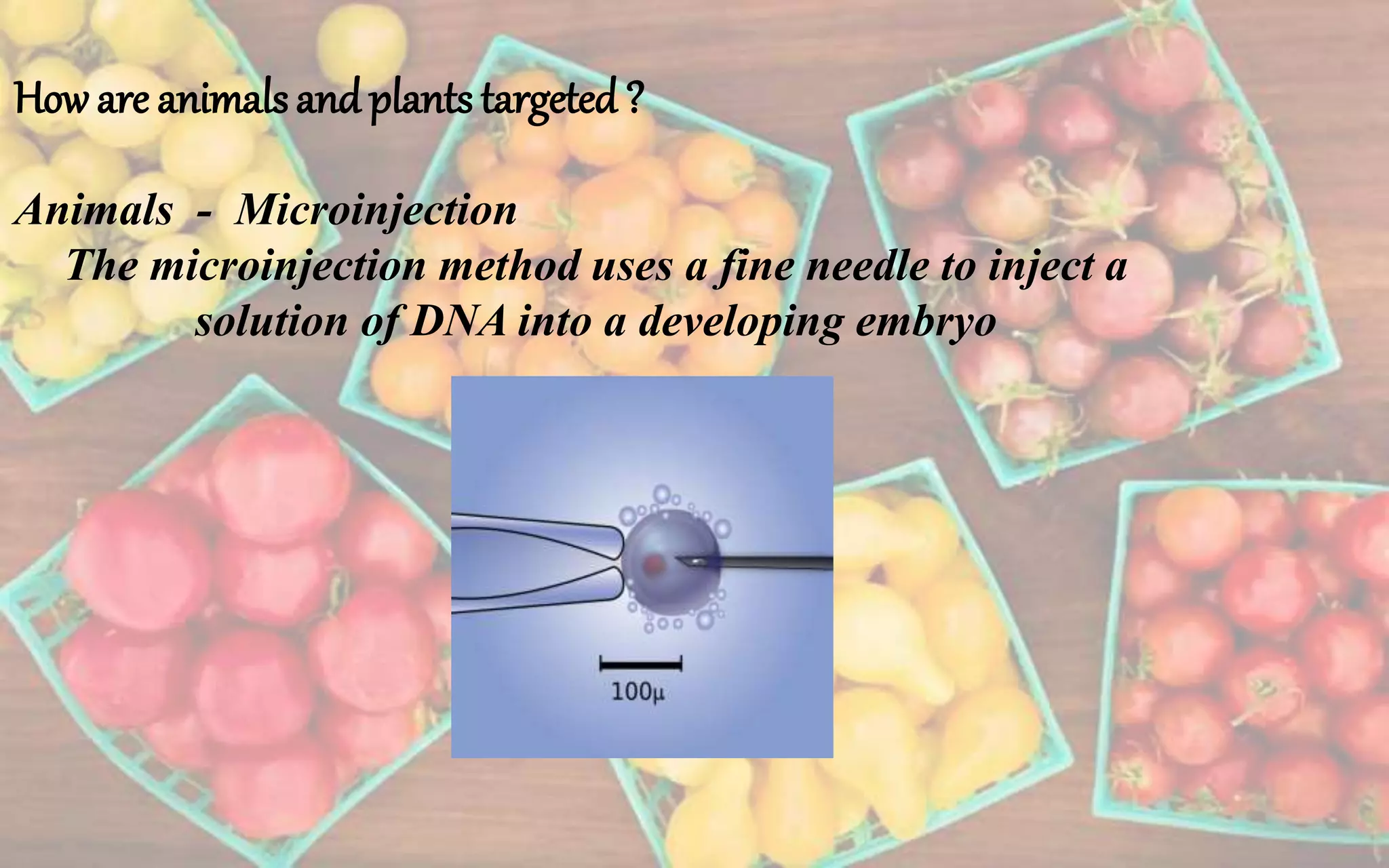
How are animalsand plants targeted ?
Animals - Microinjection
The microinjection method uses a fine needle to inject a
solution of DNA into a developing embryo
Plant- Agrobacterium that normally infects plants with
disease is used to infect plant with gene of interests .
A particle gun is used to shoot small bits of metal coated
with the gene into the plant.
Examples:
1. Golden Rice – genetic engineered crop
 It is capable of producing Beta- Carotene- precursor of vitamin A
 Developed by Ingo Potrukus (Sweden) and Peter Beyer (Germany)
 Two daffodil genes and one bacterial gene that carry out the
synthesis of Beta- carotene from Geranylgeranyl di phosphate
(GGDP), transferred to rice callus.
 Plants regenerated from such callus produce golden rice
 It contains all enzymes responsible for synthesis of beta carotene
from GGDP.
 Endosperm synthesizes.
 DE husked rice appears golden brown color- golden rice
 Consumed- synthesis of vitamin A
 Will reduce deficiency in people suffering from under nutrition.
 Reduce diarrhea, respiratory problems and measles.
Process:
benefits of gm foods
 Easing of world hunger
 Development of crops that can be grown in marginal soil.
 Reduced strain on non-renewable resources
 Development of drought resistant crops
 Development of salt-tolerant crops
 Development of crops that make more efficient use of nitrogen
and other nutrients
 Reduced use of pesticides and herbicides
 Development of pest resistant crops
 Reduced herbicide use is better for the environment and reduces
costs for farmers
Contd.
 Improved crop quality
 Development of frost resistant crops
 Development of disease resistant crops
 Development of flood resistant crops
 Improved nutritional quality
 Development of foods designed to meet specific
nutritional goals
Whomakes sure that gm foodsare safe?
Government agencies regulate gm foods
GM foods in US are required to be labeled only if the
nutritional value is changed or a new allergen is introduced.
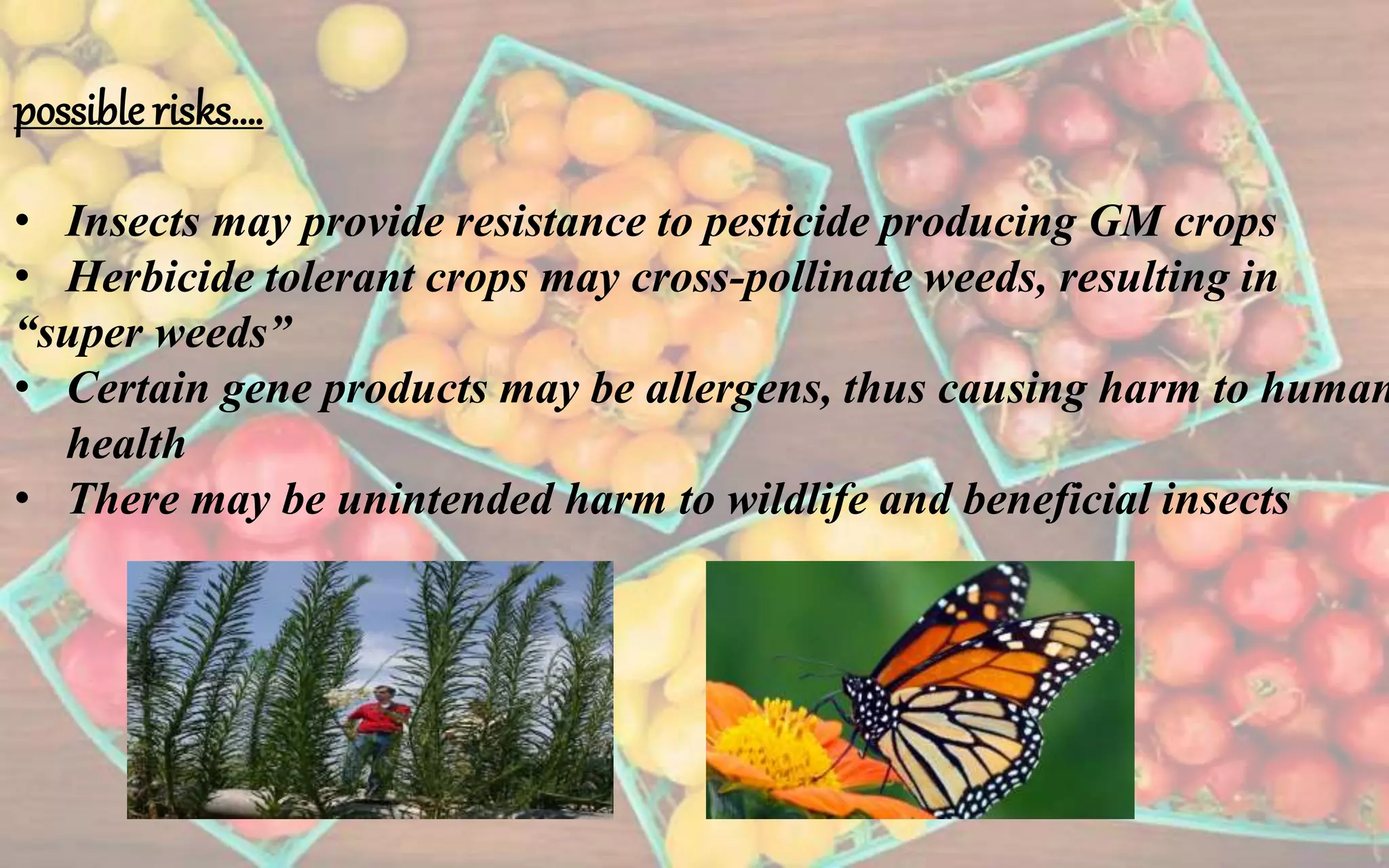
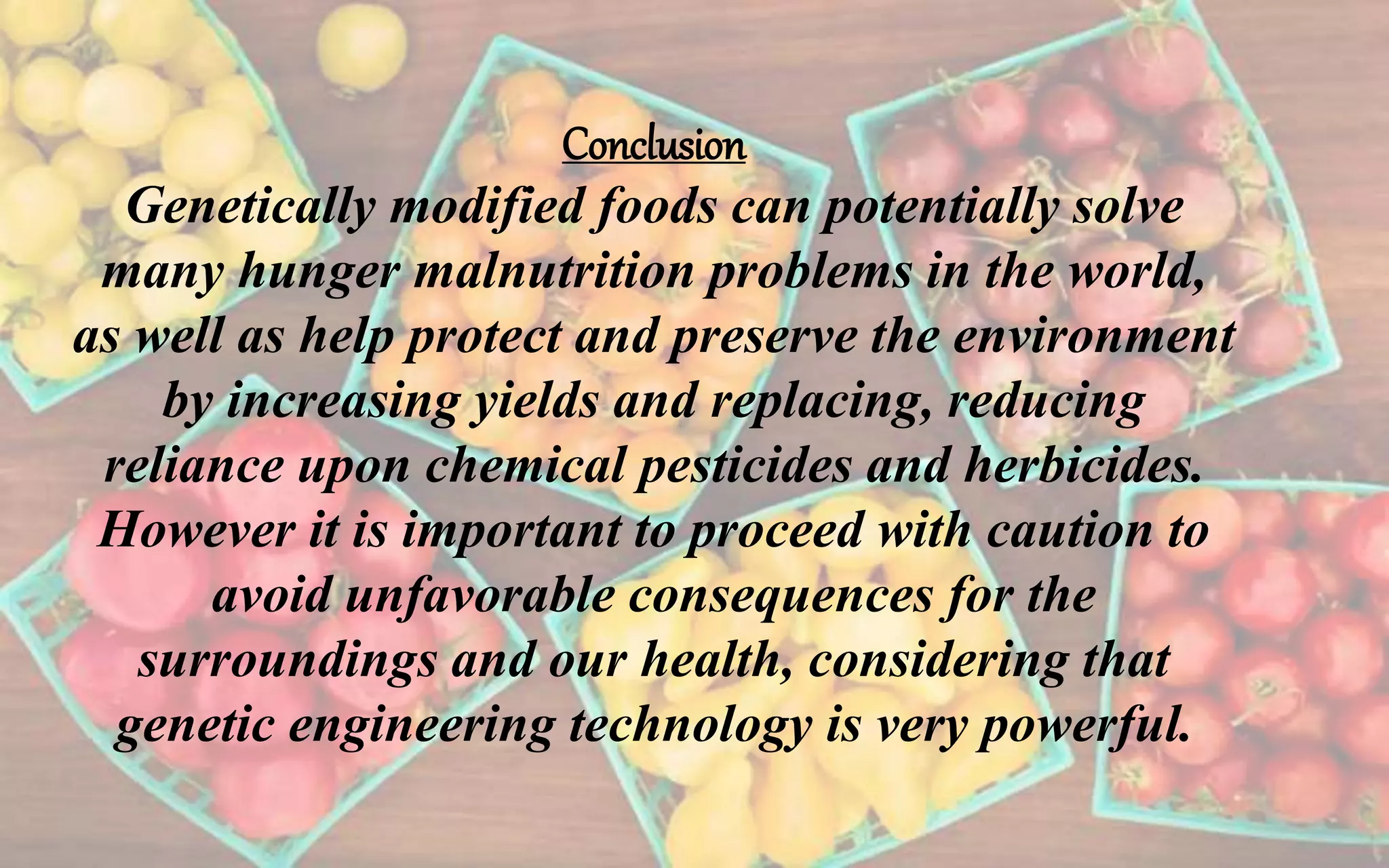
possible risks….
• Insects may provide resistance to pesticide producing GM crops
• Herbicide tolerant crops may cross-pollinate weeds, resulting in
“super weeds”
• Certain gene products may be allergens, thus causing harm to human
health
• There may be unintended harm to wildlife and beneficial insects
 ALLERGENICITY
 In India, hundreds of laborers picking cotton and working in
cotton ginning factories developed allergic reactions when
handling the BT cotton. This didn’t happen with the non-Bt
varieties. (investigation reports)
 Hospital records: “Show that victims of itching have increased
massively within years and all of them are related to BT cotton
farming”
Labeling
• GM Food labeling was introduced to give consumers the
freedom to choose between GMOs and conventional
products.
• Essentially, if a foodstuff is produced using genetic
engineering, this must be indicated on its label.
• Labeling empowers the buyer. In order to choose between
products with or without genetically modified organisms,
consumers need transparent, controllable and straight
forward labeling regulations.
• Labeling requirements: for neutral information only - not
for warning
Conclusion
Genetically modified foods can potentially solve
many hunger malnutrition problems in the world,
as well as help protect and preserve the environment
by increasing yields and replacing, reducing
reliance upon chemical pesticides and herbicides.
However it is important to proceed with caution to
avoid unfavorable consequences for the
surroundings and our health, considering that
genetic engineering technology is very powerful.
What's your decision ?
Genetically modified foods, Labelling

Genetically modified foods, Labelling

  • 1.
    GENETICALLY MODIFIED FOODS PresentedBy : Saritha Sadanandan Pillai 2nd MSc Biotechnology SAS SNDP Yogam College, Konni
  • 2.
    THINK FOR AWHILE….
  • 3.
    What do youmean by Genetically Modified ?  Containing a genetic material that has been artificially altered so as to produce a desired characteristic.
  • 4.
    GENETICALLY MODIFIEDFOODS • Geneticallymodified (GM) foods derived from organisms whose genetic material (DNA) has modified in a way that it does not occur naturally by introduction of a gene from a different organism. • It does not occur naturally. • GM foods are described in many different names:  Genetically Engineered crops  Transgenic or Biotech crops  Genetically modified organism (GMO)
  • 5.
  • 6.
    How the Genesare Modified ? By Recombinant DNA Technology – Steps- 1. Restriction enzymes used to cut DNA segments from a desired genome. 2. DNA ligases are used to paste the DNA segments on to the other genome. 3. Thus, we get a recombinant genome.
  • 7.
    History • 1988- firstgenetically modified enzymes. • 1990’s- Approval of first recombinant enzyme- Chymosin (rennet preparation) • 1994- first genetically modified food Flavr Savr Tomato, developed by Calgene. • 1995- first pesticide producing crop- Bacillus thureingenesis Potato (Bt Potato) – USA • 2006- Palmer amaranth – weed that competes with cotton. • 2015- first genetically modified animal- Aqua advantage Salmon The salmon were transformed with a growth hormone and a promoter from an ocean pout enabling it to grow year round instead of only during spring and summer.
  • 8.
    Process • GMO’s aregenerated and tested in the laboratory for desired qualities. • Modification- add, removed, expression is increased or silenced or number of copies of a gene is increased or decreased. • Satisfactory strains produced are applied for regulatory approval to field- test them (“Field release”). • Approved specimens (seeds, cuttings, breeding pairs etc.) are cultivated and sold to farmers. • The farmers cultivate and market the new strain.
  • 9.
    Manipulating the dna •The whole process of genetic modification consists of Manipulating the DNA. • It allows certain genes to be identified, copied and brought into other organisms in more specific ways. Modifying Plants and Animals • Plasmid is taken out from the bacteria and the clone gene is replaced with a restriction enzyme. • For animals this is done by injecting millions of copies of the gene into the nucleus of a fertilized egg. Modifying foods • Certain genes and chemicals are injected into food such as Bananas, to make it larger & for stay riper longer – Cisgenesis genes are artificially transferred.
  • 10.
    How are animalsandplants targeted ? Animals - Microinjection The microinjection method uses a fine needle to inject a solution of DNA into a developing embryo
  • 11.
    Plant- Agrobacterium thatnormally infects plants with disease is used to infect plant with gene of interests . A particle gun is used to shoot small bits of metal coated with the gene into the plant.
  • 12.
    Examples: 1. Golden Rice– genetic engineered crop  It is capable of producing Beta- Carotene- precursor of vitamin A  Developed by Ingo Potrukus (Sweden) and Peter Beyer (Germany)  Two daffodil genes and one bacterial gene that carry out the synthesis of Beta- carotene from Geranylgeranyl di phosphate (GGDP), transferred to rice callus.  Plants regenerated from such callus produce golden rice  It contains all enzymes responsible for synthesis of beta carotene from GGDP.  Endosperm synthesizes.  DE husked rice appears golden brown color- golden rice  Consumed- synthesis of vitamin A  Will reduce deficiency in people suffering from under nutrition.  Reduce diarrhea, respiratory problems and measles.
  • 13.
  • 15.
    benefits of gmfoods  Easing of world hunger  Development of crops that can be grown in marginal soil.  Reduced strain on non-renewable resources  Development of drought resistant crops  Development of salt-tolerant crops  Development of crops that make more efficient use of nitrogen and other nutrients  Reduced use of pesticides and herbicides  Development of pest resistant crops  Reduced herbicide use is better for the environment and reduces costs for farmers
  • 16.
    Contd.  Improved cropquality  Development of frost resistant crops  Development of disease resistant crops  Development of flood resistant crops  Improved nutritional quality  Development of foods designed to meet specific nutritional goals
  • 17.
    Whomakes sure thatgm foodsare safe? Government agencies regulate gm foods GM foods in US are required to be labeled only if the nutritional value is changed or a new allergen is introduced.
  • 18.
    possible risks…. • Insectsmay provide resistance to pesticide producing GM crops • Herbicide tolerant crops may cross-pollinate weeds, resulting in “super weeds” • Certain gene products may be allergens, thus causing harm to human health • There may be unintended harm to wildlife and beneficial insects
  • 19.
     ALLERGENICITY  InIndia, hundreds of laborers picking cotton and working in cotton ginning factories developed allergic reactions when handling the BT cotton. This didn’t happen with the non-Bt varieties. (investigation reports)  Hospital records: “Show that victims of itching have increased massively within years and all of them are related to BT cotton farming”
  • 21.
    Labeling • GM Foodlabeling was introduced to give consumers the freedom to choose between GMOs and conventional products. • Essentially, if a foodstuff is produced using genetic engineering, this must be indicated on its label. • Labeling empowers the buyer. In order to choose between products with or without genetically modified organisms, consumers need transparent, controllable and straight forward labeling regulations. • Labeling requirements: for neutral information only - not for warning
  • 25.
    Conclusion Genetically modified foodscan potentially solve many hunger malnutrition problems in the world, as well as help protect and preserve the environment by increasing yields and replacing, reducing reliance upon chemical pesticides and herbicides. However it is important to proceed with caution to avoid unfavorable consequences for the surroundings and our health, considering that genetic engineering technology is very powerful.
  • 27.