GlusterFS – Architecture & Roadmap
Vijay Bellur
GlusterFS co-maintainer
http://twitter.com/vbellur
05/17/16
Agenda
● What is GlusterFS?
● Architecture
● Integration
● Use Cases
● Future Directions
● Challenges
● Q&A
05/17/16
What is GlusterFS?
●
A general purpose scale-out distributed file system.
●
Aggregates storage exports over network interconnect to
provide a single unified namespace.
●
Filesystem is stackable and completely in userspace.
●
Layered on disk file systems that support extended
attributes.
05/17/16
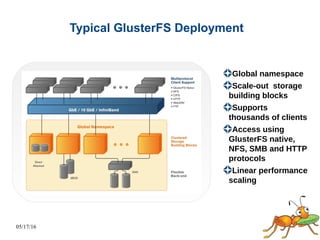
Typical GlusterFS Deployment
Global namespace
Scale-out storage
building blocks
Supports
thousands of clients
Access using
GlusterFS native,
NFS, SMB and HTTP
protocols
Linear performance
scaling
05/17/16
GlusterFS Architecture – Foundations
● Software only, runs on commodity hardware
● No external metadata servers
● Scale-out with Elasticity
● Extensible and modular
● Deployment agnostic
● Unified access
● Largely POSIX compliant
05/17/16
Concepts & Algorithms
05/17/16
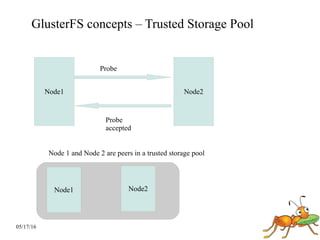
GlusterFS concepts – Trusted Storage Pool
●
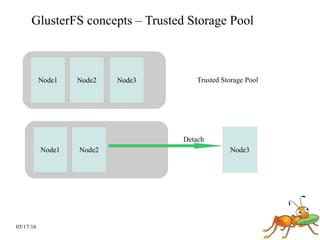
Trusted Storage Pool (cluster) is a collection of storage servers.
●
Trusted Storage Pool is formed by invitation – “probe” a new
member from the cluster and not vice versa.
●
Logical partition for all data and management operations.
●
Membership information used for determining quorum.
●
Members can be dynamically added and removed from the
pool.
05/17/16
GlusterFS concepts – Trusted Storage Pool
Node2
Probe
Probe
accepted
Node 1 and Node 2 are peers in a trusted storage pool
Node2Node1
Node1
05/17/16
GlusterFS concepts – Trusted Storage Pool
Node1 Node2 Node3Node2Node1 Trusted Storage Pool
Node3Node2Node1
Detach
05/17/16
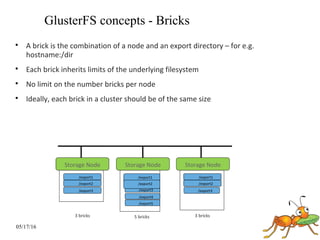

A brick is the combination of a node and an export directory – for e.g.
hostname:/dir

Each brick inherits limits of the underlying filesystem

No limit on the number bricks per node

Ideally, each brick in a cluster should be of the same size
/export3 /export3 /export3
Storage Node
/export1
Storage Node
/export2
/export1
/export2
/export4
/export5
Storage Node
/export1
/export2
3 bricks 5 bricks 3 bricks
GlusterFS concepts - Bricks
05/17/16
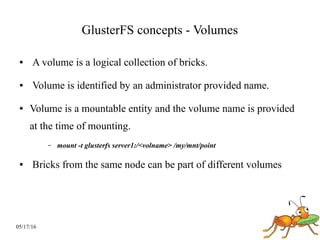
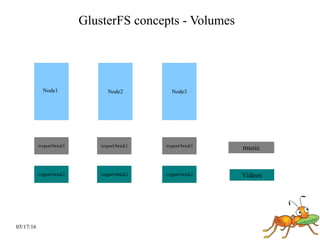
GlusterFS concepts - Volumes
● A volume is a logical collection of bricks.
● Volume is identified by an administrator provided name.
● Volume is a mountable entity and the volume name is provided
at the time of mounting.
– mount -t glusterfs server1:/<volname> /my/mnt/point
● Bricks from the same node can be part of different volumes
05/17/16
GlusterFS concepts - Volumes
Node2Node1 Node3
/export/brick1
/export/brick2
/export/brick1
/export/brick2
/export/brick1
/export/brick2
music
Videos
05/17/16
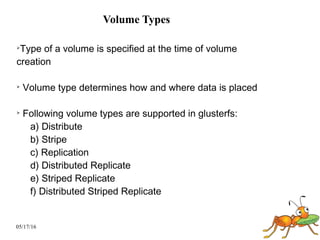
Volume Types
➢
Type of a volume is specified at the time of volume
creation
➢
Volume type determines how and where data is placed
➢
Following volume types are supported in glusterfs:
a) Distribute
b) Stripe
c) Replication
d) Distributed Replicate
e) Striped Replicate
f) Distributed Striped Replicate
05/17/16
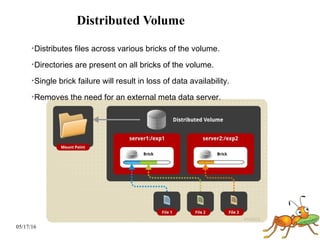
Distributed Volume
➢
Distributes files across various bricks of the volume.
➢
Directories are present on all bricks of the volume.
➢
Single brick failure will result in loss of data availability.
➢
Removes the need for an external meta data server.
05/17/16
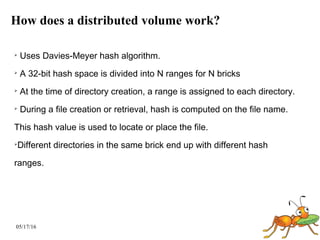
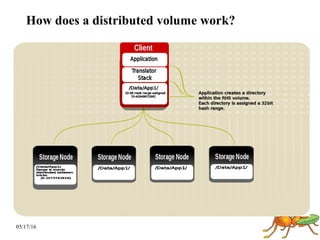
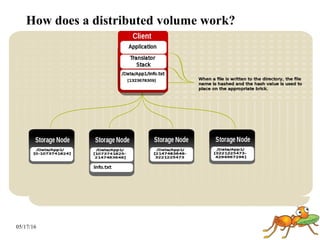
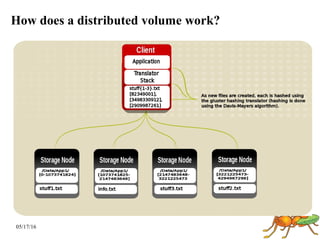
How does a distributed volume work?
➢
Uses Davies-Meyer hash algorithm.
➢
A 32-bit hash space is divided into N ranges for N bricks
➢
At the time of directory creation, a range is assigned to each directory.
➢
During a file creation or retrieval, hash is computed on the file name.
This hash value is used to locate or place the file.
➢
Different directories in the same brick end up with different hash
ranges.
05/17/16
How does a distributed volume work?
05/17/16
How does a distributed volume work?
05/17/16
How does a distributed volume work?
05/17/16
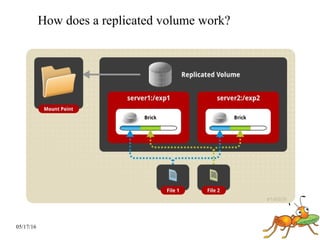
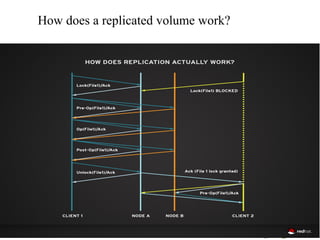
Replicated Volume
●
Synchronous replication of all directory and file updates.
●
Provides high availability of data when node failures occur.
●
Transaction driven for ensuring consistency.
●
Changelogs maintained for re-conciliation.
●
Any number of replicas can be configured.
05/17/16
How does a replicated volume work?
05/17/16
How does a replicated volume work?
05/17/16
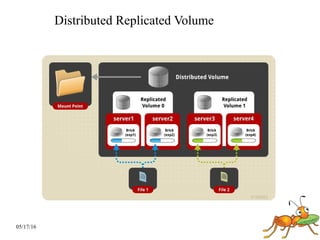
Distributed Replicated Volume
● Distribute files across replicated bricks
● Number of bricks must be a multiple of the replica count
● Ordering of bricks in volume definition matters
● Scaling and high availability
● Reads get load balanced.
● Most preferred model of deployment currently.
05/17/16
Distributed Replicated Volume
05/17/16
Striped Volume
●
Files are striped into chunks and placed in various bricks.
●
Recommended only when very large files greater than the size
of the disks are present.
●
Chunks are files with holes – this helps in maintaining offset
consistency.
●
A brick failure can result in data loss. Redundancy with
replication is highly recommended (striped replicated volumes).
05/17/16
Elastic Volume Management
Application transparent operations that can be performed in the
storage layer.
●
Addition of Bricks to a volume
●
Remove brick from a volume
●
Rebalance data spread within a volume
●
Replace a brick in a volume
●
Performance / Functionality tuning
05/17/16
Access Mechanisms
05/17/16
Access Mechanisms
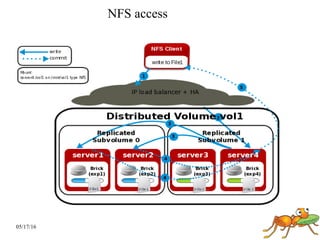
Gluster volumes can be accessed via the following mechanisms:
– FUSE based Native protocol
– NFSv3
– SMB
– libgfapi
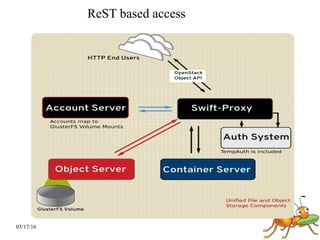
– ReST/HTTP
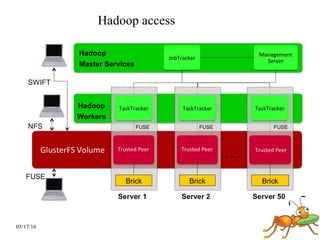
– HDFS
05/17/16
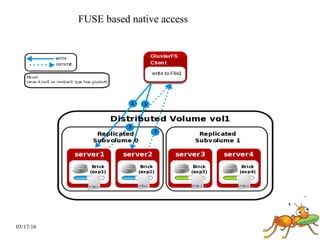
FUSE based native access
05/17/16
NFS access
05/17/16
libgfapi
●
Exposes APIs for accessing Gluster volumes.
●
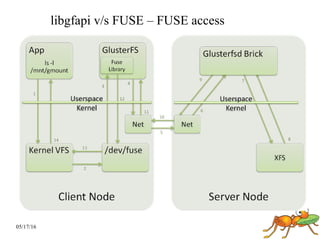
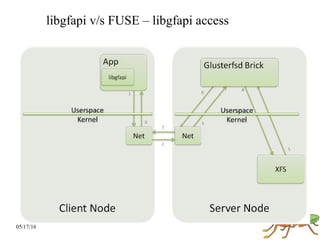
Reduces context switches.
●
qemu, samba, NFS Ganesha integrated with libgfapi.
●
Both sync and async interfaces available.
●
Emerging bindings for various languages.
05/17/16
libgfapi v/s FUSE – FUSE access
05/17/16
libgfapi v/s FUSE – libgfapi access
05/17/16
ReST based access
05/17/16
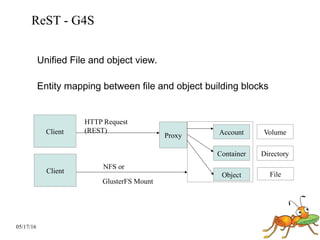
ReST - G4S
Client
Proxy Account
Container
Object
HTTP Request
(REST)
Directory
Volume
FileClient
NFS or
GlusterFS Mount
Unified File and object view.
Entity mapping between file and object building blocks
05/17/16
Hadoop access
05/17/16
Implementation
05/17/16
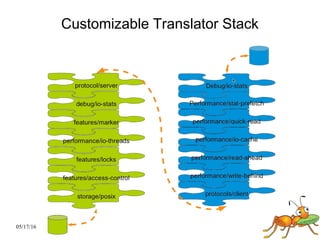
Translators in GlusterFS
●
Building blocks for a GlusterFS process.
●
Based on Translators in GNU HURD.
●
Each translator is a functional unit.
●
Translators can be stacked together for achieving
desired functionality.
●
Translators are deployment agnostic – can be loaded
in either the client or server stacks.
05/17/16
Customizable Translator Stack
05/17/16
Ecosystem Integration
05/17/16
Ecosystem Integration
●
Currently integrated with various ecosystems:
●
OpenStack
●
Samba
●
Ganesha
●
oVirt
●
qemu
●
Hadoop
●
pcp
●
Proxmox
●
uWSGI
05/17/16
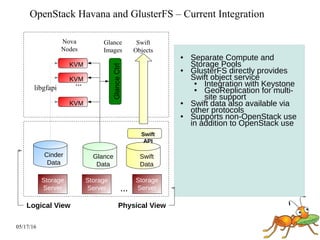
OpenStack Havana and GlusterFS – Current Integration
Glance
Images
Nova
Nodes
Swift
Objects
Cinder
Data
Glance
Data
Swift
Data
Swift
API
Storage
Server
Storage
Server
Storage
Server…
KVM
KVM
KVM
…
● Separate Compute and
Storage Pools
● GlusterFS directly provides
Swift object service
● Integration with Keystone
● GeoReplication for multi-
site support
● Swift data also available via
other protocols
● Supports non-OpenStack use
in addition to OpenStack use
Logical View Physical View
libgfapi
05/17/16
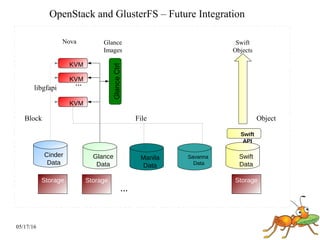
OpenStack and GlusterFS – Future Integration
Glance
Images
Nova Swift
Objects
Cinder
Data
Glance
Data
Swift
Data
Swift
API
Storage Storage Storage
…
KVM
KVM
KVM
…
libgfapi
Glance
Data
Manila
Data
Savanna
Data
FileBlock Object
05/17/16
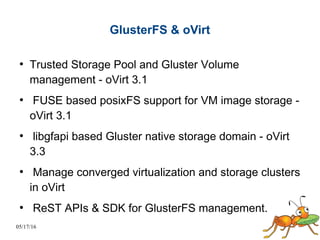
GlusterFS & oVirt
●
Trusted Storage Pool and Gluster Volume
management - oVirt 3.1
●
FUSE based posixFS support for VM image storage -
oVirt 3.1
●
libgfapi based Gluster native storage domain - oVirt
3.3
●
Manage converged virtualization and storage clusters
in oVirt
●
ReST APIs & SDK for GlusterFS management.
05/17/16
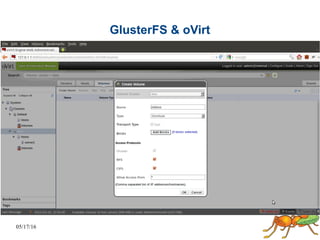
GlusterFS & oVirt
05/17/16
Use Cases - current
● Unstructured data storage
● Archival
● Disaster Recovery
● Virtual Machine Image Store
● Cloud Storage for Service Providers
● Content Cloud
● Big Data
● Semi-structured & Structured data
05/17/16
Future Directions
05/17/16
New Features in GlusterFS 3.5
● Distributed geo-replication
● File snapshots
● Compression translator
● Multi-brick Block Device volumes
● Readdir ahead translator
● Quota Scalability
05/17/16
Beta Features in GlusterFS 3.5
● Disperse translator for Erasure Coding
● Encryption at rest
● Support for bricks on Btrfs
● libgfapi support for NFS Ganesha (NFS v4)
05/17/16
Geo-replication in 3.5
●
Before 3.5
➢
Merkle tree based optimal volume crawling
➢
Single driver on the master
➢
SPOF
●
In 3.5
➢
Based on changelog
➢
One driver per replica set on the master
➢
No SPOF
05/17/16
Quota in 3.5
● Before 3.5
– Client side enforcement
– Configuration in volume files would block scalability
– GFID accesses could cause incorrect accounting
– Only hard quota supported
● In 3.5
– Server side enforcement
– Better configuration management for scalability.
– GFID to path conversion enables correct accounting.
– Both hard and soft quotas supported
05/17/16
Prominent Features beyond GlusterFS 3.5
●
Volume snapshots
●
New Style Replication
●
pNFS access with NFS Ganesha
●
Data tiering / HSM
●
Multi master geo-replication
●
Support Btrfs features
●
Caching improvements
●
libgfchangelog
●
and more...
05/17/16
Challenges
● Scalability – 1024 nodes, 72 brontobytes?
● Hard links
● Rename
● Monolithic tools
● Monitoring
● Reduce Capex and Opex
05/17/16
Resources
Mailing lists:
gluster-users@gluster.org
gluster-devel@nongnu.org
IRC:
#gluster and #gluster-dev on freenode
Links:
http://www.gluster.org
http://hekafs.org
http://forge.gluster.org
http://www.gluster.org/community/documentation/index.php/Arch
Thank you!
Vijay Bellur
vbellur at redhat dot com

GlusterFs Architecture & Roadmap - LinuxCon EU 2013

  • 1.
    GlusterFS – Architecture& Roadmap Vijay Bellur GlusterFS co-maintainer http://twitter.com/vbellur
  • 2.
    05/17/16 Agenda ● What isGlusterFS? ● Architecture ● Integration ● Use Cases ● Future Directions ● Challenges ● Q&A
  • 3.
    05/17/16 What is GlusterFS? ● Ageneral purpose scale-out distributed file system. ● Aggregates storage exports over network interconnect to provide a single unified namespace. ● Filesystem is stackable and completely in userspace. ● Layered on disk file systems that support extended attributes.
  • 4.
    05/17/16 Typical GlusterFS Deployment Globalnamespace Scale-out storage building blocks Supports thousands of clients Access using GlusterFS native, NFS, SMB and HTTP protocols Linear performance scaling
  • 5.
    05/17/16 GlusterFS Architecture –Foundations ● Software only, runs on commodity hardware ● No external metadata servers ● Scale-out with Elasticity ● Extensible and modular ● Deployment agnostic ● Unified access ● Largely POSIX compliant
  • 6.
  • 7.
    05/17/16 GlusterFS concepts –Trusted Storage Pool ● Trusted Storage Pool (cluster) is a collection of storage servers. ● Trusted Storage Pool is formed by invitation – “probe” a new member from the cluster and not vice versa. ● Logical partition for all data and management operations. ● Membership information used for determining quorum. ● Members can be dynamically added and removed from the pool.
  • 8.
    05/17/16 GlusterFS concepts –Trusted Storage Pool Node2 Probe Probe accepted Node 1 and Node 2 are peers in a trusted storage pool Node2Node1 Node1
  • 9.
    05/17/16 GlusterFS concepts –Trusted Storage Pool Node1 Node2 Node3Node2Node1 Trusted Storage Pool Node3Node2Node1 Detach
  • 10.
    05/17/16  A brick isthe combination of a node and an export directory – for e.g. hostname:/dir  Each brick inherits limits of the underlying filesystem  No limit on the number bricks per node  Ideally, each brick in a cluster should be of the same size /export3 /export3 /export3 Storage Node /export1 Storage Node /export2 /export1 /export2 /export4 /export5 Storage Node /export1 /export2 3 bricks 5 bricks 3 bricks GlusterFS concepts - Bricks
  • 11.
    05/17/16 GlusterFS concepts -Volumes ● A volume is a logical collection of bricks. ● Volume is identified by an administrator provided name. ● Volume is a mountable entity and the volume name is provided at the time of mounting. – mount -t glusterfs server1:/<volname> /my/mnt/point ● Bricks from the same node can be part of different volumes
  • 12.
    05/17/16 GlusterFS concepts -Volumes Node2Node1 Node3 /export/brick1 /export/brick2 /export/brick1 /export/brick2 /export/brick1 /export/brick2 music Videos
  • 13.
    05/17/16 Volume Types ➢ Type ofa volume is specified at the time of volume creation ➢ Volume type determines how and where data is placed ➢ Following volume types are supported in glusterfs: a) Distribute b) Stripe c) Replication d) Distributed Replicate e) Striped Replicate f) Distributed Striped Replicate
  • 14.
    05/17/16 Distributed Volume ➢ Distributes filesacross various bricks of the volume. ➢ Directories are present on all bricks of the volume. ➢ Single brick failure will result in loss of data availability. ➢ Removes the need for an external meta data server.
  • 15.
    05/17/16 How does adistributed volume work? ➢ Uses Davies-Meyer hash algorithm. ➢ A 32-bit hash space is divided into N ranges for N bricks ➢ At the time of directory creation, a range is assigned to each directory. ➢ During a file creation or retrieval, hash is computed on the file name. This hash value is used to locate or place the file. ➢ Different directories in the same brick end up with different hash ranges.
  • 16.
    05/17/16 How does adistributed volume work?
  • 17.
    05/17/16 How does adistributed volume work?
  • 18.
    05/17/16 How does adistributed volume work?
  • 19.
    05/17/16 Replicated Volume ● Synchronous replicationof all directory and file updates. ● Provides high availability of data when node failures occur. ● Transaction driven for ensuring consistency. ● Changelogs maintained for re-conciliation. ● Any number of replicas can be configured.
  • 20.
    05/17/16 How does areplicated volume work?
  • 21.
    05/17/16 How does areplicated volume work?
  • 22.
    05/17/16 Distributed Replicated Volume ●Distribute files across replicated bricks ● Number of bricks must be a multiple of the replica count ● Ordering of bricks in volume definition matters ● Scaling and high availability ● Reads get load balanced. ● Most preferred model of deployment currently.
  • 23.
  • 24.
    05/17/16 Striped Volume ● Files arestriped into chunks and placed in various bricks. ● Recommended only when very large files greater than the size of the disks are present. ● Chunks are files with holes – this helps in maintaining offset consistency. ● A brick failure can result in data loss. Redundancy with replication is highly recommended (striped replicated volumes).
  • 25.
    05/17/16 Elastic Volume Management Applicationtransparent operations that can be performed in the storage layer. ● Addition of Bricks to a volume ● Remove brick from a volume ● Rebalance data spread within a volume ● Replace a brick in a volume ● Performance / Functionality tuning
  • 26.
  • 27.
    05/17/16 Access Mechanisms Gluster volumescan be accessed via the following mechanisms: – FUSE based Native protocol – NFSv3 – SMB – libgfapi – ReST/HTTP – HDFS
  • 28.
  • 29.
  • 30.
    05/17/16 libgfapi ● Exposes APIs foraccessing Gluster volumes. ● Reduces context switches. ● qemu, samba, NFS Ganesha integrated with libgfapi. ● Both sync and async interfaces available. ● Emerging bindings for various languages.
  • 31.
  • 32.
    05/17/16 libgfapi v/s FUSE– libgfapi access
  • 33.
  • 34.
    05/17/16 ReST - G4S Client ProxyAccount Container Object HTTP Request (REST) Directory Volume FileClient NFS or GlusterFS Mount Unified File and object view. Entity mapping between file and object building blocks
  • 35.
  • 36.
  • 37.
    05/17/16 Translators in GlusterFS ● Buildingblocks for a GlusterFS process. ● Based on Translators in GNU HURD. ● Each translator is a functional unit. ● Translators can be stacked together for achieving desired functionality. ● Translators are deployment agnostic – can be loaded in either the client or server stacks.
  • 38.
  • 39.
  • 40.
    05/17/16 Ecosystem Integration ● Currently integratedwith various ecosystems: ● OpenStack ● Samba ● Ganesha ● oVirt ● qemu ● Hadoop ● pcp ● Proxmox ● uWSGI
  • 41.
    05/17/16 OpenStack Havana andGlusterFS – Current Integration Glance Images Nova Nodes Swift Objects Cinder Data Glance Data Swift Data Swift API Storage Server Storage Server Storage Server… KVM KVM KVM … ● Separate Compute and Storage Pools ● GlusterFS directly provides Swift object service ● Integration with Keystone ● GeoReplication for multi- site support ● Swift data also available via other protocols ● Supports non-OpenStack use in addition to OpenStack use Logical View Physical View libgfapi
  • 42.
    05/17/16 OpenStack and GlusterFS– Future Integration Glance Images Nova Swift Objects Cinder Data Glance Data Swift Data Swift API Storage Storage Storage … KVM KVM KVM … libgfapi Glance Data Manila Data Savanna Data FileBlock Object
  • 43.
    05/17/16 GlusterFS & oVirt ● TrustedStorage Pool and Gluster Volume management - oVirt 3.1 ● FUSE based posixFS support for VM image storage - oVirt 3.1 ● libgfapi based Gluster native storage domain - oVirt 3.3 ● Manage converged virtualization and storage clusters in oVirt ● ReST APIs & SDK for GlusterFS management.
  • 44.
  • 45.
    05/17/16 Use Cases -current ● Unstructured data storage ● Archival ● Disaster Recovery ● Virtual Machine Image Store ● Cloud Storage for Service Providers ● Content Cloud ● Big Data ● Semi-structured & Structured data
  • 46.
  • 47.
    05/17/16 New Features inGlusterFS 3.5 ● Distributed geo-replication ● File snapshots ● Compression translator ● Multi-brick Block Device volumes ● Readdir ahead translator ● Quota Scalability
  • 48.
    05/17/16 Beta Features inGlusterFS 3.5 ● Disperse translator for Erasure Coding ● Encryption at rest ● Support for bricks on Btrfs ● libgfapi support for NFS Ganesha (NFS v4)
  • 49.
    05/17/16 Geo-replication in 3.5 ● Before3.5 ➢ Merkle tree based optimal volume crawling ➢ Single driver on the master ➢ SPOF ● In 3.5 ➢ Based on changelog ➢ One driver per replica set on the master ➢ No SPOF
  • 50.
    05/17/16 Quota in 3.5 ●Before 3.5 – Client side enforcement – Configuration in volume files would block scalability – GFID accesses could cause incorrect accounting – Only hard quota supported ● In 3.5 – Server side enforcement – Better configuration management for scalability. – GFID to path conversion enables correct accounting. – Both hard and soft quotas supported
  • 51.
    05/17/16 Prominent Features beyondGlusterFS 3.5 ● Volume snapshots ● New Style Replication ● pNFS access with NFS Ganesha ● Data tiering / HSM ● Multi master geo-replication ● Support Btrfs features ● Caching improvements ● libgfchangelog ● and more...
  • 52.
    05/17/16 Challenges ● Scalability –1024 nodes, 72 brontobytes? ● Hard links ● Rename ● Monolithic tools ● Monitoring ● Reduce Capex and Opex
  • 53.
    05/17/16 Resources Mailing lists: gluster-users@gluster.org gluster-devel@nongnu.org IRC: #gluster and#gluster-dev on freenode Links: http://www.gluster.org http://hekafs.org http://forge.gluster.org http://www.gluster.org/community/documentation/index.php/Arch
  • 54.