GlusterFS & OpenStack
Vijay Bellur
Red Hat
Agenda
➢ What is GlusterFS?
➢ Architecture
➢ Concepts
➢ Algorithms
➢ Access Mechanisms
➢ Implementation
➢ OpenStack and GlusterFS
➢Resources
➢ Q&A
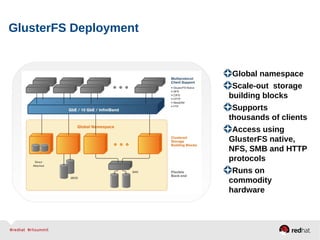
GlusterFS Deployment
Global namespace
Scale-out storage
building blocks
Supports
thousands of clients
Access using
GlusterFS native,
NFS, SMB and HTTP
protocols
Runs on
commodity
hardware
GlusterFS concepts

Trusted Storage Pool (cluster) is a collection of storage
servers.

Trusted Storage Pool is formed by invitation – you
“probe” a new member from the cluster and not vice
versa.

Logical partition for all data and management
operations.

Membership information used for determining quorum.

Members can be dynamically added and removed from
the pool.
GlusterFS concepts – Trusted Storage Pool
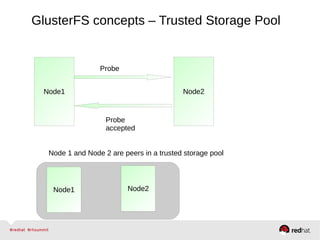
Node1 Node2
Probe
Probe
accepted
Node 1 and Node 2 are peers in a trusted storage pool
Node2Node1
GlusterFS concepts – Trusted Storage Pool
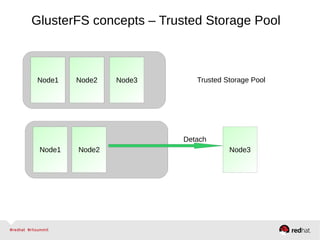
Node1 Node2 Node3Node2Node1 Trusted Storage Pool
Node3Node2Node1
Detach

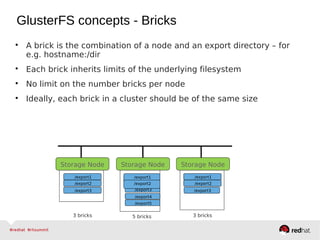
A brick is the combination of a node and an export directory – for
e.g. hostname:/dir

Each brick inherits limits of the underlying filesystem

No limit on the number bricks per node

Ideally, each brick in a cluster should be of the same size
/export3 /export3 /export3
Storage Node
/export1
Storage Node
/export2
/export1
/export2
/export4
/export5
Storage Node
/export1
/export2
3 bricks 5 bricks 3 bricks
GlusterFS concepts - Bricks
GlusterFS concepts - Volumes
➢ A volume is a logical collection of bricks.
➢ Volume is identified by an administrator provided name.
➢Volume is a mountable entity and the volume name is
provided at the time of mounting.
➢ mount -t glusterfs server1:/<volname> /my/mnt/point
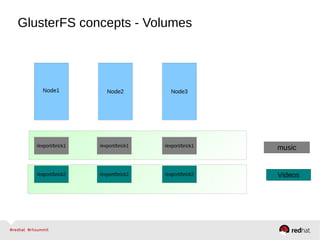
➢ Bricks from the same node can be part of different
volumes
GlusterFS concepts - Volumes
Node2Node1 Node3
/export/brick1
/export/brick2
/export/brick1
/export/brick2
/export/brick1
/export/brick2 Videos
music
Volume Types
➢Type of a volume is specified at the time of volume
creation
➢ Volume type determines how and where data is placed
➢ Following volume types are supported in glusterfs:
a) Distribute
b) Stripe
c) Replication
d) Distributed Replicate
e) Striped Replicate
f) Distributed Striped Replicate
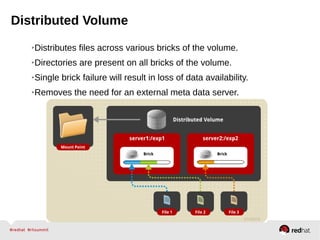
Distributed Volume
➢Distributes files across various bricks of the volume.
➢Directories are present on all bricks of the volume.
➢Single brick failure will result in loss of data availability.
➢Removes the need for an external meta data server.
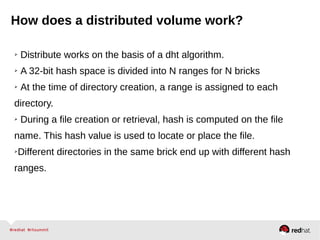
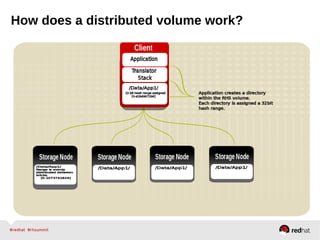
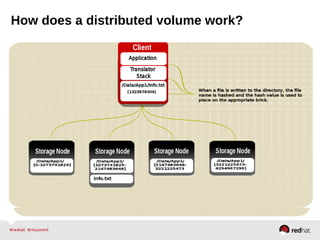
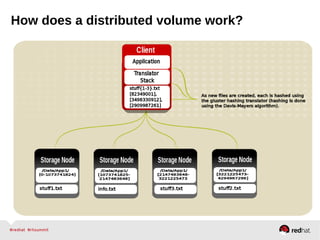
How does a distributed volume work?
➢ Distribute works on the basis of a dht algorithm.
➢ A 32-bit hash space is divided into N ranges for N bricks
➢ At the time of directory creation, a range is assigned to each
directory.
➢ During a file creation or retrieval, hash is computed on the file
name. This hash value is used to locate or place the file.
➢Different directories in the same brick end up with different hash
ranges.
How does a distributed volume work?
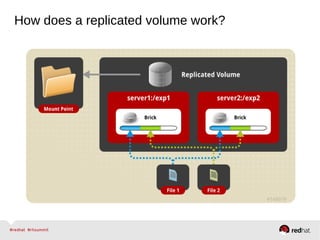
Replicated Volume
➢Creates synchronous copies of all directory and file
updates.
➢Provides high availability of data when node failures
occur.
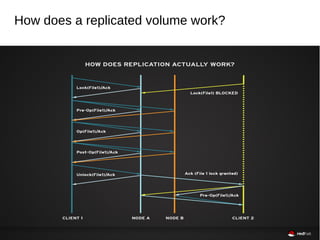
➢Transaction driven for ensuring consistency.
➢Changelogs maintained for re-conciliation.
➢Any number of replicas can be configured.
How does a replicated volume work?
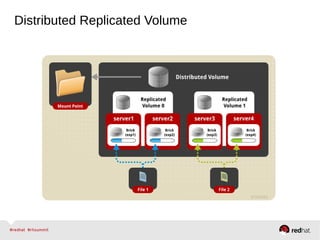
Distributed Replicated Volume
➢
Distribute files across replicated bricks
➢
Number of bricks must be a multiple of the replica count
➢
Ordering of bricks in volume definition matters
➢
Scaling and high reliability
➢
Improved read performance in most environments.
➢
Most preferred model of deployment currently.
Distributed Replicated Volume
Striped Volume
➢Files are striped into chunks and placed in various bricks.
➢Recommended only when very large files greater than
the size of the disks are present.
➢Chunks are files with holes – this helps in maintaining
offset consistency.
➢A brick failure can result in data loss. Redundancy with
replication is highly recommended
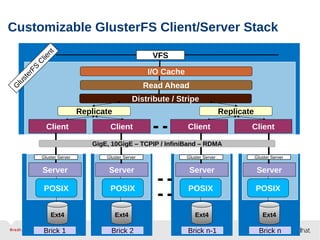
Translators in GlusterFS
➢Building blocks for a GlusterFS process.
➢Based on Translators in GNU HURD.
➢Each translator is a functional unit.
➢Translators can be stacked together for
achieving desired functionality.
➢ Translators are deployment agnostic – can
be loaded in either the client or server stacks.
VFS
Server
I/O Cache
Distribute / Stripe
POSIX
Ext4 Ext4Ext4
POSIX POSIX
Brick 1
ServerServer
Read Ahead
Brick 2 Brick n-1
Gluster Server
Replicate
Ext4
POSIX
Server
Brick n
Replicate
Customizable GlusterFS Client/Server Stack
Client
Gluster Server
Client
GigE, 10GigE – TCPIP / InfiniBand – RDMA
Gluster ServerGluster Server
Client Client
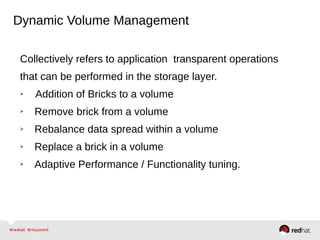
Dynamic Volume Management
Collectively refers to application transparent operations
that can be performed in the storage layer.
➢ Addition of Bricks to a volume
➢ Remove brick from a volume
➢ Rebalance data spread within a volume
➢ Replace a brick in a volume
➢ Adaptive Performance / Functionality tuning.
Access Mechanisms:
Gluster volumes can be accessed via the following
mechanisms:
➢ FUSE
➢ NFS
➢ SMB
➢ libgfapi
➢ ReST
➢ HDFS
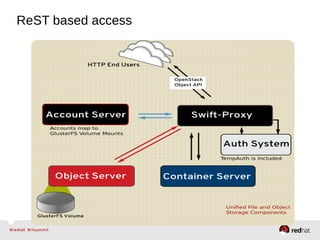
ReST based access
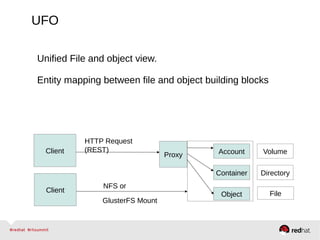
UFO
Client
Proxy Account
Container
Object
HTTP Request
(REST)
Directory
Volume
FileClient
NFS or
GlusterFS Mount
Unified File and object view.
Entity mapping between file and object building blocks
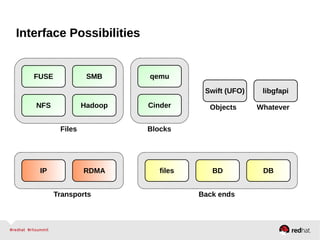
Interface Possibilities
qemu
NFS
SMB
Hadoop
FUSE
Cinder
Swift (UFO)
Files Blocks
Objects
libgfapi
Whatever
IP RDMA
Transports
files BD
Back ends
DB
Interface Possibilities
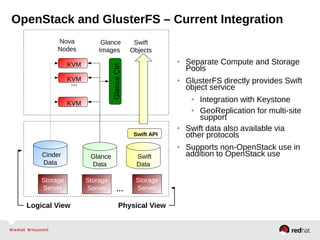
OpenStack and GlusterFS – Current Integration
Glance
Images
Nova
Nodes
Swift
Objects
Cinder
Data
Glance
Data
Swift
Data
Swift API
Storage
Server
Storage
Server
Storage
Server…
KVM
KVM
KVM
…
● Separate Compute and Storage
Pools
● GlusterFS directly provides Swift
object service
● Integration with Keystone
● GeoReplication for multi-site
support
● Swift data also available via
other protocols
● Supports non-OpenStack use in
addition to OpenStack use
Logical View Physical View
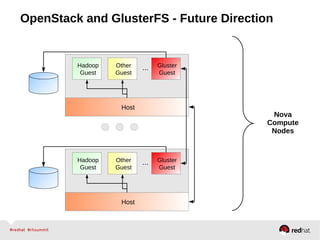
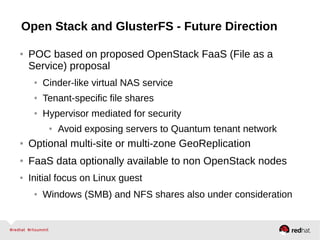
OpenStack and GlusterFS - Future Direction
Hadoop
Guest
Other
Guest
...
Host
Gluster
Guest
Hadoop
Guest
Other
Guest
...
Host
Gluster
Guest
Nova
Compute
Nodes
Open Stack and GlusterFS - Future Direction
● POC based on proposed OpenStack FaaS (File as a
Service) proposal
● Cinder-like virtual NAS service
● Tenant-specific file shares
● Hypervisor mediated for security
● Avoid exposing servers to Quantum tenant network
● Optional multi-site or multi-zone GeoReplication
● FaaS data optionally available to non OpenStack nodes
● Initial focus on Linux guest
● Windows (SMB) and NFS shares also under consideration
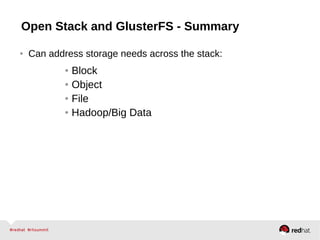
Open Stack and GlusterFS - Summary
● Can address storage needs across the stack:
● Block
● Object
● File
● Hadoop/Big Data
Resources
Mailing lists:
gluster-users@gluster.org
gluster-devel@nongnu.org
IRC:
#gluster and #gluster-dev on freenode
Links:
http://www.gluster.org
http://hekafs.org
http://forge.gluster.org
http://www.gluster.org/community/documentation/index.php/Arch
Questions?
Thank You!

Glusterfs and openstack

  • 1.
  • 2.
    Agenda ➢ What isGlusterFS? ➢ Architecture ➢ Concepts ➢ Algorithms ➢ Access Mechanisms ➢ Implementation ➢ OpenStack and GlusterFS ➢Resources ➢ Q&A
  • 3.
    GlusterFS Deployment Global namespace Scale-outstorage building blocks Supports thousands of clients Access using GlusterFS native, NFS, SMB and HTTP protocols Runs on commodity hardware
  • 4.
  • 5.
     Trusted Storage Pool(cluster) is a collection of storage servers.  Trusted Storage Pool is formed by invitation – you “probe” a new member from the cluster and not vice versa.  Logical partition for all data and management operations.  Membership information used for determining quorum.  Members can be dynamically added and removed from the pool. GlusterFS concepts – Trusted Storage Pool
  • 6.
    GlusterFS concepts –Trusted Storage Pool Node1 Node2 Probe Probe accepted Node 1 and Node 2 are peers in a trusted storage pool Node2Node1
  • 7.
    GlusterFS concepts –Trusted Storage Pool Node1 Node2 Node3Node2Node1 Trusted Storage Pool Node3Node2Node1 Detach
  • 8.
     A brick isthe combination of a node and an export directory – for e.g. hostname:/dir  Each brick inherits limits of the underlying filesystem  No limit on the number bricks per node  Ideally, each brick in a cluster should be of the same size /export3 /export3 /export3 Storage Node /export1 Storage Node /export2 /export1 /export2 /export4 /export5 Storage Node /export1 /export2 3 bricks 5 bricks 3 bricks GlusterFS concepts - Bricks
  • 9.
    GlusterFS concepts -Volumes ➢ A volume is a logical collection of bricks. ➢ Volume is identified by an administrator provided name. ➢Volume is a mountable entity and the volume name is provided at the time of mounting. ➢ mount -t glusterfs server1:/<volname> /my/mnt/point ➢ Bricks from the same node can be part of different volumes
  • 10.
    GlusterFS concepts -Volumes Node2Node1 Node3 /export/brick1 /export/brick2 /export/brick1 /export/brick2 /export/brick1 /export/brick2 Videos music
  • 11.
    Volume Types ➢Type ofa volume is specified at the time of volume creation ➢ Volume type determines how and where data is placed ➢ Following volume types are supported in glusterfs: a) Distribute b) Stripe c) Replication d) Distributed Replicate e) Striped Replicate f) Distributed Striped Replicate
  • 12.
    Distributed Volume ➢Distributes filesacross various bricks of the volume. ➢Directories are present on all bricks of the volume. ➢Single brick failure will result in loss of data availability. ➢Removes the need for an external meta data server.
  • 13.
    How does adistributed volume work? ➢ Distribute works on the basis of a dht algorithm. ➢ A 32-bit hash space is divided into N ranges for N bricks ➢ At the time of directory creation, a range is assigned to each directory. ➢ During a file creation or retrieval, hash is computed on the file name. This hash value is used to locate or place the file. ➢Different directories in the same brick end up with different hash ranges.
  • 14.
    How does adistributed volume work?
  • 15.
    How does adistributed volume work?
  • 16.
    How does adistributed volume work?
  • 17.
    Replicated Volume ➢Creates synchronouscopies of all directory and file updates. ➢Provides high availability of data when node failures occur. ➢Transaction driven for ensuring consistency. ➢Changelogs maintained for re-conciliation. ➢Any number of replicas can be configured.
  • 18.
    How does areplicated volume work?
  • 19.
    How does areplicated volume work?
  • 20.
    Distributed Replicated Volume ➢ Distributefiles across replicated bricks ➢ Number of bricks must be a multiple of the replica count ➢ Ordering of bricks in volume definition matters ➢ Scaling and high reliability ➢ Improved read performance in most environments. ➢ Most preferred model of deployment currently.
  • 21.
  • 22.
    Striped Volume ➢Files arestriped into chunks and placed in various bricks. ➢Recommended only when very large files greater than the size of the disks are present. ➢Chunks are files with holes – this helps in maintaining offset consistency. ➢A brick failure can result in data loss. Redundancy with replication is highly recommended
  • 23.
    Translators in GlusterFS ➢Buildingblocks for a GlusterFS process. ➢Based on Translators in GNU HURD. ➢Each translator is a functional unit. ➢Translators can be stacked together for achieving desired functionality. ➢ Translators are deployment agnostic – can be loaded in either the client or server stacks.
  • 24.
    VFS Server I/O Cache Distribute /Stripe POSIX Ext4 Ext4Ext4 POSIX POSIX Brick 1 ServerServer Read Ahead Brick 2 Brick n-1 Gluster Server Replicate Ext4 POSIX Server Brick n Replicate Customizable GlusterFS Client/Server Stack Client Gluster Server Client GigE, 10GigE – TCPIP / InfiniBand – RDMA Gluster ServerGluster Server Client Client
  • 25.
    Dynamic Volume Management Collectivelyrefers to application transparent operations that can be performed in the storage layer. ➢ Addition of Bricks to a volume ➢ Remove brick from a volume ➢ Rebalance data spread within a volume ➢ Replace a brick in a volume ➢ Adaptive Performance / Functionality tuning.
  • 26.
    Access Mechanisms: Gluster volumescan be accessed via the following mechanisms: ➢ FUSE ➢ NFS ➢ SMB ➢ libgfapi ➢ ReST ➢ HDFS
  • 27.
  • 28.
    UFO Client Proxy Account Container Object HTTP Request (REST) Directory Volume FileClient NFSor GlusterFS Mount Unified File and object view. Entity mapping between file and object building blocks
  • 29.
    Interface Possibilities qemu NFS SMB Hadoop FUSE Cinder Swift (UFO) FilesBlocks Objects libgfapi Whatever IP RDMA Transports files BD Back ends DB Interface Possibilities
  • 30.
    OpenStack and GlusterFS– Current Integration Glance Images Nova Nodes Swift Objects Cinder Data Glance Data Swift Data Swift API Storage Server Storage Server Storage Server… KVM KVM KVM … ● Separate Compute and Storage Pools ● GlusterFS directly provides Swift object service ● Integration with Keystone ● GeoReplication for multi-site support ● Swift data also available via other protocols ● Supports non-OpenStack use in addition to OpenStack use Logical View Physical View
  • 31.
    OpenStack and GlusterFS- Future Direction Hadoop Guest Other Guest ... Host Gluster Guest Hadoop Guest Other Guest ... Host Gluster Guest Nova Compute Nodes
  • 32.
    Open Stack andGlusterFS - Future Direction ● POC based on proposed OpenStack FaaS (File as a Service) proposal ● Cinder-like virtual NAS service ● Tenant-specific file shares ● Hypervisor mediated for security ● Avoid exposing servers to Quantum tenant network ● Optional multi-site or multi-zone GeoReplication ● FaaS data optionally available to non OpenStack nodes ● Initial focus on Linux guest ● Windows (SMB) and NFS shares also under consideration
  • 33.
    Open Stack andGlusterFS - Summary ● Can address storage needs across the stack: ● Block ● Object ● File ● Hadoop/Big Data
  • 34.
    Resources Mailing lists: gluster-users@gluster.org gluster-devel@nongnu.org IRC: #gluster and#gluster-dev on freenode Links: http://www.gluster.org http://hekafs.org http://forge.gluster.org http://www.gluster.org/community/documentation/index.php/Arch
  • 35.