Data Reduction for Gluster with VDO
October 27th 2017
Presented by:
Jered Floyd
Member of Technical Staff
jered@redhat.com
VDO | PRESENTATION2
What is Virtual Data Optimizer?
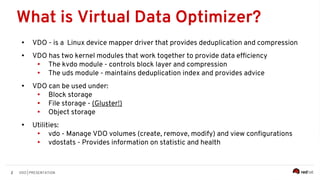
• VDO - is a Linux device mapper driver that provides deduplication and compression
• VDO has two kernel modules that work together to provide data efficiency
• The kvdo module - controls block layer and compression
• The uds module - maintains deduplication index and provides advice
• VDO can be used under:
• Block storage
• File storage - (Gluster!)
• Object storage
• Utilities:
• vdo - Manage VDO volumes (create, remove, modify) and view configurations
• vdostats - Provides information on statistic and health
● Open Source and GPL as of Monday! (~165k LOC)
https://github.com/dm-vdo
● Will ship with RHEL 7.5 as an out-of-tree module
● Working with upstream community to address concerns
(Tabs! Spaces! camelCase! under_scores! And some real
stuff too)
● Hope to be upstream in 9-12 months
Open Source and Upstream Plans
4
User Benefits
• Deduplication and compression have been core user requests for Gluster
• VDO increases storage efficiency, reduces costs
• VDO makes high-performance storage more affordable
• Because data reduction is applied at the OS layer, VDO works anywhere the
OS lives
• OS-based data reduction benefits all software layers above
• Less data to store translates to less data to move - device level replication
can be vastly accelerated
5
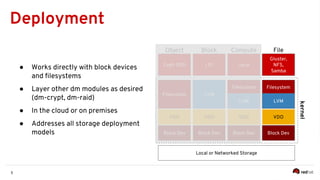
Deployment
● Works directly with block devices
and filesystems
● Layer other dm modules as desired
(dm-crypt, dm-raid)
● In the cloud or on premises
● Addresses all storage deployment
models
Ceph OSD LIO Local
Gluster,
NFS,
Samba
Filesystem LVM
Filesystem
LVM
Filesystem
LVM
VDO VDOVDOVDO
Block Dev Block Dev Block Dev Block Dev
Local or Networked Storage
Object Block Compute File
kernel
6
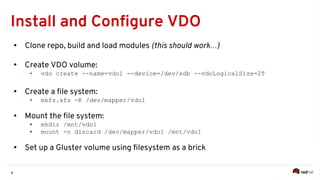
Install and Configure VDO
• Clone repo, build and load modules (this should work…)
• Create VDO volume:
• vdo create --name=vdo1 --device=/dev/sdb --vdoLogicalSize=2T
• Create a file system:
• mkfs.xfs -K /dev/mapper/vdo1
• Mount the file system:
• mkdir /mnt/vdo1
• mount -o discard /dev/mapper/vdo1 /mnt/vdo1
• Set up a Gluster volume using filesystem as a brick
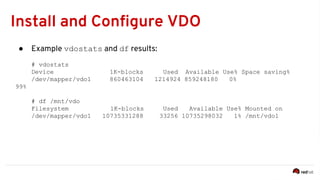
Install and Configure VDO
● Example vdostats and df results:
# vdostats
Device 1K-blocks Used Available Use% Space saving%
/dev/mapper/vdo1 860463104 1214924 859248180 0%
99%
# df /mnt/vdo
Filesystem 1K-blocks Used Available Use% Mounted on
/dev/mapper/vdo1 10735331288 33256 10735298032 1% /mnt/vdo1
8
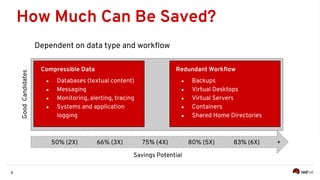
How Much Can Be Saved?
Redundant Workflow
● Backups
● Virtual Desktops
● Virtual Servers
● Containers
● Shared Home Directories
Compressible Data
● Databases (textual content)
● Messaging
● Monitoring, alerting, tracing
● Systems and application
logging
75% (4X)50% (2X) 66% (3X) 80% (5X) 83% (6X) +
GoodCandidates
Savings Potential
Dependent on data type and workflow
9
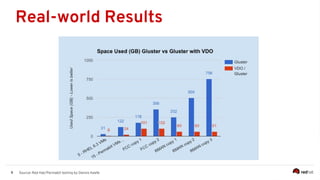
Real-world Results
Source: Red Hat/Permabit testing by Dennis Keefe
10
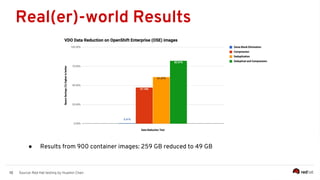
Real(er)-world Results
Source: Red Hat testing by Huamin Chen
● Results from 900 container images: 259 GB reduced to 49 GB
11
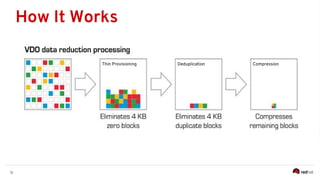
Thin Provisioning Deduplication Compression
How It Works
12
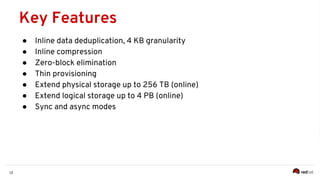
● Inline data deduplication, 4 KB granularity
● Inline compression
● Zero-block elimination
● Thin provisioning
● Extend physical storage up to 256 TB (online)
● Extend logical storage up to 4 PB (online)
● Sync and async modes
Key Features
13
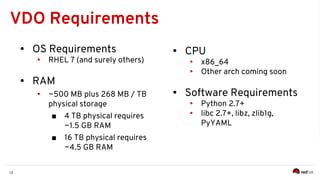
VDO Requirements
• OS Requirements
• RHEL 7 (and surely others)
• RAM
• ~500 MB plus 268 MB / TB
physical storage
■ 4 TB physical requires
~1.5 GB RAM
■ 16 TB physical requires
~4.5 GB RAM
• CPU
• x86_64
• Other arch coming soon
• Software Requirements
• Python 2.7+
• libc 2.7+, libz, zlib1g,
PyYAML
14
● Free space monitoring (vdostats, dmevent)
● Enhancements to DHT for better dedupe at scale
● Deduplication enhancements for replication
● Documentation / Best Practices / Automation
● Questions? Complaints? I’m Jered Floyd <jered@redhat.com>
● Join us at vdo-devel@redhat.com:
https://www.redhat.com/mailman/listinfo/vdo-devel
Next Steps, Q&A

Data Reduction for Gluster with VDO

  • 1.
    Data Reduction forGluster with VDO October 27th 2017 Presented by: Jered Floyd Member of Technical Staff jered@redhat.com
  • 2.
    VDO | PRESENTATION2 Whatis Virtual Data Optimizer? • VDO - is a Linux device mapper driver that provides deduplication and compression • VDO has two kernel modules that work together to provide data efficiency • The kvdo module - controls block layer and compression • The uds module - maintains deduplication index and provides advice • VDO can be used under: • Block storage • File storage - (Gluster!) • Object storage • Utilities: • vdo - Manage VDO volumes (create, remove, modify) and view configurations • vdostats - Provides information on statistic and health
  • 3.
    ● Open Sourceand GPL as of Monday! (~165k LOC) https://github.com/dm-vdo ● Will ship with RHEL 7.5 as an out-of-tree module ● Working with upstream community to address concerns (Tabs! Spaces! camelCase! under_scores! And some real stuff too) ● Hope to be upstream in 9-12 months Open Source and Upstream Plans
  • 4.
    4 User Benefits • Deduplicationand compression have been core user requests for Gluster • VDO increases storage efficiency, reduces costs • VDO makes high-performance storage more affordable • Because data reduction is applied at the OS layer, VDO works anywhere the OS lives • OS-based data reduction benefits all software layers above • Less data to store translates to less data to move - device level replication can be vastly accelerated
  • 5.
    5 Deployment ● Works directlywith block devices and filesystems ● Layer other dm modules as desired (dm-crypt, dm-raid) ● In the cloud or on premises ● Addresses all storage deployment models Ceph OSD LIO Local Gluster, NFS, Samba Filesystem LVM Filesystem LVM Filesystem LVM VDO VDOVDOVDO Block Dev Block Dev Block Dev Block Dev Local or Networked Storage Object Block Compute File kernel
  • 6.
    6 Install and ConfigureVDO • Clone repo, build and load modules (this should work…) • Create VDO volume: • vdo create --name=vdo1 --device=/dev/sdb --vdoLogicalSize=2T • Create a file system: • mkfs.xfs -K /dev/mapper/vdo1 • Mount the file system: • mkdir /mnt/vdo1 • mount -o discard /dev/mapper/vdo1 /mnt/vdo1 • Set up a Gluster volume using filesystem as a brick
  • 7.
    Install and ConfigureVDO ● Example vdostats and df results: # vdostats Device 1K-blocks Used Available Use% Space saving% /dev/mapper/vdo1 860463104 1214924 859248180 0% 99% # df /mnt/vdo Filesystem 1K-blocks Used Available Use% Mounted on /dev/mapper/vdo1 10735331288 33256 10735298032 1% /mnt/vdo1
  • 8.
    8 How Much CanBe Saved? Redundant Workflow ● Backups ● Virtual Desktops ● Virtual Servers ● Containers ● Shared Home Directories Compressible Data ● Databases (textual content) ● Messaging ● Monitoring, alerting, tracing ● Systems and application logging 75% (4X)50% (2X) 66% (3X) 80% (5X) 83% (6X) + GoodCandidates Savings Potential Dependent on data type and workflow
  • 9.
    9 Real-world Results Source: RedHat/Permabit testing by Dennis Keefe
  • 10.
    10 Real(er)-world Results Source: RedHat testing by Huamin Chen ● Results from 900 container images: 259 GB reduced to 49 GB
  • 11.
    11 Thin Provisioning DeduplicationCompression How It Works
  • 12.
    12 ● Inline datadeduplication, 4 KB granularity ● Inline compression ● Zero-block elimination ● Thin provisioning ● Extend physical storage up to 256 TB (online) ● Extend logical storage up to 4 PB (online) ● Sync and async modes Key Features
  • 13.
    13 VDO Requirements • OSRequirements • RHEL 7 (and surely others) • RAM • ~500 MB plus 268 MB / TB physical storage ■ 4 TB physical requires ~1.5 GB RAM ■ 16 TB physical requires ~4.5 GB RAM • CPU • x86_64 • Other arch coming soon • Software Requirements • Python 2.7+ • libc 2.7+, libz, zlib1g, PyYAML
  • 14.
    14 ● Free spacemonitoring (vdostats, dmevent) ● Enhancements to DHT for better dedupe at scale ● Deduplication enhancements for replication ● Documentation / Best Practices / Automation ● Questions? Complaints? I’m Jered Floyd <jered@redhat.com> ● Join us at vdo-devel@redhat.com: https://www.redhat.com/mailman/listinfo/vdo-devel Next Steps, Q&A