
PRESENTED BY-
K.AGASYA RAJ
DEFINITION
The cells of the body use glucose for energy, and the
brain must have glucose to function.
 Glucose attracts water, but because cell
membranes are made of lipids, or fats.
 So, to pass from the cell membrane, glucose needs a
protein to carry it. These are the glucose transporters.
There are 13 of them, but first four are well
explained.
Types
 13 members
On the basis of sequence similarities, the GLUT family has been divided into three
subclasses.
Class I
Class I comprises GLUT1-GLUT4
Class II:
GLUT5 (SLC2A5), a fructose transporter
GLUT7 - SLC2A7 - (SLC2A7), transporting glucose out of the endoplasmic reticulum.
GLUT9 – SLC2A9
GLUT11 (SLC2A11)
Class III comprises:
GLUT6 (SLC2A6),
GLUT8 (SLC2A8),
GLUT10 (SLC2A10),
GLUT12 (SLC2A12), and
the H+/myoinositol transporter HMIT (SLC2A13)
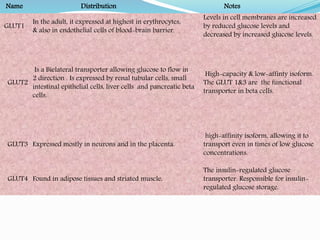
Name Distribution Notes
GLUT1
In the adult, it expressed at highest in erythrocytes,
& also in endothelial cells of blood-brain barrier.
Levels in cell membranes are increased
by reduced glucose levels and
decreased by increased glucose levels.
GLUT2
Is a Bielateral transporter allowing glucose to flow in
2 direction . Is expressed by renal tubular cells, small
intestinal epithelial cells, liver cells and pancreatic beta
cells.
High-capacity & low-affinty isoform.
The GLUT 1&3 are the functional
transporter in beta cells.
GLUT3 Expressed mostly in neurons and in the placenta.
high-affinity isoform, allowing it to
transport even in times of low glucose
concentrations.
GLUT4 Found in adipose tissues and striated muscle.
The insulin-regulated glucose
transporter. Responsible for insulin-
regulated glucose storage.
GLUT5 (SLC2A5)
GLUT5 exhibits no transport activity for glucose, but
mediates fructose transport.
Primarily expressed in the jejunal region.
 In the small intestine, GLUT5 is localized to both the apical
and basolaterial membranes mediates fructose absorption.
GLUT6 (SLC2A6)
Is composed of 507 amino acids.
Its mRNA is predominantly expressed in the brain, spleen
and peripheral leucocytes.
No translocation of GLUT6 can be stimulated by insulin.
GLUT7 (SLC2A7)
 Comprised of 524 amino acids.
 It does not transport galactose & xylose
 The tissue distribution of GLUT7 mRNA is the small
intestine, colon, testis and prostate .
GLUT8 (SLC2A8)
It is homology to GLUT 1-4, but is more closely related to
hexose transporters present in plants and bacteria .
Also differs from other GLUT’s at the C-terminal
cytoplasmic tail, which is quite short at 20 amino acids in
length.
GLUT9 (SLC2A9)
The major isoform GLUT9 is comprised of 540
amino acids.
It is expressed mainly in the kidney and liver.
GLUT10 (SLC2A10)
It is composed of 541 amino acids in humans.
Its mRNA is expressed at highest levels in the liver
and pancreas.
It’s deficiency has recently been found in arterial
tortuosity syndrome .
GLUT11 (SLC2A11)
These three isoforms are expressed in a tissue specific
manner.
GLUT11A is present in heart, skeletal muscle and kidney .
GLUT11B is present in placenta, adipose tissue, and kidney.
GLUT11C present in adipose tissue, heart, skeletal muscle
and pancreas .
GLUT12 (SLC2A12)
Same family and contains a number of similar
features to GLUT4.
 In adult tissues, GLUT12 expression appears to be
restricted to insulin-sensitive skeletal muscle, heart
and fat.
SGLT1
The sodium-dependent glucose transporter expressed in
the small intestinal mucosa.
It is the small intestinal brush-border transporter .
 Thus plays a major role in absorption of dietary D-glucose
and D-galactose from the intestinal lumen.
SGLT2 (SLC5A2)
SGLT2 is a low-affinity glucose transporter.
 It is predominantly located in the S1 and S2 segments of
renal convoluted proximal tubules .
It is associated with autosomal recessive renal glycosuria in
human patients.
Clinical significance OF GLUT2
Defects in the SLC2A2 gene with a particular type
of glycogen storage disease called Fanconi-Bickel
syndrome.
GLUT2 preventing edema-induced stroke, coma.
CONCLUSION
These proteins can lead to various pathological
conditions, such as diabetes, obesity and cancer.

Glucose receptors1

  • 1.
  • 2.
    DEFINITION The cells ofthe body use glucose for energy, and the brain must have glucose to function.  Glucose attracts water, but because cell membranes are made of lipids, or fats.  So, to pass from the cell membrane, glucose needs a protein to carry it. These are the glucose transporters. There are 13 of them, but first four are well explained.
  • 3.
    Types  13 members Onthe basis of sequence similarities, the GLUT family has been divided into three subclasses. Class I Class I comprises GLUT1-GLUT4 Class II: GLUT5 (SLC2A5), a fructose transporter GLUT7 - SLC2A7 - (SLC2A7), transporting glucose out of the endoplasmic reticulum. GLUT9 – SLC2A9 GLUT11 (SLC2A11) Class III comprises: GLUT6 (SLC2A6), GLUT8 (SLC2A8), GLUT10 (SLC2A10), GLUT12 (SLC2A12), and the H+/myoinositol transporter HMIT (SLC2A13)
  • 4.
    Name Distribution Notes GLUT1 Inthe adult, it expressed at highest in erythrocytes, & also in endothelial cells of blood-brain barrier. Levels in cell membranes are increased by reduced glucose levels and decreased by increased glucose levels. GLUT2 Is a Bielateral transporter allowing glucose to flow in 2 direction . Is expressed by renal tubular cells, small intestinal epithelial cells, liver cells and pancreatic beta cells. High-capacity & low-affinty isoform. The GLUT 1&3 are the functional transporter in beta cells. GLUT3 Expressed mostly in neurons and in the placenta. high-affinity isoform, allowing it to transport even in times of low glucose concentrations. GLUT4 Found in adipose tissues and striated muscle. The insulin-regulated glucose transporter. Responsible for insulin- regulated glucose storage.
  • 5.
    GLUT5 (SLC2A5) GLUT5 exhibitsno transport activity for glucose, but mediates fructose transport. Primarily expressed in the jejunal region.  In the small intestine, GLUT5 is localized to both the apical and basolaterial membranes mediates fructose absorption.
  • 6.
    GLUT6 (SLC2A6) Is composedof 507 amino acids. Its mRNA is predominantly expressed in the brain, spleen and peripheral leucocytes. No translocation of GLUT6 can be stimulated by insulin.
  • 7.
    GLUT7 (SLC2A7)  Comprisedof 524 amino acids.  It does not transport galactose & xylose  The tissue distribution of GLUT7 mRNA is the small intestine, colon, testis and prostate .
  • 8.
    GLUT8 (SLC2A8) It ishomology to GLUT 1-4, but is more closely related to hexose transporters present in plants and bacteria . Also differs from other GLUT’s at the C-terminal cytoplasmic tail, which is quite short at 20 amino acids in length.
  • 9.
    GLUT9 (SLC2A9) The majorisoform GLUT9 is comprised of 540 amino acids. It is expressed mainly in the kidney and liver.
  • 10.
    GLUT10 (SLC2A10) It iscomposed of 541 amino acids in humans. Its mRNA is expressed at highest levels in the liver and pancreas. It’s deficiency has recently been found in arterial tortuosity syndrome .
  • 11.
    GLUT11 (SLC2A11) These threeisoforms are expressed in a tissue specific manner. GLUT11A is present in heart, skeletal muscle and kidney . GLUT11B is present in placenta, adipose tissue, and kidney. GLUT11C present in adipose tissue, heart, skeletal muscle and pancreas .
  • 12.
    GLUT12 (SLC2A12) Same familyand contains a number of similar features to GLUT4.  In adult tissues, GLUT12 expression appears to be restricted to insulin-sensitive skeletal muscle, heart and fat.
  • 13.
    SGLT1 The sodium-dependent glucosetransporter expressed in the small intestinal mucosa. It is the small intestinal brush-border transporter .  Thus plays a major role in absorption of dietary D-glucose and D-galactose from the intestinal lumen.
  • 14.
    SGLT2 (SLC5A2) SGLT2 isa low-affinity glucose transporter.  It is predominantly located in the S1 and S2 segments of renal convoluted proximal tubules . It is associated with autosomal recessive renal glycosuria in human patients.
  • 15.
    Clinical significance OFGLUT2 Defects in the SLC2A2 gene with a particular type of glycogen storage disease called Fanconi-Bickel syndrome. GLUT2 preventing edema-induced stroke, coma.
  • 16.
    CONCLUSION These proteins canlead to various pathological conditions, such as diabetes, obesity and cancer.