carbohydrate metabolism
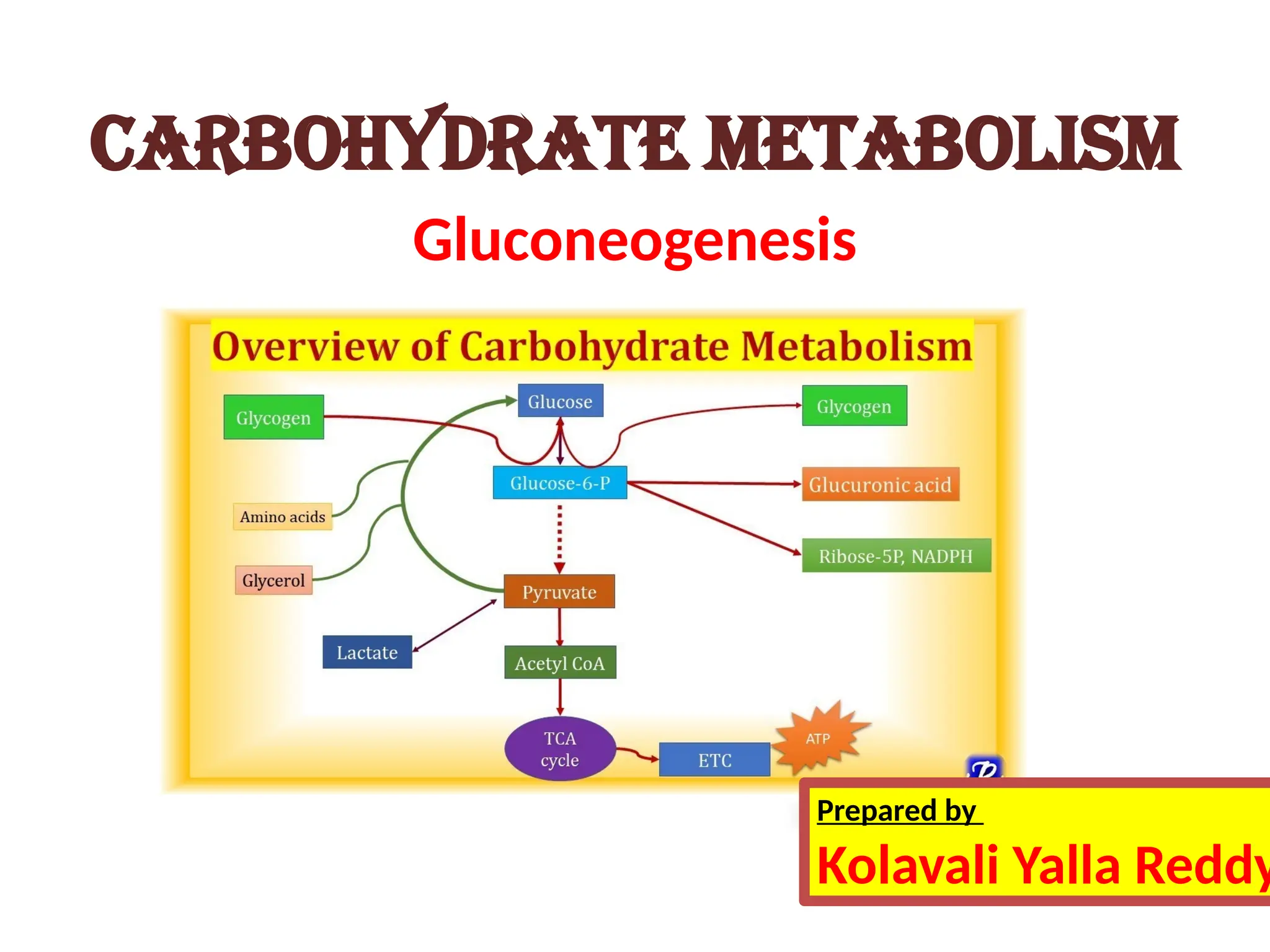
Gluconeogenesis
Prepared by
Kolavali Yalla Reddy
•Gluconeogenesis- Pathway and its significance
CONTENTS
Gluconeogenesis- Pathway
The synthesis of glucose from noncarbohydrate
compounds is known as gluconeogenesis.
The major substrates/precursors for gluconeogenesis
are lactate, pyruvate, glucogenic amino acids, propionate
and glycerol.
Location
• Gluconeogenesis occurs mainly in the cytosol,
although some precursors are produced in
the mitochondria.
• Gluconeogenesis mostly takes place in liver
(about 1 kg glucose synthesized everyday)
and, to some extent, in kidney matrix (about
one-tenth of liver capacity).
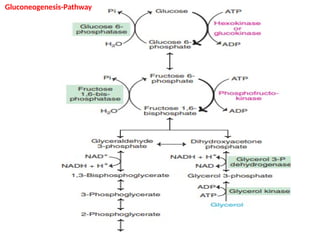
Gluconeogenesis-Pathway
Reactions of gluconeogenesis
• Gluconeogenesis closely resembles the reversed
pathway of glycolysis, although it is not the
complete reversal of glycolysis. Essentially, 3 (out of
10) reactions of glycolysis are irreversible.
• The seven reactions are common for both glycolysis
and gluconeogenesis.
• The three irreversible steps of glycolysis are
catalysed by the enzymes, namely hexokinase,
phosphofructokinase and pyruvate kinase.
• These three stages—bypassed by alternate
enzymes specific to gluconeogenesis
Reactions of gluconeogenesis
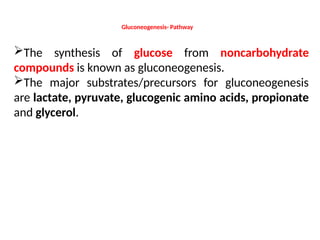
• 1. Conversion of pyruvate to
phosphoenolpyruvate :
• This takes place in two steps (Fig.13.12). Pyruvate
carboxylase is a biotin— dependent mitochondrial
enzyme that converts pyruvate to oxaloacetate in
presence of ATP and CO2. This enzyme regulates
gluconeogenesis and requires acetyl CoA for its
activity.
• Oxaloacetate is synthesized in the mitochondrial
matrix. It has to be transported to the cytosol to be
used in gluconeogenesis, where the rest of the
pathway occurs.
• Due to membrane impermeability, oxaloacetate cannot
diffuse out of the mitochondria. It is converted to malate
and then transported to the cytosol. Within the cytosol,
oxaloacetate is regenerated.
• The reversible conversion of oxaloacetate and malate is
catalysed by malate dehydrogenase, an enzyme present in
both mitochondria and cytosol.
• In the cytosol, phosphoenolpyruvate carboxykinase
converts oxaloacetate to phosphoenolpyruvate. GTP or ITP
(not ATP) is used in this reaction and the CO2 (fixed by
carboxylase) is liberated.
• 2. Conversion of fructose 1,6-bisphosphate to
fructose 6-phosphate : Phosphoenolpyruvate
undergoes the reversal of glycolysis until
fructose 1,6-bisphosphate is produced. The
enzyme fructose 1,6-bisphosphatase converts
fructose 1,6-bisphosphate to fructose 6-
phosphate. This enzyme requires Mg2+ ions.
Fructose 1,6- bisphosphatase is absent in
smooth muscle and heart muscle. This enzyme
is also regulatory in gluconeogenesis.
• 3. Conversion of glucose 6-phosphate to
glucose : Glucose 6-phosphatase catalyses the
conversion of glucose 6-phosphate to glucose.
The presence or absence of this enzyme in a
tissue determines whether the tissue is
capable of contributing glucose to the blood or
not. It is mostly present in liver and kidney but
absent in muscle, brain and adipose tissue.
The overall summary of gluconeogenesis for the
conversion of pyruvate to glucose is shown below 2
Pyruvate + 4ATP + 2GTP + 2NADH + 2H+ + 6H2O
Glucose + 2NAD+ + 4ADP + 2GDP + 6Pi + 6H+
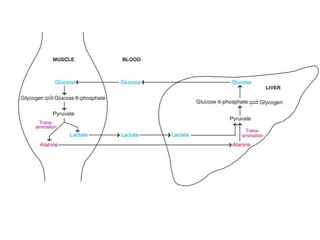
Gluconeogenesis from lactate
(Cori cycle)
• Lactate produced by active skeletal muscle is a
major precursor for gluconeogenesis.
• Under anaerobic conditions, pyruvate is
reduced to lactate by lactate dehydrogenase
(LDH)
• Pyruvate + NADH + H+ LDH Lactate + NAD+
Importance of gluconeogenesis
• Glucose occupies a key position in the metabolism and its continuous
supply is absolutely essential to the body for a variety of functions.
• 1. Brain and central nervous system, erythrocytes, testes and kidney
medulla are dependent on glucose for continuous supply of energy.
Human brain alone requires about 120 g of glucose per day, out of
about 160 g needed by the entire body.
• 2. Glucose is the only source that supplies energy to the skeletal muscle,
under anaerobic conditions.
• 3. In fasting even more than a day, gluconeogenesis must occur to meet
the basal requirements of the body for glucose and to maintain the
intermediates of citric acid cycle. This is essential for the survival of
humans and other animals.
• 4. Certain metabolites produced in the tissues accumulate in the blood,
e.g. lactate, glycerol, propionate etc. Gluconeogenesis effectively clears
them from the blood
Gluconeogenesis- Pathway and its significance

Gluconeogenesis- Pathway and its significance

  • 1.
  • 2.
    •Gluconeogenesis- Pathway andits significance CONTENTS
  • 3.
    Gluconeogenesis- Pathway The synthesisof glucose from noncarbohydrate compounds is known as gluconeogenesis. The major substrates/precursors for gluconeogenesis are lactate, pyruvate, glucogenic amino acids, propionate and glycerol.
  • 4.
    Location • Gluconeogenesis occursmainly in the cytosol, although some precursors are produced in the mitochondria. • Gluconeogenesis mostly takes place in liver (about 1 kg glucose synthesized everyday) and, to some extent, in kidney matrix (about one-tenth of liver capacity).
  • 5.
  • 7.
    Reactions of gluconeogenesis •Gluconeogenesis closely resembles the reversed pathway of glycolysis, although it is not the complete reversal of glycolysis. Essentially, 3 (out of 10) reactions of glycolysis are irreversible. • The seven reactions are common for both glycolysis and gluconeogenesis. • The three irreversible steps of glycolysis are catalysed by the enzymes, namely hexokinase, phosphofructokinase and pyruvate kinase. • These three stages—bypassed by alternate enzymes specific to gluconeogenesis
  • 8.
    Reactions of gluconeogenesis •1. Conversion of pyruvate to phosphoenolpyruvate : • This takes place in two steps (Fig.13.12). Pyruvate carboxylase is a biotin— dependent mitochondrial enzyme that converts pyruvate to oxaloacetate in presence of ATP and CO2. This enzyme regulates gluconeogenesis and requires acetyl CoA for its activity. • Oxaloacetate is synthesized in the mitochondrial matrix. It has to be transported to the cytosol to be used in gluconeogenesis, where the rest of the pathway occurs.
  • 9.
    • Due tomembrane impermeability, oxaloacetate cannot diffuse out of the mitochondria. It is converted to malate and then transported to the cytosol. Within the cytosol, oxaloacetate is regenerated. • The reversible conversion of oxaloacetate and malate is catalysed by malate dehydrogenase, an enzyme present in both mitochondria and cytosol. • In the cytosol, phosphoenolpyruvate carboxykinase converts oxaloacetate to phosphoenolpyruvate. GTP or ITP (not ATP) is used in this reaction and the CO2 (fixed by carboxylase) is liberated.
  • 10.
    • 2. Conversionof fructose 1,6-bisphosphate to fructose 6-phosphate : Phosphoenolpyruvate undergoes the reversal of glycolysis until fructose 1,6-bisphosphate is produced. The enzyme fructose 1,6-bisphosphatase converts fructose 1,6-bisphosphate to fructose 6- phosphate. This enzyme requires Mg2+ ions. Fructose 1,6- bisphosphatase is absent in smooth muscle and heart muscle. This enzyme is also regulatory in gluconeogenesis.
  • 11.
    • 3. Conversionof glucose 6-phosphate to glucose : Glucose 6-phosphatase catalyses the conversion of glucose 6-phosphate to glucose. The presence or absence of this enzyme in a tissue determines whether the tissue is capable of contributing glucose to the blood or not. It is mostly present in liver and kidney but absent in muscle, brain and adipose tissue. The overall summary of gluconeogenesis for the conversion of pyruvate to glucose is shown below 2 Pyruvate + 4ATP + 2GTP + 2NADH + 2H+ + 6H2O Glucose + 2NAD+ + 4ADP + 2GDP + 6Pi + 6H+
  • 12.
    Gluconeogenesis from lactate (Coricycle) • Lactate produced by active skeletal muscle is a major precursor for gluconeogenesis. • Under anaerobic conditions, pyruvate is reduced to lactate by lactate dehydrogenase (LDH) • Pyruvate + NADH + H+ LDH Lactate + NAD+
  • 14.
    Importance of gluconeogenesis •Glucose occupies a key position in the metabolism and its continuous supply is absolutely essential to the body for a variety of functions. • 1. Brain and central nervous system, erythrocytes, testes and kidney medulla are dependent on glucose for continuous supply of energy. Human brain alone requires about 120 g of glucose per day, out of about 160 g needed by the entire body. • 2. Glucose is the only source that supplies energy to the skeletal muscle, under anaerobic conditions. • 3. In fasting even more than a day, gluconeogenesis must occur to meet the basal requirements of the body for glucose and to maintain the intermediates of citric acid cycle. This is essential for the survival of humans and other animals. • 4. Certain metabolites produced in the tissues accumulate in the blood, e.g. lactate, glycerol, propionate etc. Gluconeogenesis effectively clears them from the blood