INTRODUCTION
Gluconeogenesis is a metabolic pathway that results in the synthesis
of glucose from certain non-carbohydrate carbon substrates.
Non carbohydrate
precursors
Glucose
gluconeogenesis
Lactate
Pyruvate
Gluconic amino acids
Propionate
Glycerol
SITE
Liver- contribute 85%
Kidney- contributes 15%
During prolonged fasting
kidney can contribute upto
40%
PATHWAY
Partly mitochondrial
Partly cytoplasmic
IMPORTANCE
Glucogenogenesis is the chief
source of blood glucose after
18 hours of starvation.
Maintains blood glucose level.
It removes the lactate
produced by muscle cells.
It removes the glycerol
produced by adipose tissue.
Glucose is the only source of
energy for:
Nervous system
Skeletal system
OVERVIEW
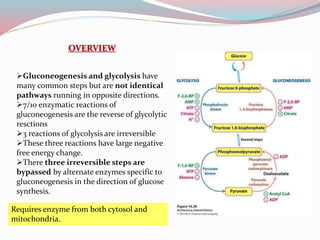
Gluconeogenesis and glycolysis have
many common steps but are not identical
pathways running in opposite directions.
7/10 enzymatic reactions of
gluconeogenesis are the reverse of glycolytic
resctions
3 reactions of glycolysis are irreversible
These three reactions have large negative
free energy change.
There three irreversible steps are
bypassed by alternate enzymes specific to
gluconeogenesis in the direction of glucose
synthesis.
Requires enzyme from both cytosol and
mitochondria.
1) CONVERSIONOF PYRUVATETO PHOSPHOENOLPYRUVATE
(a) When pyruvate is the precursor
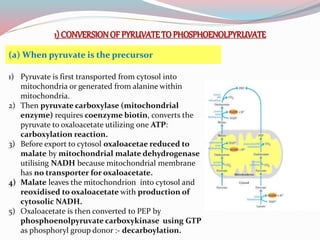
1) Pyruvate is first transported from cytosol into
mitochondria or generated from alanine within
mitochondria.
2) Then pyruvate carboxylase (mitochondrial
enzyme) requires coenzyme biotin, converts the
pyruvate to oxaloacetate utilizing one ATP:
carboxylation reaction.
3) Before export to cytosol oxaloacetae reduced to
malate by mitochondrial malate dehydrogenase
utilising NADH because mitochondrial membrane
has no transporter for oxaloacetate.
4) Malate leaves the mitochondrion into cytosol and
reoxidised to oxaloacetate with production of
cytosolic NADH.
5) Oxaloacetate is then converted to PEP by
phosphoenolpyruvate carboxykinase using GTP
as phosphoryl group donor :- decarboylation.
(a) When lactate is the precursor
1) Conversion of lactate to pyruvate in
cytosol with lactate dehydrogenase
yields NADH.
2) Pyruvate is then transported to
mitochondria
3) Pyruvate is converted to oxaloacetate
by pyruvate carboxylase.
4) Oxaloacetate is directly converted to
PEP with mitochondrial isoenzyme
PEP carboxykinase
5) PEP is transported out of
mitochondria and continue on
gluconeogenic path.
2) CONVERSIONOF fructose 1,6-bisphosphateto fructose 6-phosphate
1) The enzyme fructose 1,6-
bisphosphatse converts
fructose 1,6-bisphosphate to
fructose 6 phosphate
2) This reaction requires
Magnesium ions
3) It promotes irreversible
hydrolysis of C-1 phosphate
(not phosphoryl group transfer
to ADP)
3) CONVERSIONOF glucose 6-phosphateto glucose
1) This is the final reaction
2) Dephosphorylation of glucose 6-
phosthate to glucose is catalysed by
glucose 6-phosphatase
3) This enzyme is activated by magnesium
ions found in lumenal side of
endoplasmic reticulum of hepatocytes.
4) This is hydrolysis of C-6 phosphate (not
phosphoryl group transfer to ADP)
When amino acids are the precursor
1) Amino acids are derived
from dietary proteins, tissue
proteins, or from skeletal
muscle protein during
starvation.
2) Amino acids that are
degraded to pyruvate or
citric acid cycle intermediate
are called glycogenic
amino acids.
3) These intermediates finally
give rise to glucose.
When glycerol is the precursor
1) Glycerol is librated in adipose tissue by the
hydrolysis of fats.
2) Enzyme glycerokinase found in liver
converts glycerol to glycerol 3-phosphate.
3) Glycerol 3-phosphate dehydrogenase
converts it to dehydroxy-
acetalphosphate(DHAP).
4) DHAP is an intermediate in
gluconeogenesis which untimately leads to
the formation og glucose.
When propionate is the precursor
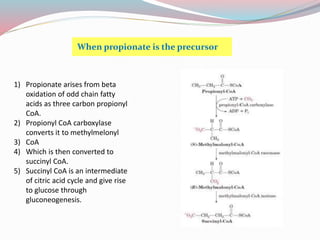
1) Propionate arises from beta
oxidation of odd chain fatty
acids as three carbon propionyl
CoA.
2) Propionyl CoA carboxylase
converts it to methylmelonyl
3) CoA
4) Which is then converted to
succinyl CoA.
5) Succinyl CoA is an intermediate
of citric acid cycle and give rise
to glucose through
gluconeogenesis.
REGULATIONOF GLUCONEOGENESIS
Gluconiogenesis and glycolysis
are reciprocally regulated.
When one pathway is activated
another pathway is inactivated.
Hormone also regulate
gluconeogenesis.

Gluconeogenesis

  • 2.
    INTRODUCTION Gluconeogenesis is ametabolic pathway that results in the synthesis of glucose from certain non-carbohydrate carbon substrates. Non carbohydrate precursors Glucose gluconeogenesis Lactate Pyruvate Gluconic amino acids Propionate Glycerol
  • 3.
    SITE Liver- contribute 85% Kidney-contributes 15% During prolonged fasting kidney can contribute upto 40% PATHWAY Partly mitochondrial Partly cytoplasmic IMPORTANCE Glucogenogenesis is the chief source of blood glucose after 18 hours of starvation. Maintains blood glucose level. It removes the lactate produced by muscle cells. It removes the glycerol produced by adipose tissue. Glucose is the only source of energy for: Nervous system Skeletal system
  • 4.
    OVERVIEW Gluconeogenesis and glycolysishave many common steps but are not identical pathways running in opposite directions. 7/10 enzymatic reactions of gluconeogenesis are the reverse of glycolytic resctions 3 reactions of glycolysis are irreversible These three reactions have large negative free energy change. There three irreversible steps are bypassed by alternate enzymes specific to gluconeogenesis in the direction of glucose synthesis. Requires enzyme from both cytosol and mitochondria.
  • 5.
    1) CONVERSIONOF PYRUVATETOPHOSPHOENOLPYRUVATE (a) When pyruvate is the precursor 1) Pyruvate is first transported from cytosol into mitochondria or generated from alanine within mitochondria. 2) Then pyruvate carboxylase (mitochondrial enzyme) requires coenzyme biotin, converts the pyruvate to oxaloacetate utilizing one ATP: carboxylation reaction. 3) Before export to cytosol oxaloacetae reduced to malate by mitochondrial malate dehydrogenase utilising NADH because mitochondrial membrane has no transporter for oxaloacetate. 4) Malate leaves the mitochondrion into cytosol and reoxidised to oxaloacetate with production of cytosolic NADH. 5) Oxaloacetate is then converted to PEP by phosphoenolpyruvate carboxykinase using GTP as phosphoryl group donor :- decarboylation.
  • 6.
    (a) When lactateis the precursor 1) Conversion of lactate to pyruvate in cytosol with lactate dehydrogenase yields NADH. 2) Pyruvate is then transported to mitochondria 3) Pyruvate is converted to oxaloacetate by pyruvate carboxylase. 4) Oxaloacetate is directly converted to PEP with mitochondrial isoenzyme PEP carboxykinase 5) PEP is transported out of mitochondria and continue on gluconeogenic path.
  • 8.
    2) CONVERSIONOF fructose1,6-bisphosphateto fructose 6-phosphate 1) The enzyme fructose 1,6- bisphosphatse converts fructose 1,6-bisphosphate to fructose 6 phosphate 2) This reaction requires Magnesium ions 3) It promotes irreversible hydrolysis of C-1 phosphate (not phosphoryl group transfer to ADP)
  • 9.
    3) CONVERSIONOF glucose6-phosphateto glucose 1) This is the final reaction 2) Dephosphorylation of glucose 6- phosthate to glucose is catalysed by glucose 6-phosphatase 3) This enzyme is activated by magnesium ions found in lumenal side of endoplasmic reticulum of hepatocytes. 4) This is hydrolysis of C-6 phosphate (not phosphoryl group transfer to ADP)
  • 11.
    When amino acidsare the precursor 1) Amino acids are derived from dietary proteins, tissue proteins, or from skeletal muscle protein during starvation. 2) Amino acids that are degraded to pyruvate or citric acid cycle intermediate are called glycogenic amino acids. 3) These intermediates finally give rise to glucose.
  • 12.
    When glycerol isthe precursor 1) Glycerol is librated in adipose tissue by the hydrolysis of fats. 2) Enzyme glycerokinase found in liver converts glycerol to glycerol 3-phosphate. 3) Glycerol 3-phosphate dehydrogenase converts it to dehydroxy- acetalphosphate(DHAP). 4) DHAP is an intermediate in gluconeogenesis which untimately leads to the formation og glucose.
  • 13.
    When propionate isthe precursor 1) Propionate arises from beta oxidation of odd chain fatty acids as three carbon propionyl CoA. 2) Propionyl CoA carboxylase converts it to methylmelonyl 3) CoA 4) Which is then converted to succinyl CoA. 5) Succinyl CoA is an intermediate of citric acid cycle and give rise to glucose through gluconeogenesis.
  • 14.
    REGULATIONOF GLUCONEOGENESIS Gluconiogenesis andglycolysis are reciprocally regulated. When one pathway is activated another pathway is inactivated. Hormone also regulate gluconeogenesis.