Nabeela Moosakutty
Lecturer
Dept. of Pharmaceutics
KTN College of Pharmacy
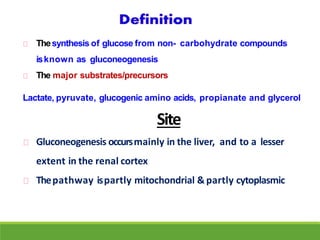
Thesynthesis of glucose from non- carbohydrate compounds
isknown as gluconeogenesis
The major substrates/precursors
Lactate, pyruvate, glucogenic amino acids, propianate and glycerol
Site
Gluconeogenesis occursmainly in the liver, and to a lesser
extent in the renal cortex
Thepathway ispartly mitochondrial & partly cytoplasmic
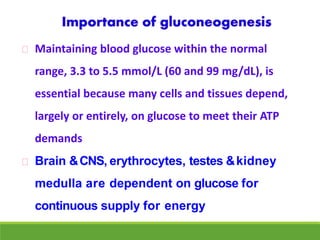
Maintaining blood glucose within the normal
range, 3.3 to 5.5 mmol/L (60 and 99 mg/dL), is
essential because many cells and tissues depend,
largely or entirely, on glucose to meet their ATP
demands
Brain &CNS, erythrocytes, testes &kidney
medulla are dependent on glucose for
continuous supply for energy
During starvation gluconeogenesis
maintains the blood glucose level
The stored glycogen isdepleted within the first 12-
18hours of fasting
On prolonged starvation, the gluconeogenesis is
speeded up &protein catabolism provides the
substrates, namely glucogenic amino acids
The excretion of pyruvate would lead to the loss of the
ability to produce ATP through aerobic respiration, i.e.
more than 10
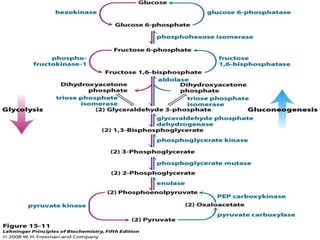
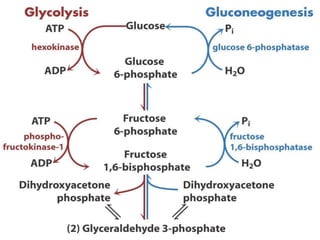
Gluconeogenesis closely resembles the
reversed pathway of glycolysis
The 3irreversible steps of glycolysis are
catalysed by the 3enzymes
Hexokinase
PFK
Pyruvate kinase
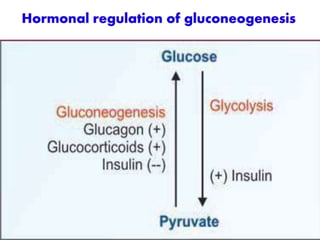
Regulation of Gluconeogenesis
These three stages bypassed by alternate
enzymes specific to gluconeogenesis
These are:
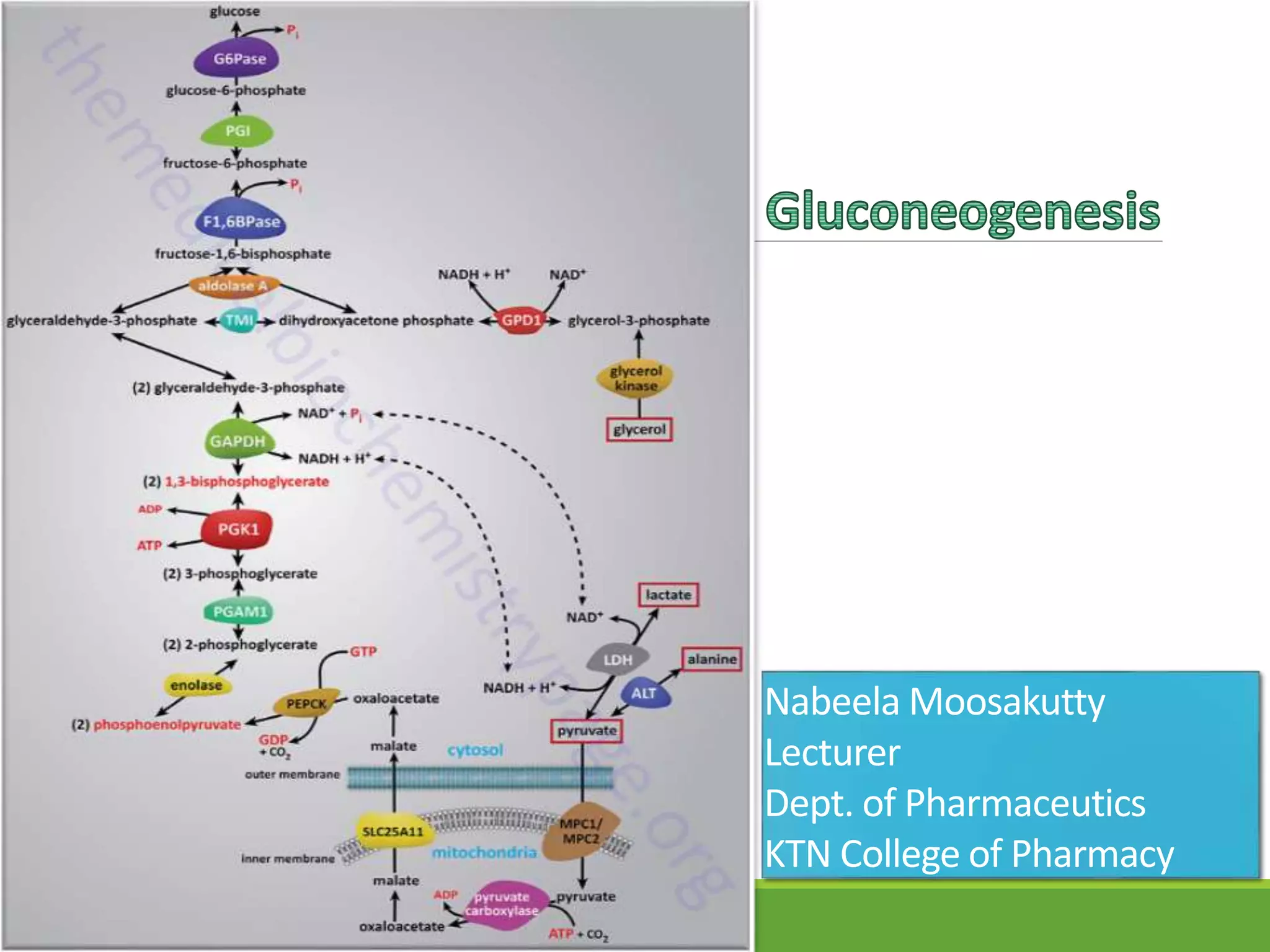
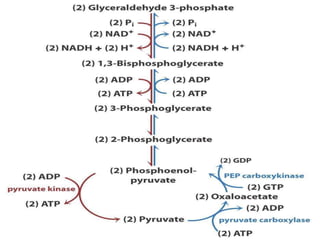
 Pyruvate carboxylase
 Phosphoenol pyruvate carboxy kinase
 Fructose-1-6-bisphosphatase
 Glucose-6-phosphatase
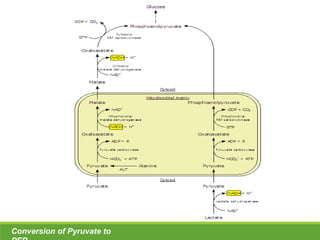
Takes place in two steps pyruvate
carboxylase is a biotin dependent
mitochondrial enzyme that converts
pyruvate to oxaloacetate in presence of ATP
& CO2
This enzyme regulates gluconeogenesis &
requires acetyl CoAfor its activity.
Oxaloacetate is synthesized in the
mitochondrial matrix.
It has to be transported to the cytosol.
Due to membrane impermeability,
oxaloacetate cannot diffuse out of the
mitochondria.
It is converted to malate &transported to
cytosol.
In the cytosol, oxaloacetate is regenerated.
The reversible conversion of oxaloacetate to
malate is catalysed by MDH, present in
mitochondria & cytosol
In the cytosol, phosphoenolpyruvate
carboxykinase converts oxaloacetate to
phospho-enol pyruvate
GTP is used in this reaction and the CO2is
liberated
For the conversion of pyruvate to phospho-enol
pyruvate, 2ATP equivalents are utilized
Conversion of Pyruvate to
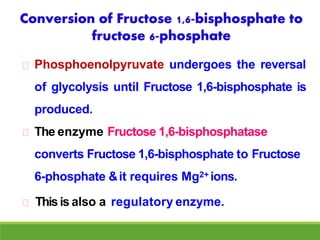
Phosphoenolpyruvate undergoes the reversal
of glycolysis until Fructose 1,6-bisphosphate is
produced.
The enzyme Fructose 1,6-bisphosphatase
converts Fructose 1,6-bisphosphate to Fructose
6-phosphate &it requires Mg2+ ions.
Thisis also a regulatory enzyme.
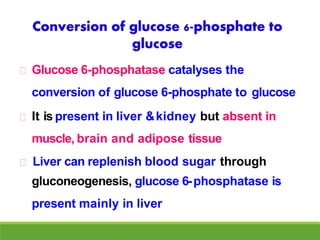
Glucose 6-phosphatase catalyses the
conversion of glucose 6-phosphate to glucose
It is present in liver &kidney but absent in
muscle, brain and adipose tissue
Liver can replenish blood sugar through
gluconeogenesis, glucose 6-phosphatase is
present mainly in liver
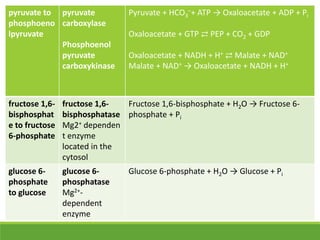
pyruvate to
phosphoeno
lpyruvate
pyruvate
carboxylase
Phosphoenol
pyruvate
carboxykinase
Pyruvate + HCO3
–+ ATP → Oxaloacetate + ADP + Pi
Oxaloacetate + GTP ⇄ PEP + CO2 + GDP
Oxaloacetate + NADH + H+ ⇄ Malate + NAD+
Malate + NAD+ → Oxaloacetate + NADH + H+
fructose 1,6-
bisphosphat
e to fructose
6-phosphate
fructose 1,6-
bisphosphatase
Mg2+ dependen
t enzyme
located in the
cytosol
Fructose 1,6-bisphosphate + H2O → Fructose 6-
phosphate + Pi
glucose 6-
phosphate
to glucose
glucose 6-
phosphatase
Mg2+-
dependent
enzyme
Glucose 6-phosphate + H2O → Glucose + Pi
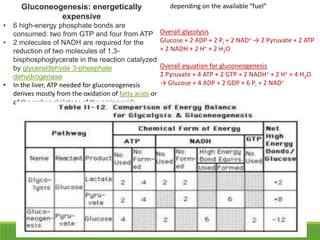
Gluconeogenesis: energetically
expensive
• 6 high-energy phosphate bonds are
consumed: two from GTP and four from ATP
• 2 molecules of NADH are required for the
reduction of two molecules of 1,3-
bisphosphoglycerate in the reaction catalyzed
by glyceraldehyde 3-phosphate
dehydrogenase
• In the liver, ATP needed for gluconeogenesis
derives mostly from the oxidation of fatty acids or
of the carbon skeletons of the amino acids,
depending on the available “fuel”
Overall glycolysis
Glucose + 2 ADP + 2 Pi + 2 NAD+ → 2 Pyruvate + 2 ATP
+ 2 NADH + 2 H+ + 2 H2O
Overall equation for gluconeogenesis
2 Pyruvate + 4 ATP + 2 GTP + 2 NADH+ + 2 H+ + 4 H2O
→ Glucose + 4 ADP + 2 GDP + 6 Pi + 2 NAD+
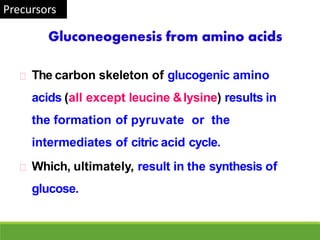
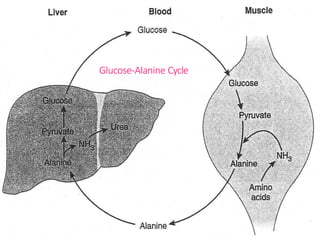
The carbon skeleton of glucogenic amino
acids (all except leucine &lysine) results in
the formation of pyruvate or the
intermediates of citric acid cycle.
Which, ultimately, result in the synthesis of
glucose.
Precursors
Glucose-Alanine Cycle
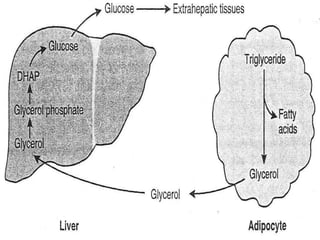
Glycerol is liberated in the adipose tissue by
the hydrolysis of fats (triacylglycerols).
The enzyme glycerokinase (found in liver &
kidney, absent in adipose tissue) activates
glycerol to glycerol 3- phosphate.
It is converted to DHAP by glycerol 3-
phosphate dehydrogenase.
DHAP is an intermediate in glycolysis.
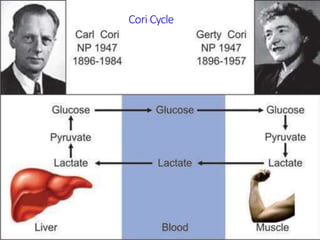
Definition:
It is a process in which glucose is converted to
Lactate in the muscle and in the liver this lactate
is re-converted to glucose.
In an actively contracting muscle, pyruvate is
reduced to lactic acid which may tend to
accumulate in the muscle.
Toprevent lactate accumulation, body utilizes
cori cycle.
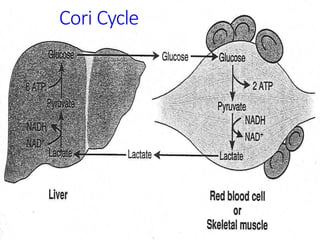
Thislactic acid from muscle diffuses into the
blood.
Lactate then reaches liver, where it is
oxidised to pyruvate.
It is entered into gluconeogenesis.
Regenerated glucose can enter into blood
and then to muscle.
Thiscycle is called cori cycle.
Cori Cycle
Cori Cycle
Textbook of Biochemistry-DM Vasudevan
Textbook of Biochemistry-U Satyanarayana

Gluconeogenesis Biochemistry Second Semester B.Pharm

  • 1.
    Nabeela Moosakutty Lecturer Dept. ofPharmaceutics KTN College of Pharmacy
  • 2.
    Thesynthesis of glucosefrom non- carbohydrate compounds isknown as gluconeogenesis The major substrates/precursors Lactate, pyruvate, glucogenic amino acids, propianate and glycerol Site Gluconeogenesis occursmainly in the liver, and to a lesser extent in the renal cortex Thepathway ispartly mitochondrial & partly cytoplasmic
  • 3.
    Maintaining blood glucosewithin the normal range, 3.3 to 5.5 mmol/L (60 and 99 mg/dL), is essential because many cells and tissues depend, largely or entirely, on glucose to meet their ATP demands Brain &CNS, erythrocytes, testes &kidney medulla are dependent on glucose for continuous supply for energy
  • 4.
    During starvation gluconeogenesis maintainsthe blood glucose level The stored glycogen isdepleted within the first 12- 18hours of fasting On prolonged starvation, the gluconeogenesis is speeded up &protein catabolism provides the substrates, namely glucogenic amino acids The excretion of pyruvate would lead to the loss of the ability to produce ATP through aerobic respiration, i.e. more than 10
  • 6.
    Gluconeogenesis closely resemblesthe reversed pathway of glycolysis The 3irreversible steps of glycolysis are catalysed by the 3enzymes Hexokinase PFK Pyruvate kinase Regulation of Gluconeogenesis
  • 7.
    These three stagesbypassed by alternate enzymes specific to gluconeogenesis These are:  Pyruvate carboxylase  Phosphoenol pyruvate carboxy kinase  Fructose-1-6-bisphosphatase  Glucose-6-phosphatase
  • 8.
    Takes place intwo steps pyruvate carboxylase is a biotin dependent mitochondrial enzyme that converts pyruvate to oxaloacetate in presence of ATP & CO2 This enzyme regulates gluconeogenesis & requires acetyl CoAfor its activity.
  • 9.
    Oxaloacetate is synthesizedin the mitochondrial matrix. It has to be transported to the cytosol. Due to membrane impermeability, oxaloacetate cannot diffuse out of the mitochondria. It is converted to malate &transported to cytosol. In the cytosol, oxaloacetate is regenerated.
  • 10.
    The reversible conversionof oxaloacetate to malate is catalysed by MDH, present in mitochondria & cytosol In the cytosol, phosphoenolpyruvate carboxykinase converts oxaloacetate to phospho-enol pyruvate GTP is used in this reaction and the CO2is liberated For the conversion of pyruvate to phospho-enol pyruvate, 2ATP equivalents are utilized
  • 11.
  • 12.
    Phosphoenolpyruvate undergoes thereversal of glycolysis until Fructose 1,6-bisphosphate is produced. The enzyme Fructose 1,6-bisphosphatase converts Fructose 1,6-bisphosphate to Fructose 6-phosphate &it requires Mg2+ ions. Thisis also a regulatory enzyme.
  • 13.
    Glucose 6-phosphatase catalysesthe conversion of glucose 6-phosphate to glucose It is present in liver &kidney but absent in muscle, brain and adipose tissue Liver can replenish blood sugar through gluconeogenesis, glucose 6-phosphatase is present mainly in liver
  • 14.
    pyruvate to phosphoeno lpyruvate pyruvate carboxylase Phosphoenol pyruvate carboxykinase Pyruvate +HCO3 –+ ATP → Oxaloacetate + ADP + Pi Oxaloacetate + GTP ⇄ PEP + CO2 + GDP Oxaloacetate + NADH + H+ ⇄ Malate + NAD+ Malate + NAD+ → Oxaloacetate + NADH + H+ fructose 1,6- bisphosphat e to fructose 6-phosphate fructose 1,6- bisphosphatase Mg2+ dependen t enzyme located in the cytosol Fructose 1,6-bisphosphate + H2O → Fructose 6- phosphate + Pi glucose 6- phosphate to glucose glucose 6- phosphatase Mg2+- dependent enzyme Glucose 6-phosphate + H2O → Glucose + Pi
  • 16.
    Gluconeogenesis: energetically expensive • 6high-energy phosphate bonds are consumed: two from GTP and four from ATP • 2 molecules of NADH are required for the reduction of two molecules of 1,3- bisphosphoglycerate in the reaction catalyzed by glyceraldehyde 3-phosphate dehydrogenase • In the liver, ATP needed for gluconeogenesis derives mostly from the oxidation of fatty acids or of the carbon skeletons of the amino acids, depending on the available “fuel” Overall glycolysis Glucose + 2 ADP + 2 Pi + 2 NAD+ → 2 Pyruvate + 2 ATP + 2 NADH + 2 H+ + 2 H2O Overall equation for gluconeogenesis 2 Pyruvate + 4 ATP + 2 GTP + 2 NADH+ + 2 H+ + 4 H2O → Glucose + 4 ADP + 2 GDP + 6 Pi + 2 NAD+
  • 19.
    The carbon skeletonof glucogenic amino acids (all except leucine &lysine) results in the formation of pyruvate or the intermediates of citric acid cycle. Which, ultimately, result in the synthesis of glucose. Precursors
  • 20.
  • 21.
    Glycerol is liberatedin the adipose tissue by the hydrolysis of fats (triacylglycerols). The enzyme glycerokinase (found in liver & kidney, absent in adipose tissue) activates glycerol to glycerol 3- phosphate. It is converted to DHAP by glycerol 3- phosphate dehydrogenase. DHAP is an intermediate in glycolysis.
  • 23.
    Definition: It is aprocess in which glucose is converted to Lactate in the muscle and in the liver this lactate is re-converted to glucose. In an actively contracting muscle, pyruvate is reduced to lactic acid which may tend to accumulate in the muscle. Toprevent lactate accumulation, body utilizes cori cycle.
  • 24.
    Thislactic acid frommuscle diffuses into the blood. Lactate then reaches liver, where it is oxidised to pyruvate. It is entered into gluconeogenesis. Regenerated glucose can enter into blood and then to muscle. Thiscycle is called cori cycle.
  • 25.
  • 26.
  • 27.
    Textbook of Biochemistry-DMVasudevan Textbook of Biochemistry-U Satyanarayana