Presented by:-
Presented to:-
                       Rampal
Chitwan Mam
                       Gautam Dhanda
(Faculty member)
                       Ankit Paul
Global strategy:-


 Organization's strategic guide to globalization.
 A sound global strategy should address these
questions:
o what must be (versus what is) the extent of market
presence in the world's major markets?
o How to build the necessary global presence?
o How to run global presence into global competitive
advantage?
Contd..


      It is appropriate in industries where firms are
     faced with strong pressures for cost reduction.
      Global strategies require firms to tightly coordinate
     their product and pricing strategies across
     international markets and locations.
      Firms that pursue a global strategy are typically
     highly centralized.
Why globalize?


      Expand global market share
      Restructure value chain on a
       global scale.
      Ultimate goal.
      Diversification.
      Expansion.
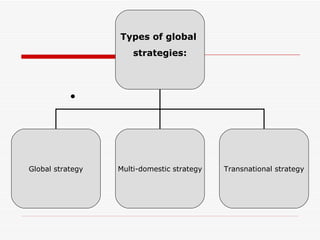
Types of global
                      strategies:


           •


Global strategy   Multi-domestic strategy   Transnational strategy
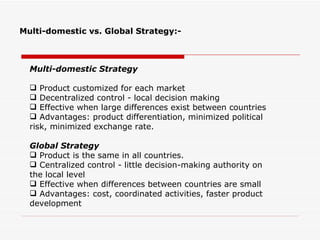
Multi-domestic vs. Global Strategy:-


  Multi-domestic Strategy

   Product customized for each market
   Decentralized control - local decision making
   Effective when large differences exist between countries
   Advantages: product differentiation, minimized political
  risk, minimized exchange rate.

  Global Strategy
   Product is the same in all countries.
   Centralized control - little decision-making authority on
  the local level
   Effective when differences between countries are small
   Advantages: cost, coordinated activities, faster product
  development
Philips followed multidomestic strategy:-


   Innovation from local R&D
   Entrepreneurial spirit
   Products tailored to individual countries
   High quality due to backward integration

Matsushita followed a global strategy :-
 Strong global distribution network
 Financial control
 More applied R&D
 Ability to get to market quickly
Sources of Competitive Advantage from a Global Strategy


Efficiency
     Economies of scale from access to more customers and
    markets
     Exploit another country's resources - labor, raw materials
     Extend the product life cycle-
     Operational flexibility - shift production as costs, exchange
    rates,
    Strategic
         First mover advantage and only provider of a product to a
        market
         Cross subsidization between countries
         Transfer price
Contd…


Risk
    Diversify macroeconomic risks (business cycles
   not perfectly correlated among countries)
    Diversify operational risks (labor problems,
   earthquakes, wars)

Learning
   Broaden learning opportunities due to diversity
   of operating environments

Reputation
    Crossover customers between markets -
   reputation and brand identification
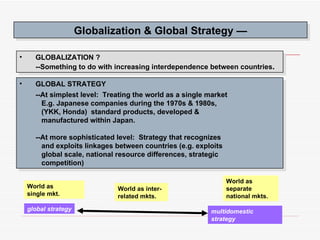
Globalization & Global Strategy —

•     GLOBALIZATION ?
      --Something to do with increasing interdependence between countries.

•     GLOBAL STRATEGY
      --At simplest level: Treating the world as a single market
        E.g. Japanese companies during the 1970s & 1980s,
        (YKK, Honda) standard products, developed &
        manufactured within Japan.

      --At more sophisticated level: Strategy that recognizes
        and exploits linkages between countries (e.g. exploits
        global scale, national resource differences, strategic
        competition)

                                                                 World as
    World as                  World as inter-                    separate
    single mkt.               related mkts.                      national mkts.

    global strategy                                        multidomestic
                                                           strategy
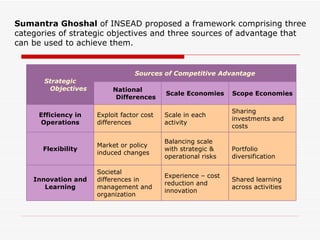
Sumantra Ghoshal of INSEAD proposed a framework comprising three
categories of strategic objectives and three sources of advantage that
can be used to achieve them.


                                 Sources of Competitive Advantage
       Strategic
        Objectives        National
                                           Scale Economies     Scope Economies
                           Differences

                                                               Sharing
     Efficiency in   Exploit factor cost   Scale in each
                                                               investments and
     Operations      differences           activity
                                                               costs

                                           Balancing scale
                     Market or policy
      Flexibility                          with strategic &    Portfolio
                     induced changes
                                           operational risks   diversification

                     Societal
                                           Experience – cost
    Innovation and   differences in                            Shared learning
                                           reduction and
       Learning      management and                            across activities
                                           innovation
                     organization
GLOBAL STRATEGIES


 Four basic avenues that companies can take to market their
 products or services globally:

  Foreign Direct Investment

  Joint ventures

  Contractual agreements.

  Licensing (includes franchising)
Joint venture :--


 Moscow, June 8, 2011 – Ford Motor Company
   and Sollers OJSC have signed agreements to
   establish a 50-50-owned joint venture in
   Russia. The new business, named Ford
   Sollers, is scheduled to start operations later
   this year.
BENEFITS FROM JOINT
VENTURE :--


       New technology used :-

       Basically it replaces the very expensive batteries
        with much smaller and inexpensive ones. This
        affords to position a car at much lower price. In any
        case it is a new product.

       It would help ford to increase the sales and
        production to regain the no.1 position in U.S or other
        markets.
Mergers and Acquisitions:-


 In 1999, Global Crossing
acquired Frontier Corporation, the
former Rochester Telephone
Corporation

 Renamed the company Global
Crossing North America, Inc.

 It sold the local telephone
operations it owned, including the
Frontier name, to Citizens
Communications in 2001, which
renamed itself Frontier
Communications in 2008.
Global level strategy

Global level strategy

  • 1.
    Presented by:- Presented to:- Rampal Chitwan Mam Gautam Dhanda (Faculty member) Ankit Paul
  • 2.
    Global strategy:-  Organization'sstrategic guide to globalization.  A sound global strategy should address these questions: o what must be (versus what is) the extent of market presence in the world's major markets? o How to build the necessary global presence? o How to run global presence into global competitive advantage?
  • 3.
    Contd..  It is appropriate in industries where firms are faced with strong pressures for cost reduction.  Global strategies require firms to tightly coordinate their product and pricing strategies across international markets and locations.  Firms that pursue a global strategy are typically highly centralized.
  • 4.
    Why globalize?  Expand global market share  Restructure value chain on a global scale.  Ultimate goal.  Diversification.  Expansion.
  • 5.
    Types of global strategies: • Global strategy Multi-domestic strategy Transnational strategy
  • 6.
    Multi-domestic vs. GlobalStrategy:- Multi-domestic Strategy  Product customized for each market  Decentralized control - local decision making  Effective when large differences exist between countries  Advantages: product differentiation, minimized political risk, minimized exchange rate. Global Strategy  Product is the same in all countries.  Centralized control - little decision-making authority on the local level  Effective when differences between countries are small  Advantages: cost, coordinated activities, faster product development
  • 7.
    Philips followed multidomesticstrategy:-  Innovation from local R&D  Entrepreneurial spirit  Products tailored to individual countries  High quality due to backward integration Matsushita followed a global strategy :-  Strong global distribution network  Financial control  More applied R&D  Ability to get to market quickly
  • 8.
    Sources of CompetitiveAdvantage from a Global Strategy Efficiency  Economies of scale from access to more customers and markets  Exploit another country's resources - labor, raw materials  Extend the product life cycle-  Operational flexibility - shift production as costs, exchange rates, Strategic  First mover advantage and only provider of a product to a market  Cross subsidization between countries  Transfer price
  • 9.
    Contd… Risk  Diversify macroeconomic risks (business cycles not perfectly correlated among countries)  Diversify operational risks (labor problems, earthquakes, wars) Learning Broaden learning opportunities due to diversity of operating environments Reputation  Crossover customers between markets - reputation and brand identification
  • 10.
    Globalization & GlobalStrategy — • GLOBALIZATION ? --Something to do with increasing interdependence between countries. • GLOBAL STRATEGY --At simplest level: Treating the world as a single market E.g. Japanese companies during the 1970s & 1980s, (YKK, Honda) standard products, developed & manufactured within Japan. --At more sophisticated level: Strategy that recognizes and exploits linkages between countries (e.g. exploits global scale, national resource differences, strategic competition) World as World as World as inter- separate single mkt. related mkts. national mkts. global strategy multidomestic strategy
  • 11.
    Sumantra Ghoshal ofINSEAD proposed a framework comprising three categories of strategic objectives and three sources of advantage that can be used to achieve them. Sources of Competitive Advantage Strategic Objectives National Scale Economies Scope Economies Differences Sharing Efficiency in Exploit factor cost Scale in each investments and Operations differences activity costs Balancing scale Market or policy Flexibility with strategic & Portfolio induced changes operational risks diversification Societal Experience – cost Innovation and differences in Shared learning reduction and Learning management and across activities innovation organization
  • 12.
    GLOBAL STRATEGIES Fourbasic avenues that companies can take to market their products or services globally:  Foreign Direct Investment  Joint ventures  Contractual agreements.  Licensing (includes franchising)
  • 13.
    Joint venture :-- Moscow, June 8, 2011 – Ford Motor Company and Sollers OJSC have signed agreements to establish a 50-50-owned joint venture in Russia. The new business, named Ford Sollers, is scheduled to start operations later this year.
  • 14.
    BENEFITS FROM JOINT VENTURE:--  New technology used :-  Basically it replaces the very expensive batteries with much smaller and inexpensive ones. This affords to position a car at much lower price. In any case it is a new product.  It would help ford to increase the sales and production to regain the no.1 position in U.S or other markets.
  • 15.
    Mergers and Acquisitions:- In 1999, Global Crossing acquired Frontier Corporation, the former Rochester Telephone Corporation  Renamed the company Global Crossing North America, Inc.  It sold the local telephone operations it owned, including the Frontier name, to Citizens Communications in 2001, which renamed itself Frontier Communications in 2008.