



Strategy Formulation
PRESENTED BY:
KAMAL SINGH
IFTM UNIVESITY
Anamika
Introduction
Strategy formulation is the process by which an organization
chooses the most appropriate courses of action to achieve its
defined goals.
This process is essential to an organization’s success, because
it provides a framework for the actions that will lead to the
anticipated results. Strategic plans should be communicated to
all employees so that they are aware of the organization’s
objectives, mission, and purpose.
Strategy formulation forces an organization to carefully look at
the changing environment and to be prepared for the possible
changes that may occur.
A strategic plan also enables an organization to evaluate its
resources, allocate budgets, and determine the most effective
plan for maximizing ROI (return on investment).
Evaluation of Current
Results:
Henry mintzberg, after much research found that strategy
formulation is typically not a regular, continuous
process. “it is small, often an irregular,discountinuous
process,proceeding in fits and starts. these are period of
stability in strategy development. But also there are
periods of flux, of grouping,of pricemical changes and
global changes.”
Mode of Strategy
Formulations:
Entrepreneurial Mode
Adaptive Mode
Planning Mode
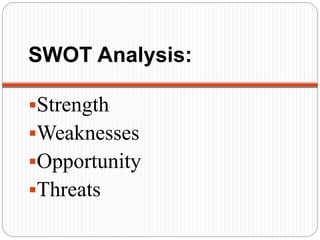
SWOT Analysis:
Strength
Weaknesses
Opportunity
Threats
STABILITY STRATEGIES
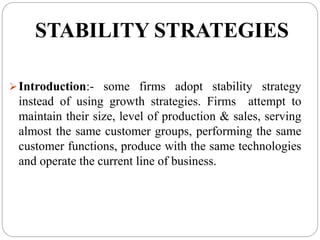
Introduction:- some firms adopt stability strategy
instead of using growth strategies. Firms attempt to
maintain their size, level of production & sales, serving
almost the same customer groups, performing the same
customer functions, produce with the same technologies
and operate the current line of business.
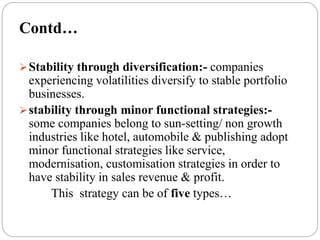
Stability through diversification:- companies
experiencing volatilities diversify to stable portfolio
businesses.
stability through minor functional strategies:-
some companies belong to sun-setting/ non growth
industries like hotel, automobile & publishing adopt
minor functional strategies like service,
modernisation, customisation strategies in order to
have stability in sales revenue & profit.
This strategy can be of five types…
Contd…
 Maintenance of status Quo
 Sustainable growth
 Pause/Proceed with caution strategy
 No change strategy
 Profit strategy.
Contd…
Reasons for adopting stability strategies:- Firms
adopt the stability strategies due to the following
reasons:
Manager of small businesses desire a satisfactory
level of profit rather than increased profit.
Maintenance of status quo involve less risk than a
more growth strategy.
Change of any form may disrupt the current working
relationship & the consequence may be detrimental to
the organisation.
Contd…
Change may upset the smooth operations and result in
poor performance especially, if the firm considers
itself successful with the present level of operations.
Some executives maintain with the stability strategy
due to inertia for change.
In some cases, firms are forced to adopt stability
strategy, if they operate in a low growth or no growth
industry.
Sometimes, firms may find that the cost of growth is
more than the benefits of the same.
Contd…
GROWTH STRATEGIES
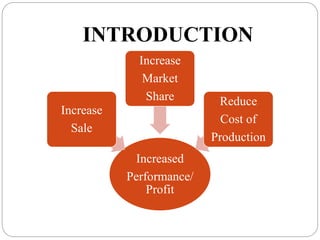
INTRODUCTION
Increased
Performance/
Profit
Increase
Sale
Increase
Market
Share Reduce
Cost of
Production
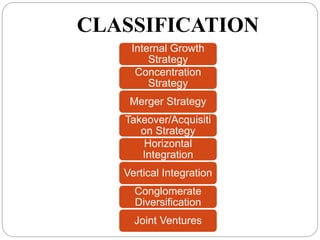
CLASSIFICATION
Internal Growth
Strategy
Concentration
Strategy
Merger Strategy
Takeover/Acquisiti
on Strategy
Horizontal
Integration
Vertical Integration
Conglomerate
Diversification
Joint Ventures
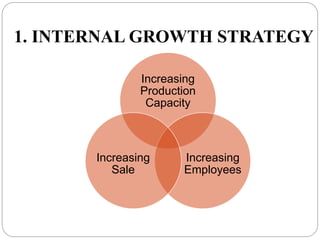
1. INTERNAL GROWTH STRATEGY
Increasing
Production
Capacity
Increasing
Employees
Increasing
Sale
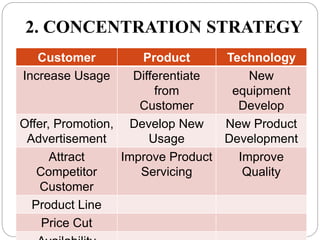
2. CONCENTRATION STRATEGY
Customer Product Technology
Increase Usage Differentiate
from
Customer
New
equipment
Develop
Offer, Promotion,
Advertisement
Develop New
Usage
New Product
Development
Attract
Competitor
Customer
Improve Product
Servicing
Improve
Quality
Product Line
Price Cut
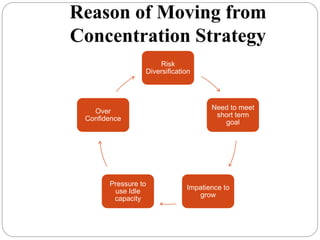
Reason of Moving from
Concentration Strategy
Risk
Diversification
Need to meet
short term
goal
Impatience to
grow
Pressure to
use Idle
capacity
Over
Confidence
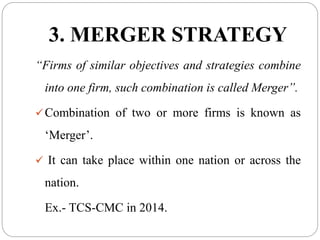
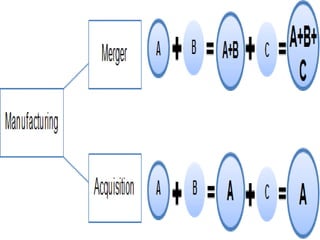
3. MERGER STRATEGY
“Firms of similar objectives and strategies combine
into one firm, such combination is called Merger”.
Combination of two or more firms is known as
‘Merger’.
 It can take place within one nation or across the
nation.
Ex.- TCS-CMC in 2014.
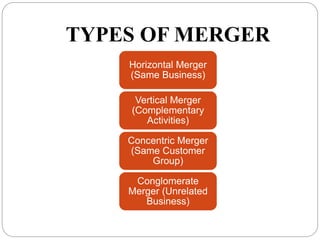
TYPES OF MERGER
Horizontal Merger
(Same Business)
Vertical Merger
(Complementary
Activities)
Concentric Merger
(Same Customer
Group)
Conglomerate
Merger (Unrelated
Business)
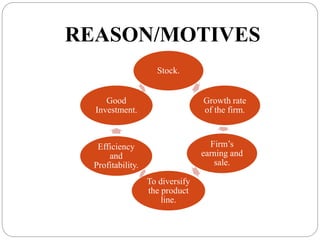
REASON/MOTIVES
Stock.
Growth rate
of the firm.
Firm’s
earning and
sale.
To diversify
the product
line.
Efficiency
and
Profitability.
Good
Investment.
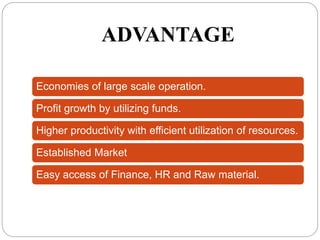
ADVANTAGE
Economies of large scale operation.
Profit growth by utilizing funds.
Higher productivity with efficient utilization of resources.
Established Market
Easy access of Finance, HR and Raw material.
DIS-ADVANTAGE
Strategic Issue (Strength & Weakness)
Managerial Issue
Legal Issue
Negative attitude of Senior firm towards
Junior.
4. TAKEOVER/ACQUISITION
“Attempt of one firm to acquire ownership or control
over another firm against the wishes of latter’s
Management.”
 It can be hostile (Against the wishes) or friendly
(through mutual consent).
Ex. Tata steel acquire Corus Group.
Videocon acquire Daewoo Electronics.
ADVANTAGE
Ensure Management
Accountability.
Easy growth opportunities.
Create mobility of resources from
one activity to another activity.
DIS-ADVANTAGE
Professionalization of management
may be replaced by money power.
Detrimental to the society.
They result in monopoly and
concentration of economic power.
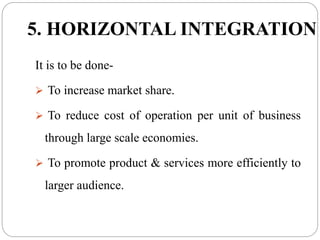
5. HORIZONTAL INTEGRATION
It is to be done-
 To increase market share.
 To reduce cost of operation per unit of business
through large scale economies.
 To promote product & services more efficiently to
larger audience.
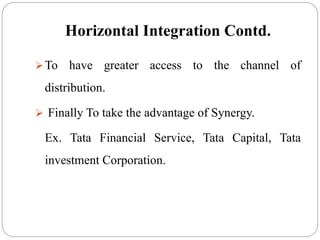
Horizontal Integration Contd.
To have greater access to the channel of
distribution.
 Finally To take the advantage of Synergy.
Ex. Tata Financial Service, Tata Capital, Tata
investment Corporation.
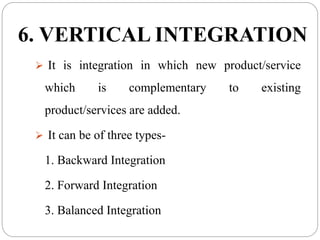
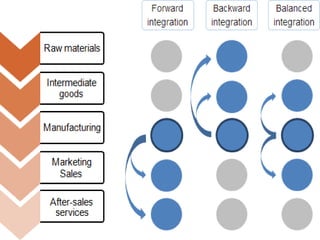
6. VERTICAL INTEGRATION
 It is integration in which new product/service
which is complementary to existing
product/services are added.
 It can be of three types-
1. Backward Integration
2. Forward Integration
3. Balanced Integration
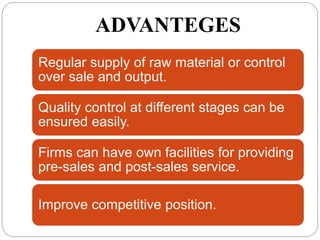
ADVANTEGES
Regular supply of raw material or control
over sale and output.
Quality control at different stages can be
ensured easily.
Firms can have own facilities for providing
pre-sales and post-sales service.
Improve competitive position.
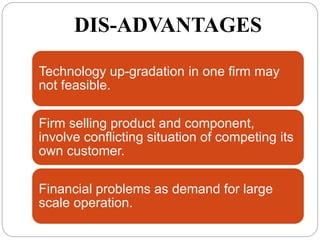
DIS-ADVANTAGES
Technology up-gradation in one firm may
not feasible.
Firm selling product and component,
involve conflicting situation of competing its
own customer.
Financial problems as demand for large
scale operation.
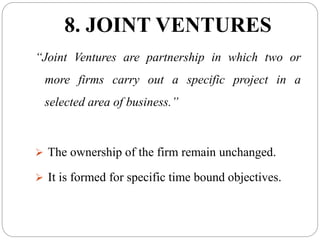
8. JOINT VENTURES
“Joint Ventures are partnership in which two or
more firms carry out a specific project in a
selected area of business.”
 The ownership of the firm remain unchanged.
 It is formed for specific time bound objectives.
When Do Joint Venture Form:
Joint Venture form-
 An activity is un-economical for an organization
to do alone.
 Risk of business has to be shared.
 Strength can be combined.
 Requirement of other firm’s ability.
CHARACTERISTICS
 It has a scheduled life cycle.
 It has to be dissolved when it has outlived its life
cycle.
 Change in environment force the joint venture to
be redesigned regularly.
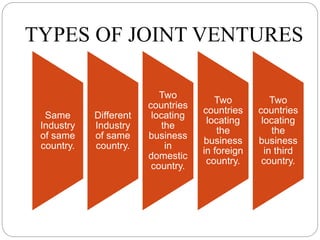
TYPES OF JOINT VENTURES
Same
Industry
of same
country.
Different
Industry
of same
country.
Two
countries
locating
the
business
in
domestic
country.
Two
countries
locating
the
business
in foreign
country.
Two
countries
locating
the
business
in third
country.
ADVANTAGES
Spread development/production cost.
Combine resources and knowledge of
expertise in different fields.
Trial process to see that firm can work in
merger.
Quick access to channel of distribution.
Minimize the risk to both the partners.
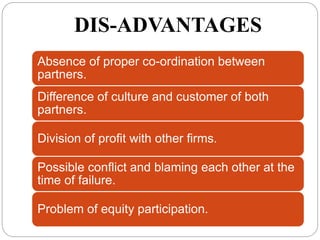
DIS-ADVANTAGES
Absence of proper co-ordination between
partners.
Difference of culture and customer of both
partners.
Division of profit with other firms.
Possible conflict and blaming each other at the
time of failure.
Problem of equity participation.
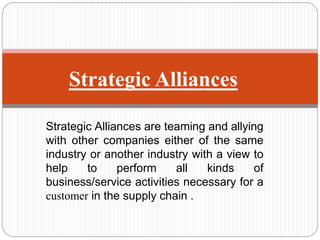
Strategic Alliances
Strategic Alliances are teaming and allying
with other companies either of the same
industry or another industry with a view to
help to perform all kinds of
business/service activities necessary for a
customer in the supply chain .
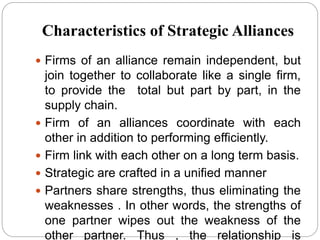
Characteristics of Strategic Alliances
 Firms of an alliance remain independent, but
join together to collaborate like a single firm,
to provide the total but part by part, in the
supply chain.
 Firm of an alliances coordinate with each
other in addition to performing efficiently.
 Firm link with each other on a long term basis.
 Strategic are crafted in a unified manner
 Partners share strengths, thus eliminating the
weaknesses . In other words, the strengths of
one partner wipes out the weakness of the
other partner. Thus , the relationship is
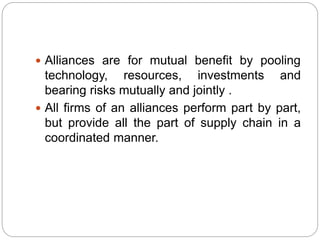
 Alliances are for mutual benefit by pooling
technology, resources, investments and
bearing risks mutually and jointly .
 All firms of an alliances perform part by part,
but provide all the part of supply chain in a
coordinated manner.
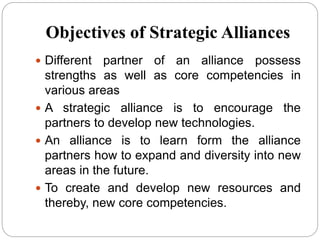
Objectives of Strategic Alliances
 Different partner of an alliance possess
strengths as well as core competencies in
various areas
 A strategic alliance is to encourage the
partners to develop new technologies.
 An alliance is to learn form the alliance
partners how to expand and diversity into new
areas in the future.
 To create and develop new resources and
thereby, new core competencies.
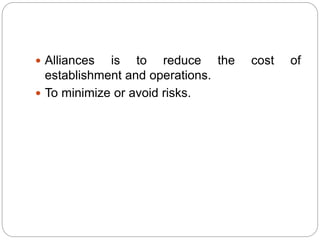
 Alliances is to reduce the cost of
establishment and operations.
 To minimize or avoid risks.
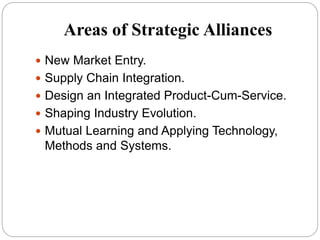
Areas of Strategic Alliances
 New Market Entry.
 Supply Chain Integration.
 Design an Integrated Product-Cum-Service.
 Shaping Industry Evolution.
 Mutual Learning and Applying Technology,
Methods and Systems.
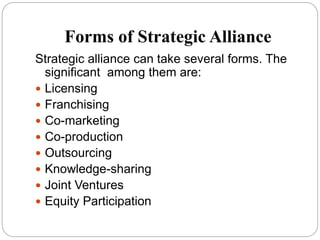
Forms of Strategic Alliance
Strategic alliance can take several forms. The
significant among them are:
 Licensing
 Franchising
 Co-marketing
 Co-production
 Outsourcing
 Knowledge-sharing
 Joint Ventures
 Equity Participation
Strategic Alliances
Advantages of Strategic Alliances
 Alliances and collaborative arrangement
normally result in win-win outcomes to the
parties.
 Alliances help in racing against rivals for
market leadership.
 Alliances help in acquiring new competencies,
improve supply chain efficiently and gain
economies of scale.
 Alliances help in entering critical markets and
building a potent market presence.
 Knowledge about unfamiliar markets.
 Skills and competencies .
Disadvantages of Strategic Alliances
 Increase in incompatibility of partners.
 Risk of Knowledge/Skill Drain .
 Risk of Dependence.
 Cost of Coordination.
 Cost of Learning .
 Cost of Inflexibility .
 Cooperation and Competition.
 Shifting Loyalties of Staff.
RETRENCHMENT
STRATEGY
RETRENCHMENT STRATEGY
A strategy used by corporations to reduce
the diversity or the overall size of the operations of
the company. This strategy is often used in order to
cut expenses with the goal of becoming a more
financial stable business.
REASON FOR ADOPTING
 Prevalence of poor economic condition.
 Competitive pressure may cause firms to pursue.
retrenchment strategies.
 Due to production inefficiencies.
 Inability of firm to implement latest technology
caused by technology evolution.
 Company is not doing well.
 Company has not meet its objective and there is
pressure from stakeholders, customers or others.
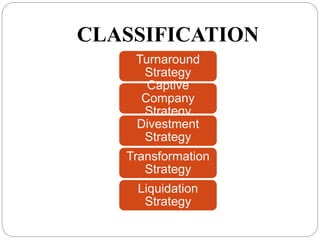
CLASSIFICATION
Turnaround
Strategy
Captive
Company
Strategy
Divestment
Strategy
Transformation
Strategy
Liquidation
Strategy
1. TURNAROUND STRATEGY
 Turnaround strategy helps to improve the internal
efficiency of the organization.
 Aim of this strategy is to transform the
organization into a learner and more effective
business.
There are two approaches in this strategy:
1. Surgical Approach
2. HRD Approach
REASONS
Incurring Losses continuously.
Declining demand for product & services.
Increasing cash outflow or decreasing cash inflow.
Declining sales & Market Share.
Declining productivity.
Continuous problem of working capital.
TURNAROUND PROCESS
 Diagnosing the problem accurately.
 Analysis the product, service, design,
configuration, customer taste & preference against
the competitor’s product and substitute product.
 Analysing production process, technology
competitor’s strategy, market segment etc.
 Feed-forward the information in various
decisional areas.
 Take up activities systematically.
2. CAPTIVE COMPANY STRATEGY
Under this strategy firm sells majority of its
product to one customer (wholesaler/dealer) or
outsources its production activities.
Customer provides design to captive manufacturer
who produce according to this design and supplies
the product to customer.
Captive strategy reduce labour cost and reducing
size of employees.
CAPTIVE COMPANY STRATEGY Contd.
The firm need not involve the cost of product
design and marketing and also minimize risk of
marketing.
It may also be effective for a new company.
The major limitation of this strategy is that the
company is limited by the activities of its captor.
3. TRANSFORMATION STRATEGY
A transformation occurs when a firm makes a
major change in its outlook and its operations
usually including moving from one kind of
business to another.
These strategies are difficult to implement because
they require a great deal of flexibility on the part of
the entire organization.
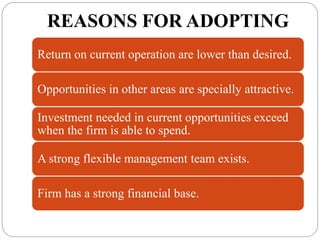
REASONS FOR ADOPTING
Return on current operation are lower than desired.
Opportunities in other areas are specially attractive.
Investment needed in current opportunities exceed
when the firm is able to spend.
A strong flexible management team exists.
Firm has a strong financial base.
4. DIVESTMENT STRATEGY
The company sells or “spins off” one of its
business unit under the divestment strategy.
It is usually adopted when the company is
performing poorly or when it no longer fits the
company’s strategic profile.
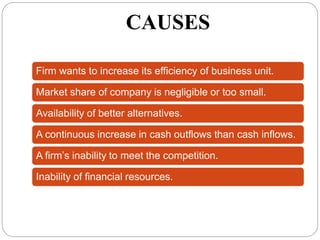
CAUSES
Firm wants to increase its efficiency of business unit.
Market share of company is negligible or too small.
Availability of better alternatives.
A continuous increase in cash outflows than cash inflows.
A firm’s inability to meet the competition.
Inability of financial resources.
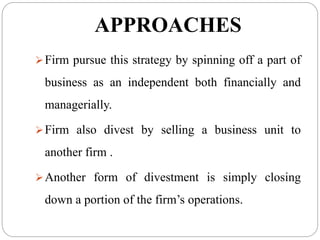
APPROACHES
Firm pursue this strategy by spinning off a part of
business as an independent both financially and
managerially.
Firm also divest by selling a business unit to
another firm .
Another form of divestment is simply closing
down a portion of the firm’s operations.
5. Liquidation Strategy
It is most extreme retrenchment strategy.
I involves closing down a business organization
and selling its assets.
This is the last alternative strategy as its
consequence are severe.
CAUSES
In small firms when one or more shareholders
want to withdraw from the business.
Other shareholders express their inability to buy
the withdrawing partner’s share.
Owners may receive “Godfather Offer” i.e. highly
attractive offer and they feel that liquidation is
more worthwhile.
Value of the assets is more worthwhile than the
rate of return earned by the firm.

STRATEGIC MANAGEMENT

  • 1.
    Strategy Formulation PRESENTED BY: KAMALSINGH IFTM UNIVESITY Anamika
  • 2.
  • 3.
    Strategy formulation isthe process by which an organization chooses the most appropriate courses of action to achieve its defined goals. This process is essential to an organization’s success, because it provides a framework for the actions that will lead to the anticipated results. Strategic plans should be communicated to all employees so that they are aware of the organization’s objectives, mission, and purpose. Strategy formulation forces an organization to carefully look at the changing environment and to be prepared for the possible changes that may occur. A strategic plan also enables an organization to evaluate its resources, allocate budgets, and determine the most effective plan for maximizing ROI (return on investment).
  • 4.
    Evaluation of Current Results: Henrymintzberg, after much research found that strategy formulation is typically not a regular, continuous process. “it is small, often an irregular,discountinuous process,proceeding in fits and starts. these are period of stability in strategy development. But also there are periods of flux, of grouping,of pricemical changes and global changes.”
  • 5.
    Mode of Strategy Formulations: EntrepreneurialMode Adaptive Mode Planning Mode
  • 6.
  • 7.
  • 8.
    STABILITY STRATEGIES Introduction:- somefirms adopt stability strategy instead of using growth strategies. Firms attempt to maintain their size, level of production & sales, serving almost the same customer groups, performing the same customer functions, produce with the same technologies and operate the current line of business.
  • 9.
    Stability through diversification:-companies experiencing volatilities diversify to stable portfolio businesses. stability through minor functional strategies:- some companies belong to sun-setting/ non growth industries like hotel, automobile & publishing adopt minor functional strategies like service, modernisation, customisation strategies in order to have stability in sales revenue & profit. This strategy can be of five types… Contd…
  • 10.
     Maintenance ofstatus Quo  Sustainable growth  Pause/Proceed with caution strategy  No change strategy  Profit strategy. Contd…
  • 11.
    Reasons for adoptingstability strategies:- Firms adopt the stability strategies due to the following reasons: Manager of small businesses desire a satisfactory level of profit rather than increased profit. Maintenance of status quo involve less risk than a more growth strategy. Change of any form may disrupt the current working relationship & the consequence may be detrimental to the organisation. Contd…
  • 12.
    Change may upsetthe smooth operations and result in poor performance especially, if the firm considers itself successful with the present level of operations. Some executives maintain with the stability strategy due to inertia for change. In some cases, firms are forced to adopt stability strategy, if they operate in a low growth or no growth industry. Sometimes, firms may find that the cost of growth is more than the benefits of the same. Contd…
  • 13.
  • 14.
  • 15.
    CLASSIFICATION Internal Growth Strategy Concentration Strategy Merger Strategy Takeover/Acquisiti onStrategy Horizontal Integration Vertical Integration Conglomerate Diversification Joint Ventures
  • 16.
    1. INTERNAL GROWTHSTRATEGY Increasing Production Capacity Increasing Employees Increasing Sale
  • 17.
    2. CONCENTRATION STRATEGY CustomerProduct Technology Increase Usage Differentiate from Customer New equipment Develop Offer, Promotion, Advertisement Develop New Usage New Product Development Attract Competitor Customer Improve Product Servicing Improve Quality Product Line Price Cut
  • 18.
    Reason of Movingfrom Concentration Strategy Risk Diversification Need to meet short term goal Impatience to grow Pressure to use Idle capacity Over Confidence
  • 20.
    3. MERGER STRATEGY “Firmsof similar objectives and strategies combine into one firm, such combination is called Merger”. Combination of two or more firms is known as ‘Merger’.  It can take place within one nation or across the nation. Ex.- TCS-CMC in 2014.
  • 21.
    TYPES OF MERGER HorizontalMerger (Same Business) Vertical Merger (Complementary Activities) Concentric Merger (Same Customer Group) Conglomerate Merger (Unrelated Business)
  • 22.
    REASON/MOTIVES Stock. Growth rate of thefirm. Firm’s earning and sale. To diversify the product line. Efficiency and Profitability. Good Investment.
  • 23.
    ADVANTAGE Economies of largescale operation. Profit growth by utilizing funds. Higher productivity with efficient utilization of resources. Established Market Easy access of Finance, HR and Raw material.
  • 24.
    DIS-ADVANTAGE Strategic Issue (Strength& Weakness) Managerial Issue Legal Issue Negative attitude of Senior firm towards Junior.
  • 25.
    4. TAKEOVER/ACQUISITION “Attempt ofone firm to acquire ownership or control over another firm against the wishes of latter’s Management.”  It can be hostile (Against the wishes) or friendly (through mutual consent). Ex. Tata steel acquire Corus Group. Videocon acquire Daewoo Electronics.
  • 26.
    ADVANTAGE Ensure Management Accountability. Easy growthopportunities. Create mobility of resources from one activity to another activity.
  • 27.
    DIS-ADVANTAGE Professionalization of management maybe replaced by money power. Detrimental to the society. They result in monopoly and concentration of economic power.
  • 28.
    5. HORIZONTAL INTEGRATION Itis to be done-  To increase market share.  To reduce cost of operation per unit of business through large scale economies.  To promote product & services more efficiently to larger audience.
  • 29.
    Horizontal Integration Contd. Tohave greater access to the channel of distribution.  Finally To take the advantage of Synergy. Ex. Tata Financial Service, Tata Capital, Tata investment Corporation.
  • 30.
    6. VERTICAL INTEGRATION It is integration in which new product/service which is complementary to existing product/services are added.  It can be of three types- 1. Backward Integration 2. Forward Integration 3. Balanced Integration
  • 32.
    ADVANTEGES Regular supply ofraw material or control over sale and output. Quality control at different stages can be ensured easily. Firms can have own facilities for providing pre-sales and post-sales service. Improve competitive position.
  • 33.
    DIS-ADVANTAGES Technology up-gradation inone firm may not feasible. Firm selling product and component, involve conflicting situation of competing its own customer. Financial problems as demand for large scale operation.
  • 35.
    8. JOINT VENTURES “JointVentures are partnership in which two or more firms carry out a specific project in a selected area of business.”  The ownership of the firm remain unchanged.  It is formed for specific time bound objectives.
  • 36.
    When Do JointVenture Form: Joint Venture form-  An activity is un-economical for an organization to do alone.  Risk of business has to be shared.  Strength can be combined.  Requirement of other firm’s ability.
  • 37.
    CHARACTERISTICS  It hasa scheduled life cycle.  It has to be dissolved when it has outlived its life cycle.  Change in environment force the joint venture to be redesigned regularly.
  • 38.
    TYPES OF JOINTVENTURES Same Industry of same country. Different Industry of same country. Two countries locating the business in domestic country. Two countries locating the business in foreign country. Two countries locating the business in third country.
  • 39.
    ADVANTAGES Spread development/production cost. Combineresources and knowledge of expertise in different fields. Trial process to see that firm can work in merger. Quick access to channel of distribution. Minimize the risk to both the partners.
  • 40.
    DIS-ADVANTAGES Absence of properco-ordination between partners. Difference of culture and customer of both partners. Division of profit with other firms. Possible conflict and blaming each other at the time of failure. Problem of equity participation.
  • 41.
    Strategic Alliances Strategic Alliancesare teaming and allying with other companies either of the same industry or another industry with a view to help to perform all kinds of business/service activities necessary for a customer in the supply chain .
  • 42.
    Characteristics of StrategicAlliances  Firms of an alliance remain independent, but join together to collaborate like a single firm, to provide the total but part by part, in the supply chain.  Firm of an alliances coordinate with each other in addition to performing efficiently.  Firm link with each other on a long term basis.  Strategic are crafted in a unified manner  Partners share strengths, thus eliminating the weaknesses . In other words, the strengths of one partner wipes out the weakness of the other partner. Thus , the relationship is
  • 43.
     Alliances arefor mutual benefit by pooling technology, resources, investments and bearing risks mutually and jointly .  All firms of an alliances perform part by part, but provide all the part of supply chain in a coordinated manner.
  • 44.
    Objectives of StrategicAlliances  Different partner of an alliance possess strengths as well as core competencies in various areas  A strategic alliance is to encourage the partners to develop new technologies.  An alliance is to learn form the alliance partners how to expand and diversity into new areas in the future.  To create and develop new resources and thereby, new core competencies.
  • 45.
     Alliances isto reduce the cost of establishment and operations.  To minimize or avoid risks.
  • 46.
    Areas of StrategicAlliances  New Market Entry.  Supply Chain Integration.  Design an Integrated Product-Cum-Service.  Shaping Industry Evolution.  Mutual Learning and Applying Technology, Methods and Systems.
  • 47.
    Forms of StrategicAlliance Strategic alliance can take several forms. The significant among them are:  Licensing  Franchising  Co-marketing  Co-production  Outsourcing  Knowledge-sharing  Joint Ventures  Equity Participation
  • 48.
  • 49.
    Advantages of StrategicAlliances  Alliances and collaborative arrangement normally result in win-win outcomes to the parties.  Alliances help in racing against rivals for market leadership.  Alliances help in acquiring new competencies, improve supply chain efficiently and gain economies of scale.  Alliances help in entering critical markets and building a potent market presence.  Knowledge about unfamiliar markets.  Skills and competencies .
  • 50.
    Disadvantages of StrategicAlliances  Increase in incompatibility of partners.  Risk of Knowledge/Skill Drain .  Risk of Dependence.  Cost of Coordination.  Cost of Learning .  Cost of Inflexibility .  Cooperation and Competition.  Shifting Loyalties of Staff.
  • 51.
  • 52.
    RETRENCHMENT STRATEGY A strategyused by corporations to reduce the diversity or the overall size of the operations of the company. This strategy is often used in order to cut expenses with the goal of becoming a more financial stable business.
  • 53.
    REASON FOR ADOPTING Prevalence of poor economic condition.  Competitive pressure may cause firms to pursue. retrenchment strategies.  Due to production inefficiencies.  Inability of firm to implement latest technology caused by technology evolution.  Company is not doing well.  Company has not meet its objective and there is pressure from stakeholders, customers or others.
  • 54.
  • 55.
    1. TURNAROUND STRATEGY Turnaround strategy helps to improve the internal efficiency of the organization.  Aim of this strategy is to transform the organization into a learner and more effective business. There are two approaches in this strategy: 1. Surgical Approach 2. HRD Approach
  • 56.
    REASONS Incurring Losses continuously. Decliningdemand for product & services. Increasing cash outflow or decreasing cash inflow. Declining sales & Market Share. Declining productivity. Continuous problem of working capital.
  • 57.
    TURNAROUND PROCESS  Diagnosingthe problem accurately.  Analysis the product, service, design, configuration, customer taste & preference against the competitor’s product and substitute product.  Analysing production process, technology competitor’s strategy, market segment etc.  Feed-forward the information in various decisional areas.  Take up activities systematically.
  • 58.
    2. CAPTIVE COMPANYSTRATEGY Under this strategy firm sells majority of its product to one customer (wholesaler/dealer) or outsources its production activities. Customer provides design to captive manufacturer who produce according to this design and supplies the product to customer. Captive strategy reduce labour cost and reducing size of employees.
  • 59.
    CAPTIVE COMPANY STRATEGYContd. The firm need not involve the cost of product design and marketing and also minimize risk of marketing. It may also be effective for a new company. The major limitation of this strategy is that the company is limited by the activities of its captor.
  • 60.
    3. TRANSFORMATION STRATEGY Atransformation occurs when a firm makes a major change in its outlook and its operations usually including moving from one kind of business to another. These strategies are difficult to implement because they require a great deal of flexibility on the part of the entire organization.
  • 61.
    REASONS FOR ADOPTING Returnon current operation are lower than desired. Opportunities in other areas are specially attractive. Investment needed in current opportunities exceed when the firm is able to spend. A strong flexible management team exists. Firm has a strong financial base.
  • 62.
    4. DIVESTMENT STRATEGY Thecompany sells or “spins off” one of its business unit under the divestment strategy. It is usually adopted when the company is performing poorly or when it no longer fits the company’s strategic profile.
  • 63.
    CAUSES Firm wants toincrease its efficiency of business unit. Market share of company is negligible or too small. Availability of better alternatives. A continuous increase in cash outflows than cash inflows. A firm’s inability to meet the competition. Inability of financial resources.
  • 64.
    APPROACHES Firm pursue thisstrategy by spinning off a part of business as an independent both financially and managerially. Firm also divest by selling a business unit to another firm . Another form of divestment is simply closing down a portion of the firm’s operations.
  • 65.
    5. Liquidation Strategy Itis most extreme retrenchment strategy. I involves closing down a business organization and selling its assets. This is the last alternative strategy as its consequence are severe.
  • 66.
    CAUSES In small firmswhen one or more shareholders want to withdraw from the business. Other shareholders express their inability to buy the withdrawing partner’s share. Owners may receive “Godfather Offer” i.e. highly attractive offer and they feel that liquidation is more worthwhile. Value of the assets is more worthwhile than the rate of return earned by the firm.