Mergers and acquisitions
Mergers A  merger  is a transaction that results in the transfer of ownership  and  control of a corporation.
Merger Motives Improve overall performance of the merged firms through cost savings, elimination of overlapping operations, improve purchasing power, increase market share, or reduce competition. Company growth Broaden product lines Acquire technology / skills Acquire new markets Financial restructuring: cutting costs selling off units laying off employees refinancing company 6
Types of Mergers Economists distinguish between three types of mergers: Horizontal Vertical Conglomerate
Horizontal Mergers Two firms producing the same product merge to achieve economies of scale. Bank A has a huge back office function to clear checks. It can just as easily handle another 500,000 customers.
Vertical Mergers A firm in industry A sells its output to industry B.  Two firms merge to integrate their production.
Conglomerate mergers Consolidated firms may sell related products, share marketing and distribution channels and perhaps production processes; or they may be wholly unrelated. Examples: Cardinal Healthcare-Allegiance;  AOL-Time Warner; Phillip Morris-Kraft; Citicorp-Travelers Insurance; Pepsico-Pizza Hut; Proctor & Gamble-Clorox.
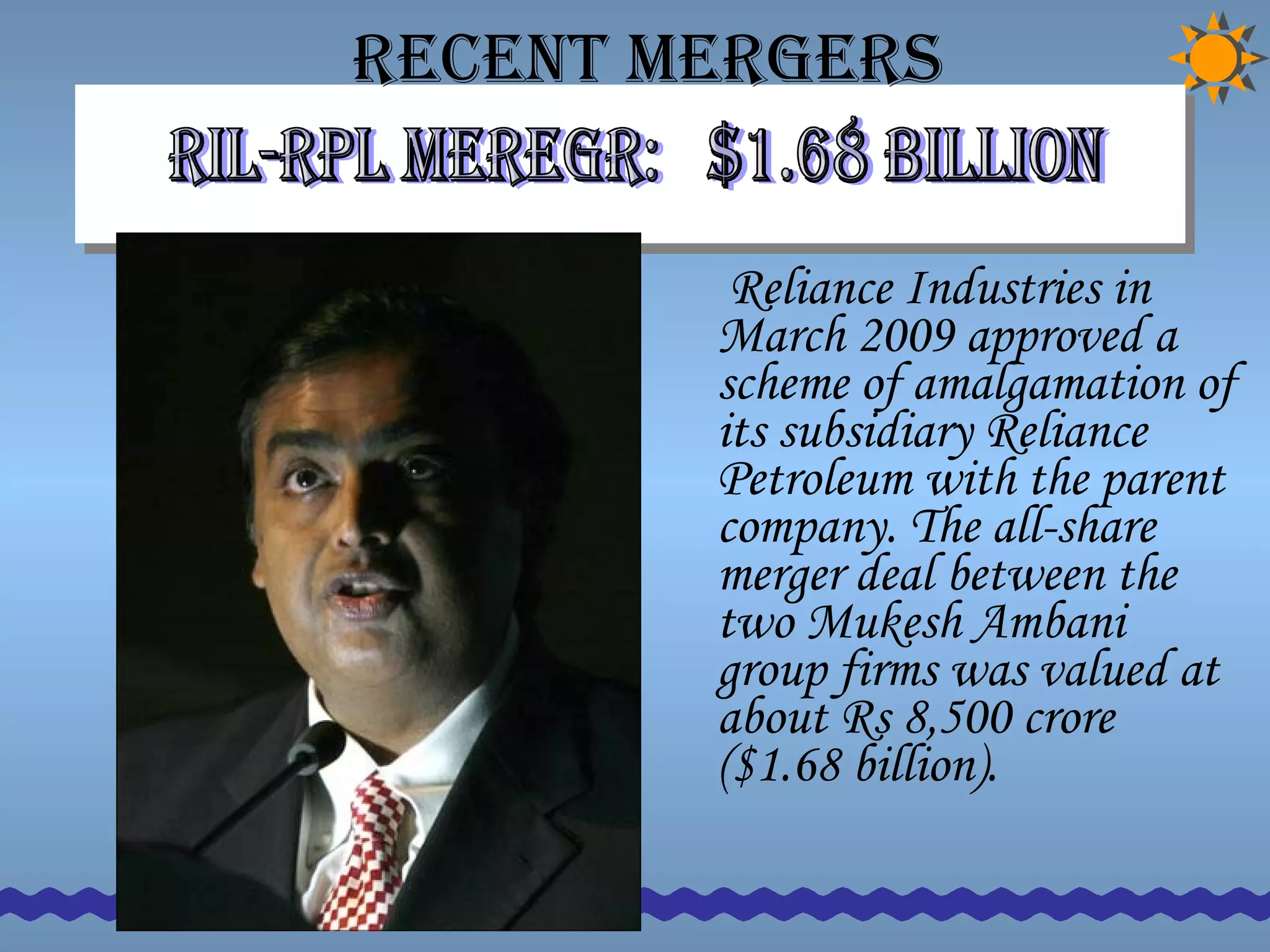
Recent Mergers  Reliance Industries in March 2009 approved a scheme of amalgamation of its subsidiary Reliance Petroleum with the parent company. The all-share merger deal between the two Mukesh Ambani group firms was valued at about Rs 8,500 crore ($1.68 billion).  RIL-rpl meregr:  $1.68 billion
ACQUISITION Acquisition One firm buys the assets or shares of another. #Takeover implies the acquiring firm is larger than the target. #Reverse takeover if the target is larger than the acquirer.
TYPES OF ACQUISITION ASSET ACQUISITIONS STOCK ACQUISITIONS
Two types of data acquisition Two types of data acquisition Static  acquisition Copying a hard drive from a powered-off system Used to be the standard Live  acquisition Copying data from a running computer
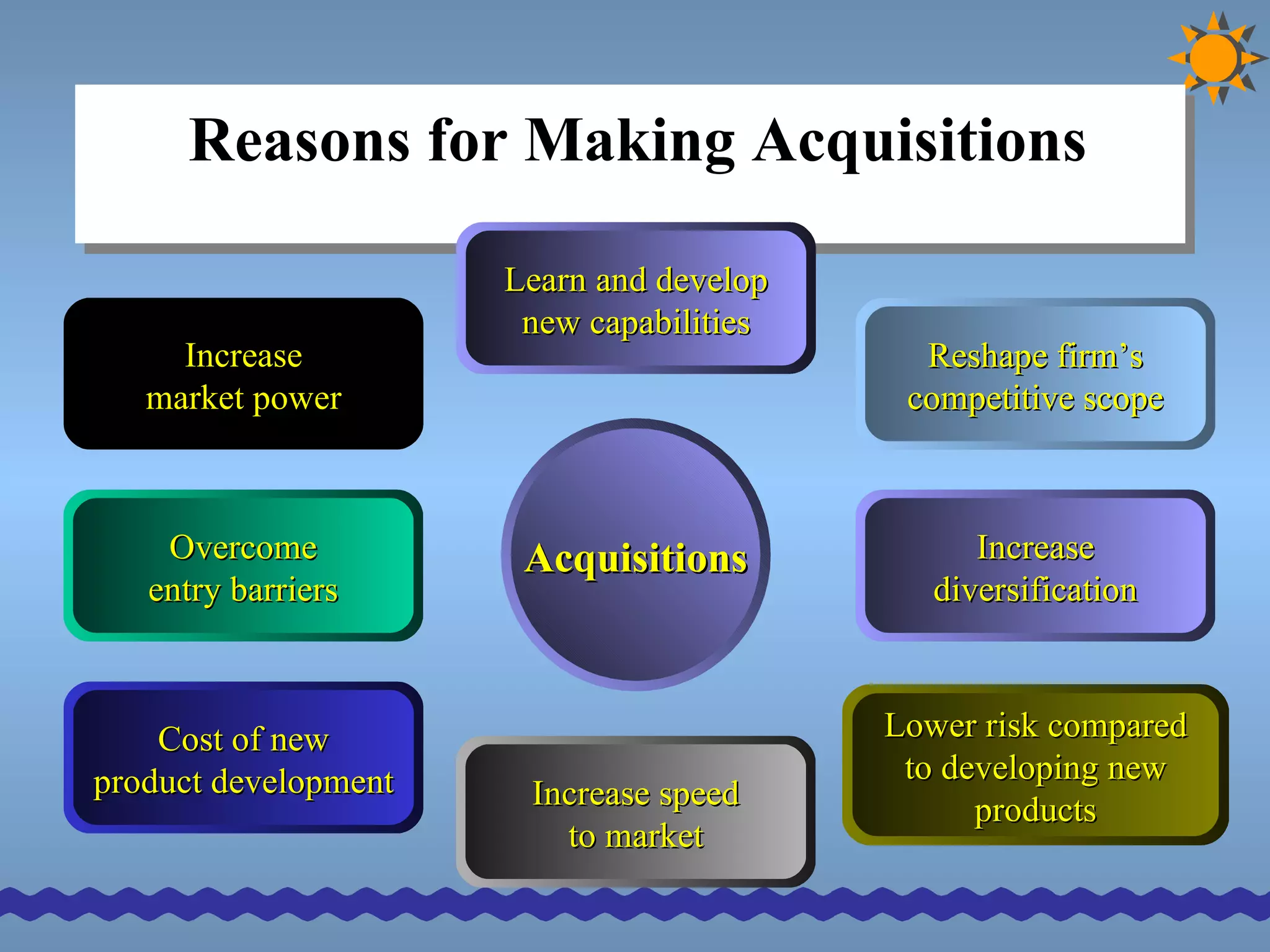
Reasons for Making Acquisitions Acquisitions Increase market power Overcome entry barriers Cost of new product development Increase speed to market Increase diversification Reshape firm’s competitive scope Lower risk compared to developing new products Learn and develop new capabilities
Mergers and Acquisitions Motivations Economies of scale and scope Scale  – production in high volumes Scope  – combining marketing or distribution for different types of related products, maybe horizontal or concentric
Mergers and Acquisitions Motivations Secure supplies or supply chain and other interdependencies- Vertical Expertise Monopoly gains  Efficiency gains by elimination of duplication/operating synergies Operating losses
M & A  RISKS Poor strategic fit   Cultural and Social Differences   Incomplete and Inadequate Due Diligence   Poorly Managed Integration   Overly Optimistic
Reasons for Mergers and Acquisitions   Capacity Economies of Scale   Accessing technology or skills Tax reasons
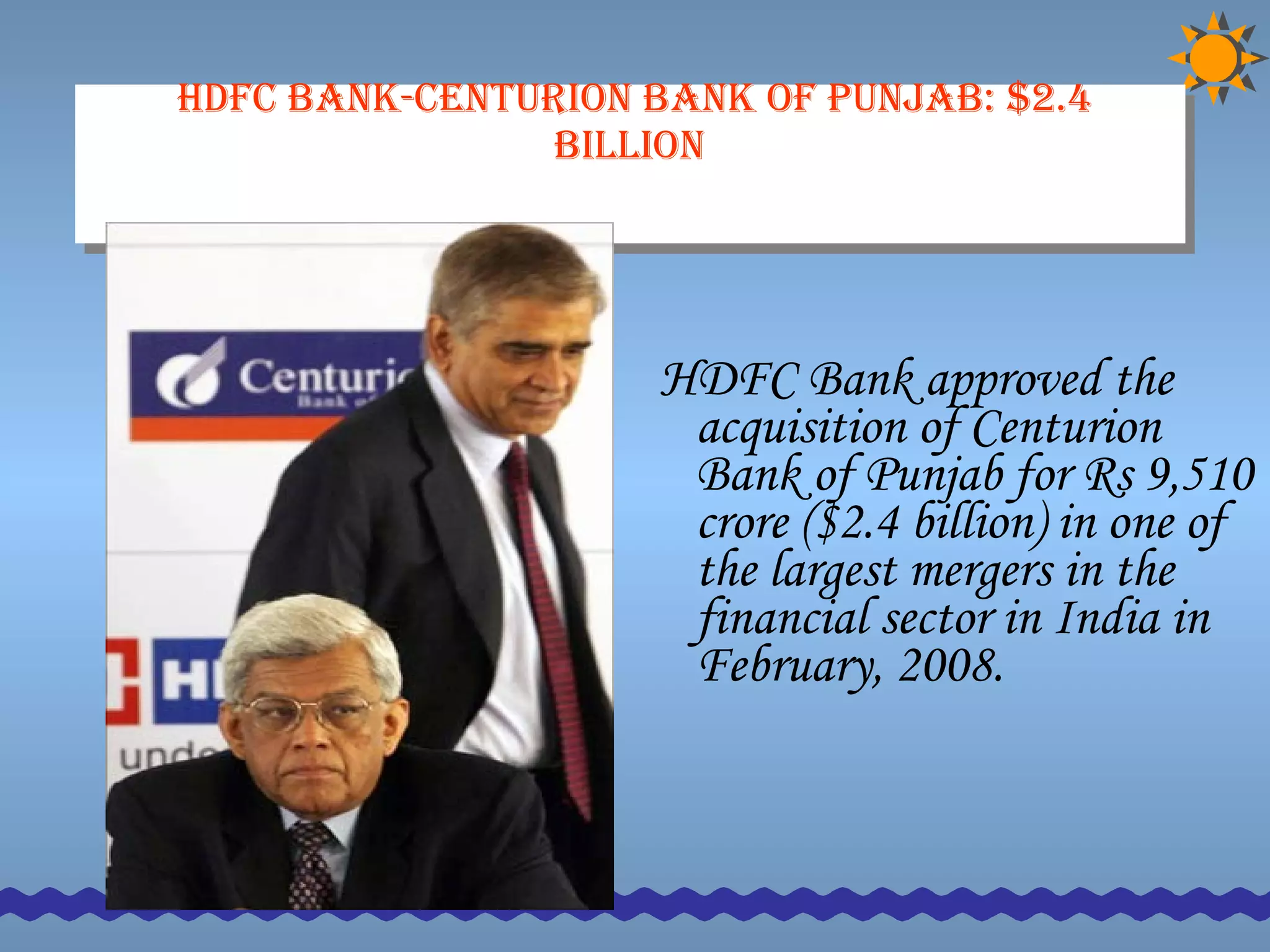
HDFC Bank-Centurion Bank of Punjab: $2.4 billion   HDFC Bank approved the acquisition of Centurion Bank of Punjab for Rs 9,510 crore ($2.4 billion) in one of the largest mergers in the financial sector in India in February, 2008.
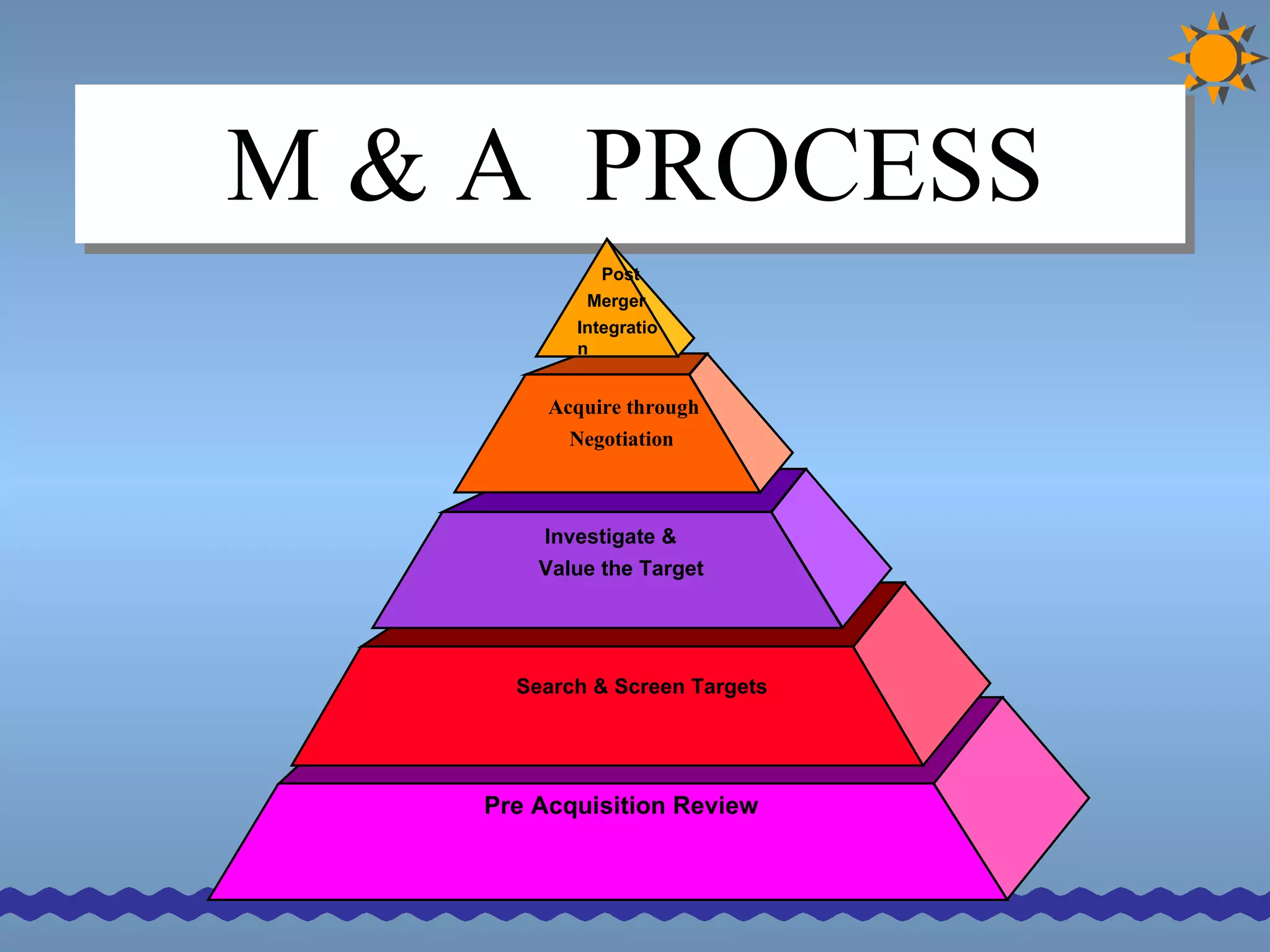
M & A  PROCESS Pre Acquisition Review Search & Screen Targets Investigate &  Value the Target Acquire through  Negotiation Post  Merger  Integration
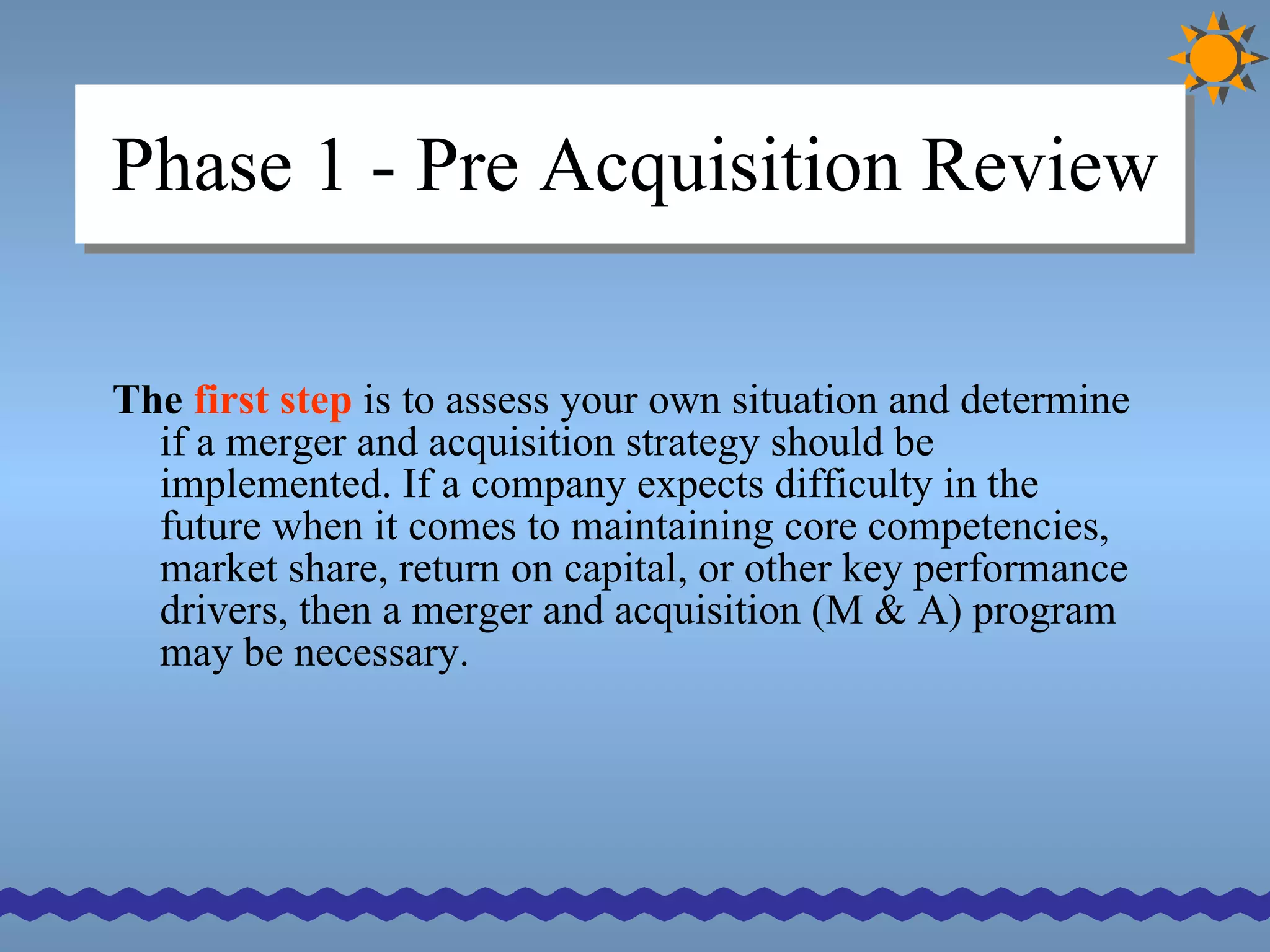
Phase 1 - Pre Acquisition Review The  first   step  is to assess your own situation and determine if a merger and acquisition strategy should be implemented. If a company expects difficulty in the future when it comes to maintaining core competencies, market share, return on capital, or other key performance drivers, then a merger and acquisition (M & A) program may be necessary.
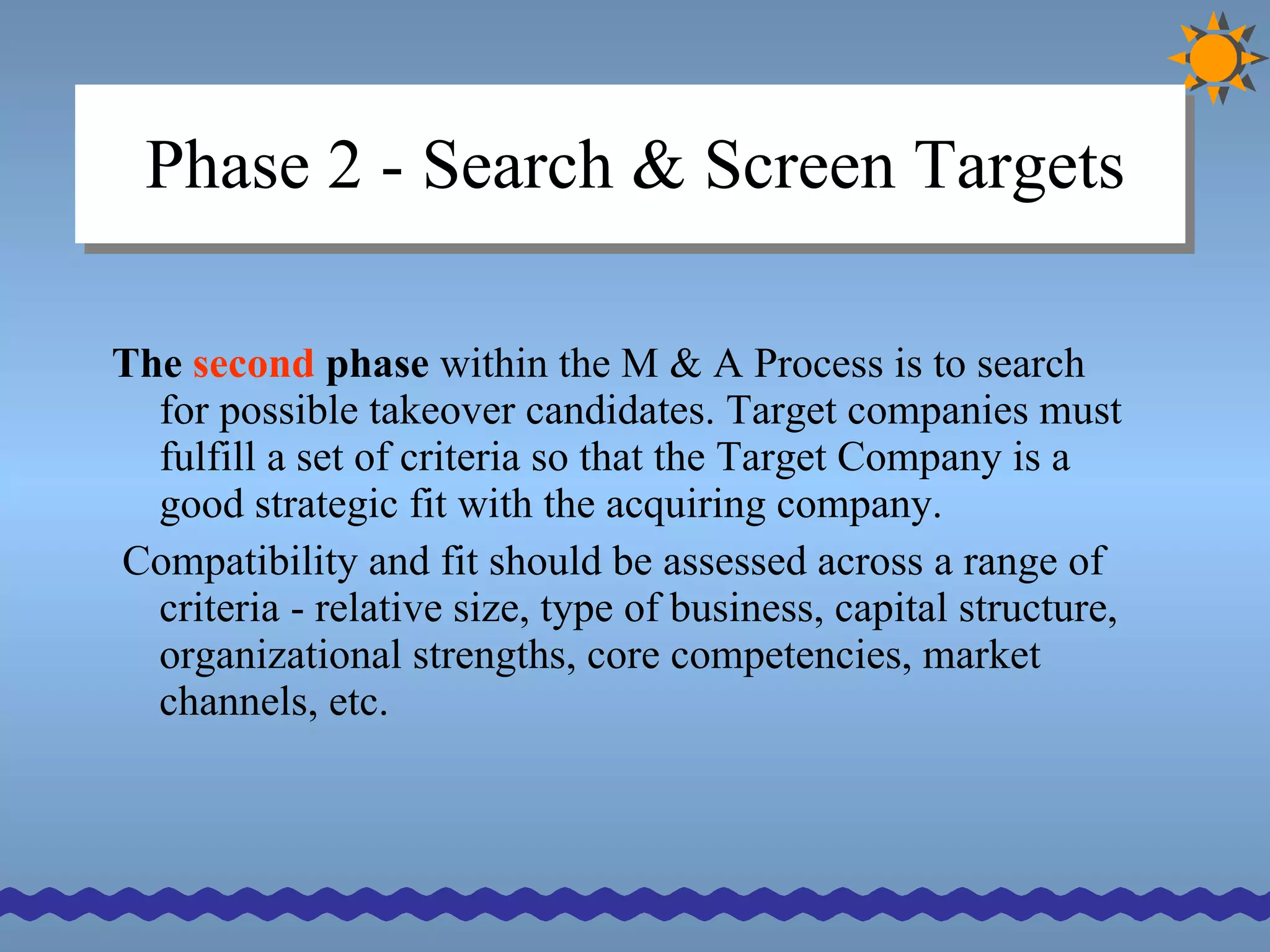
Phase 2 - Search & Screen Targets The  second  phase  within the M & A Process is to search for possible takeover candidates. Target companies must fulfill a set of criteria so that the Target Company is a good strategic fit with the acquiring company.  Compatibility and fit should be assessed across a range of criteria - relative size, type of business, capital structure, organizational strengths, core competencies, market channels, etc.
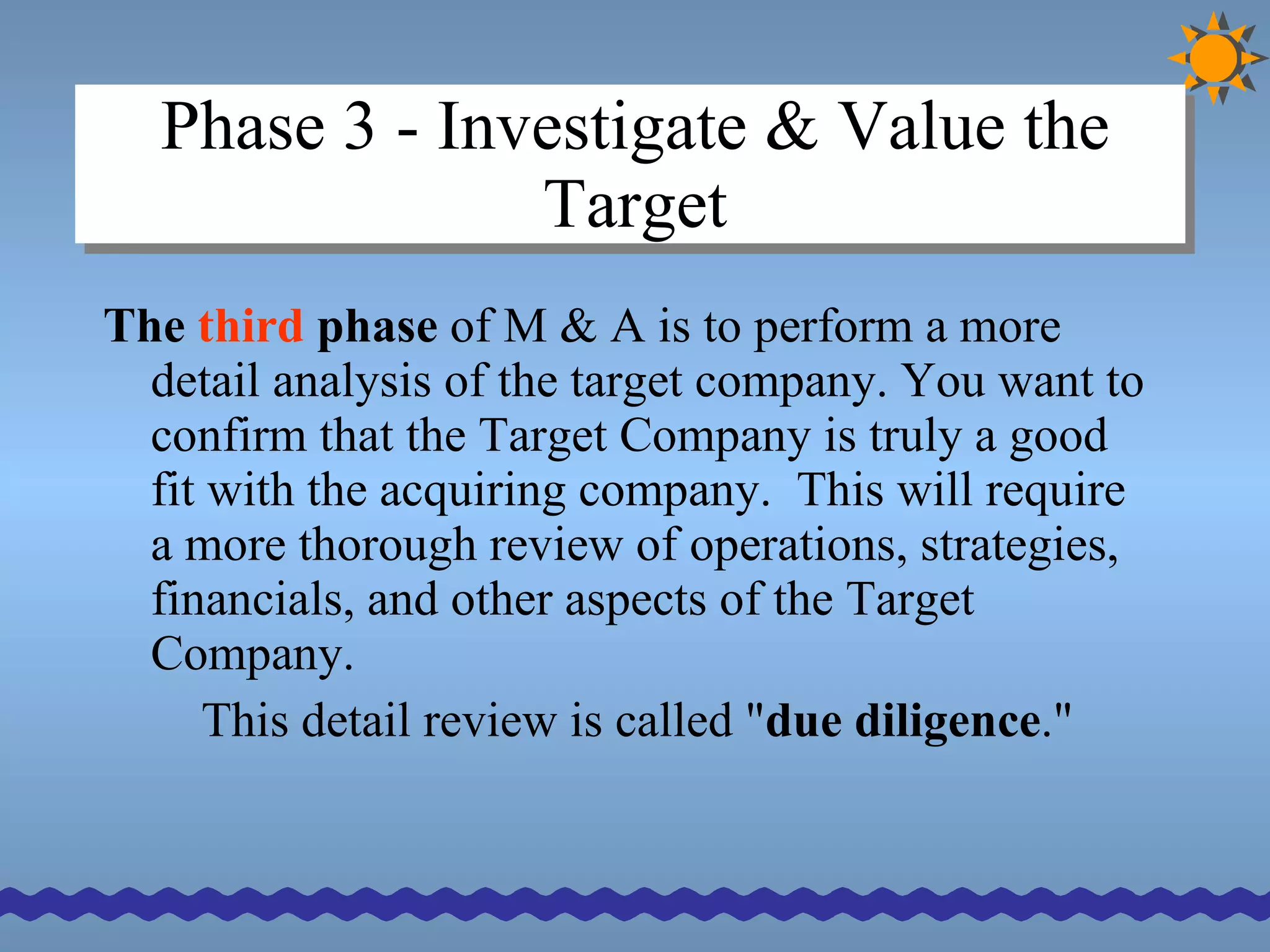
Phase 3 - Investigate & Value the Target The  third  phase  of M & A is to perform a more detail analysis of the target company. You want to confirm that the Target Company is truly a good fit with the acquiring company.  This will require a more thorough review of operations, strategies, financials, and other aspects of the Target Company.  This detail review is called " due diligence ."
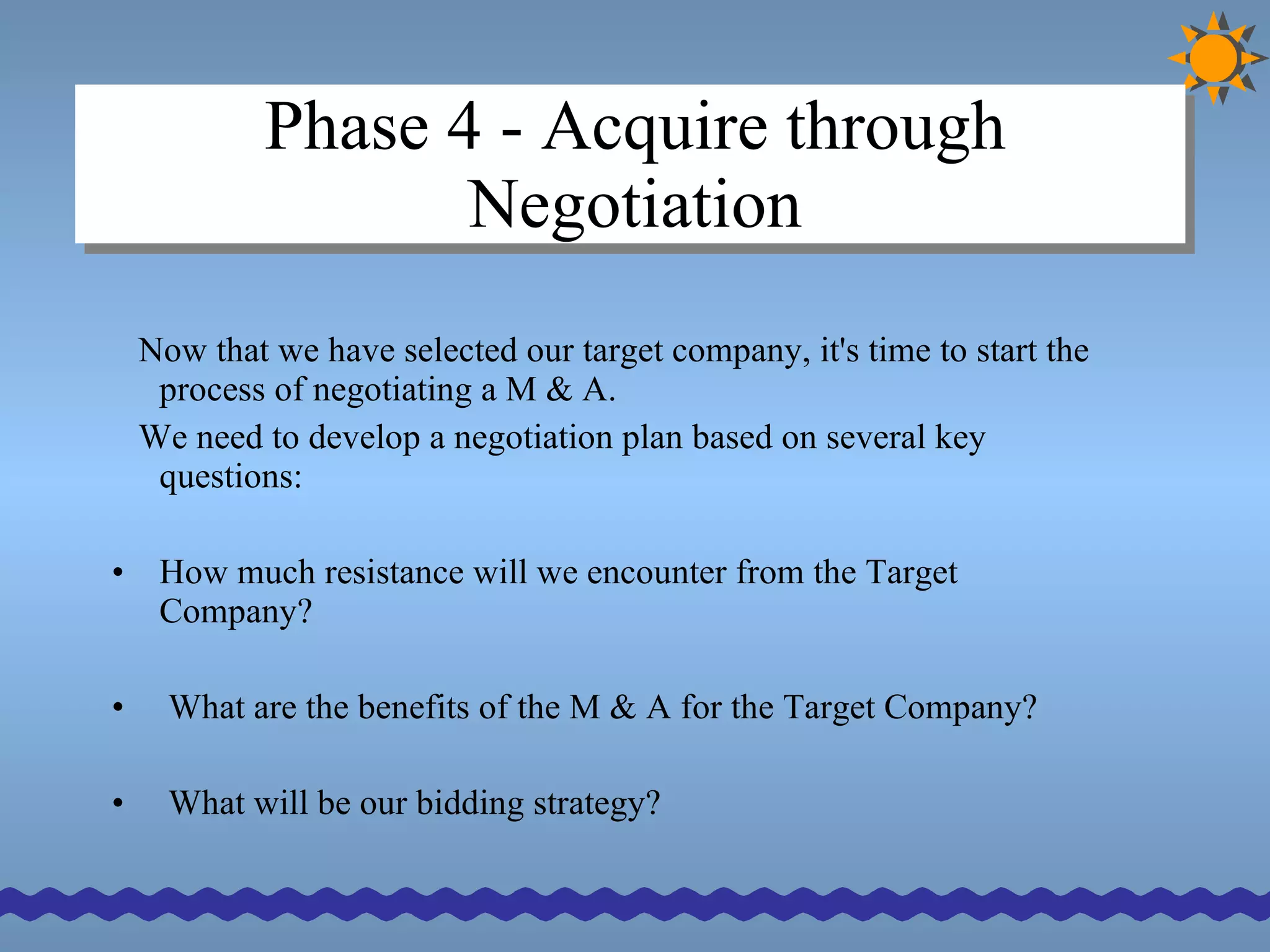
Phase 4 - Acquire through Negotiation Now that we have selected our target company, it's time to start the process of negotiating a M & A.  We need to develop a negotiation plan based on several key questions: How much resistance will we encounter from the Target Company? What are the benefits of the M & A for the Target Company? What will be our bidding strategy?
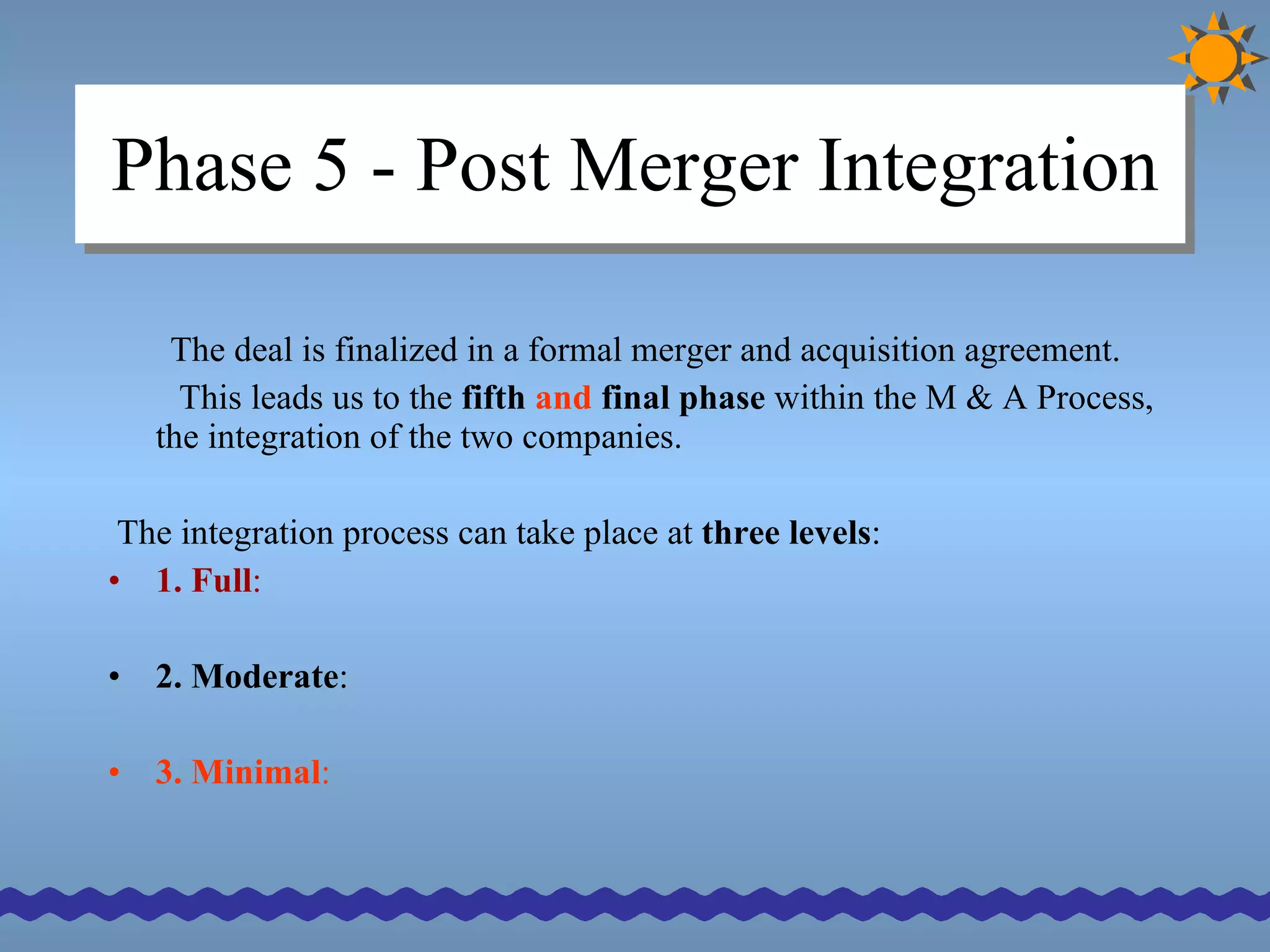
Phase 5 - Post Merger Integration The deal is finalized in a formal merger and acquisition agreement.  This leads us to the  fifth  and  final phase  within the M & A Process, the integration of the two companies. The integration process can take place at  three levels : 1. Full :  2. Moderate :  3. Minimal :
 

mergers and acquisitions

  • 1.
  • 2.
  • 3.
    Mergers A merger is a transaction that results in the transfer of ownership and control of a corporation.
  • 4.
    Merger Motives Improveoverall performance of the merged firms through cost savings, elimination of overlapping operations, improve purchasing power, increase market share, or reduce competition. Company growth Broaden product lines Acquire technology / skills Acquire new markets Financial restructuring: cutting costs selling off units laying off employees refinancing company 6
  • 5.
    Types of MergersEconomists distinguish between three types of mergers: Horizontal Vertical Conglomerate
  • 6.
    Horizontal Mergers Twofirms producing the same product merge to achieve economies of scale. Bank A has a huge back office function to clear checks. It can just as easily handle another 500,000 customers.
  • 7.
    Vertical Mergers Afirm in industry A sells its output to industry B. Two firms merge to integrate their production.
  • 8.
    Conglomerate mergers Consolidatedfirms may sell related products, share marketing and distribution channels and perhaps production processes; or they may be wholly unrelated. Examples: Cardinal Healthcare-Allegiance; AOL-Time Warner; Phillip Morris-Kraft; Citicorp-Travelers Insurance; Pepsico-Pizza Hut; Proctor & Gamble-Clorox.
  • 9.
    Recent Mergers Reliance Industries in March 2009 approved a scheme of amalgamation of its subsidiary Reliance Petroleum with the parent company. The all-share merger deal between the two Mukesh Ambani group firms was valued at about Rs 8,500 crore ($1.68 billion). RIL-rpl meregr: $1.68 billion
  • 10.
    ACQUISITION Acquisition Onefirm buys the assets or shares of another. #Takeover implies the acquiring firm is larger than the target. #Reverse takeover if the target is larger than the acquirer.
  • 11.
    TYPES OF ACQUISITIONASSET ACQUISITIONS STOCK ACQUISITIONS
  • 12.
    Two types ofdata acquisition Two types of data acquisition Static acquisition Copying a hard drive from a powered-off system Used to be the standard Live acquisition Copying data from a running computer
  • 13.
    Reasons for MakingAcquisitions Acquisitions Increase market power Overcome entry barriers Cost of new product development Increase speed to market Increase diversification Reshape firm’s competitive scope Lower risk compared to developing new products Learn and develop new capabilities
  • 14.
    Mergers and AcquisitionsMotivations Economies of scale and scope Scale – production in high volumes Scope – combining marketing or distribution for different types of related products, maybe horizontal or concentric
  • 15.
    Mergers and AcquisitionsMotivations Secure supplies or supply chain and other interdependencies- Vertical Expertise Monopoly gains Efficiency gains by elimination of duplication/operating synergies Operating losses
  • 16.
    M & A RISKS Poor strategic fit Cultural and Social Differences Incomplete and Inadequate Due Diligence Poorly Managed Integration Overly Optimistic
  • 17.
    Reasons for Mergersand Acquisitions Capacity Economies of Scale Accessing technology or skills Tax reasons
  • 18.
    HDFC Bank-Centurion Bankof Punjab: $2.4 billion HDFC Bank approved the acquisition of Centurion Bank of Punjab for Rs 9,510 crore ($2.4 billion) in one of the largest mergers in the financial sector in India in February, 2008.
  • 19.
    M & A PROCESS Pre Acquisition Review Search & Screen Targets Investigate & Value the Target Acquire through Negotiation Post Merger Integration
  • 20.
    Phase 1 -Pre Acquisition Review The first step is to assess your own situation and determine if a merger and acquisition strategy should be implemented. If a company expects difficulty in the future when it comes to maintaining core competencies, market share, return on capital, or other key performance drivers, then a merger and acquisition (M & A) program may be necessary.
  • 21.
    Phase 2 -Search & Screen Targets The second phase within the M & A Process is to search for possible takeover candidates. Target companies must fulfill a set of criteria so that the Target Company is a good strategic fit with the acquiring company. Compatibility and fit should be assessed across a range of criteria - relative size, type of business, capital structure, organizational strengths, core competencies, market channels, etc.
  • 22.
    Phase 3 -Investigate & Value the Target The third phase of M & A is to perform a more detail analysis of the target company. You want to confirm that the Target Company is truly a good fit with the acquiring company. This will require a more thorough review of operations, strategies, financials, and other aspects of the Target Company. This detail review is called " due diligence ."
  • 23.
    Phase 4 -Acquire through Negotiation Now that we have selected our target company, it's time to start the process of negotiating a M & A. We need to develop a negotiation plan based on several key questions: How much resistance will we encounter from the Target Company? What are the benefits of the M & A for the Target Company? What will be our bidding strategy?
  • 24.
    Phase 5 -Post Merger Integration The deal is finalized in a formal merger and acquisition agreement. This leads us to the fifth and final phase within the M & A Process, the integration of the two companies. The integration process can take place at three levels : 1. Full : 2. Moderate : 3. Minimal :
  • 25.