INTERNATIONAL BUSINESS LEVEL
STRATEGY

INTERNATIONAL CORPORATE LEVEL
STRATEGY
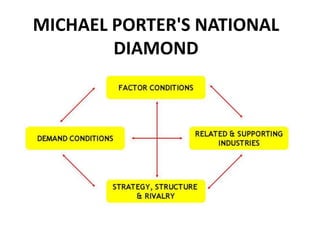
MICHAEL PORTER'S NATIONAL
        DIAMOND
FACTOR OF PRODUCTION
• A country creates its own important factors such as skilled
  resources and technological base.
• The stock of factors at a given time is less important than the
  extent that they are upgraded and deployed.
• Local disadvantages in factors of production force innovation.
  Adverse conditions such as labor shortages or scarce raw
  materials force firms to develop new methods, and this
  innovation often leads to a national comparative advantage.
EXAMPLES:
• Indian BPO sector
• Japan's relative lack of raw materials
DEMAND CONDITIONS
• When the market for a particular product is larger locally than
  in foreign markets, the local firms devote more attention to
  that product than do foreign firms, leading to a competitive
  advantage when the local firms begin exporting the product.

• A more demanding local market leads to national advantage.

• A strong, trend-setting local market helps local firms
  anticipate global trends.
DEMAND CONDITIONS
EXAMPLE:
• we can take the case of Germany which has some of the
  world's     premier    automobile   companies     like
  Mercedes, BMW, Porsche.
• German auto companies have dominated the world when it
  comes to the high-performance segment of the world
  automobile industry.
• General electric
• In Indian BPO sector
RELATED AND SUPPORTING
      INDUSTRIES
• When local supporting industries are competitive, firms enjoy
  more cost effective and innovative inputs.
• This effect is strengthened when the suppliers themselves are
  strong global competitors.
EXAMPLE:
• Silicon Valley in the USA and Silicon Glen in the UK are techno
  clusters of high-technology industries which includes
  individual computer software & semi-conductor firms.
• In Germany, a similar cluster exists around chemicals, synthetic
  dyes, textiles and textile machinery.
FIRM STRATEGY STRUCTURE
              & RIVALRY
• Local conditions affect firm strategy

• In Porter's Five Forces model, low rivalry made an industry
  attractive. While at a single point in time a firm prefers less
  rivalry, over the long run more local rivalry is better since it
  puts pressure on firms to innovate and improve. In fact, high
  local rivalry results in less global rivalry.

• Local rivalry forces firms to move beyond basic advantages
  that the home country may enjoy, such as low factor costs.
FIRM STRATEGY STRUCTURE
              & RIVALRY
Examples:
 As an example, the Japanese automobile industry with 8
  major competitors
  (Honda, Toyota, Suzuki, Isuzu, Nissan, Mazda, Mitsubishi, and
  Subaru) provide intense competition in the domestic
  market, as well as the foreign markets in which they compete.
 Local rivalry have forced firms to move beyond basic
  advantages.
  examples INFOSYS , WIPRO AND TCS [ TATAS]
EXAMPLES

• Japanese factor conditions: Japan has a relatively high
  number of electrical engineers per capita.
• Japanese demand conditions: The Japanese market was
  very demanding because of the written language.
• Large number of related and supporting industries with
  good technology, for example, good miniaturized
  components since there is less space in Japan.
• Domestic rivalry in the Japanese fax machine industry
  pushed innovation and resulted in rapid cost reductions.
INTERNATIONAL CORPORATE
         LEVEL STRATEGY

• MULTI DOMESTIC STRATEGY
• GLOBAL STRATEGY
• TRANSACTIONAL STRATEGY
MULTI DOMESTIC STRATEGY

  Multi domestic Strategy and operating decisions are
  decentralized to strategic business units (SBU) in each country
EXAMPLES
• One of the nation's most popular hamburger chains is an
  example of a multi domestic strategy. The company
  researches each country’s local customs and foods before
  creating its menu items and opening up a store. For
  example, the restaurant's stores in India do not sell any
  sandwiches made with beef, since the Indian culture sees
  cows as sacred.
GLOBAL STRATEGY
• Global Strategy Products are standardized
   across national markets
EXAMPLE
• GE, Apple, Sony and Gillette pursue a global strategy by
  competing in all markets, providing the same product for each
  market, strong centralized control, identifying customer needs
  and wants across international borders, and locating value
  adding activities where they can achieve the lowest cost.
• Boeing’s global R&D network
   – UK, Italy, (collobration)
   – Spain, Australia, Russia (FDI)
TRANSACTIONAL STRATEGY

  Transnational Strategy Seeks to achieve both global efficiency
  and local responsiveness
EXAMPLE
• A very well-known cola soft drink is one example of a
  transnational product. This company's beverage recipe is kept
  secret and has not changed in many years. The product is sold
  in over 200 countries worldwide, and this beverage company
  retains exactly the same beverage formulation in each
  country. The bottle’s label may reflect the local language, but
  the logo and contents remain the same.

International business level strategy

  • 1.
  • 2.
  • 3.
    FACTOR OF PRODUCTION •A country creates its own important factors such as skilled resources and technological base. • The stock of factors at a given time is less important than the extent that they are upgraded and deployed. • Local disadvantages in factors of production force innovation. Adverse conditions such as labor shortages or scarce raw materials force firms to develop new methods, and this innovation often leads to a national comparative advantage. EXAMPLES: • Indian BPO sector • Japan's relative lack of raw materials
  • 4.
    DEMAND CONDITIONS • Whenthe market for a particular product is larger locally than in foreign markets, the local firms devote more attention to that product than do foreign firms, leading to a competitive advantage when the local firms begin exporting the product. • A more demanding local market leads to national advantage. • A strong, trend-setting local market helps local firms anticipate global trends.
  • 5.
    DEMAND CONDITIONS EXAMPLE: • wecan take the case of Germany which has some of the world's premier automobile companies like Mercedes, BMW, Porsche. • German auto companies have dominated the world when it comes to the high-performance segment of the world automobile industry. • General electric • In Indian BPO sector
  • 6.
    RELATED AND SUPPORTING INDUSTRIES • When local supporting industries are competitive, firms enjoy more cost effective and innovative inputs. • This effect is strengthened when the suppliers themselves are strong global competitors. EXAMPLE: • Silicon Valley in the USA and Silicon Glen in the UK are techno clusters of high-technology industries which includes individual computer software & semi-conductor firms. • In Germany, a similar cluster exists around chemicals, synthetic dyes, textiles and textile machinery.
  • 7.
    FIRM STRATEGY STRUCTURE & RIVALRY • Local conditions affect firm strategy • In Porter's Five Forces model, low rivalry made an industry attractive. While at a single point in time a firm prefers less rivalry, over the long run more local rivalry is better since it puts pressure on firms to innovate and improve. In fact, high local rivalry results in less global rivalry. • Local rivalry forces firms to move beyond basic advantages that the home country may enjoy, such as low factor costs.
  • 8.
    FIRM STRATEGY STRUCTURE & RIVALRY Examples:  As an example, the Japanese automobile industry with 8 major competitors (Honda, Toyota, Suzuki, Isuzu, Nissan, Mazda, Mitsubishi, and Subaru) provide intense competition in the domestic market, as well as the foreign markets in which they compete.  Local rivalry have forced firms to move beyond basic advantages. examples INFOSYS , WIPRO AND TCS [ TATAS]
  • 9.
    EXAMPLES • Japanese factorconditions: Japan has a relatively high number of electrical engineers per capita. • Japanese demand conditions: The Japanese market was very demanding because of the written language. • Large number of related and supporting industries with good technology, for example, good miniaturized components since there is less space in Japan. • Domestic rivalry in the Japanese fax machine industry pushed innovation and resulted in rapid cost reductions.
  • 10.
    INTERNATIONAL CORPORATE LEVEL STRATEGY • MULTI DOMESTIC STRATEGY • GLOBAL STRATEGY • TRANSACTIONAL STRATEGY
  • 11.
    MULTI DOMESTIC STRATEGY Multi domestic Strategy and operating decisions are decentralized to strategic business units (SBU) in each country EXAMPLES • One of the nation's most popular hamburger chains is an example of a multi domestic strategy. The company researches each country’s local customs and foods before creating its menu items and opening up a store. For example, the restaurant's stores in India do not sell any sandwiches made with beef, since the Indian culture sees cows as sacred.
  • 12.
    GLOBAL STRATEGY • GlobalStrategy Products are standardized across national markets EXAMPLE • GE, Apple, Sony and Gillette pursue a global strategy by competing in all markets, providing the same product for each market, strong centralized control, identifying customer needs and wants across international borders, and locating value adding activities where they can achieve the lowest cost. • Boeing’s global R&D network – UK, Italy, (collobration) – Spain, Australia, Russia (FDI)
  • 13.
    TRANSACTIONAL STRATEGY Transnational Strategy Seeks to achieve both global efficiency and local responsiveness EXAMPLE • A very well-known cola soft drink is one example of a transnational product. This company's beverage recipe is kept secret and has not changed in many years. The product is sold in over 200 countries worldwide, and this beverage company retains exactly the same beverage formulation in each country. The bottle’s label may reflect the local language, but the logo and contents remain the same.