Business Models for Value
In Complex Infrastructure
3th February 2017
Professor Peter Sharratt
Presented at Consortium for the 4th Revolution | Executive Briefing Day
(#C4IR) Cambridge, UK 2-3 February 2017 | www.cir-strategy.com/events
Today	the	world’s	largest	600	ci4es	generate:	
Top	23	Mega-ci4es	with	just	1/20th	world’s	
popula1on	generate	14%	global	GDP.	
	
Metro-regions	are	2%	of	the	world’s	surface	and	
generate	80%	of	the	world’s	wealth.	
	
20%	of	global	GDP	coming	from	190	ci4es		
in	North	America	&	Canada.	
In	15	years’	1me....	
2 billion (1/4 world’s population)
$64 trillion
Will Generate 60% global GDP
1.5 billion (about 1/5th of the world’s population)
Generate $30 trillion
Over half of global GDP
CITY REGIONS AS DRIVERS OF THE GLOBAL ECONOMY
Source:	McKinsey	Global	Ins1tute		Cityscope
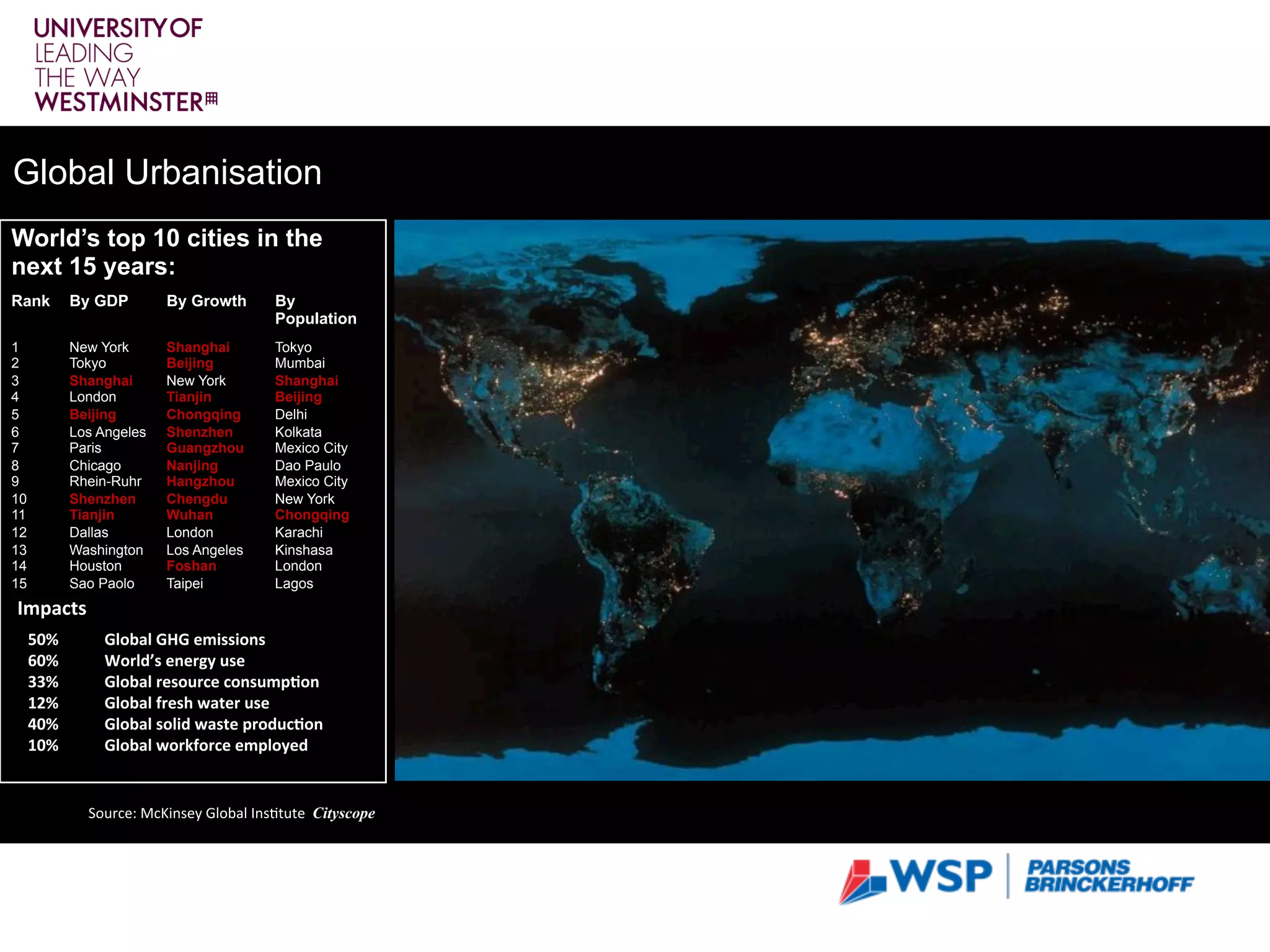
World’s top 10 cities in the
next 15 years:
Rank By GDP By Growth By
Population
1
2
3
4
5
6
7
8
9
10
11
12
13
14
15
New York
Tokyo
Shanghai
London
Beijing
Los Angeles
Paris
Chicago
Rhein-Ruhr
Shenzhen
Tianjin
Dallas
Washington
Houston
Sao Paolo
Shanghai
Beijing
New York
Tianjin
Chongqing
Shenzhen
Guangzhou
Nanjing
Hangzhou
Chengdu
Wuhan
London
Los Angeles
Foshan
Taipei
Tokyo
Mumbai
Shanghai
Beijing
Delhi
Kolkata
Mexico City
Dao Paulo
Mexico City
New York
Chongqing
Karachi
Kinshasa
London
Lagos
Impacts	
50%		
60%		
33%		
12%		
40%		
10%		
Global	GHG	emissions	
World’s	energy	use	
Global	resource	consump4on	
Global	fresh	water	use	
Global	solid	waste	produc4on	
Global	workforce	employed		
Global Urbanisation
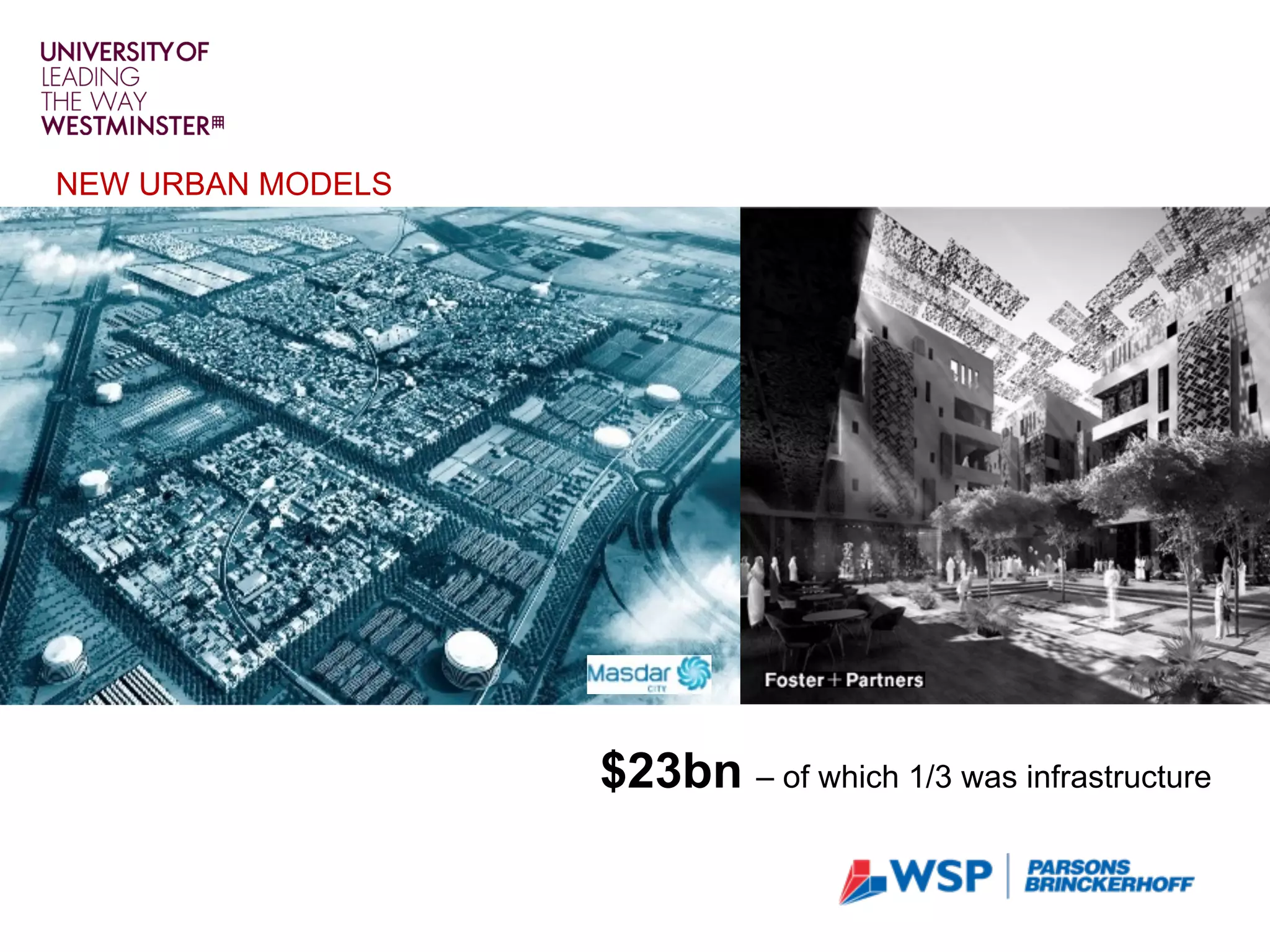
NEW URBAN MODELS
$23bn – of which 1/3 was infrastructure
Re-inventing Growth: Critical National Infrastructure
Renewable	energy	pumping	systems		on	the	canal		
Source:	Foster	+	Partners	
Red		
2		
							Dead
Cities and City Regions are the power
house of the global economy and will
continue to grow in importance. The
projected infrastructure spend to
support urban economic growth and
development is estimated to be over
$40 trillion.
Today’s Cities
Urban growth challenges are
increasingly about global security,
energy and resource constraints, re-
alignment of the global economy,
social equity and demographic issues
and the impacts of disruptive change.
CITY REGIONS AS DRIVERS OF THE GLOBAL ECONOMY
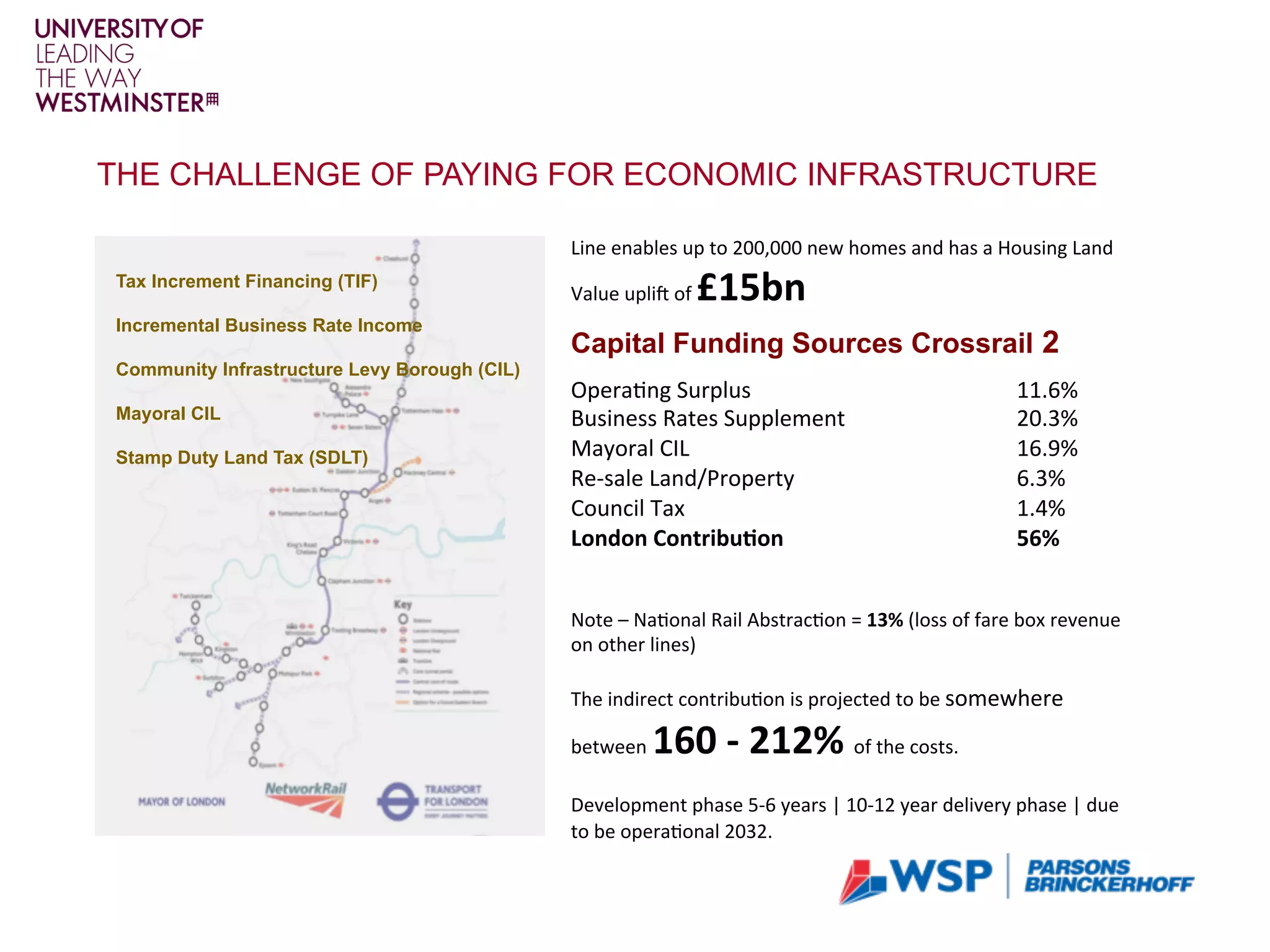
Line	enables	up	to	200,000	new	homes	and	has	a	Housing	Land	
Value	upliS	of	£15bn	


Note	–	Na1onal	Rail	Abstrac1on	=	13%	(loss	of	fare	box	revenue	
on	other	lines)
	
The	indirect	contribu1on	is	projected	to	be	somewhere	
between	160	-	212%	of	the	costs.	
Development	phase	5-6	years	|	10-12	year	delivery	phase	|	due	
to	be	opera1onal	2032.
Capital Funding Sources Crossrail 2
Opera1ng	Surplus																												
Business	Rates	Supplement									
Mayoral	CIL																																									
Re-sale	Land/Property																			
Council	Tax				
London	Contribu4on																																					
11.6%
20.3%
16.9%
6.3%
1.4%	
56%
THE CHALLENGE OF PAYING FOR ECONOMIC INFRASTRUCTURE
Tax Increment Financing (TIF)
Incremental Business Rate Income
Community Infrastructure Levy Borough (CIL)
Mayoral CIL
Stamp Duty Land Tax (SDLT)
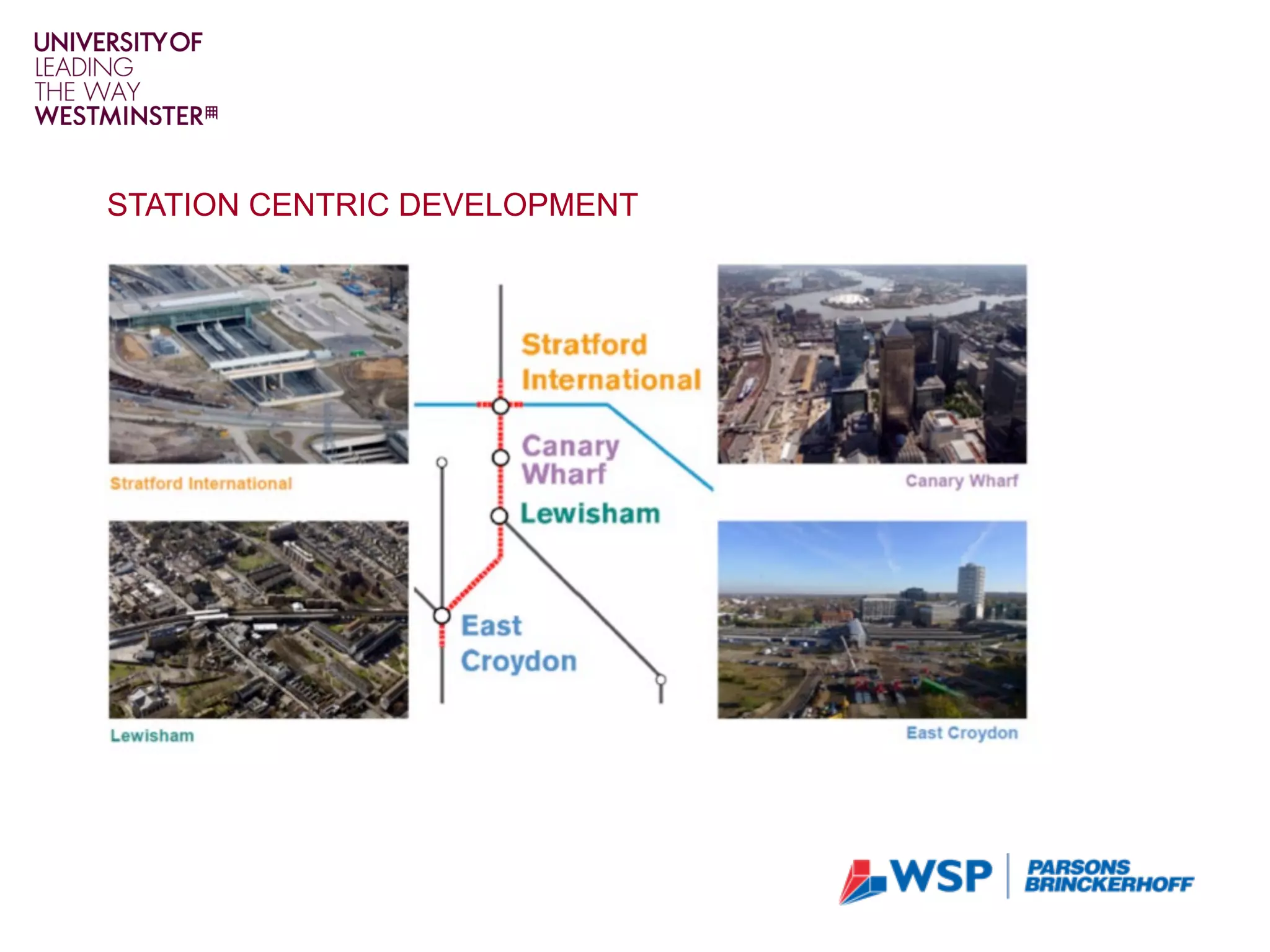
STATION CENTRIC DEVELOPMENT
WSP TFL BRIEFING:
THE	ROLE	OF	TRANSPORT	IN		MEETING	THE	MAYORS		STRATEGIC	OBJECTIVES	FOR	LONDON	
Heathrow	Gateway	 Clapham	Junc1on	Earls	Court	
Opportunity	Areas	 Areas	for	Intensifica4on	
1	
2	
3	
4	
5	
6	
7	
8	
9	
10	
11	
12	
13	
14	
15	
16	
17	
18	
19	
Bexley	Riverside	
Bromley	
Canada	Water	
Charlton	Riverside	
City	Fringe/	Tech	City	
Colindale/Burnt	Oak	
Cricklewood	/Brent	Cross	
Croydon	
Dephord	Creek	/Greenwich		
Earls		Court	&	West	Kensington	
Elephant	&	Castle	
Euston	
Greenwich	Peninsular	
Harrow	&	Wealdstone	
Heathrow	
Ilford	
Isle	of	Dogs	
Kensal	Canal	Side	
Kings	Cross	St	Pancras	


20	
21	
22	
23	
24	
25	
26	
27	
28	
29	
30	
31	
32	
33	
34	
35	
36	
37	
38	
	
Lewisham,	Cahord	&	New	Cross	
London	Bridge,	Borough,	Banks.	
London	Riverside	
Lower	Lee	Valley	
Old	Kent	Road	
Paddington	
Park	Royal	
Old	Oak	Common	
Royal	Docks		Beckton	Waterfront	
Southall	
Thamesmead	&	Abbey	Wood	
Tokenham	Court	Road	
Upper	Lee		Valley	
Vauxhall,	Nine	Elms,	Ba`ersea	
Victoria	
Waterloo	
Wembley	
White	City	
Woolwich	
39	
40	
41	
42	
43	
44	
45	
Farringdon	/	Smithfield	
Harringay	Heartlands	
Holborn	
Kidbrooke	
Mill	Hill	East	
South	Wimbledon	/	Colliers	Wood	
West	Hampstead	Interchange	
Red	=	projects	we	are	currently	engaged	on
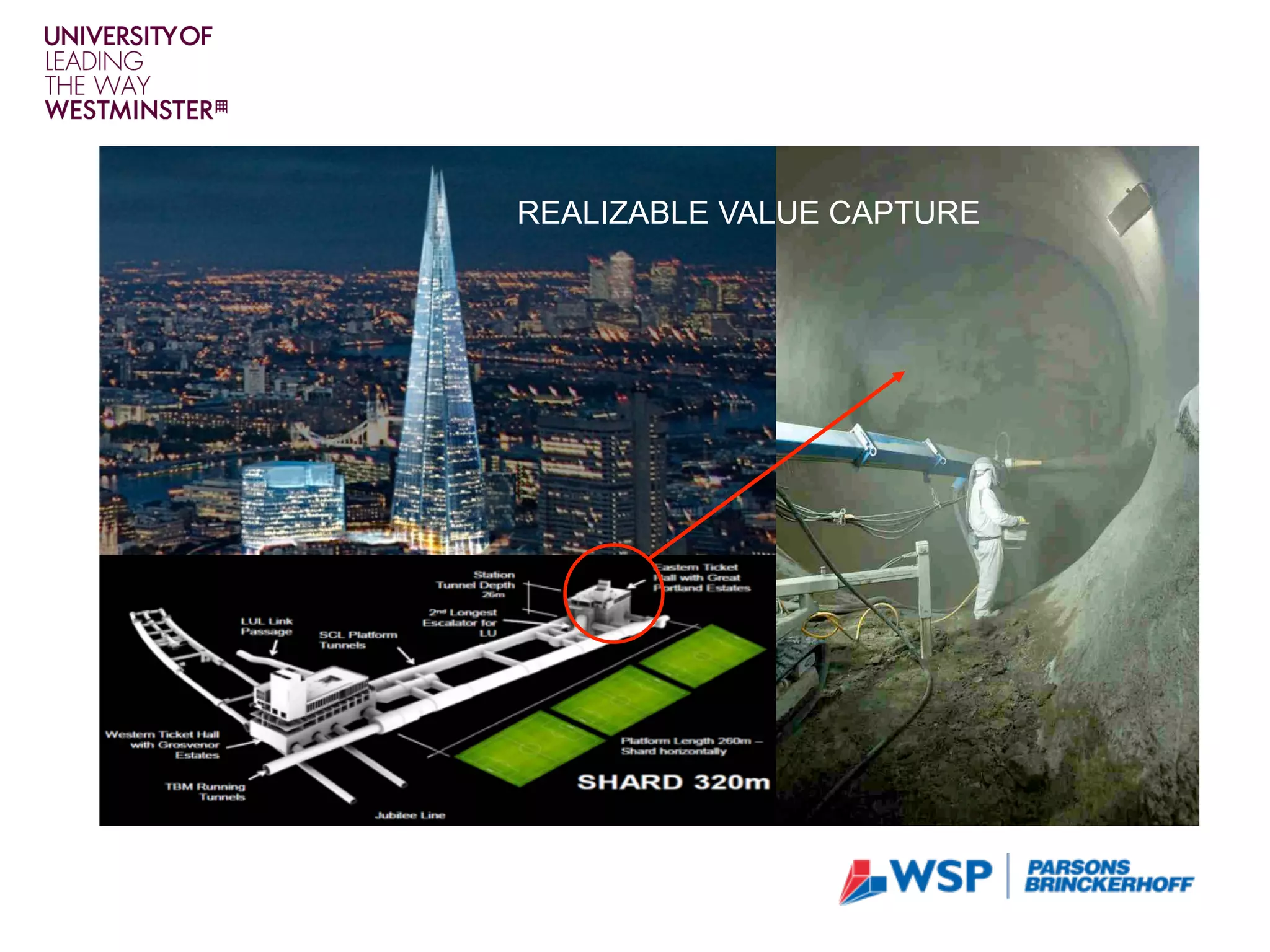
REALIZABLE VALUE CAPTURE
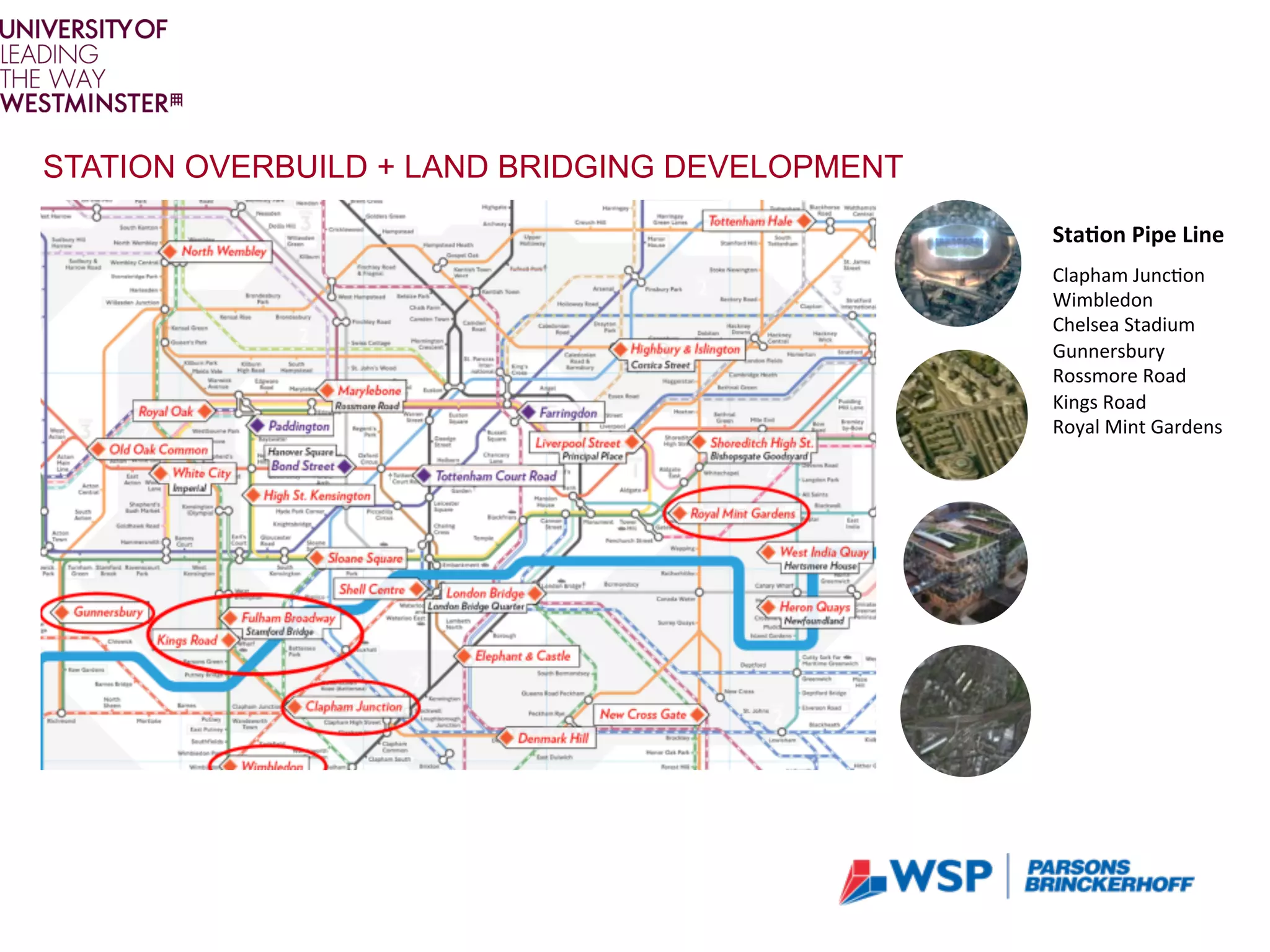
Sta4on	Pipe	Line	
Clapham	Junc1on		
Wimbledon		
Chelsea	Stadium	
Gunnersbury		
Rossmore	Road		
Kings	Road		
Royal	Mint	Gardens		
STATION OVERBUILD + LAND BRIDGING DEVELOPMENT
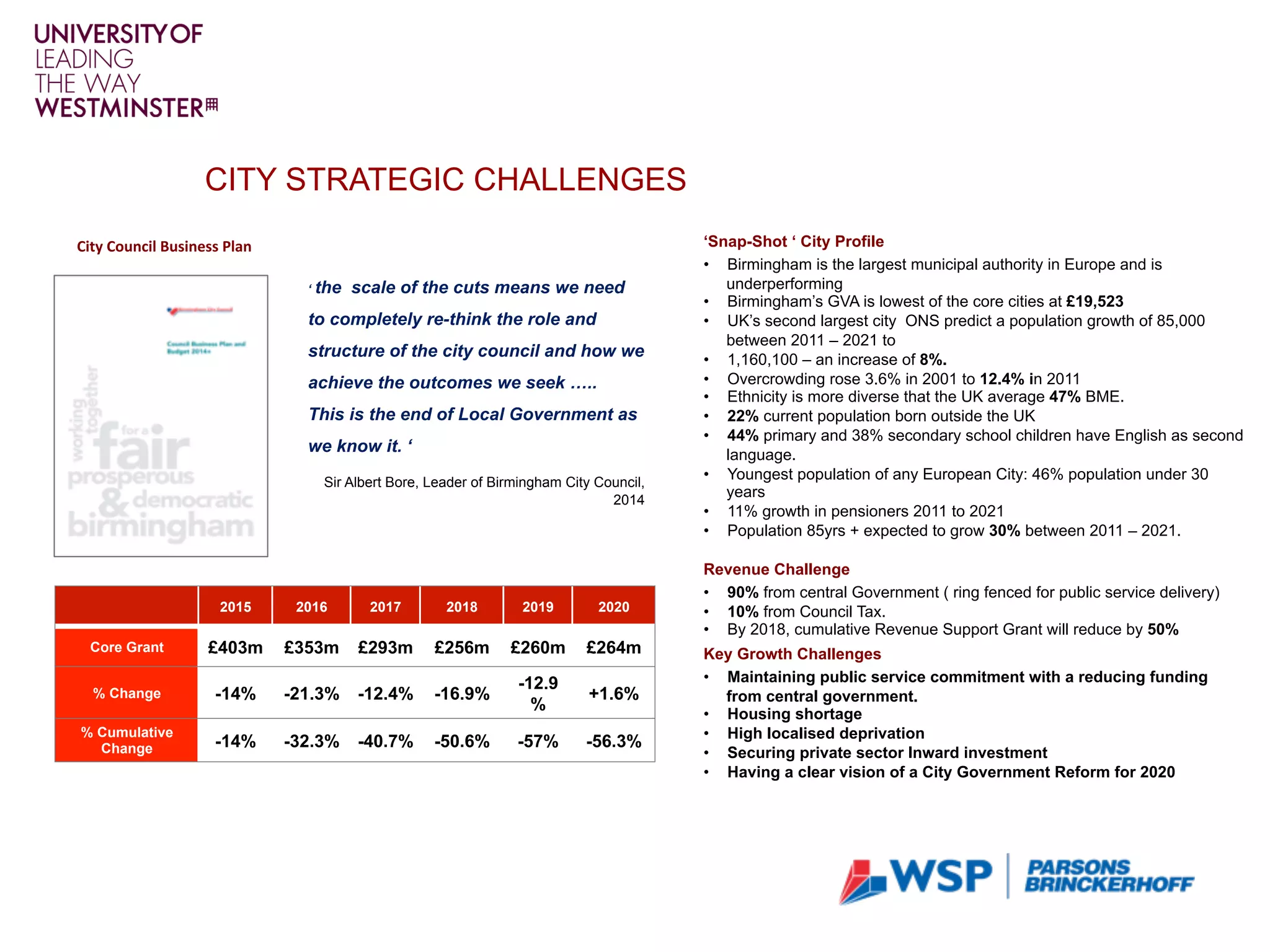
‘ the scale of the cuts means we need
to completely re-think the role and
structure of the city council and how we
achieve the outcomes we seek …..
This is the end of Local Government as
we know it. ‘
Sir Albert Bore, Leader of Birmingham City Council,
2014
‘Snap-Shot ‘ City Profile
•  Birmingham is the largest municipal authority in Europe and is
underperforming
•  Birmingham’s GVA is lowest of the core cities at £19,523
•  UK’s second largest city ONS predict a population growth of 85,000
between 2011 – 2021 to
•  1,160,100 – an increase of 8%.
•  Overcrowding rose 3.6% in 2001 to 12.4% in 2011
•  Ethnicity is more diverse that the UK average 47% BME.
•  22% current population born outside the UK
•  44% primary and 38% secondary school children have English as second
language.
•  Youngest population of any European City: 46% population under 30
years
•  11% growth in pensioners 2011 to 2021
•  Population 85yrs + expected to grow 30% between 2011 – 2021.
Revenue Challenge
•  90% from central Government ( ring fenced for public service delivery)
•  10% from Council Tax.
•  By 2018, cumulative Revenue Support Grant will reduce by 50%
Key Growth Challenges
•  Maintaining public service commitment with a reducing funding
from central government.
•  Housing shortage
•  High localised deprivation
•  Securing private sector Inward investment
•  Having a clear vision of a City Government Reform for 2020
2015 2016 2017 2018 2019 2020
Core Grant £403m £353m £293m £256m £260m £264m
% Change -14% -21.3% -12.4% -16.9%
-12.9
%
+1.6%
% Cumulative
Change -14% -32.3% -40.7% -50.6% -57% -56.3%
City	Council	Business	Plan	
CITY CITY STRATEGIC CHALLENGES
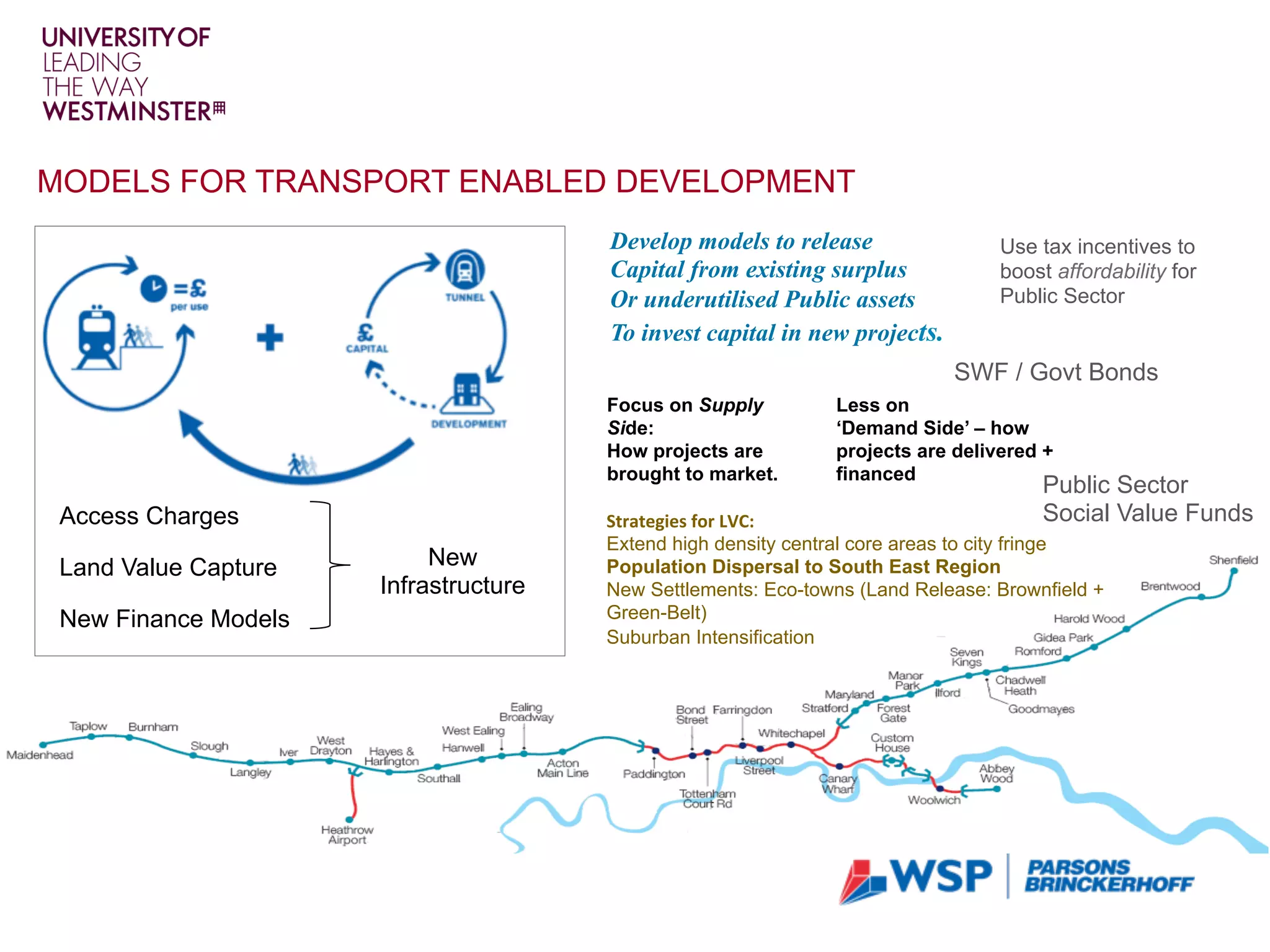
Strategies	for	LVC:		
Extend high density central core areas to city fringe
Population Dispersal to South East Region
New Settlements: Eco-towns (Land Release: Brownfield +
Green-Belt)
Suburban Intensification
Access Charges
New
Infrastructure
Land Value Capture
New Finance Models
MODELS FOR TRANSPORT ENABLED DEVELOPMENT
Focus on Supply
Side:
How projects are
brought to market.
Less on
‘Demand Side’ – how
projects are delivered +
financed
Use tax incentives to
boost affordability for
Public Sector
Develop models to release
Capital from existing surplus
Or underutilised Public assets
To invest capital in new projects.
Public Sector
Social Value Funds
SWF / Govt Bonds
‘One Belt, One Road’ – China’s Silk Road Initiative will create
A connected global economic infrastructure.
Projects Completed or Planned 2015 Source: Merics – Mercator Institute
NEW INVESTORS
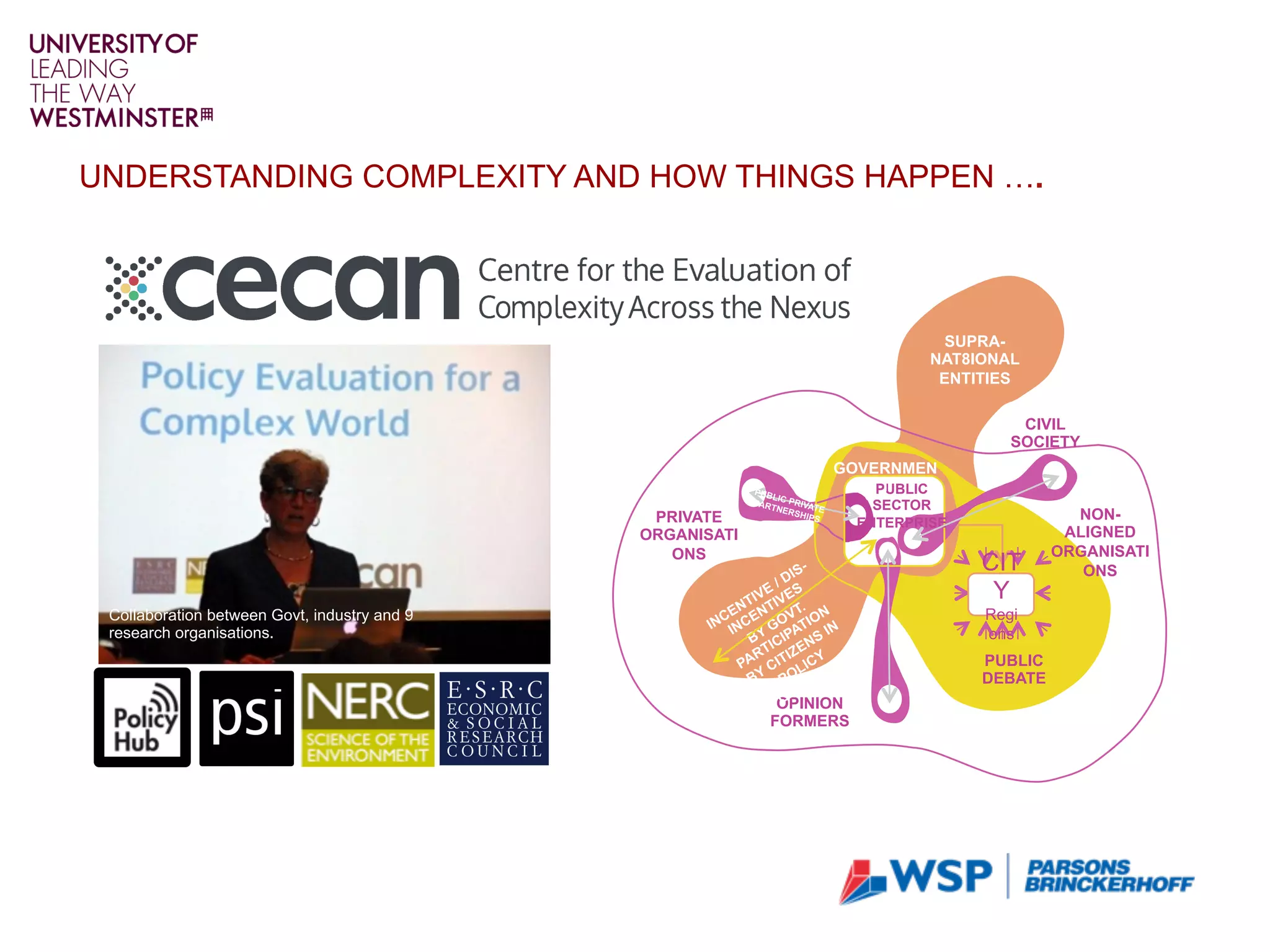
Collaboration between Govt, industry and 9
research organisations.
CIVIL
SOCIETY
NON-
ALIGNED
ORGANISATI
ONS
OPINION
FORMERS
PRIVATE
ORGANISATI
ONS
PUBLIC
SECTOR
ENTERPRISE
PUBLIC
DEBATE
GOVERNMEN
T
SUPRA-
NAT8IONAL
ENTITIES
PUBLIC PRIVATE
PARTNERSHIPS
CIT
Y
Regi
ons
UNDERSTANDING COMPLEXITY AND HOW THINGS HAPPEN ….
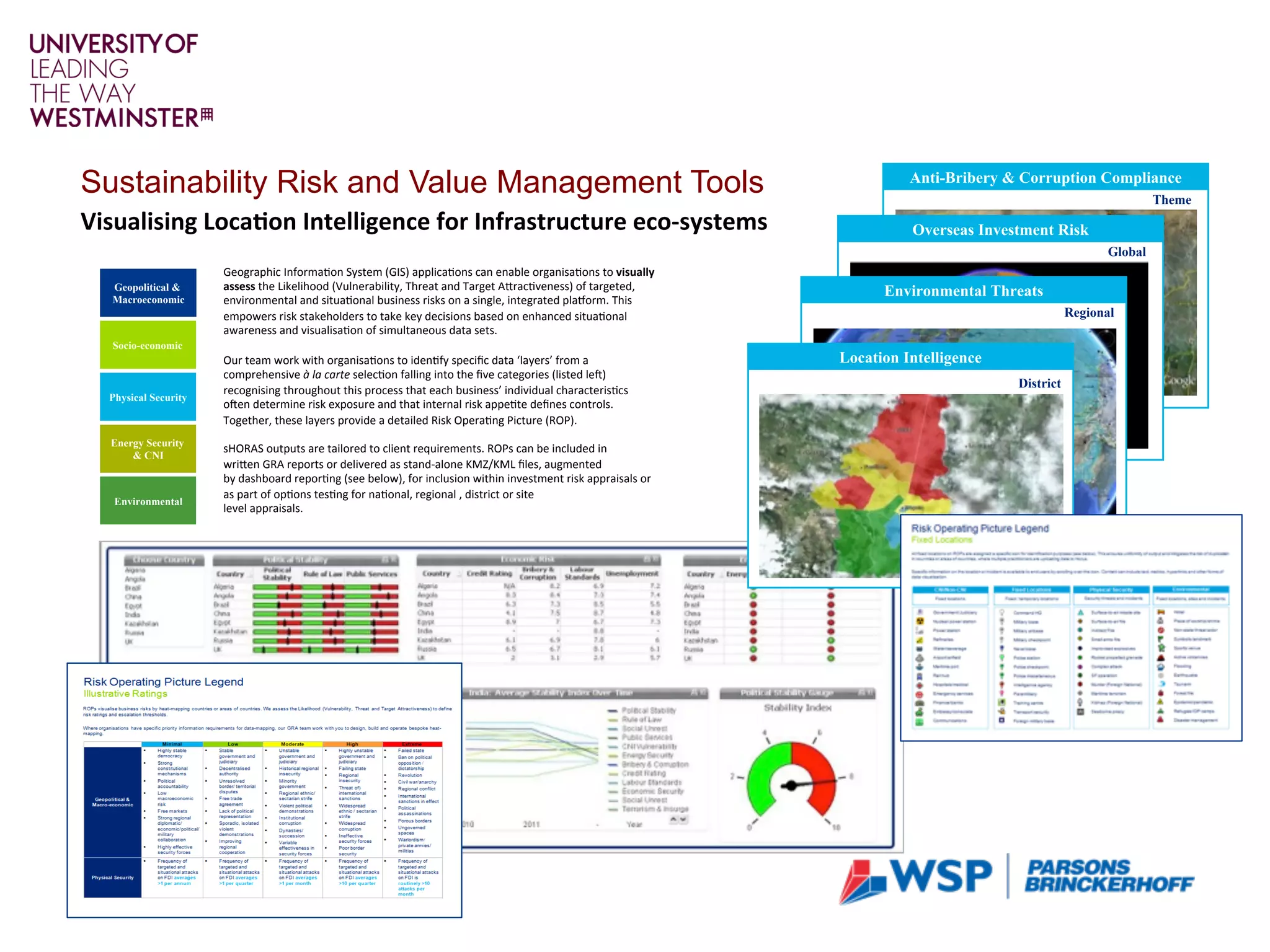
Geographic	Informa1on	System	(GIS)	applica1ons	can	enable	organisa1ons	to	visually	
assess	the	Likelihood	(Vulnerability,	Threat	and	Target	Akrac1veness)	of	targeted,	
environmental	and	situa1onal	business	risks	on	a	single,	integrated	plahorm.	This	
empowers	risk	stakeholders	to	take	key	decisions	based	on	enhanced	situa1onal	
awareness	and	visualisa1on	of	simultaneous	data	sets.	
	
Our	team	work	with	organisa1ons	to	iden1fy	specific	data	‘layers’	from	a	
comprehensive	à	la	carte	selec1on	falling	into	the	five	categories	(listed	leS)	
recognising	throughout	this	process	that	each	business’	individual	characteris1cs	
oSen	determine	risk	exposure	and	that	internal	risk	appe1te	defines	controls.	
Together,	these	layers	provide	a	detailed	Risk	Opera1ng	Picture	(ROP).	
	
sHORAS	outputs	are	tailored	to	client	requirements.	ROPs	can	be	included	in		
wriken	GRA	reports	or	delivered	as	stand-alone	KMZ/KML	files,	augmented	
by	dashboard	repor1ng	(see	below),	for	inclusion	within	investment	risk	appraisals	or	
as	part	of	op1ons	tes1ng	for	na1onal,	regional	,	district	or	site		
level	appraisals.		
Geopolitical &
Macroeconomic
Socio-economic
Physical Security
Energy Security
& CNI
Environmental
Sustainability Risk and Value Management Tools
Visualising	Loca4on	Intelligence	for	Infrastructure	eco-systems	
Theme
Anti-Bribery & Corruption Compliance
Overseas Investment Risk
Global
Environmental Threats
Regional
Location Intelligence
District
Total UK Carbon 1.215 million t
Case Study: Generic		Total	Cost	to	Serve	model	for	Data	Centres	
	
DATA CENTRE ‘COST TO SERVE’ MODELS
INPUTS
Engineering – Tier rating, IT load per hall,
number of halls, PUE
Technology – Applications, server complexity,
rack size, IT load projected growth
Real Estate – Years to plan for, location, site
cost, inflation
OUTPUTS
Engineering – area required for plant, energy
and carbon tax costs
Technology – IT Load per rack & hall, number
of servers and racks required, costs (IT
hardware, operating, migration)
Real Estate – site size required, construction
costs, maintenance and running costs
Facility parameters defined together with
cumulative total cost of ownership and spend
profile for the life of the data centre.
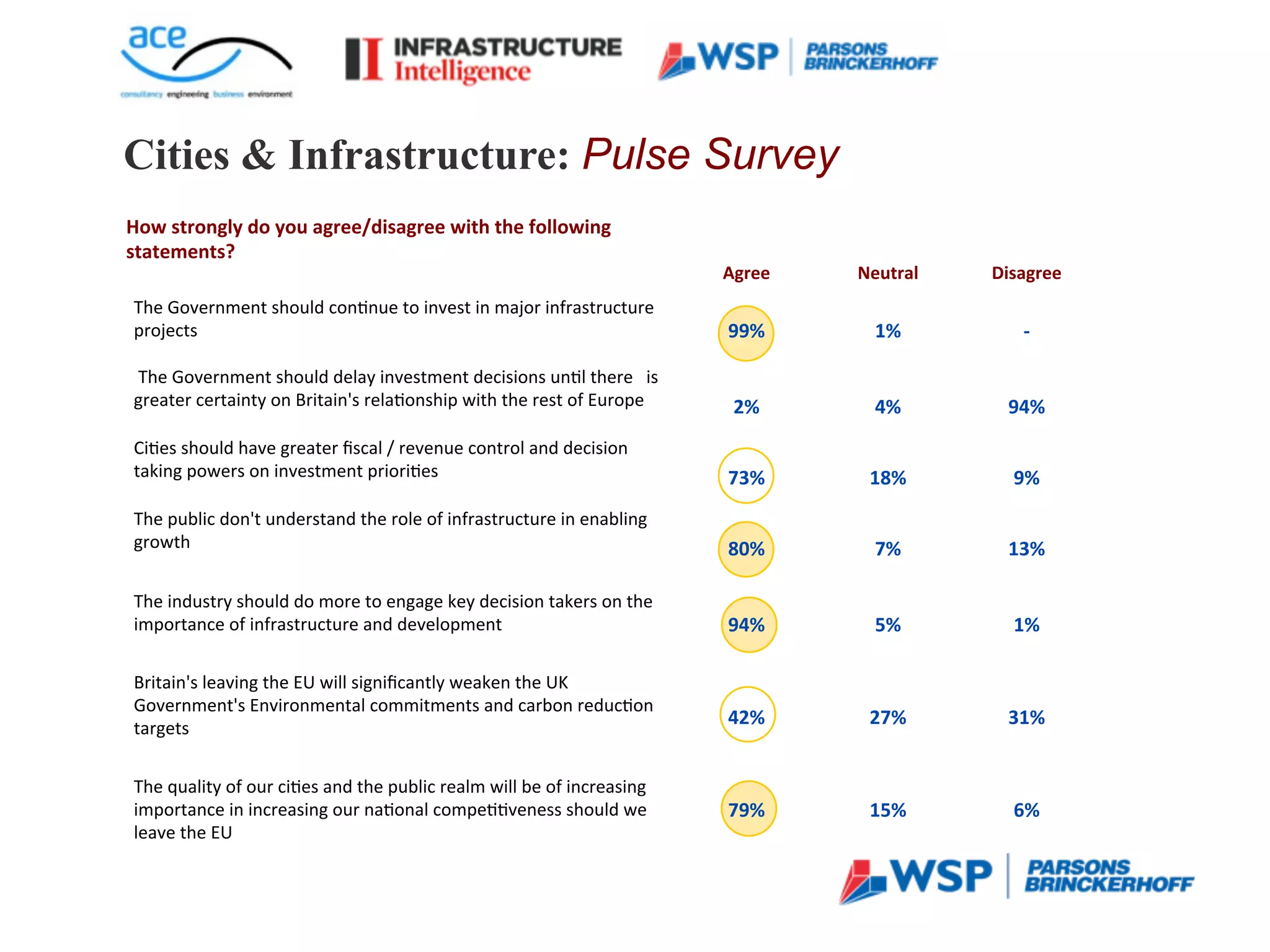
Cities & Infrastructure: Pulse Survey
How	strongly	do	you	agree/disagree	with	the	following	
statements?	
	 Agree	 Neutral	 Disagree	
The	Government	should	con1nue	to	invest	in	major	infrastructure	
projects	
	
99%	 1%	 -	
	The	Government	should	delay	investment	decisions	un1l	there			is	
greater	certainty	on	Britain's	rela1onship	with	the	rest	of	Europe	
	
2%	 4%	 94%	
Ci1es	should	have	greater	fiscal	/	revenue	control	and	decision	
taking	powers	on	investment	priori1es	
	
73%	 18%	 9%	
The	public	don't	understand	the	role	of	infrastructure	in	enabling	
growth	
	
80%	 7%	 13%	
The	industry	should	do	more	to	engage	key	decision	takers	on	the	
importance	of	infrastructure	and	development	
	
94%	 5%	 1%	
Britain's	leaving	the	EU	will	significantly	weaken	the	UK	
Government's	Environmental	commitments	and	carbon	reduc1on	
targets	
	
42%	 27%	 31%	
The	quality	of	our	ci1es	and	the	public	realm	will	be	of	increasing	
importance	in	increasing	our	na1onal	compe11veness	should	we	
leave	the	EU	
79%	 15%	 6%
A	
(14%)	
B	
(14%)	
D	
(14%)	
I	
([PERCENTAGE])	E	
([PERCENTAGE])	
L	
([PERCENTAGE])	
E	
(8%)	
K	
([PERCENTAGE])	
J	
([PERCENTAGE])	
E	
([PERCENTAGE])	
E	
([PERCENTAGE])	
C	
([PERCENTAGE])	
TOP	5	investment	priori4es	to	help	ensure	our	long	term	compe44veness	
Improved	transport	links	between	ci1es	e.g.	
HS2,	HS3	Northern	Powerhouse		
Improved	transport	linkages	within	ci1es	and	
city	regions	e.g.	Cross	Rail	2		
Increased	airport	capacity	in	the	South	East		
Conven1onal	Power	Genera1on,	
Transmission,	Distribu1on		
Increase	Renewable	Energy		
Systems	Improvement	e.g.	electrifica1on		
Improving	UK's	main	Trunk	Roads	and	
Motorways		
Improving	Local	Road	Transport		
Flood	Defense	/	Climate	Resilience		
Ranking	 Priority	
1st		
A	
B	
Improved	Transport	between	ci1es	
Improved	transport	within	ci1es	
3rd	 C	 Digital	&	IT	Infrastructure	
4th	 D	 Airport	Expansion	in	SE	
5th	
E	
F	
G	
H	
Trunk	Road	&		Motorway	Improvement	
Increased	Renewable	Energy	
Urban	Housing	
Social	Infrastructure	
9th	
10th	
11th	
12th	
I	
J	
K	
L	
Conven1onal	Power	
Flood	Defence	/	Climate	resilience	
Local	Road	Transport	
Systems	Improvements,	Electrifica1on	
Cities & Infrastructure: Pulse Survey
Single	most	important	areas	for	Government	and	policy	makers	to	ensure	growth	and	compe44veness		
Na4onal	Infrastructure	 28%	
23%	
20%	
Beker,	integrated	inter-	urban	transport	systems	
Long	term	na1onal	infrastructure	plan	with	cross	party	support	
Na1onal	clean	power	strategy	+	support	systems	
City	&	City	Regions	 22%	
20%	
17%	
Beker	public	transport	systems	
Beker,	integrated	mul1-modal	transport	systems	
Devolu1on	
Rural	 52%	
10%	
7%	
Broad-Band	
Community	Investment	
Planning	policies	that	support	economic	development
Key	Themes		
Cities & Infrastructure: Pulse Survey
Housing	was	surprisingly	not	a	major	
	issue	even	though	the	public	and		
poli<cians	see	housing	as	their	most	
	important	infrastructure	related	
	issue	(ignore	immigra<on).	If		
infrastructure	wants	to	be	vocal	it		
should	talk	in	the	language	of	housing		
(development)	that	the	public		
understands.		
Compe44veness	 We	have	been	calling	for	greater	infrastructure	investment	for	years,	we	were	on	this	
journey	anyway.	Brexit	doesn’t	impact	the	desire	or	long	term	need	for	upgrading	our	
transport	networks	that	need	it	to	cope	with	a	growing	popula1on	and	economy.	
Confidence	 Is Brexit Infrastructure’s opportunity to find it’s voice?
Not	only	does	it	provide	enormous	benefits	to	the	economy,	we	as	an	
industry	are	significant	employers	of	high	end	technical	skills	in	our	own	right.
Advocacy	&	
Awareness	
How	do	we	do	a	beker	job	in	communica1ng	the	complexi1es	and	benefits	of	
infrastructure	and	connected	development	?		
Do	we	think	that	by	persuading	the	public	can	we	persuade	government?	
How	can	we	akract	young	bright	people	to	the	industry	?	
Engagement	&	
Influence	
	
How	can	the	industry	do	more	to	engage	and	influence	decision	takers	and	
poli1cians	?		
What	do	we	need	to	do	beker	?	
1
2
3
4
‘	There	is	an	exis<ng	skills	gap	in	
this	country.	We	want	young	
people	to	see	great	careers	ahead	
of	them	with	the	promise	of	world	
class	iconic	projects	to	work	on,	
otherwise	they	may	choose	other	
industries.	Major	projects	can	help	
the	UK	to	inspire	the	next	
genera<on	of	Brunel’s.’
Professor Peter Sharratt MA, DipArch, MSt. IDBE, FRSA
Director Strategic Consulting, WSP Parson Brinckerhoff
Professor of Industry & Professional Practice, University of Westminster
Peter.Sharratt@wspgroup.com
07713 - 985 833 m

Global C4IR-1 Masterclass Cambridge - Sharratt WSP 2017