How	Can	2D	Materials	Advance	Energy	
Storage	?	
	
15th	Anniversary	High	Value	Manufacturing	&	4th	New	Materials	&	Graphene	
Conference	2017	
2-3	November	2017	
www.cir-strategy.com/events	
Dr	M.	J.	Loveridge,	Warwick	University
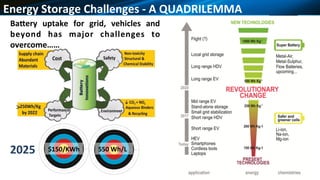
Energy	Storage	Challenges	-	A	QUADRILEMMA	
BaDery	 uptake	 for	 grid,	 vehicles	 and	
beyond	 has	 major	 challenges	 to	
overcome……	
>	
$150/KWh	 550	Wh/L	2025
Discharge:	The	Odyssey	
Charge:	The	Iliad	
Li’s	“Troy”	 Li’s	“Ithaca”	
ANODE	 CATHODE	
Li	ions	have	perpetually	tortuous,	repeated	voyages….
Li-ion	anode	&	cathode	chemistry		
BaDery	Innova[ons	-	Evolu[on	Not	Revolu[on	
C	 LiCoO2	
More	cathode	material	developments	have	been		
commercially	successful	(compared	with	anodes)
Material	Dimensional	Considera[ons	
and	the	ra[onale	behind	bio-inspira[on.
Biological	microstructures	are	the	most	op[mised	and	func[onal	
microstructures	that	exist.		
Why	bio-inspired?	
Lamella	
1nm	 5-20	nm	 50-100	nm	 3	–	7	µm	 10	–	500	µm	 >1	cm	
Osteon	Mineral	crystals	 Compact	macrostructure	Fiber	Fibril	
There	are	many	opportuni6es	to	apply	such	structural	arrangements	in	ba:ery	components
Nano-structured	materials	for	energy	storage:	2D	or	Not	2D?			
0D	
1D	
2D	
3D	
Nano	Arrays	
That	is	the	ques[on…..	
Intense	research	on	
nanomaterials	due	to	
desirable	proper6es	:	
	
•  SURFACE	AREA	
•  NOVEL	SIZE	EFFECTS	
•  ENHANCED	KINETICS	
•  MANY	TAILORABLE	
PROPERTIES	
Advantages	 Disadvantages	
Short	diffusion	
pathways,	good	
rate	capability	
Unstable	and	
difficult	to	make	
High	capacity,	
strain	relaxa6on,	
rate,	electrical	
connec6vity	
Low	surface	area	
&	diffusion	rate,	
scalable	
manufacture	
Small	crystalline	
size,	high	surface	
area,	large	SA:V,	
ease	of	synthesis	
Energy	density	
limits,	SEI	
Large	SA:V,	high	
capacity,	
structural	stability	
SEI
Property	Advantages	of	2D	Materials	
  Large	surface	areas	and	interlayer	spaces	of	2D	materials	e.g.	
graphene	&	transi6on	metal	dichalcogenides	(TMDs)	provide	an	
ideal	framework	to	store	lithium	(or	sodium)	ions	electrochemically	
  Layered	transi6on	metal	sulphides	e.g.	MoS2	have	weak	interplanar	
bonding	(van	der	Waals	interac6ons)	–	Li	ions	can	be	inserted	and	
accommodated	with	less	severe	volume	expansion
2D	into							
Energy	Innova[on	Centre		
Materials	&	Electrochemistry	Group	
3D
AMorpheus	
(EPSRC)		
2D	Alloys	
AtMoS2pheric	
(EPSRC)		
2D	Graphene	Composites	
Amorphous	Si-Sn	anodes	


MoS2-graphene	hybrids	
2D-3D	Anode	Developments	for	Li	&	Na-ion	Energy	Storage
AMorpheus	–	Plasma	enhanced	CVD	SnSi	NWs		
	
Silane	Vapour-Liquid-Solid	Growth	Mechanism	
Metal	current	collector	
2D	Sn-Si	hybrid	NW		 BoDom-up	NW	growth
Versa[lity	of	Coa[ng	3d	Substrate	Current	Collectors	
SnSi-NWs	on	carbon	fibres	SnSi-NWs	on	copper	foil	
Uniform	thickness	for	Li-diffusion	
Prac[cal	Film	Thickness	for	energy	density
Crystalline	&	Amorphous	2D	Nanowires		


20 30 40 50 60 70 80 90 100
0
2k
4k
6k
8k
10k
(132)(112)(031)
(220)
(011)
(020)
(220)
(422)
(333)
(111)
Intensity(a.u.)
2θ (deg)
Cubic	&	Tetragonal	phases
Integra6ng	2D	Materials	
Fellowship:	AtMoS2pheric
Ammonium	molybdate		
&	Thiourea	
	
220oC,	40	bar	
(110)	Basal	
plane	
Edge		
plane	
Method	1
Li-ion	Energy	Storage	 Na-ion	Energy	Storage
2	µm	
1	µm	
Few	Layer	
Graphene	
With	
hydrothermally	
grown	MoS2	
platelets	
300	nm	
	
Uniform	&	
stable	MoS2	
coverage	
	
	
0	
5000	
10000	
15000	
20000	
25000	
30000	
8	 18	 28	 38	 48	 58	 68	
Intensity	
2θ	
MoS2	on	graphene	
002	MoS2	
Graphene	
101	MoS2	
103	MoS2	 110	MoS2	
Method	2
2D	Material	as	mul6-func6onal	
Enhancing	Addi6ve	
Silicon	Anode	Research
Si-graphene	Composite	Microstructures	
Cu	foil	
0	
500	
1000	
1500	
2000	
0	 50	 100	 150	 200	 250	
Specific	Capacity	(mAh/g)	
Cycle	Number	
Charge-discharge	Electrochemical	Cycling	
Few-layer	
graphene	
Si	
Si	
Cu	foil	current	collector
Graphene:	Holis[c	Performance-enhancing	Substance!	
GRAPHENE	
Tensile	
Proper[es	
Reversible	Li+	
Intercala[on	
Improves	
structural	
stability	
X-Y	Electrical	
conduc[vity	
Wide	spectrum	of	
chemical	
func[onalisa[on	
In-plane	thermal	
conduc[on	 Maintains	
low	series	
resistance
Conclusions	
  Integra6ng	select	2D	Li	host	materials	into	3D	morphologies	is	
beneficial	to	electrochemical	performance	(surface	area,	diffusion	
paths…)	
	
  Composite	2D-3D	microstructures	incorpora6ng	graphene	offer	
mul6ple	func6ons	in	energy	storage	systems	
	
Recommenda[on:	There	is	a	need	to	explore	advanced	
manufacturing	methodology	for	nanostructured	materials.
Thank	you	for	listening…..		Any	Ques[ons?			
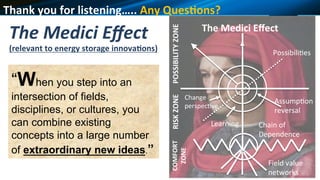
“When you step into an
intersection of fields,
disciplines, or cultures, you
can combine existing
concepts into a large number
of extraordinary new ideas.”	
The	Medici	Effect	
(relevant	to	energy	storage	innova[ons)	
	
POSSIBILITY	ZONE	RISK	ZONE	COMFORT	
ZONE	
Learning	
Possibili6es	
The	Medici	Effect	
Change	
perspec6ve	
Field	value	
networks	
Chain	of	
Dependence	
Assump6on	
reversal
Mul[-scale	materials	for	op[mised	microstructures		
(1)	Ac[ve	Materials	 (2)	Matrix	of	Conduc[ve	
Addi[ves	
(3)	Polymer	Func[onality	
&	Hybrids	


Carbon	
black	
CNTs	
VGCF	
FLG	
µm	clusters	of	
nm	par[cles	 Configura[on	/	
Property	
combina[ons	
Branching	+	
chemistry	
modifica[ons	for	
max.	interac[ons		
Hybrid	
combina[ons	
Composites	
Cross-linking	
with	Mx+	ions

Energy storage materials