Key Concepts:
• Over-urbanization
• Deindustrialization
• Redlining
• Segregation / Congregation
• Urbanization
• Urban expansion
• Gateway & shock cities
• Central place theory
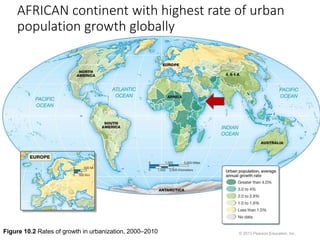
AFRICAN continent with highest rate of urban
population growth globally
© 2013 Pearson Education, Inc.Figure 10.2 Rates of growth in urbanization, 2000–2010
Global trend towards Urbanization
• Populations concentrating in cities is one of the most
important global geographic phenomena today.
• 50% of the World’s Population lives in Cities
• United Nations Center for Human Settlements notes that the
growth of cities & urbanization of rural areas are now
irreversible due to global shift to technological, industrial, &
service-based economies.
• North America has highest concentration of people living in
cities, >50%
• African continent is largest urbanizing world region.
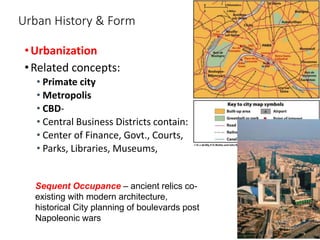
Urban History & Form
•Urbanization
•Related concepts:
• Primate city
• Metropolis
• CBD-
• Central Business Districts contain:
• Center of Finance, Govt., Courts,
• Parks, Libraries, Museums,
Sequent Occupance – ancient relics co-
existing with modern architecture,
historical City planning of boulevards post
Napoleonic wars
URBAN Origin & form: • Urbanism – the way life fostered
by urban settings, in which the
number, physical density, &
variety of people result in
distinctive attitudes, values, &
patterns of behavior.
• Urban origins – historical context
of the growth of cities, long
period of development
• Urban system – an
interdependent set of
urban settlements within a
region.
• Urban form – the physical
structure, & organization
of cities in their land use,
layout, & built
environment
• Urban ecology – the social
& demographic
composition of city
districts & neighborhoods.
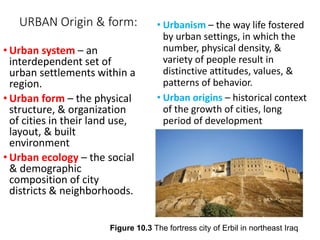
Figure 10.3 The fortress city of Erbil in northeast Iraq
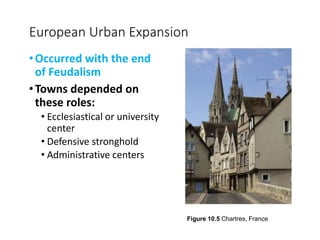
European Urban Expansion
•Occurred with the end
of Feudalism
•Towns depended on
these roles:
• Ecclesiastical or university
center
• Defensive stronghold
• Administrative centers
Figure 10.5 Chartres, France
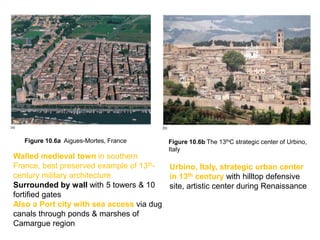
Figure 10.6b The 13thC strategic center of Urbino,
Italy
Figure 10.6a Aigues-Mortes, France
Walled medieval town in southern
France, best preserved example of 13th-
century military architecture
Surrounded by wall with 5 towers & 10
fortified gates
Also a Port city with sea access via dug
canals through ponds & marshes of
Camargue region
Urbino, Italy, strategic urban center
in 13th century with hilltop defensive
site, artistic center during Renaissance
Industrial Cities
•A Shock city is the embodiment of surprising &
disturbing economic, social, and cultural changes in
urban life.
•Manchester, England & Chicago, IL, USA were
archetypal forms of an entirely new kind of city, the
industrial city, fundamental reasons for existence to
assemble raw materials & to fabricate assemble, &
distribute manufactured goods.
•Unprecedented rates of growth & economic, social, &
political problems.
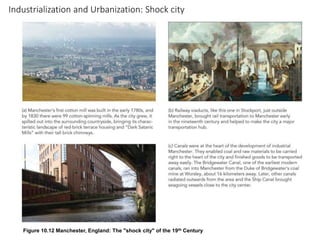
Figure 10.12 Manchester, England: The "shock city" of the 19th Century
Industrialization and Urbanization: Shock city
[Insert Figure 10.15]
Colonial Cities
•European
imperialism
•"Established" or
planted Colonial
functions
grafted onto an
existing
settlement
Figure 10.15 Mumbai, an example of colonial architecture and urban design
Imperialism & Peripheral Urbanization
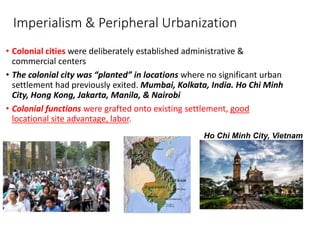
• Colonial cities were deliberately established administrative &
commercial centers
• The colonial city was “planted” in locations where no significant urban
settlement had previously exited. Mumbai, Kolkata, India. Ho Chi Minh
City, Hong Kong, Jakarta, Manila, & Nairobi
• Colonial functions were grafted onto existing settlement, good
locational site advantage, labor.
Ho Chi Minh City, Vietnam
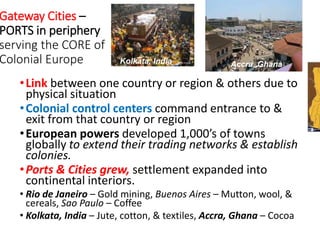
Gateway Cities –
PORTS in periphery
serving the CORE of
Colonial Europe
•Link between one country or region & others due to
physical situation
•Colonial control centers command entrance to &
exit from that country or region
•European powers developed 1,000’s of towns
globally to extend their trading networks & establish
colonies.
•Ports & Cities grew, settlement expanded into
continental interiors.
• Rio de Janeiro – Gold mining, Buenos Aires – Mutton, wool, &
cereals, Sao Paulo – Coffee
• Kolkata, India – Jute, cotton, & textiles, Accra, Ghana – Cocoa
Accra, GhanaKolkata, India
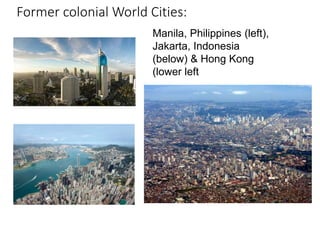
Former colonial World Cities:
Manila, Philippines (left),
Jakarta, Indonesia
(below) & Hong Kong
(lower left
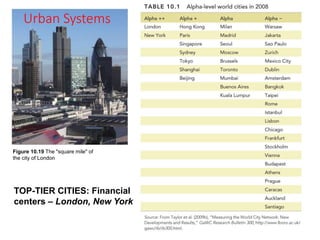
Urban Systems
Figure 10.19 The "square mile" of
the city of London
TOP-TIER CITIES: Financial
centers – London, New York
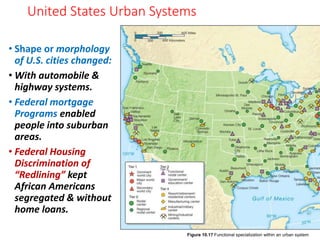
United States Urban Systems
• Shape or morphology
of U.S. cities changed:
• With automobile &
highway systems.
• Federal mortgage
Programs enabled
people into suburban
areas.
• Federal Housing
Discrimination of
“Redlining” kept
African Americans
segregated & without
home loans.
Figure 10.17 Functional specialization within an urban system
Urban Periphery: Over-urbanization
• Rural Migrants migrate to cities for opportunity.
• Exceptionally high rates of population increase. Occurs when
cities grow more rapidly than they can sustain jobs & housing.
• Produces instant slums on unpaved streets with open sewers &
no utilities.
• Housing is substandard to say the least; shacks constructed of
planks, cardboard, tar paper, thatch, mud, & corrugated iron.
• Concentrated in Africa, South America, Asia, & SW Asia – 1.75
BILLION PEOPLE LIVE THIS WAY
• 2 out of 7 People on Earth live this way
• Result of disruption of Rural Societies by Globalizing forces of
Agricultural restructuring.
North American City Structure
• Central business district
(CBD) – traditional city development based on
urban center with administrative functions
including government, banking, law, education,
& retail functions. Taller buildings &
monumental architecture.
• Zone in transition – as city space evolves &
changes, previous zones of industrial use fall
into decay, may develop into new business with
different land use; mixture of growth, change &
decline.
Figure 11.2 Chicago's
“Globalized” Financial CBD
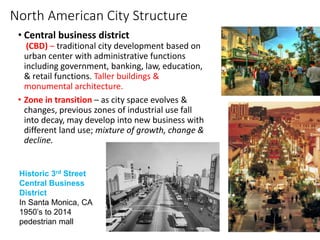
Historic 3rd Street
Central Business
District
In Santa Monica, CA
1950’s to 2014
pedestrian mall
The Core:
Urban Problems in Mature cities
•Deindustrialization – People lose jobs!
•Agglomeration – concentration of industry
types in urban areas such as auto industry,
manufacturing, and now IT
Diseconomies – loss of manufacturing overseas
results in related industries closing, loss of jobs
•Decentralization of jobs and people
•Counter-urbanization – populations leaving
American cities
•Re-urbanization – repopulation of U.S. cities
© 2013 Pearson Education, Inc.
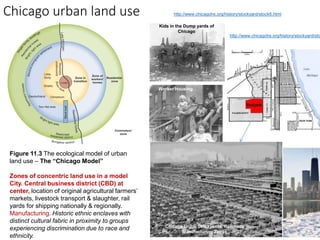
Chicago urban land use
Figure 11.3 The ecological model of urban
land use – The “Chicago Model”
Zones of concentric land use in a model
City. Central business district (CBD) at
center, location of original agricultural farmers’
markets, livestock transport & slaughter, rail
yards for shipping nationally & regionally.
Manufacturing. Historic ethnic enclaves with
distinct cultural fabric in proximity to groups
experiencing discrimination due to race and
ethnicity.
http://www.chicagohs.org/history/stockyard/stock6.html
Kids in the Dump yards of
Chicago
http://www.chicagohs.org/history/stockyard/sto
Worker Housing
Chicago Union Stockyards, Railroads
Manufacturing Zones
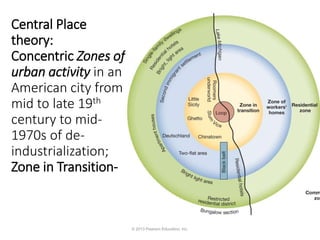
Central Place
theory:
Concentric Zones of
urban activity in an
American city from
mid to late 19th
century to mid-
1970s of de-
industrialization;
Zone in Transition-
© 2013 Pearson Education, Inc.
Urban Population & Congregation
• Congregation provides a means of cultural preservation. Allows
religious & cultural practices to be maintained & strengthens
group identity through daily involvement in routines & ways of
life.
• Minority groups are population subgroups that are perceived
as different from the general population. Defining
characteristics of minority groups can be based on race,
language, religion, nationality, caste, sexual orientation, or
lifestyle.
• Segregation – The combined result of congregation &
discrimination, the spatial separation of specific subgroups
within a wider population.
• Enclaves are tendencies toward congregation &
discrimination are long-standing but dominated by internal
cohesion.
• Ghettos long-standing products of discrimination than
congregation.
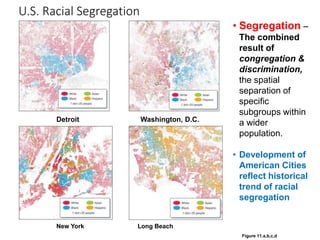
U.S. Racial Segregation
Detroit
Long BeachNew York
Washington, D.C.
Figure 11.a,b,c,d
• Segregation –
The combined
result of
congregation &
discrimination,
the spatial
separation of
specific
subgroups within
a wider
population.
• Development of
American Cities
reflect historical
trend of racial
segregation
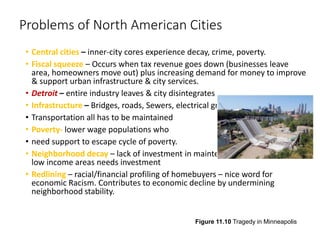
Problems of North American Cities
• Central cities – inner-city cores experience decay, crime, poverty.
• Fiscal squeeze – Occurs when tax revenue goes down (businesses leave
area, homeowners move out) plus increasing demand for money to improve
& support urban infrastructure & city services.
• Detroit – entire industry leaves & city disintegrates
• Infrastructure – Bridges, roads, Sewers, electrical grids,
• Transportation all has to be maintained
• Poverty- lower wage populations who
• need support to escape cycle of poverty.
• Neighborhood decay – lack of investment in maintenance of properties -
low income areas needs investment
• Redlining – racial/financial profiling of homebuyers – nice word for
economic Racism. Contributes to economic decline by undermining
neighborhood stability.
Figure 11.10 Tragedy in Minneapolis
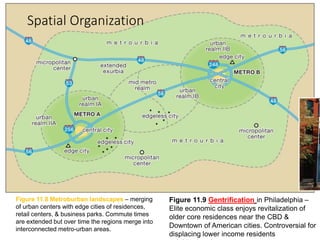
Figure 11.9 Gentrification in Philadelphia –
Elite economic class enjoys revitalization of
older core residences near the CBD &
Downtown of American cities. Controversial for
displacing lower income residents
Figure 11.8 Metroburban landscapes – merging
of urban centers with edge cities of residences,
retail centers, & business parks. Commute times
are extended but over time the regions merge into
interconnected metro-urban areas.
Spatial Organization
[Insert Figure 10.23]
World Urbanization Today
•Over-urbanization
• Squatter settlements
•Megacities –
• Very large cities
• characterized by
• both primacy & a
• high degree of centrality
•Informal sector of the economy, activities off official
records & not subject to formal regulation, “getting paid”,
also centers of self-help networks & community
organization. Serves the city core.
Figure 10.20 Slum housing in Nairobi, Kenya, a peripheral city

Disc. 4 Urban issues Ch. 11(10) Urbanization

  • 1.
    Key Concepts: • Over-urbanization •Deindustrialization • Redlining • Segregation / Congregation • Urbanization • Urban expansion • Gateway & shock cities • Central place theory
  • 2.
    AFRICAN continent withhighest rate of urban population growth globally © 2013 Pearson Education, Inc.Figure 10.2 Rates of growth in urbanization, 2000–2010
  • 3.
    Global trend towardsUrbanization • Populations concentrating in cities is one of the most important global geographic phenomena today. • 50% of the World’s Population lives in Cities • United Nations Center for Human Settlements notes that the growth of cities & urbanization of rural areas are now irreversible due to global shift to technological, industrial, & service-based economies. • North America has highest concentration of people living in cities, >50% • African continent is largest urbanizing world region.
  • 4.
    Urban History &Form •Urbanization •Related concepts: • Primate city • Metropolis • CBD- • Central Business Districts contain: • Center of Finance, Govt., Courts, • Parks, Libraries, Museums, Sequent Occupance – ancient relics co- existing with modern architecture, historical City planning of boulevards post Napoleonic wars
  • 5.
    URBAN Origin &form: • Urbanism – the way life fostered by urban settings, in which the number, physical density, & variety of people result in distinctive attitudes, values, & patterns of behavior. • Urban origins – historical context of the growth of cities, long period of development • Urban system – an interdependent set of urban settlements within a region. • Urban form – the physical structure, & organization of cities in their land use, layout, & built environment • Urban ecology – the social & demographic composition of city districts & neighborhoods. Figure 10.3 The fortress city of Erbil in northeast Iraq
  • 6.
    European Urban Expansion •Occurredwith the end of Feudalism •Towns depended on these roles: • Ecclesiastical or university center • Defensive stronghold • Administrative centers Figure 10.5 Chartres, France
  • 7.
    Figure 10.6b The13thC strategic center of Urbino, Italy Figure 10.6a Aigues-Mortes, France Walled medieval town in southern France, best preserved example of 13th- century military architecture Surrounded by wall with 5 towers & 10 fortified gates Also a Port city with sea access via dug canals through ponds & marshes of Camargue region Urbino, Italy, strategic urban center in 13th century with hilltop defensive site, artistic center during Renaissance
  • 8.
    Industrial Cities •A Shockcity is the embodiment of surprising & disturbing economic, social, and cultural changes in urban life. •Manchester, England & Chicago, IL, USA were archetypal forms of an entirely new kind of city, the industrial city, fundamental reasons for existence to assemble raw materials & to fabricate assemble, & distribute manufactured goods. •Unprecedented rates of growth & economic, social, & political problems.
  • 9.
    Figure 10.12 Manchester,England: The "shock city" of the 19th Century Industrialization and Urbanization: Shock city
  • 10.
    [Insert Figure 10.15] ColonialCities •European imperialism •"Established" or planted Colonial functions grafted onto an existing settlement Figure 10.15 Mumbai, an example of colonial architecture and urban design
  • 11.
    Imperialism & PeripheralUrbanization • Colonial cities were deliberately established administrative & commercial centers • The colonial city was “planted” in locations where no significant urban settlement had previously exited. Mumbai, Kolkata, India. Ho Chi Minh City, Hong Kong, Jakarta, Manila, & Nairobi • Colonial functions were grafted onto existing settlement, good locational site advantage, labor. Ho Chi Minh City, Vietnam
  • 12.
    Gateway Cities – PORTSin periphery serving the CORE of Colonial Europe •Link between one country or region & others due to physical situation •Colonial control centers command entrance to & exit from that country or region •European powers developed 1,000’s of towns globally to extend their trading networks & establish colonies. •Ports & Cities grew, settlement expanded into continental interiors. • Rio de Janeiro – Gold mining, Buenos Aires – Mutton, wool, & cereals, Sao Paulo – Coffee • Kolkata, India – Jute, cotton, & textiles, Accra, Ghana – Cocoa Accra, GhanaKolkata, India
  • 13.
    Former colonial WorldCities: Manila, Philippines (left), Jakarta, Indonesia (below) & Hong Kong (lower left
  • 14.
    Urban Systems Figure 10.19The "square mile" of the city of London TOP-TIER CITIES: Financial centers – London, New York
  • 15.
    United States UrbanSystems • Shape or morphology of U.S. cities changed: • With automobile & highway systems. • Federal mortgage Programs enabled people into suburban areas. • Federal Housing Discrimination of “Redlining” kept African Americans segregated & without home loans. Figure 10.17 Functional specialization within an urban system
  • 16.
    Urban Periphery: Over-urbanization •Rural Migrants migrate to cities for opportunity. • Exceptionally high rates of population increase. Occurs when cities grow more rapidly than they can sustain jobs & housing. • Produces instant slums on unpaved streets with open sewers & no utilities. • Housing is substandard to say the least; shacks constructed of planks, cardboard, tar paper, thatch, mud, & corrugated iron. • Concentrated in Africa, South America, Asia, & SW Asia – 1.75 BILLION PEOPLE LIVE THIS WAY • 2 out of 7 People on Earth live this way • Result of disruption of Rural Societies by Globalizing forces of Agricultural restructuring.
  • 17.
    North American CityStructure • Central business district (CBD) – traditional city development based on urban center with administrative functions including government, banking, law, education, & retail functions. Taller buildings & monumental architecture. • Zone in transition – as city space evolves & changes, previous zones of industrial use fall into decay, may develop into new business with different land use; mixture of growth, change & decline. Figure 11.2 Chicago's “Globalized” Financial CBD Historic 3rd Street Central Business District In Santa Monica, CA 1950’s to 2014 pedestrian mall
  • 18.
    The Core: Urban Problemsin Mature cities •Deindustrialization – People lose jobs! •Agglomeration – concentration of industry types in urban areas such as auto industry, manufacturing, and now IT Diseconomies – loss of manufacturing overseas results in related industries closing, loss of jobs •Decentralization of jobs and people •Counter-urbanization – populations leaving American cities •Re-urbanization – repopulation of U.S. cities © 2013 Pearson Education, Inc.
  • 19.
    Chicago urban landuse Figure 11.3 The ecological model of urban land use – The “Chicago Model” Zones of concentric land use in a model City. Central business district (CBD) at center, location of original agricultural farmers’ markets, livestock transport & slaughter, rail yards for shipping nationally & regionally. Manufacturing. Historic ethnic enclaves with distinct cultural fabric in proximity to groups experiencing discrimination due to race and ethnicity. http://www.chicagohs.org/history/stockyard/stock6.html Kids in the Dump yards of Chicago http://www.chicagohs.org/history/stockyard/sto Worker Housing Chicago Union Stockyards, Railroads Manufacturing Zones
  • 20.
    Central Place theory: Concentric Zonesof urban activity in an American city from mid to late 19th century to mid- 1970s of de- industrialization; Zone in Transition- © 2013 Pearson Education, Inc.
  • 21.
    Urban Population &Congregation • Congregation provides a means of cultural preservation. Allows religious & cultural practices to be maintained & strengthens group identity through daily involvement in routines & ways of life. • Minority groups are population subgroups that are perceived as different from the general population. Defining characteristics of minority groups can be based on race, language, religion, nationality, caste, sexual orientation, or lifestyle. • Segregation – The combined result of congregation & discrimination, the spatial separation of specific subgroups within a wider population. • Enclaves are tendencies toward congregation & discrimination are long-standing but dominated by internal cohesion. • Ghettos long-standing products of discrimination than congregation.
  • 22.
    U.S. Racial Segregation Detroit LongBeachNew York Washington, D.C. Figure 11.a,b,c,d • Segregation – The combined result of congregation & discrimination, the spatial separation of specific subgroups within a wider population. • Development of American Cities reflect historical trend of racial segregation
  • 23.
    Problems of NorthAmerican Cities • Central cities – inner-city cores experience decay, crime, poverty. • Fiscal squeeze – Occurs when tax revenue goes down (businesses leave area, homeowners move out) plus increasing demand for money to improve & support urban infrastructure & city services. • Detroit – entire industry leaves & city disintegrates • Infrastructure – Bridges, roads, Sewers, electrical grids, • Transportation all has to be maintained • Poverty- lower wage populations who • need support to escape cycle of poverty. • Neighborhood decay – lack of investment in maintenance of properties - low income areas needs investment • Redlining – racial/financial profiling of homebuyers – nice word for economic Racism. Contributes to economic decline by undermining neighborhood stability. Figure 11.10 Tragedy in Minneapolis
  • 24.
    Figure 11.9 Gentrificationin Philadelphia – Elite economic class enjoys revitalization of older core residences near the CBD & Downtown of American cities. Controversial for displacing lower income residents Figure 11.8 Metroburban landscapes – merging of urban centers with edge cities of residences, retail centers, & business parks. Commute times are extended but over time the regions merge into interconnected metro-urban areas. Spatial Organization
  • 25.
    [Insert Figure 10.23] WorldUrbanization Today •Over-urbanization • Squatter settlements •Megacities – • Very large cities • characterized by • both primacy & a • high degree of centrality •Informal sector of the economy, activities off official records & not subject to formal regulation, “getting paid”, also centers of self-help networks & community organization. Serves the city core. Figure 10.20 Slum housing in Nairobi, Kenya, a peripheral city

Editor's Notes

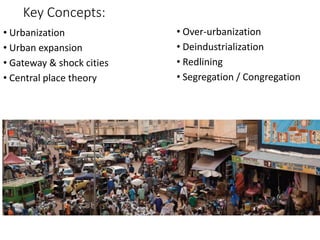
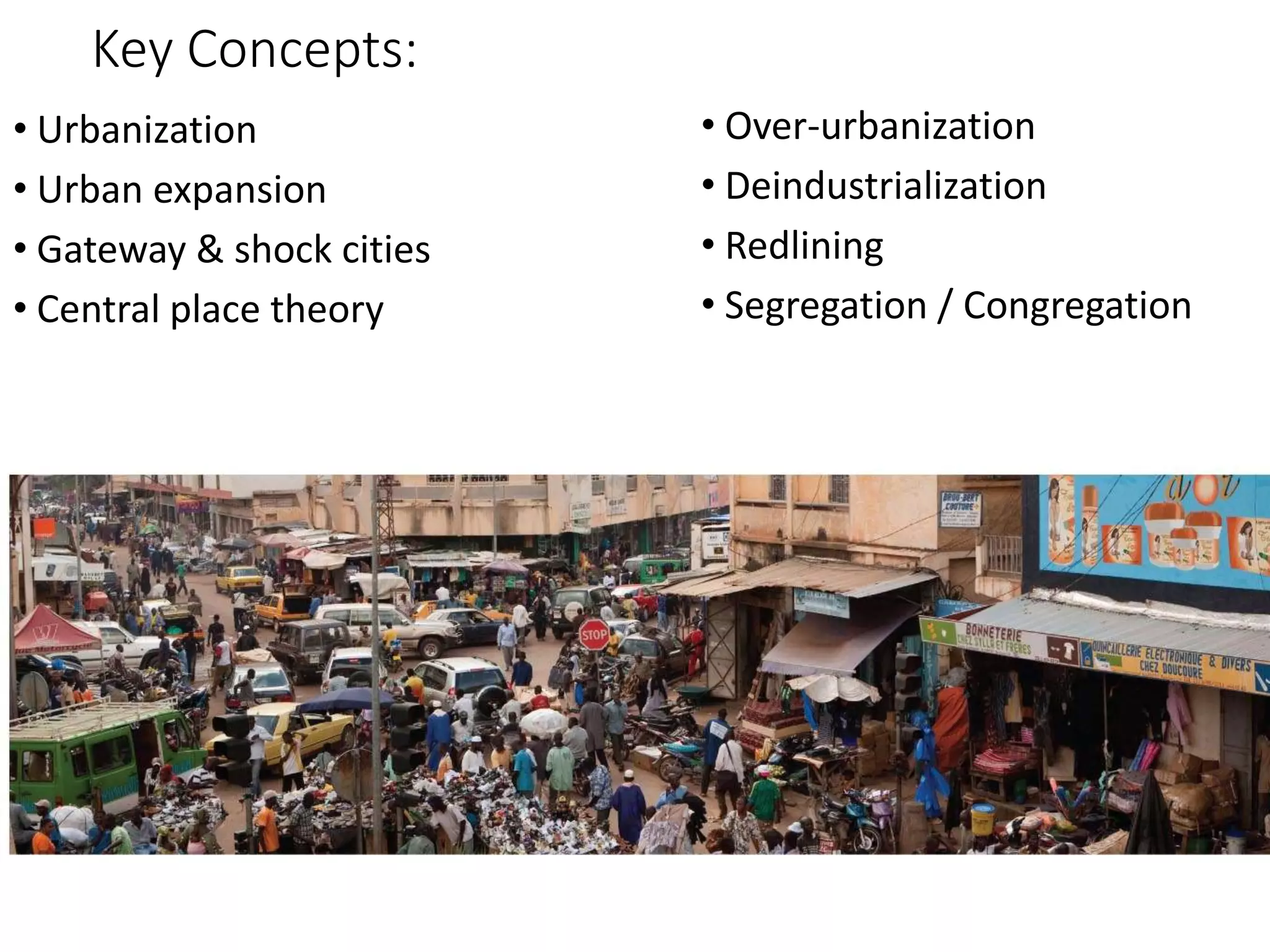
  • #2 Figure: Chapter 10 Opener Busy streets of Bamako, Mali, West Africa
  • #4 To note the extent and the significance of world urbanization.
  • #5 To identify features of the central business district. Urban form.
  • #6 To distinguish between urban system and urban form.
  • #16 Text, p. 368
  • #17 Over-ubanization – pages 374-375
  • #20 http://www.encyclopedia.chicagohistory.org/pages/3801.html