Urban Settlement
 High population
 mostly dependent on non agricultural sectors.
 Urban settlements are mostly nucleated
settlements.
 The economic and cultural characteristics of
urban settlements are entirely different from
that of rural regions.
 The transition of population from rural agrarian
economy to urban industrial and service sector
economy is termed as Urbanisation.
• The urban population of india 31.16% as per
the 2011 cencus.
• The proportion of urban population is different
in different states of india.
• Goa- 62.17%
• Himachal pradesh-10.04%
• Kerala- 47.72%
• Delhi-97.50%
• The urban population is generally high in UTs
Criteria for urban area
• Population above 5000
• Density of population above 400/sq.km
• 75% or more of the population should be
engaged in non agricultural activities.
• in addition, urban administrative headquarters
like muncipalities and corporations, military
contonments
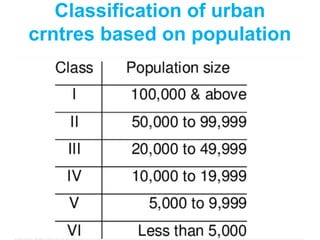
Classification of urban
crntres based on population
• Town- Small urban centres having a population
of less than 1 lakh
• City- Urban centres having population between
1 lakh to 10 lakh. Eg : Trivandrum,
• Metropolis- Big cities having a population of
more than 10 lakh eg: Jaipur, Luknow,
coimbature
• Megacity- Urban complex formed by the union
of a number of cities and having a population of
above 50 lakh. Eg: Delhi, Mumbai, Bangalore
Classification of urban centres
based on functions
• Administration
• Industry
• Education
• Tourism
• Religion/Culture
Problems faced by urban
centres
• There has manifold increase in the migration
from rural to urban areas.
• The population of big cities is more than what
they can provide.
 Problems
1.Slums
2.Traffic problems
3.pollutions
4.Lack of space
5.Over exploitation of resources
How we can control the
problems of urban area?
• Urban Planning
• Waste management
• promote cycling
• promote public transportation
• Limit no of vehicles

Urban settlements

  • 1.
    Urban Settlement  Highpopulation  mostly dependent on non agricultural sectors.  Urban settlements are mostly nucleated settlements.  The economic and cultural characteristics of urban settlements are entirely different from that of rural regions.  The transition of population from rural agrarian economy to urban industrial and service sector economy is termed as Urbanisation.
  • 2.
    • The urbanpopulation of india 31.16% as per the 2011 cencus. • The proportion of urban population is different in different states of india. • Goa- 62.17% • Himachal pradesh-10.04% • Kerala- 47.72% • Delhi-97.50% • The urban population is generally high in UTs
  • 3.
    Criteria for urbanarea • Population above 5000 • Density of population above 400/sq.km • 75% or more of the population should be engaged in non agricultural activities. • in addition, urban administrative headquarters like muncipalities and corporations, military contonments
  • 4.
  • 5.
    • Town- Smallurban centres having a population of less than 1 lakh • City- Urban centres having population between 1 lakh to 10 lakh. Eg : Trivandrum, • Metropolis- Big cities having a population of more than 10 lakh eg: Jaipur, Luknow, coimbature • Megacity- Urban complex formed by the union of a number of cities and having a population of above 50 lakh. Eg: Delhi, Mumbai, Bangalore
  • 6.
    Classification of urbancentres based on functions • Administration • Industry • Education • Tourism • Religion/Culture
  • 7.
    Problems faced byurban centres • There has manifold increase in the migration from rural to urban areas. • The population of big cities is more than what they can provide.  Problems 1.Slums 2.Traffic problems 3.pollutions 4.Lack of space 5.Over exploitation of resources
  • 8.
    How we cancontrol the problems of urban area? • Urban Planning • Waste management • promote cycling • promote public transportation • Limit no of vehicles